

ZipTie tracks the mentions of your brand, whether positive or negative, in AI-generated texts in Google AI Overview, ChatGPT, and Perplexity. Using actual browser sessions instead of the API guesswork, it ranks and orders the necessary edits so that you know what changes need to take place on your website next.
It is possible to rank first on Google and still lose potential customers if they were able to get the needed information just by reading the AI-generated texts. This was the problem that ZipTie had been created to solve. A recent study made by Conductor showed how the presence of AI Overview texts in Google searches had increased from 13 % in early 2025 to 25%. That is why search ranking tools that existed previously were not suitable for the task of analyzing such results and the teams finally faced the need to start using specialized AI search performance monitoring services.
This article shows how the ZipTie software functions, how its traces work the way it is superior to the basic SEO programs that are currently available in the market.
What Is the ZipTie AI Search Performance Tool?
ZipTie is a cloud-based platform focused on one job: tracking whether your brand gets mentioned or cited inside AI-generated answers. It monitors three engines Google AI Overviews, ChatGPT, and Perplexity though it doesn’t yet cover Gemini, SearchGPT, or Bing Copilot. The team behind it also built Onely, a technical SEO agency, so the tool carries credibility with practitioners who care about measurement accuracy rather than marketing polish.
Unlike Ahrefs or Semrush, which measure blue-link rankings, ZipTie measures a different layer entirely. Specifically, it checks whether a generative engine’s synthesized answer names your domain as a source. This distinction matters because AI Overviews and answer engines don’t rank ten links instead, they pick a handful of trusted sources and summarize them. If you’re not one of those sources, you’re invisible in a channel your analytics can’t even show you.
How Does ZipTie Track AI Overviews? (The Detection Architecture)
Most competing trackers approximate AI Overview results through API calls, and as a result, they frequently miss the overview entirely. ZipTie instead uses real browser sessions and real Google accounts. Therefore, it captures exactly what a user sees including the full answer text and a downloadable screenshot. In benchmark testing, this browser-level approach detected AI Overviews on a meaningfully larger share of tracked keywords than API-based competitors did.
Pro Tip: Before choosing any AI-visibility tool, ask the vendor whether detection happens through a real browser session or an API approximation. Because the accuracy gap between the two methods is large, it can change your entire content roadmap.
The platform runs on three modules:
- Monitoring captures full response text across the three tracked engines
- Content Optimization flags why a competitor got cited instead of you
- Insights rolls mentions, sentiment, and citation quality into a single AI Success Score
In short, each query you configure gets scanned across all three engines and scored on mention frequency, sentiment, and citation quality. So prioritization isn’t a guessing game.
ZipTie Use Cases: Real-World Examples
- SaaS vendor comparisons. When ChatGPT recommends three competitors for “best CRM for small business” and skips you, ZipTie surfaces the content gap causing the omission.
- Health and YMYL content. Because detection accuracy matters most in sensitive categories, practitioners auditing medical brands often lean on ZipTie specifically for AI Overview inclusion tracking.
- Agency reporting at scale. Some agencies run thousands of monitored queries weekly across client accounts, using ZipTie’s dashboards to justify content spend against AI-referral traffic.
- Content-gap triage. Rather than guessing which page to update next, teams sort by AI Success Score and fix the highest-revenue queries first.
Did You Know? Research from Princeton, Georgia Tech, the Allen Institute for AI, and IIT Delhi formalized generative engines as systems that gather and summarize information to answer queries. Their study found that adding concrete statistics and credible quotations lifted visibility in AI-generated answers by up to 40%, while keyword stuffing barely moved the needle. That’s the same content-gap logic ZipTie’s optimization briefs are built around.

Best AI Search Tools: How Does ZipTie Compare to Alternatives?
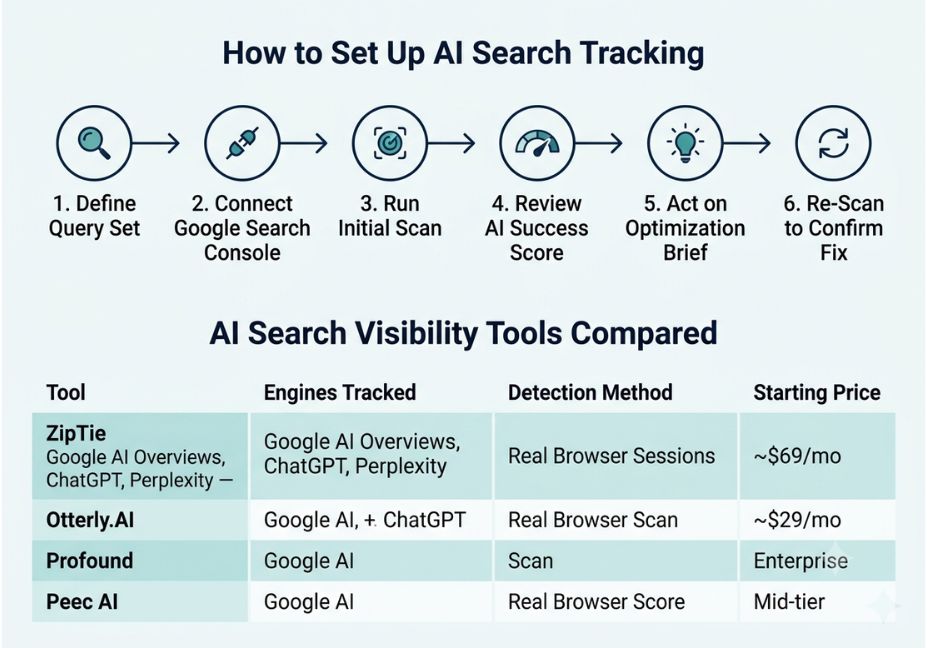
| Tool | Engines Tracked | Detection Method | Starting Price | Best For |
|---|---|---|---|---|
| ZipTie | Google AI Overviews, ChatGPT, Perplexity | Real browser sessions | ~$69/mo | Accurate AI Overview + citation tracking |
| Otterly.AI | ChatGPT, Perplexity, Google AI Overviews | Mixed | ~$29/mo | Budget-conscious teams |
| Profound | Broader LLM coverage, including Gemini | API + browser | Enterprise | Large enterprise governance |
| Peec AI | Multi-engine | API-based | Mid-tier | European market focus |
| Rankability | AI visibility + content scoring | Mixed | Mid-tier | Teams wanting AI and content optimization in one suite |
Architect’s Note: ZipTie does not currently track Claude, Gemini, or Copilot. So if your buyers research heavily through those assistants, you’ll need to pair ZipTie with a broader tool or accept that gap in your reporting.
How Do You Set Up ZipTie? (Step-by-Step)
- Define your query set. Pull your highest-intent product, comparison, and category queries. Alternatively, let ZipTie’s assistant generate these automatically from a URL or a Google Search Console import.
- Connect Google Search Console. Because ZipTie leans on GSC data for query discovery, this integration isn’t optional if you want full coverage.
- Let the initial scan run. Each configured query gets checked across Google AI Overviews, ChatGPT, and Perplexity, consuming one “AI Search check” per query per engine pass.
- Review the AI Success Score. Sort by score to find high-value queries where you’re absent or losing to a named competitor.
- Act on the optimization brief. ZipTie flags whether the issue is missing use-case framing, missing comparison points, or content that AI scrapers can’t crawl. Then you rewrite the page accordingly.
- Re-scan and confirm the fix. After all, the feedback loop only has value if you re-check the same queries once changes go live.
# Example: pulling ZipTie query performance via its REST API
import requests

response = requests.get(
    "https://api.ziptie.dev/v1/queries/performance",
    headers={"Authorization": "Bearer YOUR_API_KEY"},
    params={"project_id": "your_project", "date_range": "30d"},


for query in response.json()["queries"]:
    print(query["text"], query["ai_success_score"], query["cited"])
Technical Disclaimer: ZipTie’s API and dashboard evolve frequently. Therefore, always confirm current endpoint names and auth parameters against ZipTie’s own developer documentation before shipping this into a pipeline.
Common Mistakes and How to Avoid Them
- Treating AI Success Score as a vanity metric. It’s a prioritization signal, not a KPI to report upward on its own. Instead, pair it with AI-referral traffic in your analytics.
- Skipping the Google Search Console connection. Without it, ZipTie’s automated query discovery is noticeably weaker.
- Assuming monitoring equals optimization. ZipTie diagnoses and prioritizes, but it doesn’t write or publish content for you that action still has to come from your team.
- Ignoring the credit-based billing model. Costs can scale unpredictably if you monitor thousands of queries weekly without watching consumption.
- Forgetting engine coverage gaps. If Claude or Gemini matter to your buyer journey, ZipTie alone won’t show you that picture. It’s a mid-range tracker, not an all-engine enterprise suite.
What Are Developers and Practitioners Saying About ZipTie?
SEO practitioners including Lily Ray and Aleyda Solís have publicly recommended ZipTie for its accuracy in tracking AI Overview inclusion. Meanwhile, agencies like Seer Interactive report running it across thousands of monitored queries per week in production reporting workflows. On r/SEO, practitioners echo the same sentiment, noting that the interface for tracking AI Overview rankings feels clean and the underlying data seems accurate. This kind of unpaid, practitioner-level endorsement carries more weight than vendor marketing copy in a category this new.
FAQ People Also Ask
What is the ZipTie AI search performance tool?
ZipTie is a cloud-based platform that tracks how your brand appears inside AI-generated answers on Google AI Overviews, ChatGPT, and Perplexity, then scores and prioritizes content fixes to improve that visibility.
How do you track brand mentions in ChatGPT?
You configure target queries inside a monitoring tool like ZipTie, which scans ChatGPT’s responses for brand mentions, citations, and sentiment, then reports whether you appear versus your competitors.
Does ZipTie track Claude or Gemini?
No. As of 2026, ZipTie covers Google AI Overviews, ChatGPT, and Perplexity only. Claude, Gemini, and Copilot are not currently tracked.
How much does ZipTie cost?
Plans start around $69 per month for the Starter tier, or roughly $58–59 per month billed annually. The Pro tier runs near $159 per month, with custom Enterprise pricing above that.
Is ZipTie worth it for a small business?
It’s worth it if your team can act on the visibility gaps it surfaces. If you’re still building foundational SEO, traditional tools should come first; ZipTie earns its keep once you already have content to optimize.
How is ZipTie different from Semrush’s AI tracking features?
Semrush measures traditional rankings, backlinks, and organic traffic. ZipTie measures a separate layer whether generative engines cite and recommend your brand so most teams run both rather than choosing one.
Conclusion
The honest answer to why choose the ZipTie AI search performance tool is that it does one narrow job better than most generalist SEO suites: accurate, browser-verified visibility tracking across Google AI Overviews, ChatGPT, and Perplexity. Its AI Success Score and citation-level detail turn a blind spot into a prioritized to-do list, even though the platform stops short of Claude or Gemini coverage and leaves the actual content rewrite to you. If AI-generated answers are already shaping how your buyers evaluate vendors, that visibility layer is no longer optional. So bookmark this guide, and explore more hands-on AI search tutorials at agentiveaiagents.com.