

Competitor positioning in academic writing tools based on AI indicates that business owners provide various phases of the research pipeline, such as drafting, language refining, maintaining citation genuineness, or being ready for submission instead of focusing on competing features in a given category. It is the reason why Paperpal, Trinka, and Writefull sound different despite providing solutions to similar issues.
If you open a few landing pages of various writing assistance tools based on AI, you will notice something unusual. Almost none of them differentiate themselves by the same parameter. The first page mentions correct citations as the main aspect of its service. The second page states the importance of confidentiality and respects the privacy of each user. The third tool barely mentions the issue of grammar but instead asks its customers whether they are ready for receiving approval from reviewers.
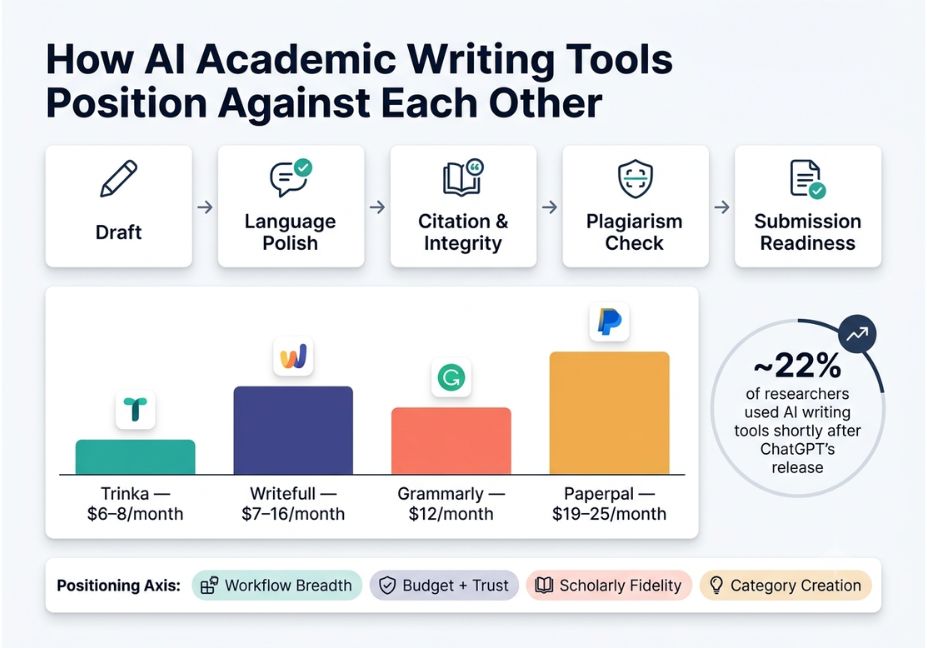
The situation mentioned does not mean that all these businesses are inconsistent. It is a mere example of segmentation based on workflow. This is the same concept that explains how a good AI-powered service breaks a project into small tasks instead of using a lengthy prompt. The information is somehow supported by a study which shows that around 20% of researchers were using such tools as ChatGPT shortly after its launch. But despite the growing awareness of such technologies among users, the process of their adoption is slower compared to knowledge.
Thus, it is reasonable to mention that it is possible to gain more insight into this niche by analyzing competitor positioning rather than comparing the functions of organizations.
What Is Competitor Positioning? (Featured Snippet Answer)
Competitor positioning is the deliberate choice of which problem, buyer, and moment in the workflow a product claims to own. It’s different from a feature list, because a feature list just describes what a product does. For AI academic writing tools specifically, positioning usually comes down to one question: does the tool own the language layer, or does it own the decision layer should this manuscript be submitted at all?
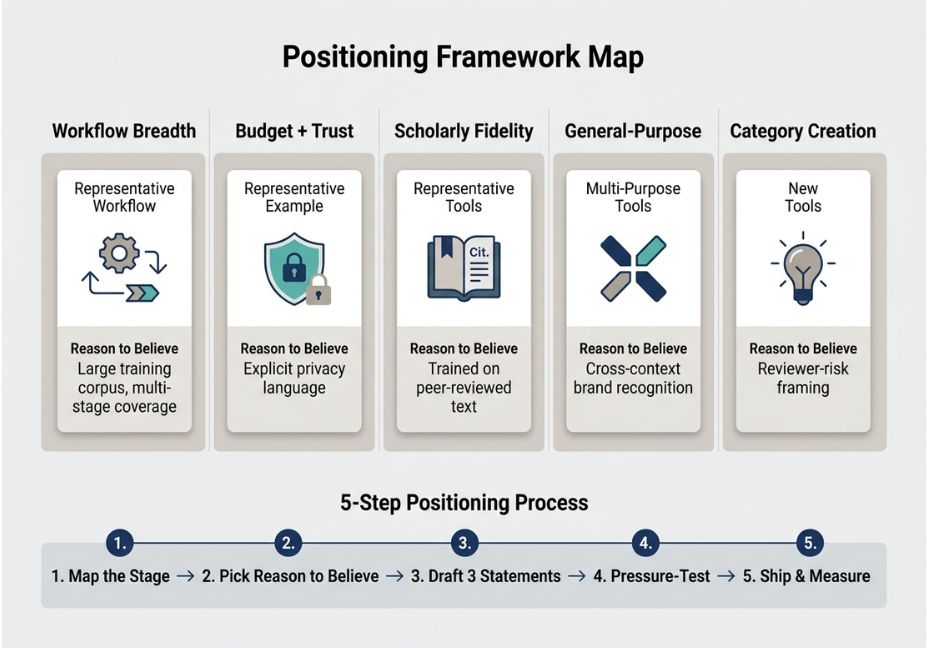
The classic marketing framework still applies here. A positioning statement anchors a target buyer, a specific need, and a reason to believe not a feature dump. In this category, that reason to believe is almost always one of three things:
- Training data provenance trained on published papers versus general web text
- Workflow breadth a single-task tool versus an end-to-end platform
- Trust signals data-retention policy, institutional compliance, auditability
How Do AI Academic Writing Tools Actually Differ From Each Other? (Voice Search)
Academic writing isn’t one task. It’s a pipeline: outline, draft, language polish, citation, plagiarism check, and submission compliance. Consequently, vendors position themselves against a specific stage rather than the whole pipeline the same way an agentic system routes a request through a planner before it ever touches a tool call.
- Drafting-stage positioning turning notes into structured academic prose, competing on speed and outline generation
- Language-polish positioning trained specifically on peer-reviewed text, competing on academic tone matching rather than generic grammar correction
- Citation and integrity positioning anchoring on reference-database size, plus plagiarism scanning against tools like Turnitin, iThenticate, or Copyleaks, as the core trust signal
- Submission-readiness positioning a newer category that asks whether a target journal would actually accept the manuscript, deliberately positioned above writing quality
Architect’s Note: Notice the parallel to agent design. A system that tries to be the planner, the tool-caller, and the memory store all at once usually loses to specialized components chained together. The same dynamic plays out here: broad “does everything” tools compete on breadth, while narrow tools compete on depth at a single pipeline stage.
Competitor Positioning in AI Academic Writing Tools Real Examples
Looking at how live vendors frame themselves makes the workflow-stage model concrete.
Paperpal, built by Cactus Communications (the parent company behind Editage), positions itself as the broadest workflow subscription. It bundles drafting, paraphrasing, citation generation from a large reference database, and submission checks at a clear $19–25/month anchor. Its messaging leans on scale millions of published articles informing the model and it’s aimed at researchers and non-native English speakers who want one subscription to cover most of the pipeline.
Trinka, on the other hand, positions on budget and institutional trust. At roughly $7/month, its messaging emphasizes technical and scientific grammar depth, plus privacy language aimed squarely at compliance-conscious institutions. That’s a deliberate contrast to Paperpal’s breadth-first framing.
Writefull positions on scholarly language fidelity and integration. Because its models are trained specifically on peer-reviewed open-access text, it leans hard on its Overleaf integration and an explicit no-data-retention promise as its reason to believe.
Grammarly, by contrast, occupies the cross-context general-writing position. It’s broader than any academic-specific competitor, but it deliberately avoids claiming academic depth instead positioning itself as the tool researchers keep for everything outside the manuscript.
Meanwhile, a newer entrant illustrates category creation rather than competition inside the existing category. Instead of competing on writing quality at all, it positions itself one layer up, asking whether a manuscript is ready for a specific journal. Its argument: polished prose doesn’t fix a weak novelty claim, a missing ORCID-linked citation trail, or a gap versus the live literature on Scopus or arXiv. That’s a textbook example of market whitespace positioning rather than fighting incumbents on their own axis, it defines a new axis the incumbents don’t claim to own.
Did You Know? A cross-journal analysis of AI tool usage in academic writing found that international researcher groups adopt tools like Grammarly at meaningfully higher rates than domestic groups. In other words, “non-native English support” isn’t just a marketing line it maps to a real, measurable buyer segment.
Best Frameworks and Approaches for Positioning Messaging
| Positioning Axis | Primary Buyer | Reason to Believe | Typical Pricing Anchor |
|---|---|---|---|
| Workflow breadth | Researchers wanting one subscription | Large training corpus, multi-stage coverage | $19–25/month |
| Budget + trust | Institutions, compliance-conscious teams | Low cost, explicit privacy language | $6–8/month |
| Scholarly fidelity | Overleaf / LaTeX-heavy writers | Trained on peer-reviewed text, no data retention | $7–16/month |
| General-purpose | Mixed research + non-research writing | Cross-context breadth, brand recognition | $12/month |
| Category creation (readiness, not writing) | Authors past the writing bottleneck | Reviewer-risk framing, journal-fit reasoning | Flat one-time fee |
Pro Tip: When two competitors’ feature lists genuinely overlap by 80%, positioning is the only lever left. So, before writing a single positioning statement, pull ten phrases your actual buyers use unprompted from reviews, support tickets, or forum threads. Otherwise, your messaging will sound like every other tool in the table above.
How Do You Build Positioning for an AI Academic Writing Tool? (Voice Search / How-To Snippet)
- Map the pipeline stage you actually own. Be honest a tool strong at grammar correction shouldn’t claim submission-readiness authority.
- Identify your reason-to-believe category. Choose one: training data provenance, workflow breadth, trust signals, or price.
- Write three positioning statement variants, each anchored to a different stage or buyer, using this formula: [buyer] who [need] chooses [product] because [reason to believe].
- Pressure-test each variant against the comparison table above. Does it collapse into a competitor’s existing axis, or does it stake new ground?
- Ship the strongest variant to one channel a landing page hero or a single ad set and measure it against one metric before rolling it out everywhere.
Because this process repeats often, teams building this kind of messaging at scale increasingly automate step three with a structured-output call rather than freeform brainstorming:
POST https://api.anthropic.com/v1/messages

  "model": "claude-sonnet-4-6",
  "max_tokens": 500,
  "messages":
    "role": "user",
    "content": "Generate 3 positioning statements for an AI academic writing tool. Buyer: non-native English PhD students. Reason to believe: trained on peer-reviewed text. Return only JSON: [{'buyer':..,'need':..,'reason':..}]"
Forcing structured JSON output, rather than prose, keeps the variants comparable side by side — the same pattern used when an agent needs a tool’s output parsed reliably instead of extracted from freeform text.
Common Mistakes and How to Avoid Them
- Competing on feature parity instead of stage ownership. If your comparison page mirrors a competitor’s table row for row, you’ve already ceded positioning.
- Burying the reason to believe. “AI-powered” isn’t a reason to believe in a category where every competitor is AI-powered.
- Ignoring pricing as a positioning signal. A $7/month price and a $25/month price make two different claims about who the buyer is. So, treat pricing copy as part of the messaging, not an afterthought.
- Claiming the entire pipeline. Buyers in this category are unusually skeptical of “does everything” claims. In fact, adoption-skepticism findings from researcher surveys suggest overclaiming actively slows trust-building rather than accelerating it.
Technical Disclaimer: Vendor pricing, feature sets, and positioning language in this article reflect publicly available information gathered in mid-2026. Because academic writing tool pricing and messaging shift frequently, verify current claims on each vendor’s own site before using them in a competitive analysis or purchasing decision.
What Is the Market Signaling Right Now?
The broader competitive-intelligence tooling market is itself evidence of how fast positioning shifts in AI-adjacent categories. These are platforms built to track messaging and pricing changes across competitor websites in near real time. Increasingly, that same tracking infrastructure extends into monitoring how brands are described inside AI-generated search answers, not just traditional SERPs built on the semantic search infrastructure that also powers retrieval-augmented systems.
Given how fast this niche moves, a positioning claim written in January can be stale by June. Therefore, treat this guide as a framework, not a fixed answer.
FAQ People Also Ask
What is competitor positioning?
Competitor positioning is the deliberate choice of which buyer, problem, and moment a product claims to own in the market, expressed through messaging rather than a feature list. It answers “why this product, for this buyer, instead of the alternative” rather than simply listing capabilities.
How do AI academic writing tools differ from general AI writing tools?
Academic-specific tools are typically trained on peer-reviewed or published scholarly text rather than general web content. Additionally, they position around research-workflow stages citation, plagiarism, submission compliance that general writing tools like Grammarly don’t claim to own.
Why do academic AI tools compete on trust instead of features?
Because feature sets converge quickly in a crowded category, trust signals data-retention policy, institutional compliance, training-data provenance become the differentiator that’s harder for a competitor to copy overnight.
How much do AI academic writing tools cost?
Pricing spans roughly $6–8/month for budget-focused tools like Trinka to $19–25/month for broader workflow platforms like Paperpal. The price itself functions as a positioning signal about which buyer segment the tool targets.
Can one tool cover the entire academic writing workflow?
Most vendors deliberately avoid this claim. Instead, the market increasingly rewards specialization at a single pipeline stage drafting, language polish, citation, or submission readiness over broad, shallow coverage.
Which AI writing tool is best for non-native English researchers?
Paperpal and Grammarly are the most commonly recommended options for non-native English researchers, since both explicitly position around language-gap support, though Paperpal targets academic tone specifically while Grammarly serves general writing.
Conclusion
Positioning in the AI academic writing tools category isn’t decided by who has the longest feature list. Instead, it’s decided by which stage of the research pipeline a vendor is willing to claim, and which trust signal it’s willing to defend. Paperpal owns breadth, Trinka owns budget-and-privacy, Writefull owns scholarly fidelity, and newer entrants are already staking out the layer above writing quality entirely.
Before writing your next positioning statement, map the stage you actually own, pressure-test it against what incumbents already claim, and ship the strongest variant to one channel before rolling it out everywhere. Bookmark this guide, and explore more competitive-analysis breakdowns at agentiveaiagents.com.