
The best AI tools for affiliate marketing in 2026 aren’t single apps they’re linked agent pipelines that handle keyword research, drafting, SEO scoring, link insertion, and commission tracking as one connected system, with a human review step before anything publishes.
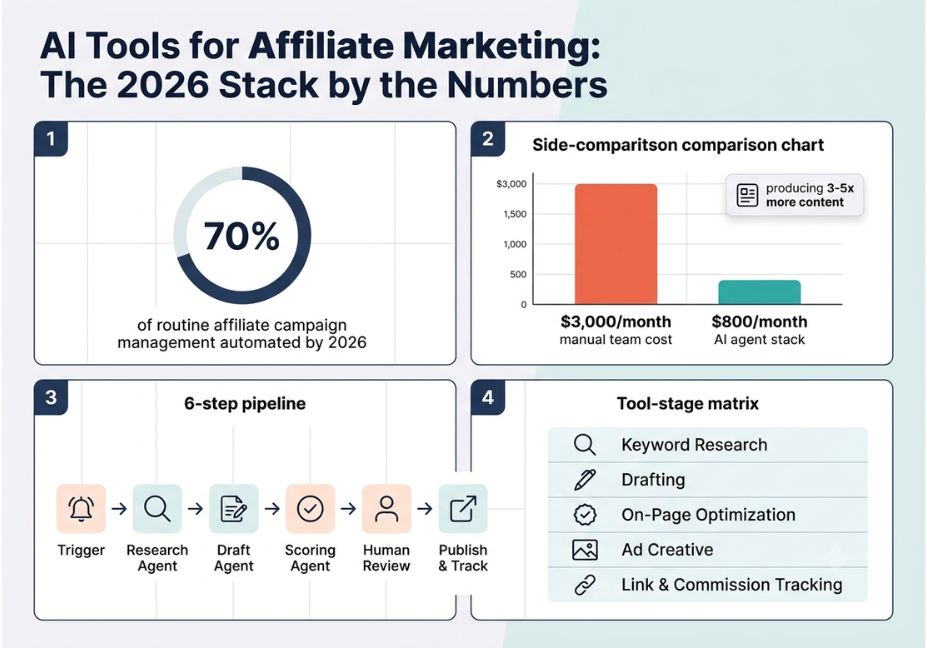
Most affiliate sites don’t lose rankings because their writing is bad. They lose rankings because their content pipeline has no fact-checking layer, no orchestration between research and drafting, and no human checkpoint before publish. Industry estimates now put automation at roughly 70% of routine affiliate campaign management by 2026. However, the sites that actually convert aren’t the ones that automated everything. Instead, they’re the ones that built a proper agent pipeline.
This guide treats AI tools for affiliate marketing the way agentiveaiagents.com treats every agentic system: as a set of connected components research, generation, scoring, and tracking rather than a pile of unrelated SaaS subscriptions. Below, you’ll see where single-shot chatbot prompting breaks down, where a real tool-use loop earns its keep, and why human review is non-negotiable, whether you’re a beginner picking your first ai agent workflow for affiliate content or scaling an existing site.
What Is an AI Agent Pipeline for Affiliate Marketing?
An agent pipeline is a chain of specialized AI components that each handle one stage of content production keyword discovery, drafting, on-page optimization, and link or commission tracking passing structured output from one stage to the next instead of relying on a single prompt to do everything.
This differs from a single chatbot session, because a pipeline monitors, drafts, and hands off work continuously, while a chatbot only acts when prompted. As a result, understanding this distinction matters: most “AI tools” marketed to affiliates are really just one node in a pipeline, not the whole system. That’s why beginners searching for the best ai tools for affiliate marketing beginners often end up buying five apps that do the same job.
How Does an AI Agent Pipeline for Affiliate Marketing Actually Work?
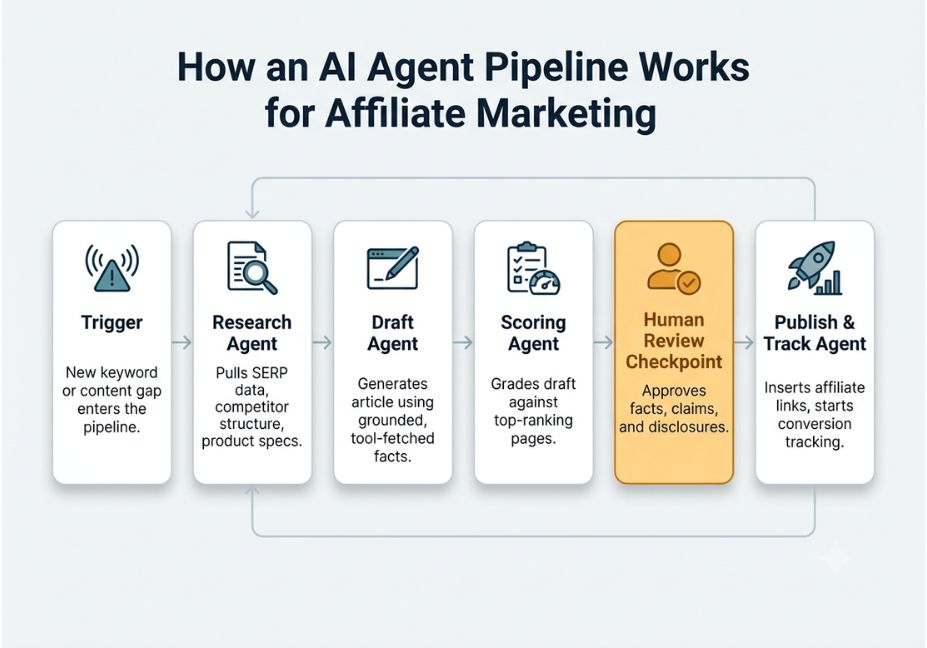
A working pipeline moves through a fixed sequence rather than one giant prompt: keyword trigger, research handoff, draft generation, SEO scoring, link insertion, and critically human review before anything publishes.
The reasoning step inside each agent typically follows the ReAct prompting pattern: the model reasons about what information it needs, calls a tool such as a search API or a product database, observes the result, and repeats until it has enough to act. Frameworks like LangChain’s agent orchestration framework implement this loop directly, chaining tool calls without a human re-prompting at every step. Similarly, OpenAI’s function calling documentation shows how a model can fetch live pricing or specs mid-generation instead of guessing.
Pro Tip: Don’t build all six pipeline stages in one week. Automate one node first usually drafting or link insertion then measure whether it actually saves time before adding the next.
- Trigger: a keyword or content gap enters the pipeline
- Research agent: pulls SERP data, competitor structure, and product specs
- Draft agent: generates the article, calling tools mid-generation to pull verified facts
- Scoring agent: grades the draft against ranking pages
- Review checkpoint: a human approves facts, claims, and disclosures
- Publish and track agent: inserts affiliate links and starts conversion tracking
Best AI Tools for Affiliate Marketing by Pipeline Stage
Rather than chasing one master “best tool,” match the tool to the pipeline stage it actually strengthens. Overbuying overlapping tools is, in fact, the single most common way affiliate operators waste budget.
| Pipeline Stage | Tool Category | What It Does | Watch For |
|---|---|---|---|
| Keyword research | SEO discovery tools | Finds low-competition, high-intent long-tail terms | Volume estimates skew optimistic |
| Drafting | AI writing agents | Generates SEO-structured drafts from a brief | Needs a fact-check pass hallucinated specs are common |
| On-page optimization | Content scoring tools (e.g., Surfer SEO-style graders) | Grades drafts against top-ranking pages using TF-IDF-style term coverage | A high score doesn’t guarantee rankings |
| Ad creative | Generative ad tools | Produces conversion-optimized banner and video variants | Brand consistency drifts without a style guide |
| Link and commission tracking | Affiliate trackers | Attributes clicks and conversions across programs, often via Zapier-style connectors | Cookie duration and cross-device tracking still have gaps |
Did You Know? One documented affiliate agent stack replaced roughly $3,000 a month in manual labor with an $800 monthly agent infrastructure budget while producing several times more content. That said, this only worked because a human checkpoint still gated every article before it went live.
How Do You Build a Minimal Affiliate Agent Workflow, Step by Step?
Here’s how to automate affiliate marketing with AI without over-engineering the system on day one:
- Define one narrow trigger. For example: “new product added to merchant feed.”
- Connect a research node. Have it pull specs, price, and existing reviews before any copy is written.
- Draft with structured output. Require the model to return sections intro, comparison, verdict as separate fields. This makes the scoring and review steps far easier to automate later.
- Score against real, current SERPs, not a generic checklist, since term coverage should reflect what’s ranking this month, not last year’s data.
- Insert links programmatically, tagged with UTM parameters, so tracking data flows back into the same pipeline that triggered the content.
- Gate publish behind human review. This single step, more than any other, separates a sustainable content operation from one that gets caught by Google’s helpful-content systems and Google Search Central’s spam policies.
python
# Simplified tool-use loop for a drafting agent
def draft_agent(product_brief, tools):
    plan = model.reason(product_brief)          # ReAct-style reasoning step
    facts = tools["product_api"].fetch(product_brief.sku)
    draft = model.generate(plan, grounded_facts=facts)
    return draft  # passed to scoring_agent() next
What Common Mistakes Should You Avoid?
Most failures trace back to skipping the retrieval step or skipping the human step, not to the writing model being “bad.”
- Publishing without fact verification. A drafting agent with no grounded data source will invent specs and prices. Anchoring generation in retrieval-augmented generation pulling verified product data before writing cuts this risk substantially.
- Treating a content score as a ranking guarantee. Term-coverage tools correlate with rankings; nevertheless, they don’t cause them.
- Automating disclosure and compliance language. FTC-style affiliate disclosures should be templated and reviewed, not left to a model’s discretion.
- Skipping cookie and tracking audits. Attribution windows vary by program, so an automated tracker misconfigured once can silently under-report commissions for months.
Technical Disclaimer: Agent framework APIs change quickly. Tool-calling syntax referenced here reflects LangChain and OpenAI documentation as of mid-2026. Therefore, always confirm against current docs before deploying in production.
What Are Developers Saying About AI Affiliate Agents?
Builder discussion around affiliate agent stacks visible across developer forums and open-source skill repositories for tools like Claude Code and Cursor consistently converges on one point: agents speed up research and first drafts, but judgment calls about which product to recommend, and how to phrase a claim, still need a person in the loop. Meanwhile, the GitHub Discussions pages for popular affiliate-agent skill repos reflect the same pattern: automation handles the repetitive 80%, and human review handles the last 20% that carries real reputational and legal risk. Even Anthropic and OpenAI, as the labs behind the underlying models, publish usage guidance recommending human oversight for consumer-facing commercial content a signal worth taking seriously.
FAQ People Also Ask
A chatbot responds only when prompted, one turn at a time. An AI agent plans, calls tools, and executes multi-step tasks like pulling product data, drafting an article, and inserting tracked links with minimal prompting at each step.
Not reliably yet. Research and drafting automate well, but fact verification, compliance disclosures, and final editorial judgment still need a human checkpoint to avoid factual errors and policy risk.
There’s no single best tool. Instead, match the tool to the pipeline stage: writing agents handle drafts, content-scoring tools handle SEO optimization, and trackers handle commission attribution. Most sites need one of each, not all of everything.
It can be, if it’s grounded in verified facts and reviewed by a human before publishing. Ungrounded, unreviewed AI content is the pattern most associated with helpful-content system flags.
Tracking agents attribute clicks and conversions using UTM parameters and program-specific cookies. They then feed that performance data back into the research stage, so future content targets what’s actually converting.
Beginners should start with one writing agent and one tracker, not a full stack. Add a content-scoring tool once you’re publishing consistently, and only automate link insertion after you trust the drafting output.
Conclusion
AI tools for affiliate marketing work best as a connected agent pipeline research, draft, score, and track rather than a single all-purpose app. The technical edge in 2026 comes from grounding drafts in retrieval-augmented generation so agents stop inventing specs, and from keeping a human checkpoint at the one place it actually matters: before publish. In short, start with one pipeline stage, prove it saves time, then extend it.
Bookmark this guide and explore more hands-on agentic workflow tutorials at agentiveaiagents.com.