
Positioning an AI academic tool means choosing a narrow best-fit customer, naming a true competitive alternative, and backing every claim with a falsifiable proof point not a longer feature list. Most AI research tools lose this fight because they compete on the same three claims: more papers, faster summaries, better accuracy.
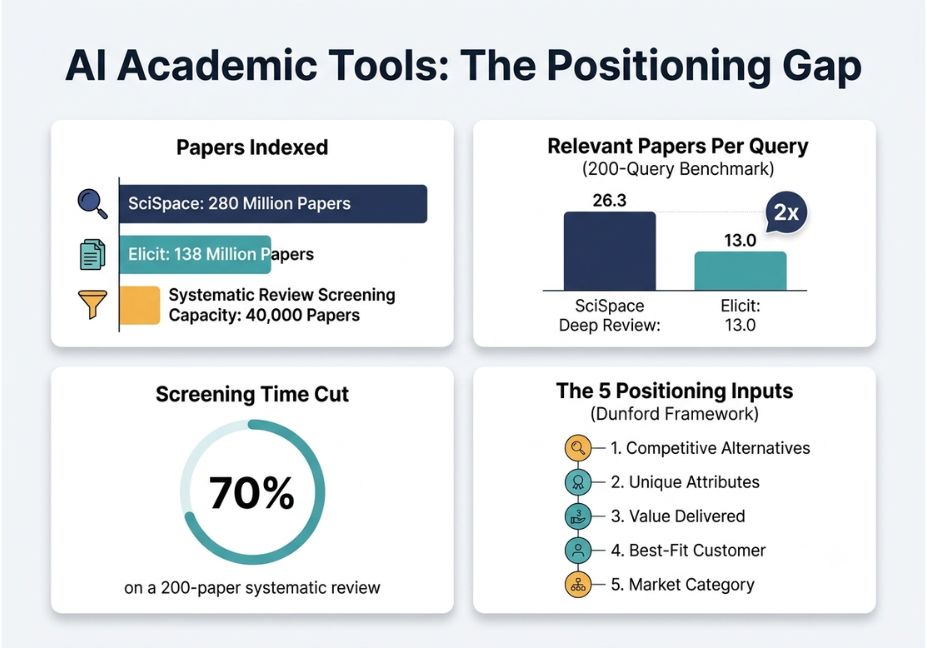
Open the homepage of any three AI research assistants, and you’ll read almost the same sentence three times. SciSpace claims 280 million papers. Elicit screens up to 40,000 papers per systematic review. Consensus promises evidence synthesis in seconds. So, all of this is true. But none of it is differentiated in a way a tired researcher, scanning five browser tabs, will actually notice.
That’s the real problem with AI academic tools competitor messaging today. The category is crowded, feature sets overlap heavily, and most positioning collapses into one generic promise: faster literature review. However, a recent independent benchmark comparing SciSpace, Elicit, and Consensus across 200 complex queries found real performance gaps between them. Yet almost none of that differentiation shows up in how these tools actually talk about themselves. In other words, the gap between actual differentiation and communicated differentiation is exactly where positioning strategy wins or loses a category.
This guide breaks down how to build defensible, specific messaging for an AI academic research tool, using the current competitive landscape as a working case study.
What Is Competitive Positioning, and Why Isn’t It the Same as Messaging?
Positioning is the internal decision about what category you compete in, who you serve best, and what you replace. Messaging, on the other hand, is how you communicate that decision externally. Confusing the two is the single most common mistake in this niche, because most teams write homepage copy before deciding what they’re actually competing against.
April Dunford’s widely cited Obviously Awesome framework breaks positioning into five ordered inputs: competitive alternatives, unique attributes, the value those attributes deliver, best-fit customer characteristics, and market category. This isn’t a new idea, either. Positioning theory traces back to classic marketing strategy on product differentiation and market alignment the same principle Geoffrey Moore later applied to tech adoption curves in Crossing the Chasm. So the core question hasn’t changed in decades: what specific place does your product occupy in a buyer’s mind?
Pro Tip: Before writing a single line of homepage copy, ask this question honestly: “What would our best customer use if we didn’t exist?” If the answer is “another AI tool,” you’re stuck in a feature race. If the answer is “grad students manually screening papers in a spreadsheet,” you’re competing against the status quo instead and that’s a far easier fight to win.
How Does Competitor Messaging Actually Work in the AI Research Tool Category?
Consider how the three leading literature-review tools have staked out different ground, whether deliberately or not:
- SciSpace leans into breadth and speed, positioning itself as an all-in-one research agent linking search, reading, and drafting.
- Elicit leans into rigor, positioning around structured screening pipelines built specifically for systematic reviews.
- Consensus leans into simplicity, positioning as a fast way to get an evidence-backed answer to a research question.
Notably, none of these three explicitly says “we are not for X.” That’s the single biggest missed opportunity across the category: best-fit customer exclusion. For example, a tool built for systematic-review screening is a poor fit for a student who just wants quick background on an unfamiliar topic. Consequently, naming who a tool isn’t for is one of the fastest ways to make positioning legible — and almost nobody in this space does it yet.
Did You Know? A recent head-to-head benchmark found SciSpace’s Deep Review mode returned roughly double the number of highly relevant papers per query compared to Elicit in cross-domain testing. That’s a specific, quantifiable differentiator and it’s far more persuasive than a vague claim like “more comprehensive results.”
AI Academic Tools Positioning: Real-World Messaging Patterns
So, how do positioning inputs actually translate into messaging output? Here’s a side-by-side comparison across common academic-tool use cases:
| Positioning Input | Weak Messaging (Generic) | Strong Messaging (Specific) |
|---|---|---|
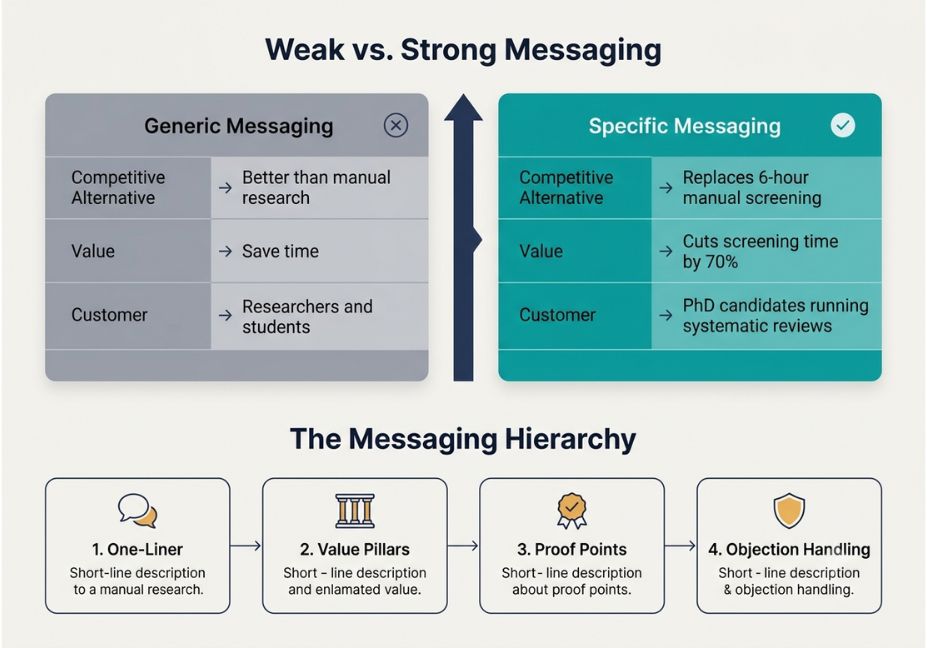
| Competitive alternative | “Better than manual research” | “Replaces the 6-hour manual screening pass grad students do before a systematic review” |
| Unique attribute | “AI-powered search” | “Screens up to 40,000 papers against your inclusion/exclusion criteria” |
| Value delivered | “Save time” | “Cuts screening time by 70% on a 200-paper review” |
| Best-fit customer | “Researchers and students” | “PhD candidates and research teams running formal systematic reviews” |
| Market category | “Research assistant” | “Systematic review screening tool” (a narrower, ownable category) |
Notice the pattern here: every weak example is technically true but unfalsifiable. By contrast, every strong example is specific enough that a competitor couldn’t copy-paste it onto their own homepage without it sounding false.
Technical Note: Positioning claims should always be falsifiable by a skeptical buyer. “We’re the most comprehensive” isn’t falsifiable it’s just an opinion. “280 million papers across multi-source retrieval,” however, is falsifiable, because a prospect can go verify it.
How Do You Build a Messaging Hierarchy for an Academic AI Product?
Once positioning inputs are locked in, the next step is translating them into layered messaging — from shortest to longest:
- One-liner. A single sentence combining category, target customer, and primary differentiator. For example: “The systematic review screening tool built for teams processing 1,000+ papers.”
- Value pillars. Three supporting claims, each tied to a specific, measurable outcome — time saved, accuracy gained, or workflow integrated.
- Proof points. Benchmarks, named studies, or citation counts that back up each pillar. This is where credibility matters most, since vague superiority claims erode trust quickly with an academic audience trained to demand evidence.
- Objection handling. This is the layer almost every AI tool skips. What does a skeptical reviewer say about hallucination risk in AI-generated summaries? Address it directly instead of hoping it doesn’t come up.
Architect’s Note: Academic buyers are unusually resistant to marketing language, precisely because they’re trained to distrust unsupported claims. As a result, a positioning strategy built on citations, named benchmarks, and honest limitations will consistently outperform one built on adjectives like “revolutionary” or “seamless.”
What Are the Most Common Mistakes in AI Academic Tool Positioning?
- Positioning against every competitor at once. Trying to out-message SciSpace on breadth, Elicit on rigor, and Consensus on simplicity all at once usually produces a homepage that says nothing clearly.
- Leading with the model instead of the outcome. A line like “Powered by GPT-5.5” tells a researcher nothing about whether the tool actually fits their workflow.
- Skipping the “who this isn’t for” line. Vague inclusivity “built for every researcher” is really a positioning failure disguised as friendliness.
- Treating positioning as a one-time exercise. Because the competitive landscape for AI research tools shifts monthly, messaging needs a quarterly review cadence, not a set-and-forget launch doc.
- Ignoring the Jobs-to-Be-Done angle. A researcher doesn’t wake up wanting an AI tool they want to finish a literature review faster, or pass peer review with fewer revisions. So, positioning tied to that underlying outcome, rather than to the product category, tends to hold up better as the tool itself evolves.
What Are Researchers Actually Saying About These Tools?
Community discussion threads among graduate students and postdocs comparing these tools consistently surface a theme that vendor messaging rarely addresses directly: trust in how a tool arrived at a summary matters just as much as how fast it got there. Researchers repeatedly ask which tool shows its sourcing clearly enough to defend a citation in front of a committee. That’s a positioning angle almost entirely absent from current homepage copy and a clear opportunity for any tool willing to lead with transparency rather than raw paper counts.
Technical Disclaimer: Feature sets, paper-database sizes, and benchmark results for AI academic tools change frequently as vendors update models and indexes. The figures cited above reflect published comparisons as of mid-2026, so always verify current specs against each vendor’s official documentation before using them in competitive messaging.
FAQ: People Also Ask
Positioning is the internal strategic decision about your category, competitive alternative, and best-fit customer. Messaging is the external language used to communicate that decision — a positioning statement rarely appears word-for-word on a website; it gets translated into a shorter messaging hierarchy first.
Ask your best customers what they’d use if your product didn’t exist. For many AI academic tools, the honest answer is manual search plus a spreadsheet, not a rival AI product and that changes the entire messaging strategy.
Outcomes, generally. Since feature parity in this category is high and shrinking fast, messaging built around outcomes like screening time cut by a specific percentage tends to be more durable than messaging built around feature lists.
Quarterly, at minimum. AI academic tools ship new capabilities and benchmarks fast enough that a positioning doc written a year ago is often already outdated.
Often, yes. Owning a specific, narrower category say, “systematic review screening tool” instead of “AI research assistant” makes it easier to be the obvious choice for a specific best-fit customer, even if it means appealing to a smaller audience.
Narrow the target customer instead of broadening the feature list. A smaller, better-defined best-fit audience is usually easier to win than trying to out-feature a larger competitor across every use case.
Conclusion
Positioning in the AI academic tools space isn’t won by having the biggest paper database or the newest model. It’s won by being specific about who the product is for, what it replaces, and what falsifiable value it delivers. Ultimately, the strongest messaging in this category will come from teams willing to name a narrow best-fit customer, back claims with real benchmarks, and say clearly who the product isn’t for. Bookmark this guide, and explore more hands-on AI agent and AI tooling breakdowns at agentiveaiagents.com.