
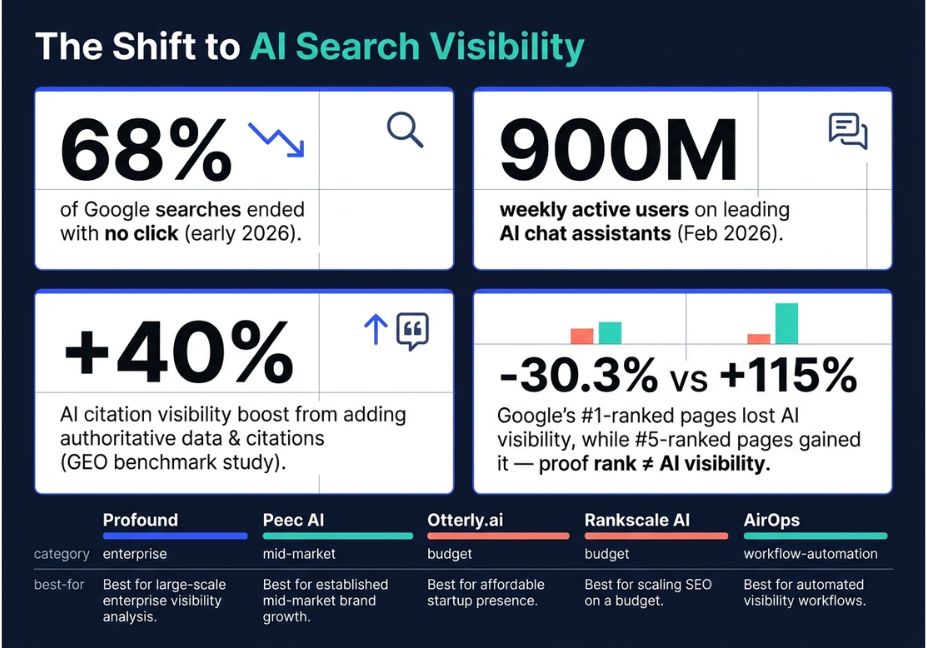
Your product can rank #1 on Google, and it can still be invisible where it matters now: inside the answer itself. About 68% of Google searches ended without a click in early 2026. Meanwhile, ChatGPT reached roughly 900 million weekly active users that same quarter. So when a buyer asks Perplexity or Google AI Mode “what’s the best tool for X,” and your brand isn’t in the synthesized answer, no amount of keyword ranking saves you. This is exactly the gap that AI search visibility tools exist to close. As a result, generative engine optimization has emerged as its own discipline, sitting alongside not replacing traditional SEO.
An AI search visibility tool tracks how often ChatGPT, Perplexity, Gemini, and Google AI Overviews mention or cite your brand, then scores that presence so you can compare it against competitors. Top providers in 2026 include Profound (enterprise), Peec AI (mid-market), AirOps (workflow automation), and Otterly.ai (budget monitoring).
Most buying guides for this category stop at a features-and-pricing table. This one goes a layer deeper. Below, you’ll find how these tools are actually built as retrieval-and-fanout agents, how to read their data correctly, and, finally, how to turn a visibility score into a working content pipeline.
What Is an AI Search Visibility Tool?
An AI search visibility tool is software that monitors how often, and how accurately, an AI answer engine mentions or cites a specific brand, product, or domain. In practice, this covers engines like ChatGPT, Perplexity, Gemini, Google AI Overviews, Claude, and Copilot. Under the hood, most platforms run what’s called a prompt fanout: they send hundreds of representative queries to each engine on a schedule, then parse the returned text for brand and competitor mentions. In other words, this is functionally closer to a monitoring agent built on retrieval-augmented generation (RAG) than to a traditional keyword rank tracker which is exactly why the category behaves so differently from legacy SEO software.
If you’re already familiar with how a retrieval layer like LlamaIndex or a vector database like Pinecone chunks and embeds content for lookup, the mechanism will feel familiar: these visibility tools are essentially running the same embedding-and-retrieval logic in reverse, checking whether your content gets pulled into someone else’s generated answer.
How Does AI Visibility Tracking Actually Work?
Each platform runs three coordinated jobs behind the scenes, and the differences between them explain most of the pricing and accuracy gaps in this market.
- Prompt generation either user-supplied or auto-suggested from your site content and competitor set
- Fanout execution the same prompt sent across multiple engines, and often multiple geographies or languages, on a recurring cadence
- Parsing and scoring extracting brand mentions, citation URLs, sentiment, and position, then aggregating everything into a share-of-voice metric
Technical Note: The accuracy of any visibility tool is bounded by how it queries the underlying engine. Specifically, tools that call official APIs (where available) get more reproducible results than tools that scrape rendered UI output. This is because AI answers are non-deterministic, so the same prompt can return a different answer on the next run.
Some platforms go further still, connecting to CDN traffic data (Cloudflare, Akamai) to correlate AI crawler visits with actual referral traffic. This matters because a citation with zero downstream traffic tells a very different story than one driving qualified visits.
Best AI Search Visibility Tools for Enterprise, Startup, and Budget Use Cases
Coverage, pricing model, and depth of remediation meaning whether a tool just flags a gap or actually helps you fix it vary sharply across this category. Here’s how the most-referenced providers compare as of mid-2026.
| Tool | Best For | Standout Feature | Fix-the-Gap Capability |
|---|---|---|---|
| Profound | Enterprise / Fortune 500 | Real-time volume data across 10+ engines, sentiment dashboards | Analytics-heavy, limited content generation |
| Peec AI | Growing startups, mid-market | Unlimited seats, auto-suggested prompts from site content | Moderate prompt discovery only |
| Otterly.ai | Quick, budget checkups | Fast setup, mention and sentiment tracking | Low monitoring-first |
| Rankscale AI | Budget-conscious teams | Competitor benchmarking from around €20/month | Low dashboards only |
| AirOps | Teams needing workflow automation | Turns visibility insight into repeatable content workflows | High built for remediation |
| Surfer AI Tracker | Content teams already in Surfer | AI citation tracking layered onto existing content scoring | Moderate tied to Surfer’s editor |
| SE Ranking / SE Visible | Teams wanting an add-on to an existing SEO stack | Sentiment analytics bundled with SEO tools | Low no technical-fix layer, 7-day data refresh |
Pro Tip: Before buying, run the same 10 prompts manually against ChatGPT, Perplexity, and Google AI Mode yourself first. Then, compare what you see against the tool’s trial dashboard. For example, several teams testing SE Visible found it misidentified competitors entirely for a niche SaaS product a good reminder that self-verification matters more here than in mature rank-tracking tools.
Did You Know? According to the original GEO benchmark study out of Princeton and Georgia Tech, adding authoritative citations and statistics to a page boosted its AI citation visibility by as much as 40%. Interestingly, pages already ranked #1 in traditional search actually saw AI visibility drop by 30.3%, while fifth-ranked pages gained over 115%. In other words, traditional rank and AI visibility are no longer the same signal.
AI Search Visibility Use Cases Real-World Examples
- B2B SaaS comparison queries: tracking whether ChatGPT recommends your product when someone asks “best [category] tool”
- E-commerce product research: monitoring whether a conversational shopping agent surfaces your SKU over a competitor’s
- Enterprise brand risk: catching negative sentiment or factual errors about your company before they compound across engines
- Content prioritization: using citation gaps to decide which pages need restructuring, rather than which keywords need targeting
How to Track Brand Mentions in ChatGPT: Step-by-Step GEO Workflow
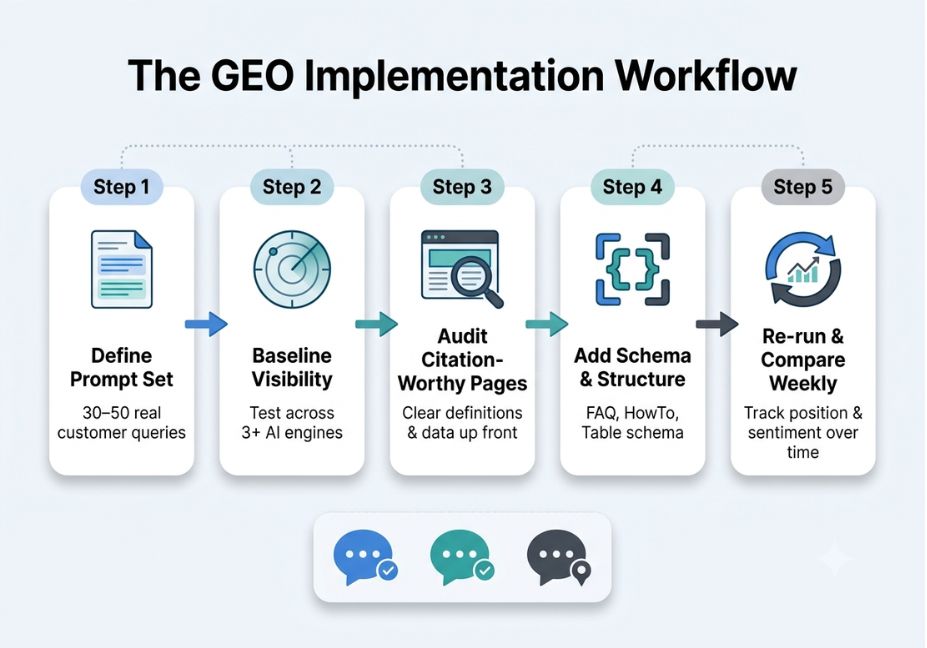
- Define your prompt set. Pull 30–50 real queries from sales calls, support tickets, and competitor comparisons, rather than guessed keywords.
- Baseline your visibility. Run the prompt set through your chosen tool, or manually, across at least three engines before making any content changes.
- Audit citation-worthy pages. Structure content with clear definitions, named entities, and data points up front. This mirrors the same signals an orchestration layer like LangChain or LlamaIndex would extract when chunking a document for retrieval.
- Add schema and structured data. Machine-parseable structure, such as FAQ schema and HowTo schema, increases the odds that a retrieval step surfaces the right passage.
- Re-run and compare. Track position and sentiment changes weekly, rather than daily, since AI answers are volatile enough that daily noise obscures the real trend.
python
# Minimal example: fanning a prompt set out to a model via the API
# and flagging brand mentions (simplified illustration, not production code)
import requests

prompts = ["best ai search visibility tool", "top GEO platforms 2026"]
brand = "agentiveaiagents"

for prompt in prompts:
    response = requests.post(
        "https://api.anthropic.com/v1/messages",
        headers={"content-type": "application/json"},
        json={
            "model": "claude-sonnet-4-6",
            "max_tokens": 500,
            "messages": [{"role": "user", "content": prompt}],


    text = response.json()["content"][0]["text"]
    print(prompt, "->", brand.lower() in text.lower())
Technical Disclaimer: Framework versions and API behaviors evolve rapidly. This snippet is illustrative as of mid-2026, so always check the current Anthropic API documentation before deploying a similar monitoring script.
Common Mistakes and How to Avoid Them
- Treating one snapshot as ground truth. Since LLM outputs are non-deterministic, a single query run is noise, not a trend.
- Chasing mention count over citation quality. Being cited with a link is worth far more than being mentioned in passing, so track them separately.
- Ignoring engine-specific behavior. Google AI Overviews, Perplexity, and ChatGPT weight sources differently. Therefore, a strategy tuned for one won’t transfer cleanly to another.
- Skipping the traffic correlation step. A rising visibility score that never shows up in referral logs may reflect a tracking artifact, rather than real reach.
What Developers Are Saying
Skepticism about measurement accuracy is common in developer circles. For instance, threads among developers discussing AI search tracking accuracy on Reddit’s r/LocalLLaMA regularly note that two tools running the “same” prompt against the same engine, on the same day, can return meaningfully different visibility scores. This is largely because each vendor samples and averages non-deterministic model output differently.
FAQ People Also Ask (Voice-Search Optimized)
What’s the best AI search visibility tool right now?
For enterprise brands, Profound is the most frequently cited option because of its multi-engine coverage and sentiment dashboards. For smaller teams, Peec AI and Rankscale AI offer similar core tracking at a much lower price point.
How do I check if ChatGPT is mentioning my brand?
You can manually type your target prompts into ChatGPT, Perplexity, and Gemini and read the responses yourself, or use a dedicated tool that automates this across dozens of prompts on a recurring schedule and stores the history.
Is GEO the same thing as SEO?
No, they’re related but distinct. Traditional SEO optimizes for ranking in a list of links, while GEO optimizes for being selected, summarized, and cited inside one synthesized answer which depends more on content structure than on keyword density.
Can I improve my AI search visibility for free?
Yes, partially. Manually running your prompt set against free-tier ChatGPT, Perplexity, and Gemini gives you a rough baseline, though paid tools add scheduling, historical trends, and competitor benchmarking that manual checks can’t match at scale.
How often should I check my AI visibility data?
Weekly is a reasonable cadence for most brands. Daily checks tend to surface model-output noise rather than a genuine trend, given how non-deterministic AI answers can be from one run to the next.
Which AI visibility tool works best for enterprises?
Profound is the enterprise favorite, thanks to its multi-engine coverage, sentiment dashboards, and CDN traffic integration, though its pricing sits well above budget-tier tools like Rankscale AI or Otterly.ai.
Conclusion
AI search visibility tools have moved from novelty to necessity as generative engines increasingly are the search result. The market splits cleanly into monitoring-first tools (Otterly.ai, Rankscale AI), workflow-first tools (AirOps), and enterprise analytics platforms (Profound). Ultimately, picking correctly depends on whether you need a dashboard or a remediation pipeline. Whichever tool you choose, treat the score as a diagnostic, not a scoreboard the real work of AI search visibility is still building citation-worthy content. Bookmark this guide, and explore more hands-on agentic AI tutorials at agentiveaiagents.com.