

Most brands have never read what ChatGPT says about them. That’s the real reason to care about why use AI search optimization tools for your business. Search no longer ends with a ranked list of blue links. Instead, it ends with a single generated answer, and that answer either names your company or it doesn’t.
According to Stanford HAI’s 2026 AI Index, AI adoption is outpacing every prior technology shift, including the personal computer and the internet. As a result, the audience asking questions inside ChatGPT, Google Gemini, and Perplexity is growing faster than most marketing teams’ monitoring can keep up with. Meanwhile, OpenAI, Google, and Anthropic continue to expand how their models pull live web content into answers, which raises the stakes further for small businesses using AI search optimization tools to stay visible.
The mechanics behind this shift aren’t mysterious to anyone who has built with retrieval-augmented generation (RAG). In short, an AI engine answering a query runs the same basic loop a RAG-based agent runs: embed the query, retrieve the most semantically relevant chunks, rank them, and generate a grounded answer from whatever survives that filter. Consequently, if your content isn’t structured to be retrievable and quotable at the chunk level, it doesn’t matter how well it ranks in classic search it simply isn’t in the candidate set. That’s the gap AI search optimization tools exist to close.
What Is AI Search Optimization?
AI search optimization is the practice of structuring content so language models retrieve, trust, and cite it when generating answers. Also called generative engine optimization (GEO) or answer engine optimization (AEO), it sits downstream of classic SEO but runs on different mechanics.
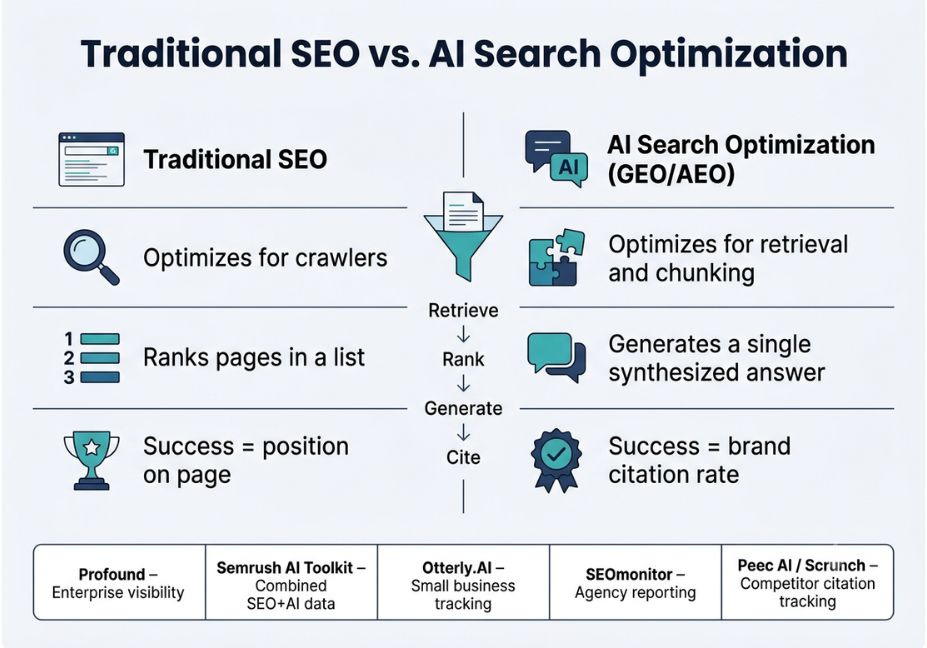
Instead of optimizing for a crawler and a ranking algorithm, you’re optimizing for a retrieval-augmented generation pipeline. That pipeline chunks your page, embeds it, and scores it for semantic relevance against a user’s prompt. For example, a query like “how does AI search optimization work for small businesses” triggers the same retrieve-rank-generate sequence, regardless of which AI engine handles it.
This distinction matters because citation rate and share of voice not keyword rank are the metrics that now correlate with whether a buyer ever sees your brand mentioned.
How AI Search Optimization Tools Actually Work
Unlike legacy SEO software, AI search optimization tools don’t simply crawl for keywords. Instead, most run a variation of this pipeline:
- Prompt sampling the tool queries a set of realistic buyer prompts against ChatGPT, Google Gemini, Perplexity, and Google AI Overviews on a schedule.
- Citation extraction it then parses each generated answer to detect which brands, domains, and sources were named or linked.
- Retrieval diagnostics next, it evaluates whether your content is structured (chunk length, heading clarity, direct-answer phrasing) in a way that a retrieval system would actually surface.
- Competitive scoring finally, it benchmarks your citation frequency against named competitors across the same prompt set.
Technical Note: This is functionally the same retrieval-rank-generate loop used in agentic RAG systems, just pointed at the open web instead of a private knowledge base. For instance, Pinecone’s own documentation on the retrieval and reranking pipeline describes this two-stage process retrieve broadly, then rerank for relevance which is effectively what an AI Overview, ChatGPT, or Anthropic’s Claude does with your page before deciding to cite it.
Because each AI platform runs its own retrieval stack, citation behavior varies significantly between engines. As a result, a page frequently cited by one model may be invisible in another. This is precisely why manual, one-off checks give an incomplete picture of your actual AI search visibility and why long-tail tracking across multiple prompts, not just your primary keyword, matters so much for topical authority.
Why Use AI Search Optimization Tools for Your Business: 6 Real Reasons
1. You can’t manage what you can’t measure. AI answers are phrased differently across engines, regions, and time. Therefore, a single manual check tells you almost nothing about your standing at scale which is why this is often the top reason small businesses adopt AI search optimization tools.
2. AI search traffic converts at a meaningfully higher rate. Industry benchmarking has put AI-referred traffic conversion well above traditional organic search. In other words, it’s a channel worth defending even when volume is still small.
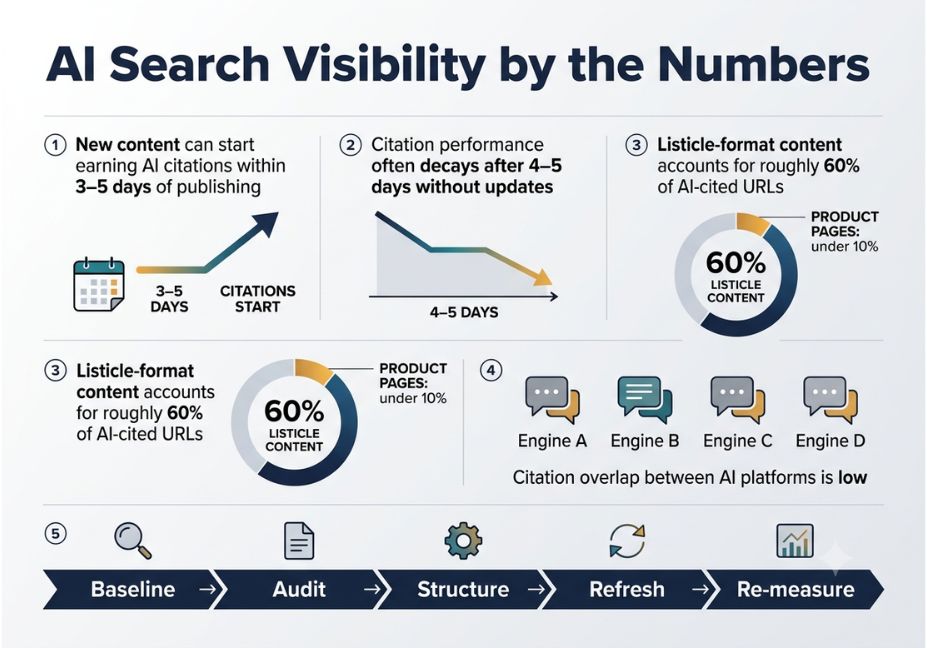
3. Citation windows are short. Monitoring data shows new content can start generating AI citations within three to five days of publishing. However, citation performance often decays after four to five days without updates a freshness cycle traditional SEO tools were never built to track.
4. Competitive defense matters. If a rival gets named in an AI answer and you don’t, you lose the buyer before they ever reach your site. Worse, there’s zero signal in your analytics that it happened.
5. Attribution is otherwise invisible. AI-driven discovery frequently shows up as branded search or direct traffic rather than a clickable referral. So, without a tool built to detect that pattern, the ROI of your AI visibility work is essentially unmeasurable.
6. It closes the loop between diagnosis and action. Ultimately, a tool tells you where the citation gaps are; a content and retrieval strategy is what actually closes them.
Did You Know? Analysis of AI-cited domains found that listicle-format content structured “top N” comparisons and rankings accounted for roughly 60% of all cited URLs, while product pages made up less than 10%. Structure, not just authority, drives retrievability.
Best AI Search Optimization Tools and Platforms
There’s no single best platform the right one depends on whether you need visibility tracking, content optimization, or technical/schema tooling underneath it.
| Tool | Best For | Notable Feature |
|---|---|---|
| Profound | Enterprise AI visibility | Multi-LLM brand tracking at scale |
| Semrush AI Toolkit | Teams already on Semrush | Connects classic SEO data to AI citation data |
| Otterly.AI | Small business / budget-conscious teams | Low-cost entry point for AI Overview tracking |
| SEOmonitor | Agencies | Client-ready AI + SERP reporting in one dashboard |
| Peec AI / Scrunch | Mid-market monitoring | Prompt-level citation and competitor comparison |
Pro Tip: Don’t pick a tool by feature list alone. Run a baseline audit first most platforms offer a free or low-cost check so you know whether your gap is a content problem (nothing to cite) or a retrieval problem (good content, poor structure).
Step-by-Step: How to Get Started with AI Search Optimization
- Baseline your visibility. Choose 25–50 high-intent prompts your buyers realistically type into ChatGPT or Gemini, and run them through a tracking tool.
- Audit content structure. Check whether your key pages answer a question directly in the first sentence — this is what a retrieval system chunks and reranks first.
- Add structured data. Schema markup helps both classic crawlers and retrieval systems parse entity relationships on the page.
json
{
  "@context": "https://schema.org",
  "@type": "FAQPage",
  "mainEntity":
    "@type": "Question",
    "name": "What are AI search optimization tools?",
    "acceptedAnswer":
      "@type": "Answer",
      "text": "Platforms that track how often AI engines cite your brand and help you close content and structure gaps."
- Refresh on a cycle. Given how fast citation performance decays, treat high-value pages like a maintenance schedule, not a one-time publish.
- Re-measure and compare. Track citation share against named competitors monthly, not quarterly AI answer patterns shift faster than traditional rankings.
Technical Disclaimer: AI platforms update their retrieval and ranking behavior frequently, and citation tracking tools update their supported engines just as often. Figures and tool comparisons in this article reflect the AI search landscape as of mid-2026 verify current platform coverage before committing budget.
Common Mistakes and How to Avoid Them
- Treating GEO as a rebrand of SEO. The ranking factors overlap; however, citation depends on chunk-level retrievability, not just domain authority.
- Ignoring content format. Product pages and corporate messaging are structurally disadvantaged compared to comparison and how-to formats.
- Checking visibility once and stopping. Given the short citation-freshness window, a single audit is a snapshot, not a strategy.
- Optimizing for one engine only. Citation overlap between AI platforms is low. For example, content tuned for Google Search Central’s AI Overview guidelines may still be invisible in ChatGPT or Perplexity, since each engine’s retrieval model weighs entities and freshness differently.
FAQ — People Also Ask
What are AI search optimization tools?
AI search optimization tools track how often AI engines like ChatGPT, Gemini, and Perplexity mention your brand, then help you fix the content gaps causing low visibility.
How is AI search optimization different from traditional SEO?
Traditional SEO targets crawlers and rankings. AI search optimization targets retrieval and citation inside a generated answer instead.
Do small businesses need AI search optimization tools?
Yes. Many AI search optimization tools for small business budgets offer low-cost plans, since visibility gaps affect small brands just as much as enterprises.
How do these tools measure ROI?
They detect indirect traffic patterns, like branded search and direct visits that spike after a citation event, since AI-referred visitors rarely click a link.
Can I do AI search optimization without a tool?
At a small scale, yes. However, manual checks miss how answers vary across engines and time, so most teams eventually automate the tracking.
What is the best AI search optimization tool for small business use?
For small budgets, Otterly.AI is generally the best AI search optimization tool for small business teams, since it offers low-cost AI Overview tracking without enterprise pricing.
Conclusion
The honest answer to why use AI search optimization tools for your business is that AI-generated answers have replaced page two there’s no scroll-through fallback, and no analytics signal when you’re simply left out. The businesses treating this as a retrieval and content-structure problem, not just a marketing dashboard, are the ones building durable citation share. Start with a baseline audit, fix the structural gaps a retrieval system would actually reward, and re-measure on a cycle that matches how fast AI citations decay.