
Most brands don’t lose visibility in AI search because their product is worse. They lose it because their content was never built for how a generative engine actually reads it. When ChatGPT, Perplexity, or Google AI Overviews answer a question, they aren’t ranking your page. Instead, they’re pulling a handful of passages from a retrieval pool and deciding, sentence by sentence, whether you’re worth citing.
That’s a fundamentally different scoring problem than the one traditional SEO tools were built to solve. As a result, a new category has emerged to measure it: the AI visibility optimization tool. This guide breaks that category down clearly, compares the leading platforms, and shows you how to check your own AI visibility today, even without a paid subscription.
What Is an AI Visibility Optimization Tool?
Direct answer (featured-snippet target, ~45 words): An AI visibility optimization tool is software that tracks how often, how prominently, and how favorably a brand is mentioned inside AI-generated answers from tools like ChatGPT, Gemini, and Perplexity. It monitors citation frequency across engines and recommends content changes to improve that visibility over time.
This discipline is often called generative engine optimization (GEO) or answer engine optimization (AEO), and it’s closely related to entity SEO and structured data best practices published by Google Search Central. Unlike keyword-rank trackers, these platforms query multiple generative engines with representative prompts on a set schedule, then parse the responses for brand mentions, sentiment, and source attribution.
The category traces back to formal research. A Princeton and Georgia Tech team formalized the idea of “generative engines” in a 2023 paper, describing a new class of search systems that synthesize answers from multiple sources using large language models rather than ranking a list of pages (arxiv.org/abs/2311.09735). Their benchmark also found that old-school SEO tactics like keyword stuffing largely fail to move the needle inside generative engines, which is exactly why this new tool category exists.
How Does AI Visibility Optimization Work?
Under the hood, nearly every serious platform in this space runs the same three-stage loop. Understanding it helps you evaluate any vendor, whether you’re a solo founder or a Gartner-tracked enterprise brand.
Numbered-list snippet target:
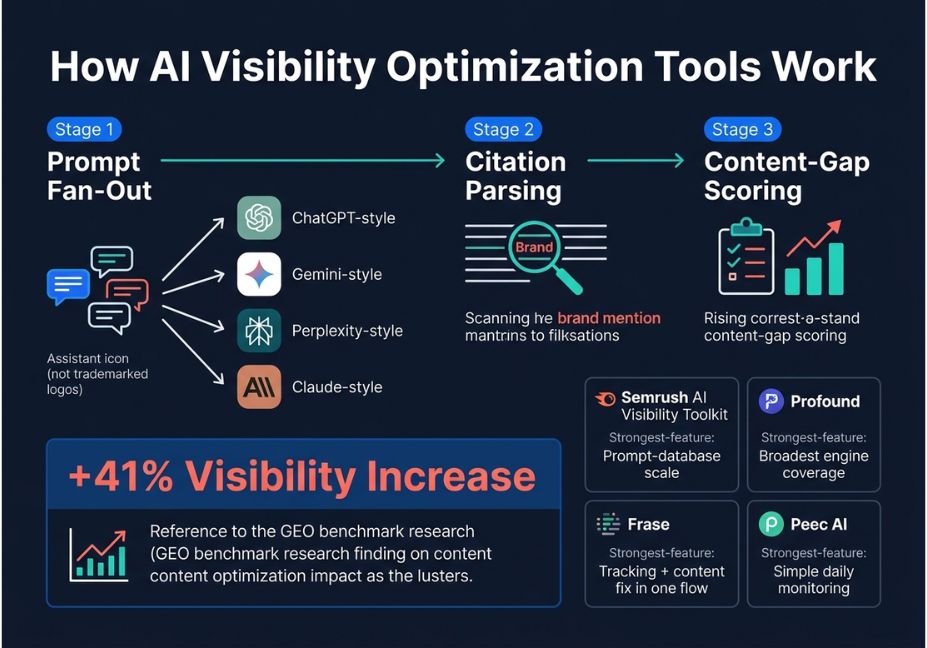
- Prompt fan-out the tool maintains a bank of representative user prompts, such as “best CRM for startups,” and sends them to multiple engines (ChatGPT, Gemini, Claude, Perplexity, Copilot) on a schedule.
- Citation parsing each response is scanned for brand mentions, source URLs, and sentiment, then normalized into a share-of-voice metric per engine.
- Content-gap scoring the platform compares which pages were cited against which pages should have been cited, then surfaces a prioritized list of pages to fix.
Pro Tip: Because LLM outputs vary between identical calls, ask any vendor whether they re-run each prompt multiple times to average out response variance, or whether they sample just once. One-shot sampling produces noisy, unreliable scores.
According to the same GEO benchmark, tactics like adding supporting statistics and relevant quotations were the strongest performers. They lifted visibility by as much as 41% over baseline in one evaluation metric. That’s a data point most vendor pages repeat without linking back to its source, so it’s worth knowing where it actually comes from.
Top AI Visibility Optimization Tools, Compared
Coverage, pricing model, and workflow depth vary a lot across this category. Here’s how the leading platforms stack up on the criteria that matter most, whether you’re comparing tools for an enterprise rollout or looking for the best free AI visibility optimization tool to start with.
Table snippet target:
| Tool | Engine Coverage | Strongest At | Best For |
|---|---|---|---|
| Semrush AI Visibility Toolkit | ChatGPT, Gemini, AI Overviews, AI Mode, Perplexity, Claude, Copilot, Grok, DeepSeek | Prompt-database scale, existing SEO integration | Enterprise teams already on Semrush |
| Profound | ChatGPT, Perplexity, Google AI Mode, Gemini, Copilot, Meta AI, Grok, DeepSeek, Claude, AI Overviews | Broadest engine coverage, agency mode | Agencies managing multiple brand accounts |
| Frase | Major AI engines plus traditional SEO scoring | Closing the loop from tracking to content fix in one workflow | Content teams that want tracking and drafting together |
| Peec AI | ChatGPT, Claude, Perplexity, Grok, DeepSeek | Simplicity, daily prompt monitoring | Small teams and an AI visibility optimization tool for small business budgets |
Technical Note: None of these platforms publicly disclose their exact citation-parsing algorithm. Because of this, treat every “visibility score” as a relative benchmark against your own historical baseline rather than an absolute truth. Response variance between identical prompts run minutes apart is common and is well documented in the GEO-bench methodology referenced above.
AI Visibility Optimization Use Cases
- Competitive benchmarking: seeing which competitor gets cited for a category-defining prompt, and understanding why.
- Content-gap prioritization: routing writers to the pages an AI engine ignored, not just the ones ranking low on Google.
- Misinformation correction: catching when a model states outdated pricing or references a discontinued feature.
- Agency reporting: translating “share of voice in ChatGPT” into a metric a non-technical client, or a HubSpot-trained marketing team, can act on directly.
How to Check Your AI Visibility for Free
You don’t need an enterprise contract to get a directional read on your AI visibility. In fact, a minimal version of the prompt-fan-out and citation-parsing steps above can be built in an afternoon using any major LLM provider’s API, including OpenAI’s or Anthropic’s documentation as a reference.
python
import anthropic
import json

client = anthropic.Anthropic()

PROMPTS =
    "What is the best AI visibility optimization tool?",
    "Recommend a tool for tracking brand mentions in ChatGPT.",


BRAND = "YourBrand"

def check_visibility(prompt: str) -> dict:
    response = client.messages.create(
        model="claude-sonnet-4-6",
        max_tokens=500,
        messages=[{"role": "user", "content": prompt}],

    text = response.content[0].text
    mentioned = BRAND.lower() in text.lower()
    return {"prompt": prompt, "mentioned": mentioned, "response": text}

results = [check_visibility(p) for p in PROMPTS]
print(json.dumps(results, indent=2))
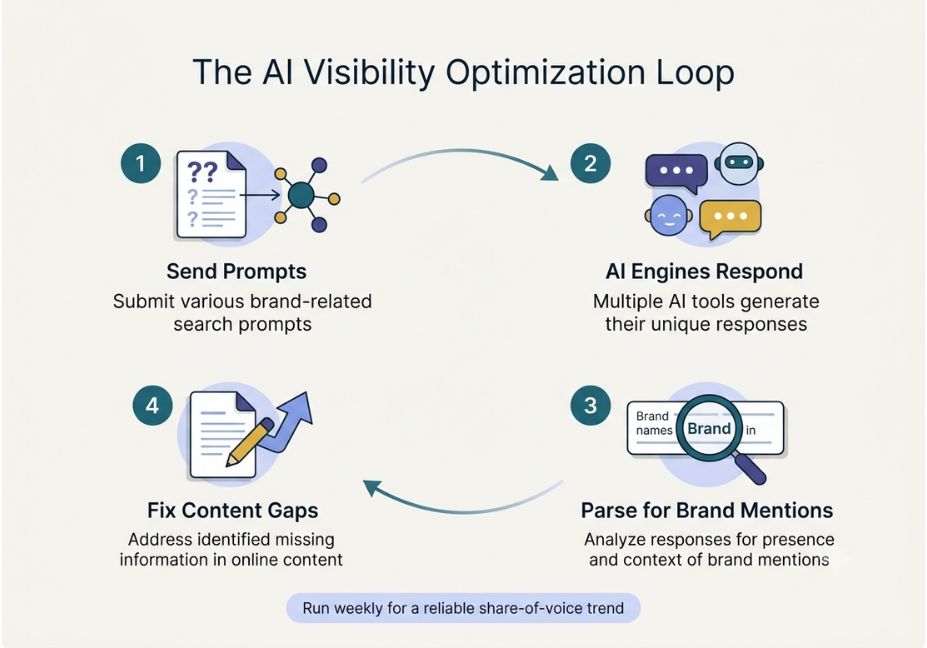
Run this weekly across a fixed prompt list and log the mentioned field over time. That gives you a rudimentary share-of-voice trendline, similar to the core signal paid platforms sell, minus the sentiment scoring and multi-engine polish.
Technical Disclaimer: Framework versions evolve rapidly. The code above uses the Anthropic Messages API as of August 2026. Always check the official docs for the current model string before deploying.
Common Mistakes and How to Avoid Them
- Treating a single prompt run as ground truth. LLM outputs vary between identical calls, so always sample multiple times before trusting a score.
- Ignoring sentiment. Being mentioned isn’t the same as being recommended. A tool that only counts mentions will miss negative citations.
- Optimizing content in isolation from entity signals. A page can be well-written and still invisible if the model can’t confidently resolve who you are.
- Assuming GEO replaces SEO. Most AI answers are still built on content that already ranks well organically. GEO extends that foundation; it doesn’t substitute for it.
FAQ (Voice Search and Featured Snippet Optimized)
What is an AI visibility optimization tool?
An AI visibility optimization tool is software that repeatedly asks AI assistants questions, checks whether your brand comes up in the answer, and tells you what to fix so it shows up more often.
What’s the difference between an AI visibility tool and a regular SEO tool?
A regular SEO tool tells you where your website ranks on a Google results page. An AI visibility tool tells you whether your brand gets mentioned by name inside an AI-generated answer, which is a different and newer kind of visibility.
How do AI visibility tools track brand mentions inside ChatGPT?
They send a set list of questions to the AI on a regular schedule, check the answers for your brand name and any links back to your site, and turn that into a score you can track over time.
Can I check my AI visibility for free?
Yes. You can ask ChatGPT, Claude, or Perplexity your own industry questions by hand, or write a short script that automates the same check, without paying for a subscription.
Is GEO the same thing as AEO?
Yes, for most practical purposes. Generative engine optimization and answer engine optimization both describe getting cited inside an AI-generated answer, though GEO is slightly more focused on multi-source answers and AEO on direct-answer features.
What is the best AI visibility optimization tool for a small business?
For a small business or solo brand, a lighter tool like Peec AI or a free do-it-yourself script is usually enough to start, since enterprise platforms are priced and built for tracking dozens of prompts across many accounts at once.
Conclusion
AI visibility optimization tools solve a real problem: your brand can rank on page one of Google and still be invisible inside an AI-generated answer. The platforms leading the category differ mainly in engine coverage and how tightly tracking connects to a content-fix workflow. Still, every one of them runs some version of the prompt-fan-out-and-parse loop described here. Whether you buy a platform or check your own AI visibility for free first, understanding that loop is what actually moves your visibility forward. Bookmark this guide and explore more hands-on AI agent tutorials at agentiveaiagents.com.