
Most marketing teams don’t have an AI tools problem they have an AI tools sprawl problem. For instance, ask a growth marketer in 2026 what’s in their stack, and you’ll usually get a list of six to ten overlapping subscriptions. However, a smaller and faster-growing group has skipped the sprawl entirely and moved to agentic AI systems that possess agency to plan and act autonomously rather than waiting for a prompt every time.
Consequently, that split copy-paste chatbot tools versus autonomous marketing agents is the real story behind AI tools for marketing in 2026, free or paid. In this guide, we’ll break down both categories honestly, so you can choose the right layer for your team’s size, budget, and risk tolerance.
What Is the Difference Between an AI Marketing Tool and an AI Marketing Agent?
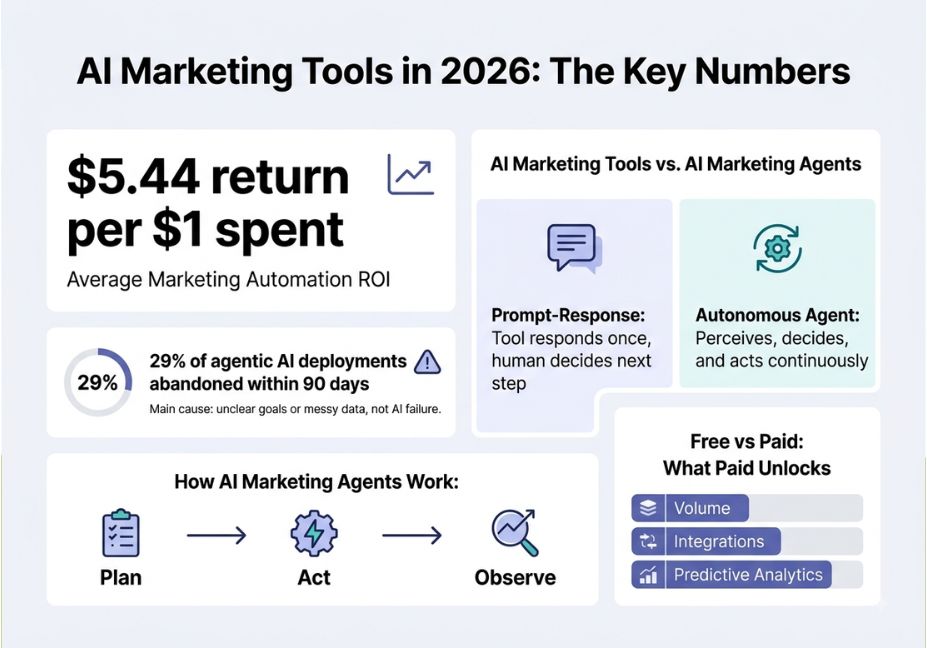
Direct answer: An AI marketing tool responds to one prompt and stops, while an AI marketing agent perceives data, makes decisions, and takes action continuously without a human triggering each step.
For example, Grammarly checking your grammar or Copy.ai drafting a headline are both prompt-response tools useful, but bounded by whatever you type. An AI marketing agent, on the other hand, is different: it perceives inputs such as ad performance, CRM signals, and site behavior, then makes a decision against a defined goal and executes an action on its own. This loop of reasoning and acting is often built on the ReAct pattern the ReAct pattern of reasoning and acting in a loop first formalized in AI research and now embedded in commercial marketing agents from OpenAI, Google Gemini, and Anthropic’s Claude, among others.
What Are the Best Free AI Marketing Tools for Small Business in 2026?
Free tiers vary enormously some are genuinely useful, while others are just 14-day trials wearing a “free” label. That said, a few categories consistently deliver real value at $0:
- Copywriting and content drafting generous free word or credit allowances for social captions, product descriptions, and first-draft blog content
- Design freemium platforms with AI background removal, resizing, and template generation built in
- Analytics machine-learning-powered analytics that fill in behavioral gaps when users decline cookies, at no cost
- SEO research free-tier keyword and question research tools that reveal what your audience is actually searching for
Pro Tip: Before subscribing to anything, run one week using only free tiers. In most cases, teams discover 60–70% of their actual workflow is already covered without spending a dollar, which shows exactly where a paid upgrade needs to earn its keep.
When Is It Worth Paying for AI Marketing Tools Instead of Using Free Ones?
Paid plans typically unlock three things free tiers withhold: volume (higher generation limits), integration depth (CRM and ad-platform sync), and advanced analytics (predictive modeling instead of historical reporting). Therefore, if a paid tool doesn’t clearly deliver at least one of those three, it’s probably not worth the upgrade.
| Category | Free-tier ceiling | What paid unlocks |
|---|---|---|
| All-in-one SEO/content suites | Limited keyword tracking, capped audits | Full site audits, competitor tracking, AI content scoring |
| Email/CRM automation | Small subscriber caps, basic sequences | Multi-step behavioral automation, deeper segmentation |
| AI copywriting | Capped monthly words/credits | Brand-voice training, team collaboration, longer outputs |
| Conversion rate optimization (CRO) | Basic landing page builder | AI traffic routing, A/B testing at scale |
Did You Know? Industry benchmarking data puts average marketing automation ROI at around $5.44 return per $1 spent. Even so, that figure climbs sharply for teams running agentic workflows with clean data and one specific, measurable goal.
How Do AI Marketing Agents Actually Decide What Action to Take?
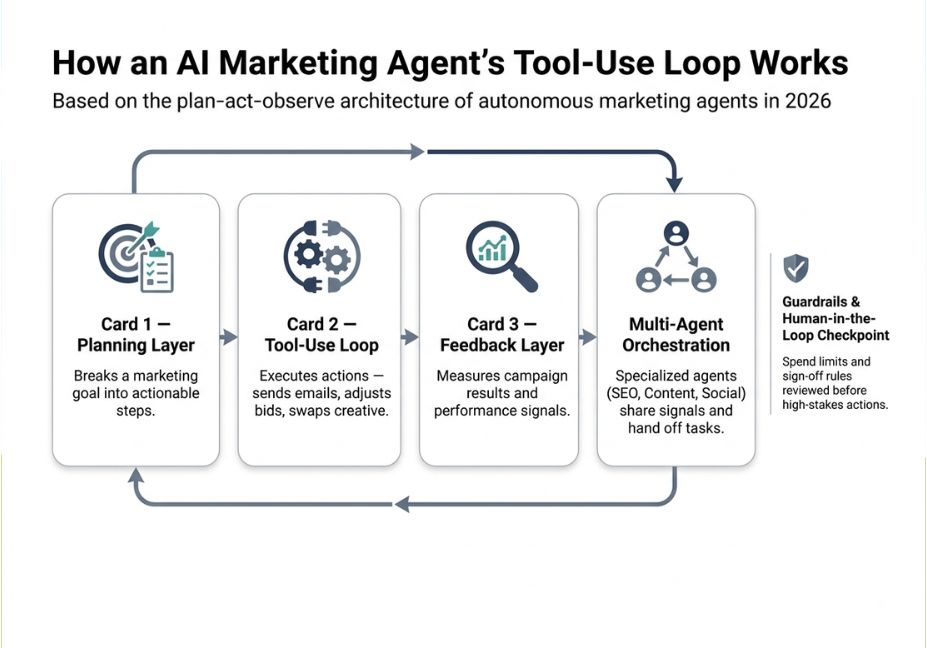
Direct answer: AI marketing agents run a plan-act-observe loop they break a goal into steps, execute an action through connected tools, measure the result, and adjust automatically.
Under the hood, most 2026-era marketing agents follow a similar architecture. First, a planning layer breaks a goal into steps. Next, a tool-use loop executes actions like sending an email, adjusting a bid, or swapping creative. Finally, a feedback layer measures results and adjusts course. To coordinate this, platforms increasingly rely on how an orchestration layer chains tool calls together, especially across multiple specialized agents one for SEO, one for content, one for paid media rather than a single monolithic system.
Technical Note: This is known as a multi-agent system (MAS) pattern, not simply a smarter chatbot. For example, when an SEO agent identifies a rising keyword, it can hand that signal directly to a content agent, which then triggers a social agent a chain of actions no single prompt-response tool can replicate.
Best AI Marketing Tools by Function: 2026 Snapshot
- Content and copy: Jasper AI has evolved from a writing assistant into a content workflow manager, automatically repurposing one asset into multiple channel formats.
- CRM-native automation: HubSpot Breeze and Salesforce Agentforce sit inside existing CRM data, making them the lowest-friction entry point into agentic marketing for teams already on those platforms.
- SEO and content optimization: All-in-one suites like Semrush combine AI content scoring with keyword and backlink research in one dashboard.
- Email and lifecycle marketing: Klaviyo’s AI layer increasingly runs send-time and segment decisions autonomously rather than on a fixed schedule.
- AI search visibility: As more buyers research through Google Gemini, Perplexity, and ChatGPT instead of classic search, some teams are also adding tools specifically for Generative Engine Optimization (GEO) alongside traditional SEO.
What Mistakes Do Teams Make When Adopting AI Marketing Tools?
- Skipping the guardrails. Spend thresholds and sign-off rules need to exist before an agent goes live, not after it makes an expensive autonomous call.
- Treating agentic AI as “set and forget.” Roughly three in ten agentic deployments get abandoned within 90 days usually because of unclear success metrics or messy underlying data, not because the AI itself failed.
- Buying for the demo, not the data. After all, an agent is only as good as the CRM and analytics data feeding it; a polished sales demo can’t fix disorganized customer data.
- Skipping the human-in-the-loop checkpoint. Even the most autonomous 2026 platforms perform best with a defined review point before high-stakes actions ship.
What Are Developers and Marketers Saying About AI Agent Reliability?
Outside the vendor blogs, developer discussions about agent reliability in production consistently raise the same concern: agents are only as trustworthy as the tool-use loop and error-handling built around them. Similarly, marketing teams report that the biggest failures aren’t bad AI models they’re brittle handoffs between tools and unclear escalation paths when an agent hits an edge case.
Technical Disclaimer: Tool pricing, free-tier limits, and feature sets shift frequently in this category. So, the comparisons above reflect the general market as of mid-2026 always confirm current pricing on the vendor’s own page before budgeting.
FAQ — People Also Ask
What is the difference between AI marketing tools and AI marketing agents?
AI marketing tools respond to a single prompt and then stop, leaving you to decide the next step. AI marketing agents, by contrast, perceive data, decide, and act in a continuous loop without a human triggering each action which is why they suit ongoing campaign management better.
Are free AI marketing tools actually worth using in 2026?
Yes, for specific jobs. Free tiers in copywriting, design, and basic analytics deliver genuinely useful output. That said, the gap versus paid plans shows up mainly in volume limits, integrations, and advanced predictive analytics.
How do AI agents decide what marketing actions to take?
Most run a plan-act-observe loop: they break a goal into steps, execute an action through connected tools, measure the result, and then adjust a pattern related to the ReAct reasoning approach used broadly in agentic AI systems.
Can small businesses use agentic AI marketing tools without a technical team?
Yes. Several 2026 platforms are built to abstract the complexity, so you simply define a high-level goal like “increase qualified leads,” and the system handles strategy and execution. Even so, a data or ops-savvy person should still own oversight.
What is the ROI of AI marketing automation?
Reported returns vary by workflow, but industry benchmarking places average marketing automation ROI around $5.44 per $1 spent. Furthermore, more mature agentic deployments report notably higher multiples when goals and data are clean.
How is AI search optimization (GEO) different from traditional SEO for marketing content?
Traditional SEO targets ranking in Google’s blue links, while Generative Engine Optimization (GEO) targets being cited or summarized inside AI answers from tools like ChatGPT, Gemini, and Perplexity. As a result, content needs clear, quotable, directly-answered statements — not just keyword-optimized paragraphs.
Conclusion
Ultimately, the AI tools for marketing conversation in 2026 isn’t really “free versus paid” anymore it’s prompt-response tools versus autonomous agents. Free tiers still earn their place for copywriting, design, and quick research. Paid tools, meanwhile, buy volume and integration depth. But the biggest shift overall is the move toward agentic systems that plan, act, and optimize without waiting on a prompt each time.
So, start small: audit what you already pay for, pilot one agentic workflow with clear guardrails, and expand only where the data backs it up. Bookmark this guide and explore more hands-on agentic AI tutorials at agentiveaiagents.com.