
Most guides stop at the marketing layer. They’ll tell you ChatGPT mentioned your brand fourteen times last week. That’s useful. However, it skips a harder problem: was the citation even true? A 2026 evaluation of commercial LLMs and deep research agents found that API-only models without web access produce valid citation URLs only 40–70% of the time. So if your agent is fabricating sources, no brand dashboard catches that before your users do.
This guide covers both layers. First, the pipeline-level tools engineers use to verify and ground citations inside a RAG (retrieval-augmented generation) system. Second, the brand-level tools marketers use to track how AI answer engines cite that content once it’s public.
What Is AI Content Citation Tracking?
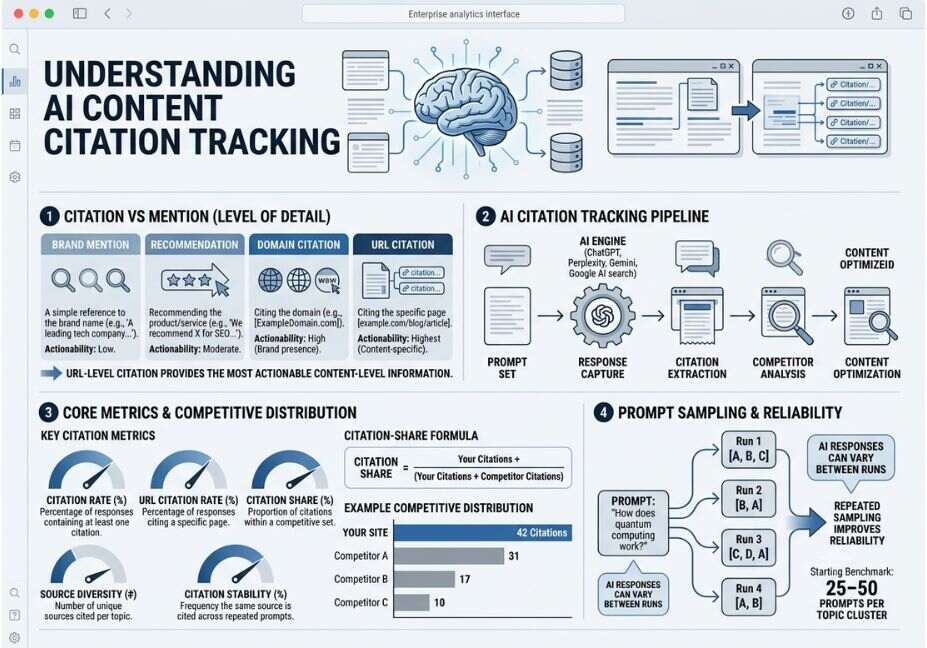
AI content citation tracking is the practice of monitoring, verifying, or measuring how AI systems reference source content. It happens at two points: inside a generation pipeline, where the question is whether a claim actually came from the retrieved document, and across public answer engines, where the question is whether ChatGPT or Perplexity links back to your domain.
The concept builds on retrieval-augmented generation, a method where a model is paired with a retrieval component that fetches relevant documents and grounds its response in verifiable sources. This is the same pattern used by major labs, including OpenAI, Anthropic, and Google DeepMind, in their production search and research features. You can read more in the Wikipedia entry on retrieval-augmented generation.
How Does Citation Tracking Actually Work?
At the pipeline level, citation tracking runs in three passes. First, extraction: the agent’s answer is broken into individual claims. Next, verification: each claim is checked against its source, either through entity-matching or an LLM-as-a-judge. Finally, scoring: a faithfulness score is generated, and unsupported claims get flagged before the response ships.
At the brand level, the process runs in reverse. Monitoring platforms fire a bank of prompts at ChatGPT, Perplexity, Gemini, and Google AI Overviews, then log which domains get named or linked. These platforms separate a mention where an engine simply names a brand from a citation, where it links to content as a source. That distinction matters, because a high mention rate paired with a low citation rate usually signals strong brand recognition but a real content-authority gap.
Did you know? Only 11% of domains cited by ChatGPT overlap with domains cited by Perplexity, according to a 2026 per-engine audit. In other words, single-platform monitoring gives you a misleading picture of your actual AI visibility.
How Do You Track AI Citations in a RAG Pipeline? (For Builders)
If you’re shipping a RAG pipeline or an agent that generates cited answers, tracking has to happen before the response leaves your system not weeks later when a marketer spots it in a dashboard.
- RAGAS an open-source evaluation framework. It computes a faithfulness score by generating statements from a question-answer pair, then checking how many are actually supported by the context.
- rag-citation an open-source citation-generation library for RAG pipelines (https://github.com/rahulanand1103/rag-citation). It automatically generates citations for AI output and flags hallucination when generated entities, like dates or dollar figures, don’t appear anywhere in the retrieved context.
- OpenLLMetry / Traceloop an OpenTelemetry-based instrumentation layer for LLM apps (https://github.com/traceloop/openllmetry). It logs prompts, retrieved chunks, and responses so a claim-by-claim verification pass can run downstream.
- Deepchecks / Open RAG Eval evaluation toolkits built with academic partners, including the University of Waterloo. Open RAG Eval includes a dedicated Citation metric to verify sources and a Hallucination metric to catch unsupported details.
Architect’s note: Citation hallucination isn’t always “wrong facts.” Often it’s a correct fact attributed to the wrong source which is arguably worse, because it looks verifiable while quietly pointing users toward conflicting information. Researchers have started calling this pattern citation hallucination in long-form RAG output.
What Causes an AI Agent to Hallucinate a Source?
An agent typically hallucinates a citation for one of two reasons. Either it generates a URL or attribution from parametric memory instead of the document it actually retrieved, or it states a correct fact but misattributes it to the wrong chunk inside its own context window. Both failures are invisible to the end user, because the citation still looks legitimate.
How Do You Monitor Brand Citations Across ChatGPT and Perplexity? (For Content and SEO Teams)
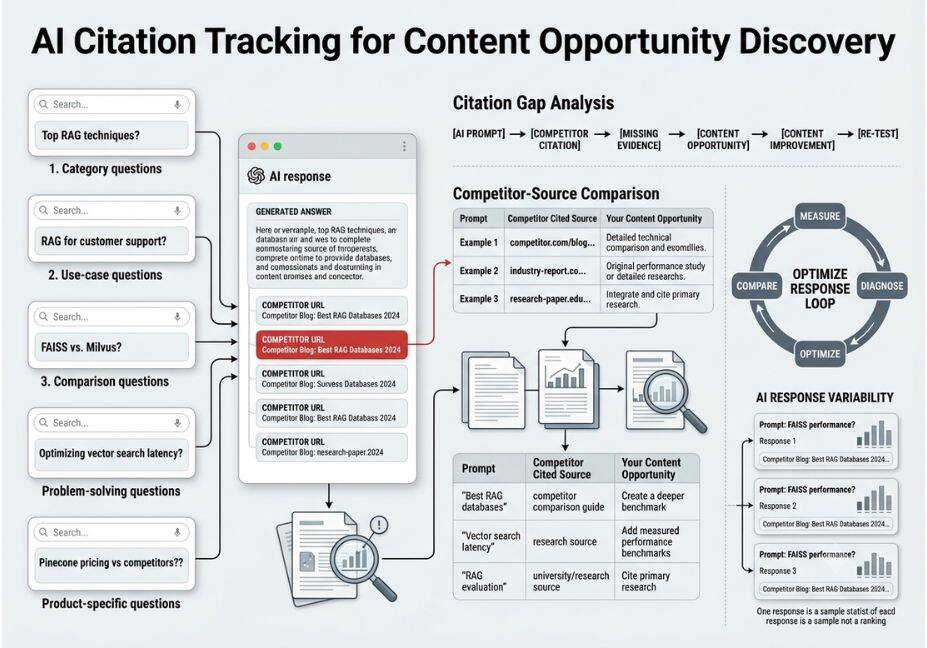
Once content is public, a second class of tool tracks whether AI answer engines actually cite it.
| Tool | Best For | Notable Capability |
|---|---|---|
| Semrush AI Visibility Toolkit | Teams already using Semrush | Tracks citation share, prominence, and stability; benchmarks against up to nine competitors per prompt |
| Profound | Enterprise AEO programs | Deep multi-engine citation analysis at scale (~$499/mo) |
| Otterly AI | Budget-conscious first-time trackers | Captures cited URLs and source domains weekly for tracked prompts |
| Scrunch AI | Compliance-sensitive organizations | Auto-detects citation gaps where competitors are cited but you aren’t; SOC 2 Type II certified |
| AirOps | Teams pairing monitoring with content production | Multi-engine monitoring paired with brand-governed content generation |
Pro tip: Track citation rate alongside mention rate, not instead of it. A high mention rate with a low citation rate almost always signals a content-authority gap, not a visibility gap.
Why Does This Matter Right Now?
The urgency isn’t hypothetical. Sources cited inside AI answers get clicked at a 41% rate, compared to roughly 30% for traditional organic results. Meanwhile, AI-generated responses now drive an estimated 83–93% of zero-click consumption across major search surfaces. Even so, the average brand mention rate across AI answers sits at just 17.2%, even among brands with strong traditional SEO. As a result, most teams are optimizing hard for a channel where they’re barely visible.
How Do You Build a Basic Citation Verification Pass?
For teams building their own agent rather than buying a SaaS dashboard, a minimal verification loop looks like this:
python
from rag_citation import CitationChecker

checker = CitationChecker(embedding_model="your-embedding-model")

result = checker.verify(
    answer="LangChain orchestrates tool calls through a ReAct-style agent loop.",
    context=retrieved_chunks
)

if not result.is_supported:
    flag_for_review(result.unsupported_entities)
This mirrors the claim-by-claim pattern used in production observability stacks. There, a judge LLM first breaks the answer into individual atomic statements, then checks each one against the retrieved context. This approach is far more reliable than simply asking a model, “Is this faithful?” because that kind of vague prompt produces inconsistent results.
Technical disclaimer: RAG evaluation APIs evolve quickly. The code above reflects general library patterns as of mid-2026. Always check current documentation before shipping.
Common Mistakes and How to Avoid Them
- Treating “mentioned” and “cited” as the same signal. A mention without a link isn’t a citation. Conflating the two inflates your reported visibility.
- Monitoring a single engine. Because ChatGPT and Perplexity citation overlap is so low, tracking only one platform is close to guessing.
- Skipping pipeline-level checks entirely. Teams that only monitor brand citations downstream have no way to catch hallucination before it ships. The fix belongs at generation time, not after publication.
- Trusting a single faithfulness score. RAG faithfulness shifts with model version, retrieval recency, and sampling. Track the trend, not one reading.
What Are Developers Saying About Citation Tracking?
Discussion on r/LocalLLaMA and in GitHub issues for citation-verification libraries tends to converge on the same complaint: claim-level verification is computationally expensive at scale. Consequently, many teams fall back to spot-checking a sample of outputs rather than verifying every single response — a trade-off worth weighing before committing to a fully automated pipeline.
FAQ — People Also Ask
What’s the difference between AI citation tracking and backlink tracking?
Backlink tools show where other sites link to you. AI citation tracking shows whether an AI answer engine names or links to you inside a generated response. It’s a separate visibility surface, because AI engines don’t always reward the same content that earns backlinks.
How do AI agents verify citations before generating an answer?
Agents decompose the draft answer into atomic claims. Then, each claim is checked against the retrieved context using entity-matching or an LLM-as-a-judge. This produces a faithfulness or groundedness score before the response reaches the user.
Can I track citations across ChatGPT, Perplexity, and Google AI Overviews in one tool?
Yes. Most modern AEO platforms, including Semrush, Profound, Otterly, and Scrunch, monitor multiple engines at once. This matters because citation overlap between engines is low, so single-engine tracking misses most of the picture.
What causes citation hallucination in RAG systems?
It usually happens when a model generates a URL or attribution from parametric memory instead of the retrieved document, or when it states a correct fact but misattributes it to the wrong source in its context window.
Are there free or open-source citation tracking tools?
Yes. RAGAS, the rag-citation library, OpenLLMetry, and Open RAG Eval are open-source options for pipeline-level citation and faithfulness checking. Brand-level AI answer-engine monitoring, on the other hand, is mostly commercial.
Conclusion
AI content citation tracking isn’t one category it’s two connected layers. Builders need pipeline-level tools like RAGAS, rag-citation, and OpenLLMetry to catch citation hallucination before an agent’s response ships. Content and SEO teams need brand-level AEO platforms to measure share of voice across ChatGPT, Perplexity, and Google AI Overviews once that content goes public. Treat the two as one pipeline instead of two separate problems, and you’ll catch bad citations at the source instead of finding them in a dashboard weeks later.
Bookmark this guide and explore more hands-on agentic AI tutorials at agentiveaiagents.com.