
An exceptional website can still experience low search visibility if search engines fail to find critical website URLs easily. This is very much true when the site undergoes changes like migration, frequent publishing of articles, URL modification, or changing internal links.
The term Sitemap Generator UploadArticle.com is frequently being typed in by site owners who need a simple way to create a XML sitemap without necessarily writing one or downloading any special software.
However, creating a sitemap.xml file is only part of what is required from an SEO perspective.
To create a sitemap that can be genuinely useful, you must make sure that it includes URLs of the right kind: the public, accessible, canonical, and really valuable. Automatically created files may have all the technical properties required but still help you to receive very weak indexing signals.
This article shows how Sitemap Generator UploadArticle.com works and where its limits are, as well as the way in which it can be verified by means of Google Search Console, canonicalization, and new technical SEO techniques.
What Is Sitemap Generator UploadArticle.com?
. A Sitemap Generator UploadArticle.com is essentially a web-based application that allows users to scan an online platform and produce an XML sitemap that consists of URLs that are found.
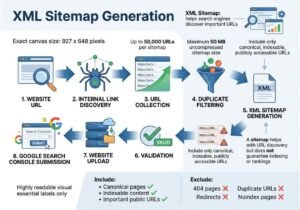
. The process of generating a sitemap is simple:
. The user has to put a website’s starting URL.
. The instrument follows the internal links within the site.
. It gathers web pages that are detected during the crawling.
. The posts are made into an XML format.
. Then, the sitemap should be saved on the site.
. An XML sitemap is a file that contains URLs and is used by engines to know what exists on the site. Sitemaps.org protocol describes the rules of making sitemaps and how the URLs have to be presented.
. Nevertheless, it should be understood that the availability of a sitemap does not guarantee the website’s crawling and getting high positions.
. According to Google’s documentations, sitemaps are only a way to provide access to the URLs, but the crawling and indexing depend on a number of factors.
How Does Sitemap Generator UploadArticle.com Work?
At a technical level, the software application is simply classified as a lightweight web crawler.
The standard pattern appears like this:
Home URL
↓
Internal link detection
↓
Link gathering
↓
Duplicate removal
↓
XML sitemap creation
↓
Validation and examination
↓
Hosted on web server
↓
Search engine submission
The web crawler utilizes the seed URL and tracks links that are present in the public domain.
More specifically:
https://example.com/
↓
https://example.com/blog/
↓
https://example.com/blog/article-one/
https://example.com/blog/article-two/
The identified URLs can then be placed in XML entries like this:
The product must be uploaded at a point that allows search engine crawlers to easily access it.
Why XML Sitemaps Still Matter for Technical SEO
Today’s search engines can find websites using links. So why do we need to have a sitemap?
The fact is that not all websites require a sitemap.
As stated by Google, small websites with a limited number of pages and efficient internal linking may not need a sitemap to be created manually. However, the bigger the site, the more advantage you will have from using the sitemap.
In case your website:
Has plenty of pages
Has regular updates
Has deeply nested pages
Has gaps in internal linking
Just moved to a new domain
Has some media or specialized content
Is not really discovered by the search engines
Facts You Probably Did Not Expect:
A sitemap can contain as many as 50,000 URLs or 50 MB compressed information. However, if you operate a big website, you will need to divide its URLs into several sitemaps and use a sitemap index.”
Sitemap Generator UploadArticle.com: Step-by-Step Workflow
When using a sitemap generator of another company, make sure to perform this procedure instead of submitting the sitemap generated immediately.
Step 1: See If You Already Have a Sitemap
Before getting a new sitemap made, check the following places:
https://example.com/sitemap.xml
https://example.com/sitemap_index.xml
https://example.com/wp-sitemap.xml
In addition check the following files:
https://example.com/robots.txt
It is probable that your hosting provider or content management application generates the sitemap automatically.
The creation of a second sitemap can create additional problems.
Step 2: Enter the Correct Website URL
Use the canonical home page such as:
https://example.com/
Do not use an old redirected version such as
http://example.com/
unless it is the canonized URL.
Step 3: Generate the Sitemap
The generator crawls your website and collects the internal URLs.
However, there can be some issues regarding that to take into account.
How to Submit the Sitemap to Google Search Console
Upon hosting the respective file, you should then submit its URL via Google Search Console.
The significant point here is that you normally submit the sitemap URL and not upload the XML file onto Google.
The workflow follows:
Confirm your website property.
Login to Google Search Console.
Type the sitemap path.
Submit the sitemap.
Check the results of processing.
The Sitemaps report on Google Search Console signifies for the website owners the history of submitted sitemaps and any error that Google experienced while processing a sitemap.
What URLs Should You Include in a Sitemap?
It is advised to be picky while forming the sitemap.
There are a few distinct guidelines for deciding on the parts to be included in the sitemap:
Your sitemap should include only the following URLs:
– URLs in canonical form
– URLs that can be indexed
– URLs that are available to the public
– URLs important for search engines
– URLs returning positive HTTP responses
Avoid including all URLs that your crawler discovers.
URL classification matrix for the sake of their inclusion in the sitemap.
URL Type Include in the Sitemap? Reason
Canonical article Yes The content is vital for indexing and can be considered valuable
Product page Yes The URL is indexed
301 redirect No Sitemap must have the URL of the destination page
404 page No The URL is non-existing
Noindex page Usually No The URL has contradictory signals
Duplicated URL No The canonical version is to be used
Internal search URL Usually No The URL is of little use or may lead to endless crawling
Staging page No The URL should not be mentioned in live sitemap.
A piece of advice.
The best tactic is as follows:
sitemap URLs→canonical URLs→indexable pages→powerful internal links
Sitemap Generator vs Automatic CMS Sitemaps
Sitemap Generator UploadArticle.com may be useful for one-off projects, but it is not necessarily the best architecture for every website.
| Approach | Strength | Limitation | Best For |
|---|---|---|---|
| Third-party sitemap generator | Fast and simple | May require manual regeneration | Small or static websites |
| CMS-generated sitemap | Automatic updates | Depends on CMS configuration | Most blogs |
| SEO plugin sitemap | More control | Plugin configuration required | WordPress websites |
| Custom sitemap pipeline | Highly flexible | Requires development work | Enterprise platforms |
For websites publishing content every day, automatic generation is usually more reliable than repeatedly running a manual crawler.
Common Sitemap Mistakes That Hurt SEO Monitoring
1. The inclusion of URLs that diverge from the norm
When your sitemap includes:
https://example.com/page
but the URL revealed by the page is:
https://www.example.com/page/
then you’re giving conflicting signals.
2. Including redirects
Avoid using your sitemap as a historical record of URLs.
Instead, you should keep your URLs updated for final canonical URLs.
3. Wrong lastmod dates
The lastmod should show periods of meaningful changes in the content.
Changing lastmod dates artificially for crawling purposes is not a good practice.
Will Sitemap Generator UploadArticle.com Find Every Page?
There is no sitemap crawler that can assure the discovery of all URLs.
The majority of tools are built on the basis of internal links.
This leads to delays in discovering orphan pages.
For instance:
Homepage
↓
Category
↓
Article A
If Article B is created but has no links to it:
Article B
A typical crawler is likely to overlook it.
Some more limitations are related to:
Links rendered by JavaScript
Limitless URL space
Parameters for the session
Authentication
Restrictions on crawling
Dead URLs
FAQ: UploadArticle.com Sitemap Generator
What is UploadArticle.com Sitemap Generator?
The Sitemap Generator UploadArticle.com is a web-based tool that scans public URLs of websites and produces an XML sitemap that can be uploaded to the website, making it available for search engines to index.
Is UploadArticle.com Sitemap Generator a free tool?
Currently, the information found online describes this tool as a free online sitemap generator. However, since there is not much publicly available first-party documentation, the user should check the current features and output before using it in any workflow.
How to submit an xml sitemap?
Upload the sitemap.xml document at an online accessible place and submit its URL via Google Search Console. You can also mention the sitemap in your robots.txt file.
Does a sitemap generator capture all pages of my website?
Not at times. Pages that do not come across any links for crawling, pages depending on JavaScript, blocked URLs or orphan pages may not be indexed by a standard website crawler.
When is the right time to update your sitemap?
If your CMS has a built-in sitemap generator, changes import into the existing sitemap during normal publishing procedures. In the case of manual sitemap generators, the sitemap has to be generated every time you publish important new material, change your URLs, or move your site from a previous host.

Conclusion
In conclusion, Sitemap Generator UploadArticle.com is an excellent fit for quick creation of XML sitemap for smaller web projects and single time technical SEO needs.
The three best takeaways of the process are quite straightforward indeed.
• Sitemap has to be created accurately based on canonical URLs;
• Output should be validated rather than blindly submitted;
• Indexing must be followed separately since sitemap submission does not guarantee ranking.
When it comes to most websites today, it is better to use sitemap automation. However, lightweight generator is still a convenient option for static sites, migrations, audits, and quick campaigns.
Don’t forget to save this guide, validate your technical SEO practices, and learn about more useful AI, automation, and optimization practices at agentiveaiagents.com.