
Traditional SEO tools could not cope with the measurement challenge posed by AI search technology.
In Google, one website might have an excellent ranking but be hidden in the recommendations provided by AI tools such as ChatGPT, Perplexity, Gemini, or Google AI Mode. On the other hand, one particular domain may not perform well in traditional SERPs but still get mentions from the AI-generated solutions.
That is why the importance of the tools for analyzing a website’s visibility in AI search is growing continuously for technical SEO experts, content strategists, and publishers focused on AI.
The challenge is that AI visibility is a stable mechanism that includes mentions of the brand, citations of the sources, the reach of the prompts, incoming traffic from AI, and the accessibility to the crawlers. Measuring any one of those provides only a fraction of the full picture.
This article describes how AI visibility tools work, which metrics are the most important, and how to create an effective monitoring workflow.
What Is Website AI Search Visibility?
AI search visibility of a website evaluates the frequency the website, brand, or content appears in the answers that AI search systems provide.
Unlike conventional ranking metrics, the measurement involves several indicators:
A brand appears in the AI-generated answer.
A specific page is referenced as the source.
A domain shows up in different related queries.
A competitor receives more mentions.
AI systems provide the traffic to the website.
Search engines or AI bots can see important information.
The concept is closely related to Generative Engine Optimization (GEO). GEO as a new area has introduced the measurement and enhancement of creator visibility in generative search environments, which illustrates the fact that conventional ranking cannot serve as a complete metric anymore.
Note
AI visibility cannot be identified with LLM “ranking.” Different platforms employ different methods of retrieval, synthesis, citation, and display. Effective analysis should focus on measurable outcomes like mentions and citations.
Now that the measurement model is established, let us analyze what the visibility analysis must include.
1. Track AI Mentions and Citation Frequency
The first job of tools for analyzing website AI search visibility is determining whether an AI system actually references your website or brand.
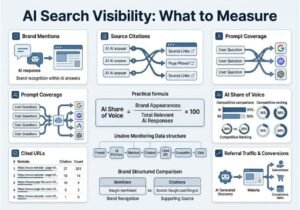
The two most useful metrics are:
- Mentions: How often your brand appears in an AI answer.
- Citations: How often the AI system links to your domain or page as supporting evidence.
These signals are related but not identical.
For example, an AI assistant might recommend a company by name without citing its official website. Another answer may cite a research article from the website without explicitly mentioning the brand in the response.
Ahrefs Brand Radar measures AI visibility through metrics including mentions, citations, impressions, and AI share of voice across multiple AI platforms.
What to measure
| Metric | What it tells you |
|---|---|
| Brand mentions | Whether AI systems recognize your brand |
| Domain citations | Whether your website is used as evidence |
| Cited URLs | Which individual pages perform best |
| Citation frequency | How consistently pages appear |
| Competitor citations | Which domains win the same topics |
Pro Tip: Track citations at the URL level, not only the domain level. A website may have strong overall visibility while only two or three pages generate most AI citations.
2. Analyze Visibility Across AI Platforms
When it comes to AI search analysis, one of the main errors that people commit is considering several AI systems as one search engine.
AI systems are completely different.
For example, a certain website may perform according to different standards on:
ChatAI
Google AI Overview
Google AI mode
Perplexity
Gemini
Microsoft Copilot
Different platforms have different ways of obtaining the information, making databases, partnerships in the process of searching.
Google states that its AI search tools can make use of the “query fan-out” approach, whereby a search generates several almost similar queries with topics and sources before the result appears. As a result, a webpage may not have the answer to the query posed.
Platform comparison framework
Platform type Single most important parameter to control
AI search + with citations Citation frequency
AI chat Brand frequency
Google AI functions Search effectiveness
Answer engines Prompt visibility
Multiple models Amount of voice
Architect’s note
It is better not to formulate a single “AI ranking” as the measurement methodology is unclear.
It is better to register
Prompt → AI platform → mention → citation → URL → competitor → date
3. Use Prompt Tracking Instead of Generic Keyword Tracking
In traditional SEO, the process begins with a search term.
The trend towards looking at visibility in search engines through AI means that there is an increased importance placed on the questions that will be asked.
An example of a classic keyword might be:
AI visibility tools
However, the questions that users will pose to the AI system may include:
What tools can show whether my site appears in ChatGPT?
How will I find out about the number of citations I have in Google AI?
Which AI tools can track the activity of my competitors?
Why does my website rank on Google but not show up in AI answers?
These questions point to the different contexts in which information can be retrieved.
It is therefore possible for teams to use modern AI tools to keep track of the special questions that they want to have answers to when looking for their brand or information about their website and content. Ahrefs, for example, makes a distinction between general visibility based on search terms and that of special searches.
Recommended types of prompts to make
Group prompts into the following types:
Information-based prompts
Product comparison prompts
Recommendation prompts
Solution-promoting prompts
4. Compare AI Share of Voice Against Competitors
Website visibility becomes more useful when compared to others.
Let’s say your website was mentioned as a source in 12% of the queries announced on one subject. This is of no real meaning without knowing if competitors receive:
8%
15%
40%
This is why AI share of voice is so important.
Simply put, the calculation can be represented as:
AI Share of Voice =
Brand Citations / Total Number of Relevant Responses x 100
Also, you can use the model and treat citations and mentions differently.
Example model in Python
queries = 100
brand_mentions = 22
brand_citations = 15
#calculating scores
mention_percentage = brand_mentions / queries
citation_percentage = brand_citations / queries
scale = (mention_percentage * 0.4 + citation_percentage * 0.6) * 100
print(f”AI Visibility Score: {scale:.1f}”)
This example shouldn’t be taken as an industry-standard forecast model. Instead, it illustrates how teams can combine various signals into an internal monitoring
model.
Comparison checklist
When comparing your KPI against those of competitors, look at the following factors:
– The frequency of mentions
– The frequency of citations
– The number of references
– Coverage in prompts
– Coverage in platforms
– Sentiment or recommendations
– Change over time
5. Analyze Which Pages AI Systems Actually Cite
Reporting concerned with domains can mask certain valuable opportunities.
For instance
/blog/ai-search-guide/ received 30 mentions
/tools/visibility-checker/ received 25 mentions
while the rest of the 500 pages get nearly none of this
In such cases, “publish more content” is not necessarily the answer.
Rather, it is essential to understand what makes successful pages successful.
This can be done by looking for similarities in:
Content structure
Original research
Directness of answers
Tables
Depth of technicality
Coverage of entities
Newness
Authority signals.
Google promotes generative artificial intelligence technologies, saying that SEO principles, such as crawlability, internal links, text usability, and the presence of structured data correspond to the content available to Google.
Firstly, we need to ask ourselves the following questions concerning the articles that got citations.
Does the article answer a specific question in a straightforward way?
Is the content original?
Is the comparison structured?
Is the information checkable?
Is the given content crawlable?
Is the subject matter covered thoroughly?
6. Combine AI Visibility Data With Website Analytics
Monitoring AI citations suggests possible visibility.
Analytics indicates real results.
Your measurement stack needs to link AI search signals to:
– Referral sessions
– Engaged sessions
– Conversion
– Assisted conversions
– Landing pages
– AI crawlers activity
According to Google, it is better to measure the overall value of visits instead of just clicks, because users coming from AI-related search may behave differently in terms of engagement.
Measurement process suggested
Step 1: Find pages that get AI citation.
Step 2: Check if these pages get any referral traffic that is related to AI.
Step 3: Put first the pages where visibility and business results overlap.
7. Check Technical Accessibility for AI Search
Sometimes the quality of the content may lead to issues with the visibility of AI.
The cause of visibility problems may also lie in the technical accessibility of the content.
In regard to Google AI features, pages should comply with Google Search requirements and satisfy technical rules for being indexed or produced in snippets. According to Google, there is no need for particular markup files or rules regarding AI schema entries in order to get indexed.
For ChatGPT Search, OpenAI recommends that publishers ensure that their relevant public content is not restricted for OpenAI crawler.
Technical visibility checklist
Ensure that the following items are checked:
robots.txt access
Indexability
HTTP response status
Internal linking
JavaScript rendering
Canonical URLs
Structured data consistency
Availability of important text
Page speed and quality
An important tip
Do not create an llms.txt file just because you think it might help with ranking.
Best Tools for Analyzing Website AI Search Visibility
The right tool depends on the type of analysis you need.
| Tool category | Best for | Key measurement |
|---|---|---|
| AI visibility platforms | Cross-platform monitoring | Mentions and citations |
| SEO platforms with AI features | Combined SEO + AI analysis | AI visibility and organic search |
| First-party search reporting | Google-owned performance data | Generative search impressions |
| Web analytics | Measuring actual outcomes | Traffic and conversions |
| Custom API workflows | Technical teams | Fully customized prompts and scoring |
Ahrefs Brand Radar is particularly useful for teams that want large-scale AI visibility research, custom prompt tracking, citations, and competitive analysis. Its methodology uses search-backed prompts rather than relying entirely on synthetic question generation.
Common Mistakes When Measuring AI Search Visibility
Error one: Confusing mentions with citations
They show that a brand name appears in the conversation, but a citation serves as a proof of referencing a given web page.
Error two: Having too many requests
Large list of requests leads to messy dashboards
Start with important queries and then build on what you learn.
Error three: Forgetting about traditional SEO
Google has made it clear that the basics of SEO are still useful for making generative AI work properly.
Error four: Evaluating visibility instead of traffic.
Having a very high visibility score is interesting.
Having a high visibility score which translates into conversions is useful.
Error five: Believing that AI output is stable
AI results may vary due to:
Changes in models
Changes in search indexes
Changes in retrieval
New content
Rewording of requests
It’s better to track trends than to react to one of the outputs.
A Practical AI Search Visibility Workflow
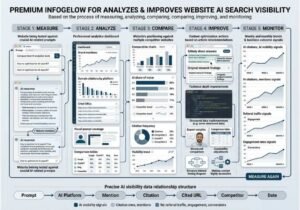
The effective process of monitoring is as follows:
Step 1: Create the topic set
Determine:
The main commercial topics
Informational topics
Queries for comparing competitors
Queries for recommendations
Step 2: Create prompt clusters
Generate 5–10 versions of prompts for every main topic.
Step 3: Understand the baseline visibility
Note down:
Mentions
Citations
Cited pages
Presence of competitors
Differences between platforms
Step 4: Identify the content gaps
Which questions get AI answers, without referring to our website?
These are usually your best optimization opportunities.
Step 5: Optimize the relevant page
Concentrate on:
Clear answer
Unique data
Technical excellence
Well-structured content
Expert opinion
Step 6: Keep track of the changes.
Follow the trends weekly or monthly, do not check the output manually every day.
FAQ
Is it possible to assess visibility of the website in AI search?
It is possible to assess visibility of the website in AI search using the necessary tools, which can keep track of invocation of AI technology. The mentioned tools allow gaining insights into information related to both website performance and traffic metrics.
What tools can help track AI search visibility?
The platforms monitoring visibility in AI searches can be used for tracking mentions of brands and websites using ChatGPT, Google AI Overview, AI Mode, Gemini, Perplexity, and Copilot. This being said, each of the platforms has its own advantages and possibilities.
How do I find out if my website is mentioned by ChatGPT?
You can use the AI visibility tools or try various prompts yourself to assess if ChatGPT has mentioned your website. OpenAI suggests publishers make sure publicly available content meant for ChatGPT searches is available to the search engine crawling it.
What is the difference between SEO tracking and AI visibility tracking?
SEO tracking measures only rankings, impressions, clicks, and organic search traffic while AI visibility tracking measures whether answers provided by AI contain any mentions of your brand or website. There is an overlap between these two spheres since effective SEO affects discoverability.
How can I achieve good visibility in Google AI Overviews?
To improve visibility in Google AI Overviews, it is necessary to follow the basic Google core SEO rules such as making sure crawled and indexable content is available, providing unique content aimed at people first, using a proper schema, supporting content with relevant media, and ensuring structured data correlates with visible content.
Conclusion
Excellent tools for measuring web AI search visibility do not just give one indicator. They show you where you have been mentioned online, which pages are referenced online, what queries influence visibility, how you and your competitors compare to each other, and if AI discovery has brought tangible business results.
The best strategy includes 3 aspects:
– Monitoring mentions and references of AI.
– First-party search and website analyses.
– Analyzing technical SEO and content gaps.
Measuring AI search is still in development but the basic idea is evident: measure true visibility, recognize crucial pages and queries, and improve the content and technical aspect accordingly.
Add this guide to your bookmarks and find out other useful tutorials on AI search and agentive processes on agentiveaiagents.com.
One Response