
Sales revenue is slowly leaking away from your internal operation because of your voice menus or “IVR” or Interactive Voice Response Systems, which is not from agents. The problem is typically your menu tree.
Voice and call center benchmarking shows that the average containment rates of legacy IVR systems fall well below 30% meaning that 7 out of every 10 customers will simply leave the menu, either press 0 to speak to an agent immediately or otherwise abandon their efforts to accomplish their goal by interacting with an IVR. In high call volume businesses, DTMF-driven rigid IVR solutions have also driven abandonment rates above 40% during peak periods. There is a nearly one-to-one correlation with lost conversion sales as well as increased customer churn due to these call abandonment metrics.
By contrast, an AI phone agent uses an advanced LLM technology to run with a live NLP( Natural language Processing) pipeline, tool-use loop, and real-time CRM integration for resolving calls instead of just routing them to agents.
This comparison guide provides a side-by-side analysis of both systems from an architectural, functional and production standpoint; ultimately giving you guidance on determining which systems belong in your technology stack by 2026. The guide will also provide an overview of failure modes associated with both systems that many competitors do not want you to see including LLMs hallucinating and ASR failure cascading down.
What Is IVR? (And Why It Still Exists)
Interactive Voice Response (IVR) is a telephony technology that routes callers through pre-recorded, menu-driven prompts. It uses touch-tone DTMF input or limited keyword voice recognition to do so. Commercial IVR deployment started in the 1970s, and the core mechanism has barely changed since then.
IVR systems operate on static decision trees. Every path is hand-coded by an engineer before deployment. Every branch must be anticipated in advance. Therefore, if a caller asks something outside the tree, the system cannot help them.
In short, IVR does one thing reliably: it routes. It cannot infer intent, hold context across turns, or execute tasks against live data.
Technical Note: Basic IVR uses DTMF signals the tones your keypad produces. “Conversational IVR” adds an ASR layer but still matches keywords against a fixed grammar. It is not free-form NLU, and it does not generalize to natural phrasing.
However, IVR still has legitimate use cases. For example, high-volume utility companies with purely routing-based call flows PIN verification, account number entry get reliable value from IVR at low cost. The technology is not dead. It is simply insufficient for complex caller intent.
What Is an AI Phone Agent?
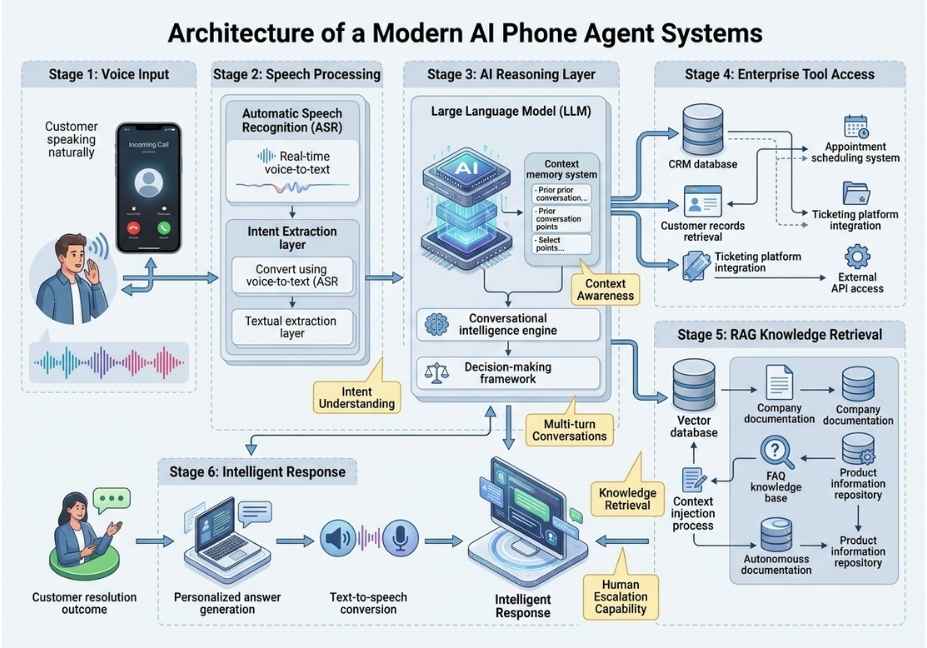
An AI phone agent is an autonomous voice system that handles inbound and outbound calls through a full NLU pipeline. The pipeline runs in this sequence: automatic speech recognition (ASR) → natural language understanding (NLU) → dialogue management → action execution → text-to-speech (TTS) response.
Unlike IVR, the AI phone agent does not follow a tree. Instead, it resolves a goal.
The underlying architecture is agentic. Specifically, the LLM receives transcribed caller speech, infers intent, selects a tool calendar API, CRM lookup, or knowledge base retrieval executes the action, and returns a grounded response. All of this happens inside a single call turn.
This structure is functionally identical to the ReAct-style reasoning and acting loop described by Yao et al. (2023), applied to real-time voice conversations.
Core components of an AI phone agent:
- ASR layer: Converts speech to text in real time (e.g., Deepgram, OpenAI Whisper)
- NLU / intent classifier: Identifies caller intent and named entities date, account number, issue type
- Dialogue manager: Tracks conversation state across multiple turns
- Tool-use layer: Calls external APIs CRM, scheduling system, knowledge base
- TTS layer: Converts LLM output to natural-sounding speech (e.g., ElevenLabs, Google TTS)
Contextual Entity Note: Platforms like Twilio, VAPI, and Bland AI provide the telephony infrastructure layer. GPT-4o and similar frontier models power the reasoning core. Together, they form the full contact center automation stack.
IVR vs AI Phone Agent: Side-by-Side Feature Comparison
The table below shows the core differences at a glance. Use it to evaluate which system fits your current call flow needs.
| Feature | Traditional IVR | AI Phone Agent |
|---|---|---|
| Input method | DTMF keypad / keyword matching | Free-form natural speech |
| Intent handling | Predefined tree only | Dynamic NLU handles novel phrasing |
| Task execution | Route only | Schedule, lookup, update, resolve |
| Context retention | None across turns | Full multi-turn conversation memory |
| CRM integration | Static lookup at best | Live read/write via tool-use API |
| Multilingual support | Requires separate menu builds | Model-level, configurable per call |
| Containment rate | ~30% industry average | 70–90% with well-scoped deployment |
| First-call resolution | Low most calls escalate | 70%+ FCR achievable |
| Maintenance | Re-engineer tree for every new path | Update intent scope or knowledge base |
| Failure mode | Dead-end loops, caller abandonment | LLM hallucination, ASR misrecognition |
| Compliance readiness | Mature, auditable | Requires HIPAA / GDPR configuration |
| Latency | Near-zero (pre-recorded) | 200–400ms round-trip on optimized infra |
Did You Know? IVR costs enterprises approximately $262 per customer annually. That figure accounts for call abandonment, escalation overhead, and resulting churn based on 2026 contact center industry benchmarks.

How an AI Phone Agent Actually Works: The Agentic Loop
Most IVR-vs-AI comparisons stop at “it uses NLP.” This section goes further because the production details are where deployments succeed or fail.
Consider a caller who says: “I need to reschedule my Thursday appointment and my insurance information changed too.”
A traditional IVR cannot parse that sentence. It either loops or transfers. By contrast, an AI phone agent runs the following internal sequence:
Step 1 : Transcription The streaming ASR pipeline converts the caller’s spoken words to text in real time. Tools like Deepgram Nova-2 achieve word error rates below 8% on conversational English.
Step 2 : Intent and entity extraction The NLU layer identifies: intent: reschedule_appointment, date_entity: Thursday, secondary_intent: update_insurance. Therefore, the system knows it must complete two tasks, not one.
Step 3 : Multi-step planning The dialogue manager flags the compound request. Consequently, it queues both a calendar update and a CRM write operation before responding.
Step 4 : Tool-use execution The tool-use loop fires two sequential API calls: GET /appointments?caller_id=... followed by PATCH /appointments/{id} and POST /crm/insurance-update.
Step 5 : Grounded response generation The LLM receives the raw API return values as context. As a result, it generates a response grounded in real data not a hallucinated assumption.
Step 6 : Speech synthesis TTS converts the response to natural-sounding audio and streams it back. The entire sequence completes in under two seconds on optimized infrastructure.
The key architectural insight is this: the AI phone agent does not just talk it acts. Furthermore, it acts based on verified data, not pattern matching. That distinction is what separates an agentic voice system from conversational IVR.
Pro Tip: LangChain’s tool-calling abstractions let you define voice agent tools as typed Python functions. The LLM reads the docstrings to decide which tool to call. This approach is the fastest path to a production-ready multi-tool AI phone agent without writing a custom orchestration layer from scratch.
# Minimal example: AI phone agent tool definitions (LangChain-style)
from langchain.tools import tool

@tool
def get_appointment(caller_id: str) -> dict:
    """Retrieve the next scheduled appointment for a caller by their phone ID."""
    return crm_client.appointments.get(caller_id=caller_id)

@tool
def reschedule_appointment(appointment_id: str, new_date: str) -> dict:
    """Reschedule an existing appointment to a new date (ISO 8601 format)."""
    return crm_client.appointments.update(id=appointment_id, date=new_date)

@tool
def update_insurance(caller_id: str, insurance_data: dict) -> dict:
    """Update a caller's insurance information in the CRM."""
    return crm_client.profiles.update_insurance(caller_id=caller_id, data=insurance_data)
Technical Disclaimer: Code examples above use LangChain v0.3.x as of June 2026. Tool-calling APIs evolve rapidly. Therefore, always verify against the official LangChain documentation before deploying to production.
Real-World Use Cases: When Each System Wins
Choosing between IVR and an AI phone agent depends largely on caller intent complexity. Here is how to think about it.
When IVR Still Makes Sense
- Call volume is extremely high and routing is the only goal
- All callers follow a predictable, low-variance path for example, PIN entry or account number lookup
- Infrastructure budget is limited and call complexity is genuinely low
- Compliance requires a fully auditable, static decision record with no generative output
When an AI Phone Agent Delivers Clear ROI
- Callers regularly ask multi-part or compound questions
- Scheduling, lead qualification, or data collection happen over the phone
- Multilingual callers make up a meaningful share of call volume
- After-hours coverage is needed without increasing staffing costs
- First-call resolution is a tracked KPI tied directly to revenue or retention metrics
Industries Adopting AI Phone Agents Fastest
Healthcare scheduling sees the strongest ROI because caller intent is highly variable and resolution requires live EHR access. Similarly, financial services benefits because account inquiries, fraud alerts, and balance checks all require real-time CRM reads. Legal intake, home services dispatch, and SaaS customer support follow closely for the same reason: variable intent plus live data dependency.
The 4 Failure Modes Nobody Talks About
This section covers what vendor comparisons skip entirely. AI phone agents break in ways IVR never does. Therefore, understanding these failure modes before deployment is not optional it is architectural due diligence.
Failure Mode 1: ASR Misrecognition Cascades
When the ASR layer produces a bad transcript due to a regional accent, background noise, or VOIP compression artifacts the NLU receives corrupted input. Unlike IVR, which simply re-prompts, an LLM may confabulate a plausible but incorrect intent from the garbled text.
Mitigation: Implement confidence-scored ASR with explicit fallback routing. Specifically, when ASR confidence drops below a set threshold, route to a human agent rather than forwarding the bad transcript to the LLM.
Failure Mode 2: LLM Hallucination on Tool Outputs
When a CRM API returns an empty or ambiguous result, an under-constrained LLM may fabricate account details rather than admit uncertainty. Research on multi-agent customer service systems confirms this risk. Specifically, LLMs in agentic settings can present fabricated information as fact when the underlying API data is absent.
Mitigation: Always pass raw API return values into the LLM prompt as grounding context. Furthermore, instruct the model explicitly to defer to the data and to say “I don’t have that information” rather than filling gaps.
Failure Mode 3: Silence Threshold Collisions
An AI agent that shortens prompts based on learned caller behavior may create silence windows. The legacy telephony infrastructure may interpret these as hang-up signals and disconnect the call before resolution.
Mitigation: Redesign the call flow architecture around the AI agent rather than bolting the agent onto the existing IVR. Specifically, calibrate silence thresholds at the SIP/PSTN layer to match the AI agent’s response timing.
Failure Mode 4: Context Window Overflow
A 20-minute escalation call accumulates more tokens than most deployed models handle efficiently. Without active dialogue summarization, the agent forgets earlier turns and asks callers to repeat themselves. That is precisely the experience you are trying to eliminate.
Mitigation: Treat the context window as a managed resource, not an infinite buffer. Implement a rolling summarization step every N turns. Additionally, store structured session state caller ID, confirmed intents, completed actions in a sidecar memory object rather than in the raw conversation history.
Architect’s Note: Multi-agent architectures reduce hallucination risk significantly. For example, a dedicated intent-classification agent can validate ASR output before it reaches the main reasoning LLM. Similarly, a separate data-grounding agent can verify CRM responses before they enter the generation prompt. This pattern reduces fabrication risk without increasing response latency noticeably.
Cost and ROI: IVR vs AI Phone Agent
Beyond features, the financial case matters. Here is a direct comparison.
IVR total cost of ownership is low upfront but compounds over time. Re-engineering decision trees for each new product, language, or policy change requires developer hours. Furthermore, high abandonment rates translate directly to lost revenue that does not appear on the IVR maintenance bill.
AI phone agent costs include LLM inference (per-call compute), telephony infrastructure (Twilio or equivalent), ASR costs, and TTS generation. However, the offsetting gains are substantial. Specifically:
- Containment rates of 70–90% reduce live agent labor costs significantly
- First-call resolution above 70% cuts repeat call volume
- 24/7 coverage eliminates after-hours staffing overhead entirely
- One-time intent configuration replaces ongoing tree maintenance
Benchmark: Well-implemented AI phone agents reduce call handling time by up to 40% and handle approximately 70% of inquiries without human involvement based on 2025 contact center deployment data.
What Developers Are Saying
The practitioner consensus across engineering post-mortems and r/LocalLLaMA threads is consistent: the hard part of AI voice agents is not the LLM it is the plumbing.
CRM integration, HIPAA-compliant audio retention, carrier-specific DTMF timing, and streaming latency under 300ms are the real engineering challenges. Moreover, teams that bolt an AI agent onto an existing IVR infrastructure without redesigning the call flow typically hit silence threshold failures and context overflow within the first 60 days of production traffic.
The deployment pattern that works:
- Choose one high-volume, well-scoped intent appointment booking, order status, or account lookup
- Baseline your KPIs: abandon rate, average handle time (AHT), and CSAT
- Ship the AI phone agent for that single intent only
- Measure weekly and expand intent coverage incrementally
- Migrate the remaining IVR tree only after the core agent is stable
Do not migrate your entire IVR tree on day one. That is the most common enterprise deployment mistake.
FAQ People Also Ask
What is the difference between IVR and AI phone agents?
IVR uses pre-built decision trees and DTMF keypad input to route callers through fixed menus. AI phone agents use a real-time NLU pipeline and an LLM to understand free-form speech, infer intent, and resolve requests by calling live data systems. The core distinction is simple: IVR routes callers, whereas AI phone agents resolve caller intent end to end.
Can AI phone agents replace traditional IVR completely?
Yes, for most organizations but not immediately. IVR still handles high-volume, low-variance routing cost-effectively. Therefore, the practical path is to replace the highest-friction IVR flows first, specifically those with the highest abandonment rates. Then migrate the remaining flows iteratively as your AI agent’s intent coverage matures and stabilizes in production.
What are the failure modes of AI voice agents?
The four most common production failure modes are: ASR misrecognition cascades, LLM hallucination when tool calls return ambiguous data, silence threshold collisions with legacy telephony infrastructure, and context window overflow in long multi-turn calls. Each has a known mitigation. However, the key is designing for failure before launch not debugging it after.
How do AI phone agents integrate with CRM systems?
They integrate via the tool-use layer. Specifically, the LLM receives typed function definitions that map to CRM API endpoints. During a call, the model selects the correct tool, passes extracted entities as parameters, and receives the API response as grounding context for its reply. Therefore, the caller never knows a live database query executed mid-sentence.
What is a containment rate in voice AI?
Containment rate measures the percentage of calls fully resolved by the automated system without human escalation. Traditional IVR averages below 30% in production. By contrast, well-scoped AI phone agents consistently achieve 70–90% containment. Consequently, most callers get their issue resolved without ever reaching a live agent.
Which industries benefit most from AI phone agents?
Healthcare scheduling, financial services, legal intake, home services, and SaaS customer support see the strongest ROI. Specifically, industries where caller intent is variable, resolution requires a live data lookup, and after-hours coverage is a competitive differentiator benefit most. Purely routing-centric environments with low call variance see lower immediate gains from switching.
Is an AI phone agent better than IVR for small businesses?
Yes, in most cases. Modern AI phone agent platforms offer no-code deployment, so small businesses do not need engineering teams to get started. Furthermore, the cost per call on platforms like Bland AI or VAPI is often lower than maintaining a custom IVR tree when you factor in the developer hours for ongoing updates. The ROI case is stronger for small businesses, not weaker.
Conclusion
The IVR vs AI phone agent comparison comes down to one architectural fact: IVR controls the flow, whereas an AI phone agent resolves the intent. Three takeaways every engineering and CX leader should act on immediately:
First, containment rate is the metric that exposes the problem. If yours sits below 40%, better menu design will not fix it. Only NLU-driven intent resolution will.
Second, agentic voice agents fail differently from IVR. LLM hallucination, ASR cascades, and context overflow require explicit mitigation strategies. Therefore, build those mitigations in before you go live not after your first production incident.
Third, migration always beats big-bang replacement. Start with the one IVR flow generating the most abandonment. Ship, measure, then expand intent coverage from there. That is the pattern that survives contact with real production traffic.
Bookmark this guide and explore more hands-on agentic AI tutorials and LLM architecture deep-dives at agentiveaiagents.com.