
A title search that takes a human examiner three days now gets “cleared” by software in under an hour and title companies are increasingly comfortable saying so publicly. But an AI real estate title search tool isn’t magic; it’s a document pipeline, and every stage of that pipeline is a place where errors get introduced. Miami-based startup Titl recently raised a $2.5 million seed round specifically to combine AI extraction with blockchain-verified registries, betting that “instant and automated” title clearance is close. Meanwhile, a Stanford Law empirical study of leading AI legal research tools found hallucination rates high enough that vendor claims of “hallucination-free” output didn’t hold up under testing.
In fact, those two facts aren’t in tension they’re the same story. AI can compress a slow, manual, paper-heavy process into minutes, but only if you understand what the underlying retrieval-augmented generation (RAG) pipeline is good at and where it still needs a human title examiner in the loop. So if you’ve been searching for the best AI real estate title search tool for 2026, or simply wondering how AI title search works for real estate transactions, that’s exactly what this guide walks through next.
What Is an AI Title Search Tool?
An AI title search tool is software that automates part or all of the process of tracing a property’s chain of title the ownership history and flagging anything that could cloud a clean transfer: unpaid taxes, liens, judgments, easements, or encroachments. Instead of a human paging through deed books, county recorder indexes, and tax rolls, the system uses OCR, natural language processing, and increasingly LLM-based extraction to pull structured facts out of unstructured public records.
Crucially, most production tools still describe themselves as augmenting the title examiner rather than replacing them a framing the American Land Title Association’s own guidance on AI reinforces, noting that automation tends to shift examiners toward the more complex, judgment-heavy parts of a file rather than eliminating the role.
For real estate agents and lenders specifically asking how an AI title search tool works for real estate transactions, the short version is this: OCR converts scanned deeds into text, and retrieval-augmented generation then grounds the report in the specific instruments retrieved for that parcel not in whatever the model happened to learn during training.
How Does an AI Title Search Tool Actually Work?
Under the hood, most modern tools follow a recognizable document-AI architecture the same one agentiveaiagents.com readers will know from other RAG use cases, just applied to deeds instead of PDFs of internal wikis.
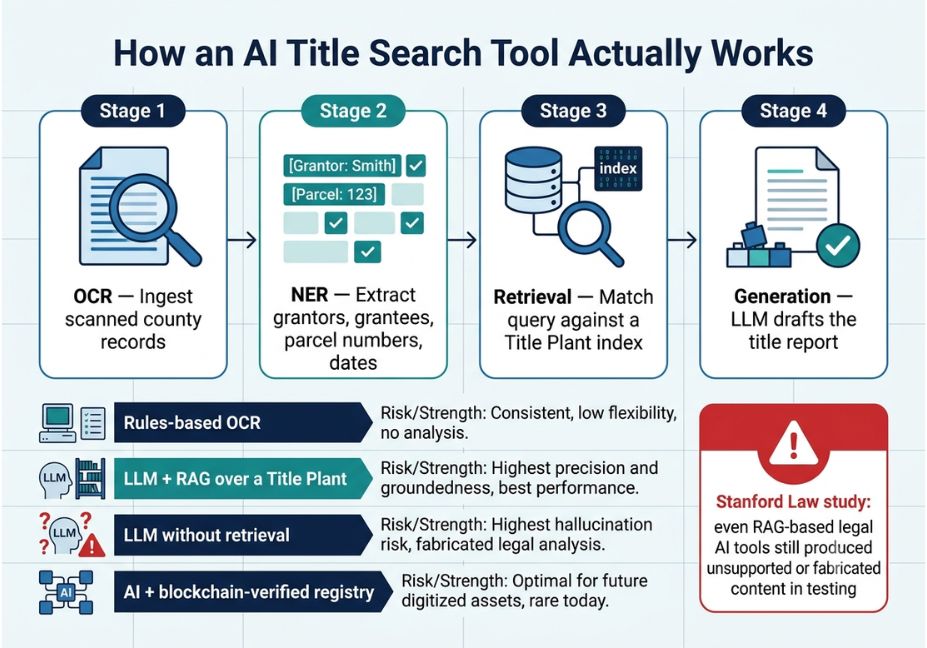
1. Ingestion and OCR. County records exist as scanned PDFs, microfilm exports, and inconsistent digital formats. Optical character recognition whether a purpose-built model or a general document-AI service like Google Document AI or Amazon Textract turns those images into machine-readable text. However, this is also the step where the industry’s biggest structural problem shows up first: record-keeping practices vary by jurisdiction, and many counties still index by party name rather than by parcel.
2. Named entity recognition (NER). The extracted text is parsed to pull out grantors, grantees, parcel numbers, dates, legal descriptions, and dollar amounts the raw entities a title examiner would normally circle by hand.
3. Retrieval. This is where retrieval-augmented generation comes in: rather than asking an LLM to “know” the property’s history, the system retrieves the specific recorded instruments relevant to the parcel using something close to a standard retrieval-augmented generation pipeline, where a query is embedded, matched against an indexed document store (often built on a title plant a proprietary, pre-indexed database of a county’s records), and the most relevant instruments are pulled back.
4. Generation and report assembly. The retrieved documents, plus the query, go to an LLM that assembles a structured title report: ownership chain, exceptions, and flagged defects.
Pro tip: If you’re evaluating a vendor, ask specifically whether their retrieval step runs against a title plant they’ve built and validated, or against raw, un-normalized county data pulled live. The former is dramatically more reliable it’s the difference between the retrieval-augmented generation architecture working against a clean index versus a messy one.
AI Title Search Use Cases: 4 Real-World Examples
- Same-day title clearance for real estate agents. Agents use AI tools to flag “deal-killer” liens or encumbrances at the moment a property is listed, rather than discovering them a week before closing.
- Chain-of-title reconstruction on complex parcels. For 30-plus-year ownership histories, AI-assisted extraction can compress a full day of manual document hunting into a few hours of structured results, with the examiner verifying rather than transcribing.
- Title fraud and wire fraud detection. Pattern-matching models scan for anomalies unusual name changes, suspicious deed timing, or duplicate filings that indicate identity theft or seller impersonation.
- Lender risk assessment. Instant, standardized property-status data lets lenders verify title status earlier in the mortgage pipeline instead of waiting on a sequential manual search.
What Are the Best AI Title Search Tools and Approaches?
Not all “AI title search” products use the same architecture, and the differences matter for accuracy. Therefore, before comparing vendors by price or turnaround time, it’s worth comparing them by pipeline design instead.
| Approach | How it works | Strength | Main risk |
|---|---|---|---|
| Rules-based automation + OCR | Extracts fields with fixed templates and regex/rules | Predictable, auditable | Brittle on non-standard document formats |
| LLM + RAG over a title plant | Retrieves indexed instruments, LLM assembles the report | Handles unstructured, varied records well | Retrieval quality depends entirely on index completeness |
| LLM without retrieval (raw generation) | Model answers from general knowledge/training data | Fast, cheap | Highest hallucination risk no grounding in actual records |
| AI + blockchain-verified registry | AI extraction feeds an immutable ledger of title status | Near real-time fraud alerts, high long-term accuracy | Still dependent on accurate initial data entry |
Did you know? One vendor combining AI extraction with a distributed-ledger registry has publicized a 99.5% accuracy target for automated closings but that figure describes the ledger-verification layer, not raw LLM output on unstructured source documents, which is a meaningfully different accuracy claim.
Step-by-Step: Evaluating or Implementing an AI Title Search Tool
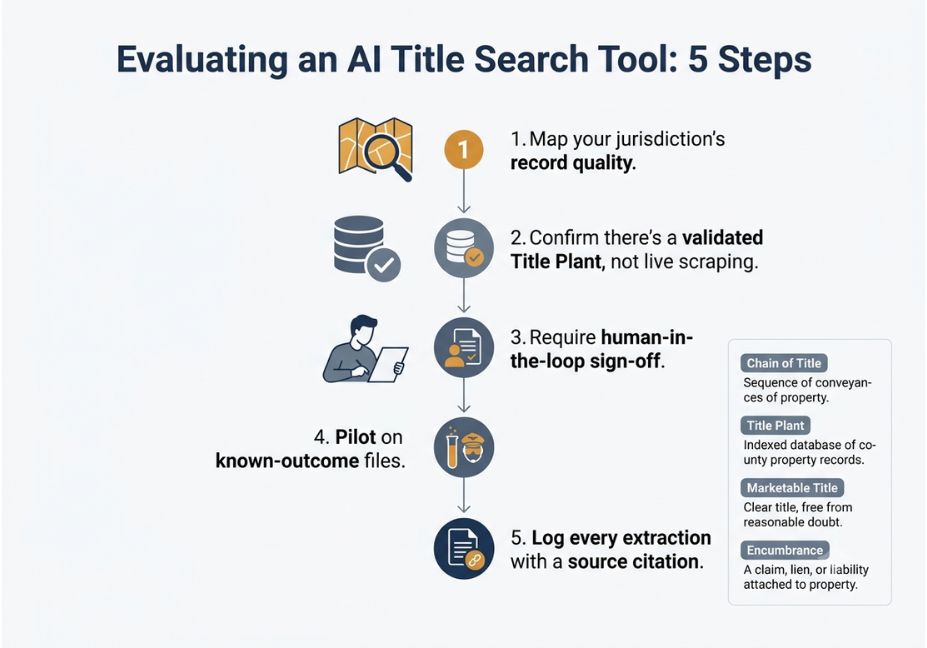
- Map your jurisdiction’s record quality first. Some counties have clean, parcel-indexed digital records; others are still name-indexed microfilm. Your realistic accuracy ceiling is set here, not by the AI vendor.
- Confirm there’s a title plant, not just live scraping. Ask whether retrieval happens against a validated, pre-built index.
- Require a human-in-the-loop sign-off step. No production tool should issue an insurable title opinion without examiner review of flagged exceptions.
- Pilot on a small batch of known-outcome files. Run the tool against title histories you’ve already manually cleared, and compare.
- Log every extraction with a source citation. Every fact in the generated report a lien amount, a grantor name should link back to the specific recorded instrument it came from, so an examiner can verify in seconds rather than re-searching from scratch.
# Simplified illustration of a retrieval step against a title plant index
def retrieve_instruments(parcel_id, query_embedding, title_plant_index, k=8):
    candidates = title_plant_index.similarity_search(
        query_embedding, filter={"parcel_id": parcel_id}, top_k=k

    return [c for c in candidates if c.metadata.get("recorded_date")]
Technical disclaimer: Retrieval implementations vary by vendor and framework version; the snippet above is illustrative of the pattern, not a production API. Always check current framework documentation before implementing.
Common Mistakes and How to Avoid Them
- Trusting AI output without a citation trail. A Stanford Law empirical study of AI legal research tools found that even RAG-based systems marketed as eliminating hallucinations still produced unsupported or fabricated content in a meaningful share of test queries the fix is requiring every generated claim to trace back to a specific document.
- Assuming AI fixes bad source data. AI does not resolve naming inconsistencies, fill structural gaps in county indexes, or connect related instruments on its own it can only extract and summarize what’s actually recorded, and unstructured public records were never designed as normalized, property-centric databases.
- Skipping the “missing information” case. When a document is silent on something (a redacted amount, a missing recital), generation models tend to fill the gap with a plausible-sounding answer instead of flagging it as unknown this is one of the more dangerous failure patterns in legal-document extraction generally, not unique to title work.
- Treating same-day turnaround as equivalent to insurability. Fast and cleared are not the same thing; an insurable title opinion still requires professional sign-off, and lenders selling loans into the secondary market to Fannie Mae or Freddie Mac will typically require it regardless of how the report was generated.
Overall, the safest mental model is this: AI shortens the search, not the standard of care. Regulators such as the CFPB have not carved out an exception for automated title work, so the underlying legal duty stays with the title company either way.
What Practitioners Are Saying
Industry discussion threads among title examiners are notably more skeptical than vendor marketing. A recurring theme: AI is good at finding and formatting records faster than a human can, but weak at catching errors the county’s own recording office introduced misfiled names, grantor/grantee index swaps, and similar clerical mistakes that require local knowledge to catch. The consensus among veteran examiners is less “AI vs. human” and more “AI as a first pass, human as the actual sign-off” a defensible middle ground for a domain where the underlying legal liability doesn’t move.
Related Terms You’ll See in an AI Title Report
Understanding these terms helps you read any AI-generated title report and any title report, period with a critical eye:
- Chain of title the sequential history of ownership transfers for a parcel.
- Title plant a pre-indexed, proprietary database of a county’s recorded documents, used for fast retrieval.
- Title defect / cloud on title any unresolved claim, lien, or discrepancy that could threaten clear ownership.
- Marketable title a title free enough of defects that a reasonable buyer would accept it.
- Encumbrance any lien, easement, or restriction that limits use of the property.
- Quitclaim deed a deed that transfers whatever interest the grantor has, with no ownership guarantee.
- Deed of trust a security instrument used in many states in place of a mortgage.
- County recorder / register of deeds the local office of record where deeds, liens, and judgments are filed.
- Title abstract a condensed written history of a property’s title, the traditional output of a manual search.
Consequently, when an AI tool generates a report, it’s really just automating the production of this same abstract faster, but built on the same underlying legal concepts.
Conclusion
The real story behind an AI real estate title search tool isn’t “AI replaces title examiners” it’s a fairly ordinary retrieval-augmented generation pipeline (OCR, entity extraction, indexed retrieval, LLM report generation) applied to a domain where source records are messy and the cost of an error is a legal one. The tools that hold up are the ones built on a validated title plant with a human sign-off step and a citation trail back to source documents, not the ones promising instant, unsupervised clearance. Bookmark this guide and explore more hands-on AI agent architecture breakdowns at agentiveaiagents.com.
FAQ People Also Ask
Can AI replace a title search company?
No. AI can automate document retrieval, OCR, and report drafting, but insurable title opinions still require a licensed examiner’s judgment, particularly for defect resolution and legal interpretation of ambiguous instruments.
How accurate is AI title search?
Accuracy depends heavily on whether retrieval runs against a validated title plant or raw county data, and on documented record quality. Vendor accuracy claims should be checked against the specific pipeline stage they describe, not treated as a single number.
What is a title plant, and why does AI need one?
A title plant is a pre-indexed, proprietary database of a county’s recorded documents. AI retrieval tools perform far better against a title plant than against live, unstructured records because the index is already normalized and searchable.
Can AI detect title fraud?
Yes, pattern-based models can flag anomalies like suspicious filing timing or identity mismatches, and this is one of the more mature, lower-risk AI applications in the space compared to full title clearance.
Does RAG eliminate hallucinations in title reports?
No. Retrieval grounds generation in real documents, which reduces but does not eliminate fabrication, especially when source records are incomplete or ambiguous.
One Response