
Most Shopify shops show conversion rates that range from 1.2% to 1.8% for every session. For digital stores, it’s a different matter. Since there is no shipping involved and no possibility of arrival damage, digital shops generally get a conversion rate from 2.5% to 6% which is more than twice the average rate for Shopify in general. So, why do some digital shops get a conversion value at the bottom of the scale while others are at the highest value? The reason is not traffic. It is how the AI tools deal with search issues and concerns from the customers.
What Is a Good Shopify Conversion Rate for Digital Products?
A good Shopify conversion rate for digital products is generally 2.5%–4%, with 6%+ achievable for stores with a loyal audience and a low-friction checkout. That said, a conversion rate benchmark is simply a reference point completed orders divided by sessions that helps a merchant judge whether performance is typical, weak, or exceptional for their category. According to Wikipedia’s definition of conversion rate optimization, it’s the systematic process of increasing the percentage of visitors who complete a desired action. For digital products, though, comparing against the platform-wide average is misleading, because digital goods behave structurally differently from physical inventory.
How Do Digital Product Conversion Rates Compare to the Shopify Average?
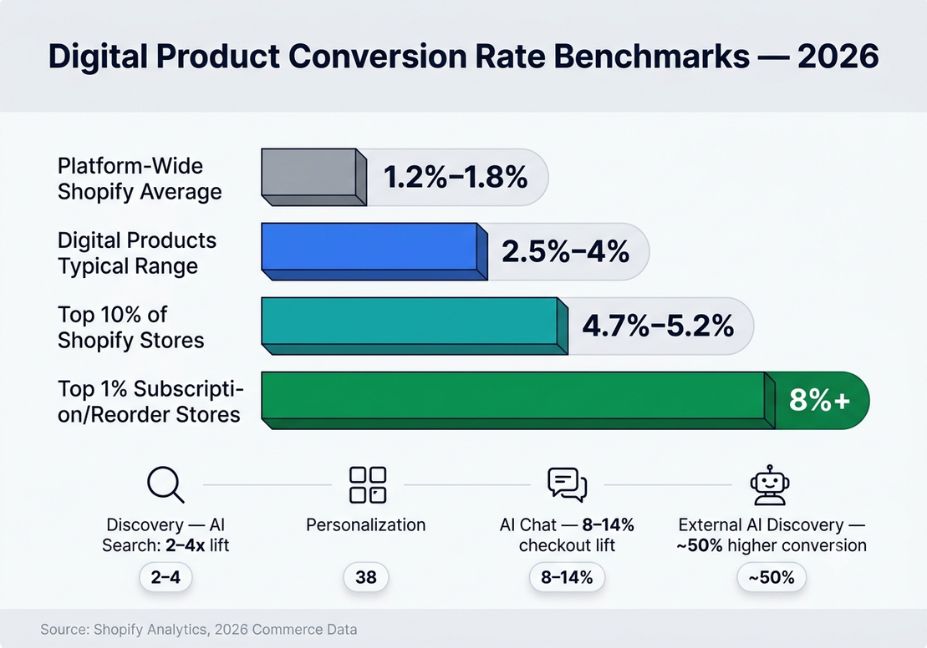
Digital products are consistently the highest-converting category in Shopify benchmark research. Here’s how the numbers stack up:
- Platform-wide average: 1.2%–1.8% of sessions
- Digital products: 2.5%–4% typical, 6%+ achievable
- Top 10% of all Shopify stores: 4.7%–5.2%
- Top 1% (subscription or reorder-heavy): 8%+
Did You Know? Digital products often convert 20–40% higher than the platform average, largely because there’s no shipping cost calculation and no “will this arrive on time” hesitation to overcome.
In short, friction is the enemy of conversion, and physical fulfillment is friction. Once you remove shipping cost, delivery estimates, and damage risk, the remaining objections are almost entirely about trust in the product itself which is exactly where AI tools now compete for merchants’ attention.
How Does AI Actually Improve Shopify Conversion Rate?
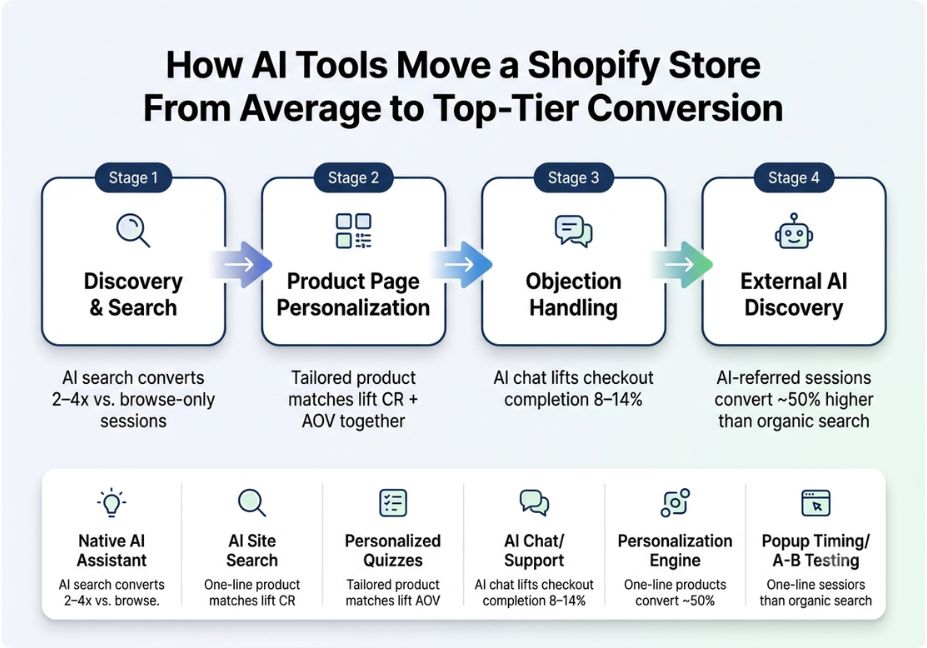
AI tools affect conversion rate at four distinct funnel stages. Treating them as one blob “AI increases conversion” is exactly why so many merchants can’t tell what’s actually working. Here’s the breakdown:
- Discovery and search. AI-powered site search understands synonyms and long-tail queries. As a result, shoppers who use on-site search convert at 2–4x the rate of pure browsers, making search quality one of the highest-leverage fixes available.
- Product page personalization. Recommendation engines tailor which digital product course, template, plugin, or ebook gets surfaced based on real browsing behavior, rather than showing the same bestseller list to every visitor.
- Objection handling. AI chat resolves pre-purchase questions live, instead of losing the customer to an unanswered FAQ gap.
- External AI discovery. Buyers arriving via AI assistants like ChatGPT, Gemini, or Perplexity already carry compressed intent. In fact, according to Shopify’s own Q1 2026 commerce data on AI-referred sessions, AI-referred product-page sessions convert nearly 50% higher than organic search sessions across most merchant categories tracked.
Architect’s Note: Don’t measure “AI performance” against your store-wide conversion rate. Instead, split sessions where an AI feature activated chat opened, recommendation clicked, quiz completed from sessions where it didn’t. That split is the only number that tells you whether the tool is paying for itself.
Best AI Tools for Digital Product Conversion Rate Comparison
| Tool Category | Example Tools | Funnel Stage | Typical Lift Reported |
|---|---|---|---|
| Native AI assistant | Shopify Magic / Sidekick | Copy, product descriptions | Time saved, not direct CR |
| AI site search | Boost Commerce, Searchanise | Discovery | 2–4x vs. browse-only sessions |
| Personalized quizzes | Octane AI | Product matching | Lifts CR and AOV together |
| AI chat / support | Gorgias, storefront chatbots | Objection handling | 8–14% checkout completion lift |
| Personalization engine | Nosto, LimeSpot | PDP + category pages | 15–30% CR lift on Plus-tier stores |
| Popup timing / A-B testing | Alia | List growth + conversion | Higher opt-in vs. static popups |
Pro Tip: If your digital product store earns under $1M/year, start with AI search and an AI chat widget before investing in an enterprise personalization platform. These two tools address the highest-frequency drop-off points can’t find it, can’t get a question answered at the lowest setup cost.
How Do You Benchmark and Improve Your Own Conversion Rate?
- Pull your real number first. Shopify’s own guidance on how conversion rate is calculated confirms it uses sessions, not unique visitors meaning a single high-intent visitor with two sessions and one order shows as a 50% rate.
- Segment before comparing. Split desktop vs. mobile, new vs. returning, and paid vs. organic traffic before comparing your number to any benchmark table.
- Isolate AI-touched sessions. Use custom segments in Shopify Analytics or Google Analytics 4 to separate AI-influenced sessions from the rest.
- Fix the highest drop-off step first not the easiest one. Cart abandonment research from the Baymard Institute has tracked checkout abandonment averaging well above 60% across e-commerce broadly, so checkout friction is usually a bigger lever than homepage design.
- Run one AI tool at a time. Otherwise, you can’t attribute the lift correctly you’ll just be stacking changes and guessing which one worked.
What Mistakes Should You Avoid?
- Benchmarking against the platform-wide 1.4% average instead of the digital-goods segment. This mistake makes a genuinely healthy digital product store look like it’s underperforming.
- Installing multiple AI apps at once (“tool sprawl”). This makes it nearly impossible to isolate which tool actually drove a change, and it often slows the store down.
- Treating a very high conversion rate as automatically good. A rate above 7–8% can sometimes signal bot traffic counted in sessions but filtered from orders, so it’s worth verifying with a second analytics source like GA4 before celebrating.
- Ignoring mobile as a separate segment. Mobile conversion rates typically run 20–40% lower than desktop, so blending the two hides where the real leak is.
What Are Store Owners Saying About AI Tools?
Merchant discussion around AI tooling on Shopify has shifted from “should I use AI” to “which AI feature is actually worth the subscription.” Across case studies and forum threads, one theme keeps repeating: AI chat and AI search show up in nearly every reported win, while broad “AI personalization” platforms show far more variance strong for large catalogs, marginal for small ones.
Conclusion
Digital products already start from a structural advantage no shipping, no delivery anxiety which puts the realistic benchmark at 2.5%–6%, not the platform-wide 1.2%–1.8%. That said, the stores hitting the top of that range aren’t relying on one big AI feature. Instead, they’re using AI search to fix discovery, AI chat to resolve objections in real time, and targeted personalization once their catalog is large enough to justify it. Benchmark against the digital-goods segment, isolate AI-touched sessions before crediting any tool, and fix checkout friction before chasing a new app. Bookmark this guide and check back as 2026 benchmark data updates.
Frequently Asked Questions (People Also Ask)
What is a good Shopify conversion rate for digital products?
2.5%–4% is typical for digital products, with 6%+ achievable for stores with a strong audience and low-friction checkout well above the platform-wide average of 1.2%–1.8%.
How is Shopify conversion rate calculated?
Shopify divides total orders by total sessions, not unique visitors, and labels this metric “Online store conversion rate” inside Shopify Analytics.
Do AI tools actually improve conversion rate?
Yes, but the effect depends on which funnel stage the tool targets. AI search and chat tools show the most consistent lift, while broad personalization platforms perform best on larger catalogs.
What’s the difference between average and top-performer benchmarks?
The average blends every store regardless of maturity, including abandoned or broken stores. Top-performer benchmarks, by contrast, reflect stores actively optimizing each funnel stage — a far more useful comparison.
Does mobile traffic lower digital product conversion rates?
Yes. Mobile sessions typically convert 20–40% lower than desktop, even for digital products, usually because of checkout friction rather than a lack of product interest.