
Artificial intelligence has moved well beyond simple chatbots and predictive analytics. Modern organizations now expect AI to automate repetitive work, assist employees with complex decision-making, analyze massive datasets, and continuously improve business operations. As companies race toward digital transformation, platforms like Drovenio AI for Business are attracting attention for their ability to streamline workflows while reducing operational costs.
Rather than functioning as a standalone AI assistant, Drovenio AI aims to become part of an organization’s daily operations. It combines intelligent automation with data analysis, document processing, workflow optimization, and AI-assisted decision support. This makes it particularly valuable for organizations seeking to improve efficiency without replacing existing software investments.
The rapid evolution of Large Language Models (LLMs) has further accelerated demand for AI-powered business platforms. Technologies developed by OpenAI, Anthropic, and Google have demonstrated that AI can understand context, summarize information, generate reports, and assist with knowledge-intensive tasks. Businesses are now looking for platforms capable of integrating these capabilities into existing operational workflows.
However, selecting an enterprise AI platform involves much more than comparing feature lists. Decision-makers must evaluate scalability, security, integration capabilities, governance, compliance, and long-term return on investment. Understanding where Drovenio AI fits within this broader AI ecosystem is essential before making strategic adoption decisions.
The following sections examine how Drovenio AI works, the business problems it solves, and why it has become part of the broader conversation around enterprise AI adoption.
What Is Drovenio AI for Business?
Drovenio AI for Business is an AI-driven business productivity platform designed to help organizations automate operational tasks, improve decision-making, and increase workforce efficiency through intelligent automation.
Unlike traditional automation software that relies on predefined rules, AI-powered business platforms use machine learning and natural language processing to interpret information, understand user intent, and generate context-aware responses. This allows businesses to automate processes that previously required human judgment.
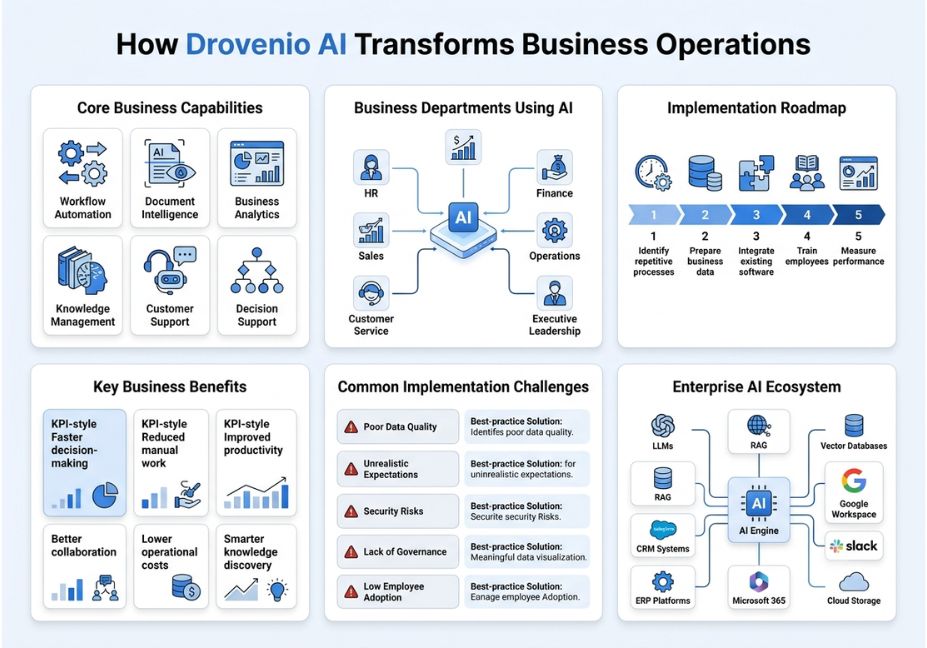
Typical capabilities include:
• Document summarization
• Customer support assistance
• Knowledge management
• Internal search
• Business analytics
• Report generation
• Task prioritization
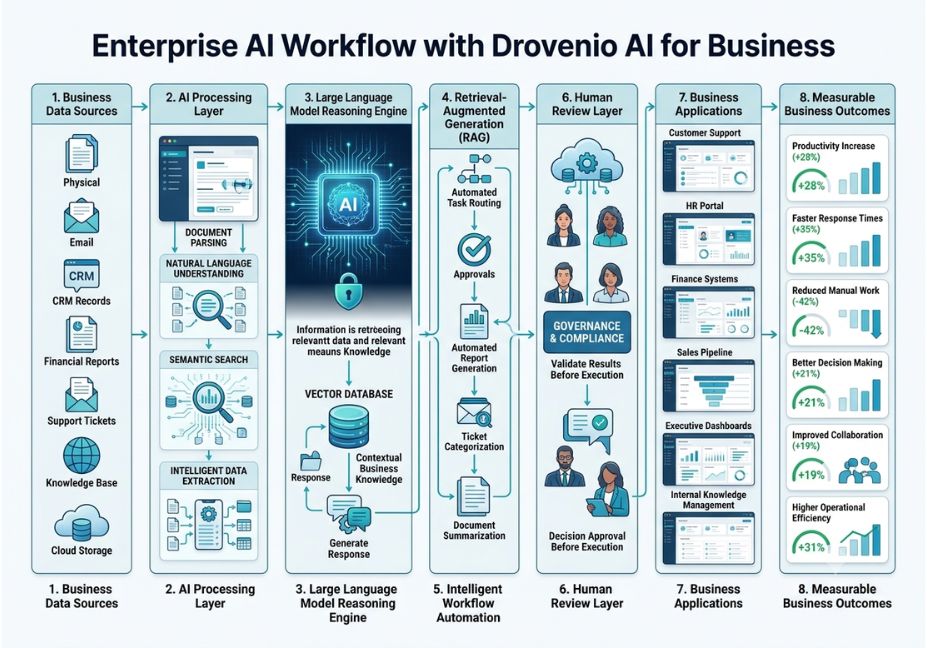
As enterprise AI matures, many organizations are also combining these capabilities with Retrieval-Augmented Generation (RAG) systems and vector databases. These technologies allow AI systems to retrieve accurate information from internal knowledge bases before generating responses, improving reliability and reducing hallucinations.
For businesses managing large volumes of documentation or customer interactions, this approach significantly enhances the quality of AI-generated outputs while maintaining access to up-to-date organizational knowledge.
How Drovenio AI Supports Modern Business Operations
Businesses generate enormous amounts of information every day. Emails, contracts, support tickets, financial reports, CRM records, meeting notes, and operational documentation all contain valuable insights. Unfortunately, employees often spend more time searching for information than acting on it.
Drovenio AI addresses this challenge by helping organizations transform fragmented information into actionable intelligence.
Key operational benefits include:
• Automating repetitive administrative tasks
• Accelerating document processing
• Improving employee productivity
• Reducing manual errors
• Supporting faster decision-making
• Enhancing collaboration across departments
• Simplifying knowledge discovery
For example, instead of manually reviewing hundreds of customer support tickets, an AI-powered workflow can automatically categorize issues, summarize conversations, identify urgent requests, and recommend appropriate responses. Employees then spend their time resolving complex problems rather than sorting data.
Similarly, finance departments can use AI-assisted document analysis to process invoices, detect inconsistencies, and generate financial summaries, reducing the time required for routine accounting tasks.
These capabilities become even more valuable when integrated into existing enterprise systems such as customer relationship management platforms, enterprise resource planning software, and cloud collaboration tools.
Core Features of Drovenio AI for Business
Although feature availability depends on deployment configuration, most enterprise AI platforms focus on several core capabilities that improve operational efficiency.
Intelligent Workflow Automation
Business workflows often involve repetitive approval processes, manual data entry, document routing, and status tracking. AI can automate these activities by recognizing patterns, extracting relevant information, and initiating predefined actions.
Instead of relying solely on static workflow rules, intelligent automation adapts to changing business contexts, making automation more flexible and scalable.
AI-Powered Document Intelligence
Organizations store thousands of documents across multiple departments. Searching manually for policies, contracts, technical documentation, or project files wastes valuable employee time.
Document intelligence enables AI to:
• Extract key information
• Generate concise summaries
• Answer questions about documents
• Identify missing information
• Recommend related resources
When combined with semantic search techniques, employees can retrieve relevant information based on meaning rather than exact keyword matches.
Business Analytics and Insights
Enterprise AI platforms increasingly support real-time analytics by examining operational data from multiple business systems.
Instead of presenting raw dashboards, AI can explain trends in plain language, identify unusual patterns, forecast potential risks, and recommend actions based on historical performance.
For executives, this reduces the time required to interpret complex reports while supporting more informed strategic planning.
Real-World Use Cases of Drovenio AI for Business
The true value of Drovenio AI lies in how it solves practical business challenges across departments. Instead of replacing employees, it augments their capabilities by handling repetitive work, surfacing insights, and accelerating decision-making.
1. Customer Support Automation
Customer service teams often deal with repetitive inquiries, ticket categorization, and response drafting. Drovenio AI can automate these tasks while ensuring agents have the right context before responding.
Benefits include:
- Faster response times
- Consistent customer interactions
- Automatic ticket routing
- AI-generated response suggestions
- Reduced workload for support agents
Pro Tip: AI should assist not replace human agents for complex or sensitive customer interactions.
2. Sales and CRM Intelligence
Sales representatives spend significant time updating CRM systems, preparing meeting summaries, and following up with leads.
Drovenio AI can help by:
- Summarizing customer meetings
- Generating follow-up emails
- Identifying high-value prospects
- Predicting sales opportunities
- Recommending next best actions
This enables sales teams to spend more time building relationships rather than performing administrative tasks.
3. Human Resources
HR departments manage resumes, employee records, onboarding documents, and policy information.
AI can automate:
- Resume screening
- Candidate matching
- Employee onboarding
- Internal policy search
- Performance review summaries
Organizations adopting AI in HR often reduce administrative overhead while improving employee experiences.
4. Finance Operations
Finance teams process invoices, expense reports, and compliance documents every day.
Drovenio AI can:
- Extract invoice data
- Detect duplicate payments
- Flag anomalies
- Generate financial summaries
- Assist with compliance documentation
Rather than replacing accountants, AI helps them focus on financial analysis and strategic planning.
5. Internal Knowledge Management
Many organizations struggle with scattered documentation stored across cloud drives, emails, and collaboration platforms.
AI-powered knowledge management enables employees to ask natural language questions such as:
“What was our cybersecurity policy updated last quarter?”
Instead of searching through dozens of folders, AI retrieves the most relevant information almost instantly.
Did You Know? Studies suggest that knowledge workers spend a significant portion of their workweek searching for information. AI-powered enterprise search can dramatically reduce this time, improving productivity.
Drovenio AI Compared with Other Business AI Platforms
Choosing an AI platform depends on business goals, existing infrastructure, customization needs, and security requirements.
| Feature | Drovenio AI | ChatGPT Enterprise | Microsoft Copilot | Google Gemini for Workspace |
|---|---|---|---|---|
| Workflow Automation | Excellent | Moderate | Excellent | Good |
| Document Analysis | Excellent | Excellent | Good | Good |
| Enterprise Integration | Strong | Moderate | Excellent | Excellent |
| Knowledge Search | Strong | Moderate | Good | Good |
| AI Content Generation | Strong | Excellent | Excellent | Excellent |
| Business Analytics | Strong | Moderate | Good | Good |
| Internal Automation | Excellent | Moderate | Excellent | Good |
| Custom AI Workflows | Good | Moderate | Good | Moderate |
No single platform is universally superior. Organizations should evaluate integration capabilities, governance features, scalability, pricing, and support before making a decision.
How to Implement Drovenio AI in Your Business
Successful AI adoption requires careful planning rather than simply deploying new softwareStep 1: Identify High-Impact Processes
Look for repetitive tasks such as:
- Data entry
- Document review
- Email processing
- Customer support
- Report generation
These often provide the fastest return on investment.
Step 2: Prepare Business Data
AI performs best with clean, organized, and accessible data.
This includes:
- Documentation
- FAQs
- Knowledge bases
- CRM records
- Internal policies
- Operational manuals
Poor data quality often leads to poor AI performance.
Step 3: Integrate Existing Systems
Most businesses already use multiple software platforms.
Typical integrations include:
- CRM systems
- ERP platforms
- Microsoft 365
- Google Workspace
- Slack
- Microsoft Teams
- Cloud storage
Connecting these systems allows AI to work within existing workflows rather than creating isolated processes.
Step 4: Train Employees
Technology adoption succeeds when employees understand how to use it effectively.
Training should include:
- Prompt writing
- AI limitations
- Security practices
- Human review processes
- Responsible AI usage
Organizations that invest in user education typically achieve better long-term results.
Step 5: Measure Performance
Track measurable business outcomes such as:
- Hours saved
- Cost reduction
- Employee productivity
- Customer satisfaction
- Response times
- Error rates
Continuous monitoring helps identify opportunities for further optimization.
Example AI Workflow
Below is a simplified example showing how AI could automate document summarization using a Large Language Model API.
from openai import OpenAI

client = OpenAI()

response = client.responses.create(
    model="gpt-4.1",
    input="Summarize this quarterly financial report into five key insights."


print(response.output_text)
This simple example demonstrates how organizations can integrate AI-generated summaries into internal reporting workflows. In production environments, additional safeguards such as authentication, logging, validation, and human review should be implemented.
Technical Disclaimer: AI frameworks and APIs evolve rapidly. Always refer to the latest official documentation for your chosen provider before deploying production systems.
Common Challenges and How to Avoid Them
While AI platforms offer significant advantages, implementation challenges are common.
Poor Data Quality
AI depends on accurate and well-structured information.
Solution: Clean and organize enterprise data before deployment.
Unrealistic Expectations
AI is not a replacement for experienced professionals.
Solution: Use AI as a decision-support tool rather than a fully autonomous system.
Security Risks
Enterprise AI often processes sensitive business information.
Solution:
- Implement role-based access control
- Encrypt sensitive data
- Monitor AI activity
- Follow compliance requirements
Lack of Governance
Without governance, AI-generated outputs may become inconsistent or unreliable.
Solution: Establish clear policies for model usage, validation, and human oversight.
Ignoring Employee Adoption
Even the best AI platform fails if employees resist using it.
Solution: Provide training, gather feedback, and demonstrate clear productivity benefits.
The Future of AI-Powered Business Platforms
Enterprise AI is rapidly evolving from simple automation tools into intelligent systems capable of reasoning, planning, and coordinating complex tasks.
Several emerging trends are shaping the future:
- AI agents that perform multi-step workflows
- Retrieval-Augmented Generation (RAG) for enterprise knowledge access
- Natural language interfaces for business applications
- AI copilots integrated into everyday software
- Predictive analytics powered by Large Language Models
- Personalized decision support for employees
Organizations that adopt AI strategically today will be better positioned to compete in increasingly data-driven markets.
Frequently Asked Questions
What is Drovenio AI for Business?
Drovenio AI for Business is an AI-powered platform designed to improve productivity through workflow automation, document analysis, business intelligence, and AI-assisted decision-making.
How does Drovenio AI help businesses?
It automates repetitive tasks, improves document processing, supports data analysis, enhances collaboration, and enables employees to access organizational knowledge more efficiently.
Is Drovenio AI suitable for small businesses?
Yes. Small and medium-sized businesses can benefit by automating administrative work, improving customer service, and reducing operational costs without requiring large IT teams.
Can Drovenio AI automate business workflows?
Yes. It can automate approvals, document routing, customer support processes, report generation, and many other repetitive workflows while integrating with existing business software.
Is Drovenio AI secure for enterprise use?
Enterprise AI platforms typically include security features such as encryption, authentication, role-based access controls, and compliance support. Organizations should verify the specific security capabilities and deployment options before implementation.
How does Drovenio AI compare with ChatGPT?
ChatGPT focuses primarily on conversational AI and content generation, while Drovenio AI emphasizes business workflow automation, enterprise productivity, and operational efficiency. The best choice depends on organizational requirements and integration needs.
Conclusion
Artificial intelligence is becoming a core component of modern business operations, and platforms like Drovenio AI for Business illustrate how organizations can move beyond simple automation toward intelligent, data-driven workflows. By combining document intelligence, workflow automation, business analytics, and AI-assisted decision-making, businesses can reduce repetitive work while enabling employees to focus on higher-value activities.
However, successful implementation requires more than deploying new software. Organizations should invest in clean data, employee training, governance, and continuous performance measurement to maximize long-term value.
Explore more practical AI, LLM, RAG, and agentic workflow guides on agentiveaiagents.com to stay ahead of the latest developments in enterprise artificial intelligence.
4 Responses