

Most AI agents don’t fail because the model is weak. They fail because nobody built a repeatable way to catch a bad tool call, a hallucinated citation, or a broken retrieval step before it reached production. That’s the gap AI assessment tools exist to close. In short, this is a very different problem from the one solved by classroom quiz generators or hiring-screener software that also happen to share the label “AI assessment.”
For teams shipping agents built on LangChain, LlamaIndex, or raw function calling, “assessment” means something specific: structured, repeatable measurement of whether an AI system’s outputs are faithful, relevant, safe, and correctly sequenced. As a result, this guide breaks down the metrics taxonomy, the leading AI evaluation frameworks for LLM agents, and a working implementation pattern you can drop into CI/CD today.
What Are AI Assessment Tools? (Direct Answer)
AI assessment tools are systems that score an AI application’s outputs and often its intermediate steps — against structured metrics such as faithfulness, relevance, and safety, instead of relying on manual spot-checks. Unlike traditional software tests, which check for one deterministic correct answer, AI assessment tools handle non-deterministic outputs: the same input can produce a different response each time, so quality has to be measured, not just verified.
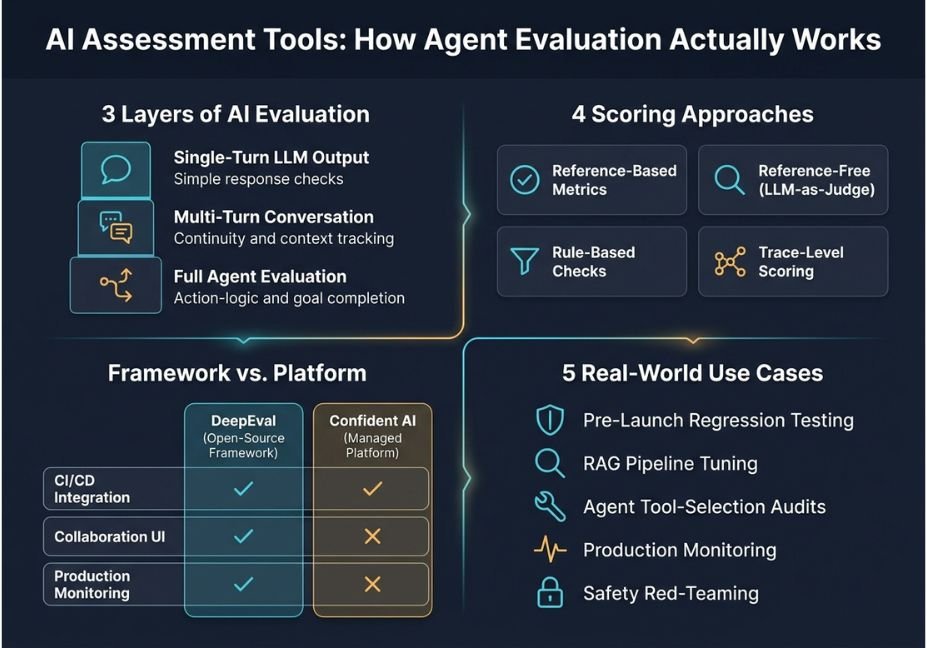
Consequently, evaluation splits into three layers: single-turn LLM outputs, multi-turn conversations, and full agent evaluation, which scores every step of an agent’s run including tool calls, planning, and retrieval rather than just the final answer.
How Do AI Evaluation Tools for LLM Agents Actually Work?
Under the hood, most tools follow the same basic architecture: an application produces an output or trace, a scoring layer applies one or more metrics to it, and the results get logged against a baseline for comparison.
Common scoring approaches include:
- Reference-based metrics compare output against a known-correct answer; useful for RAG factual-accuracy checks
- Reference-free metrics use an LLM-as-judge to score faithfulness, relevance, or toxicity without a ground truth
- Rule-based checks regex, schema validation, or PII detectors for deterministic constraints
- Trace-level scoring evaluate individual spans in an agent’s execution, since a wrong tool call early in the run corrupts everything downstream
Agents built around a tool-use loop the interleaved reasoning-then-action pattern popularized by the ReAct pattern for interleaving reasoning and tool calls are harder to assess than single-turn chat. This is because a failure can originate several steps before it becomes visible in the final response. Therefore, agent-specific evaluation tools score each span independently rather than grading only the last message.
Did You Know? Confident AI’s 2026 agent-evaluation research frames a wrong tool call at step two as corrupting every step that follows comparable to checking a patient’s temperature after surgery and calling it a full diagnosis.
What Are the Best Use Cases for AI Assessment Tools?
1. Pre-launch regression testing. Teams write evaluation suites that run in CI/CD, blocking a deploy if a prompt change drops faithfulness scores below a set threshold.
2. RAG pipeline tuning. Chunking strategy and embedding-model choice get benchmarked against retrieval-accuracy metrics before a vector store goes into production.
3. Agent tool-selection audits. Multi-step agents get scored on whether they picked the correct tool and passed the correct parameters — not just whether the final answer sounded plausible.
4. Production monitoring. Live traffic gets sampled and scored continuously, which surfaces hallucination or safety regressions that only appear at scale.
5. Compliance and safety red-teaming. Adversarial test suites probe for prompt injection, PII leakage, and toxic outputs before an agent gets customer-facing access.
Now that you understand how the evaluation loop works, let’s look at which AI assessment tools practitioners are actually reaching for in 2026.
What Are the Best AI Assessment Tools for LLM Apps and Agents?
The field splits cleanly into two categories: open-source evaluation frameworks you run in code, and managed platforms that add dashboards, collaboration, and production observability on top of them.
| Tool | Type | Best For | Agent Support | UI / Collaboration |
|---|---|---|---|---|
| DeepEval | Open-source (Python) | pytest-native CI/CD testing | Strong — tool selection, planning metrics | No native UI |
| Confident AI | Managed platform | Cross-functional teams, production-to-eval pipelines | Strong — per-span agent scoring | Yes |
| Ragas | Open-source | RAG-specific retrieval accuracy | Limited (RAG-only) | No |
| Langfuse | Open-source observability | Tracing plus lightweight eval | Moderate | Yes (self-hosted) |
| Promptfoo | Open-source CLI | Red-teaming and prompt regression | Moderate | CLI-first |
Pro Tip: If your team already lives in pytest, start with an open-source framework like the open-source DeepEval framework on GitHub before adopting a managed platform. That way, you’ll learn which metrics actually matter for your use case before paying for dashboards.
Technical Disclaimer: Framework versions evolve rapidly. Code examples in this article reflect DeepEval and LangChain APIs as of mid-2026. Always check the official docs for the latest interface.
How Do You Build an Evaluation Pipeline for an AI Agent? (Step-by-Step)
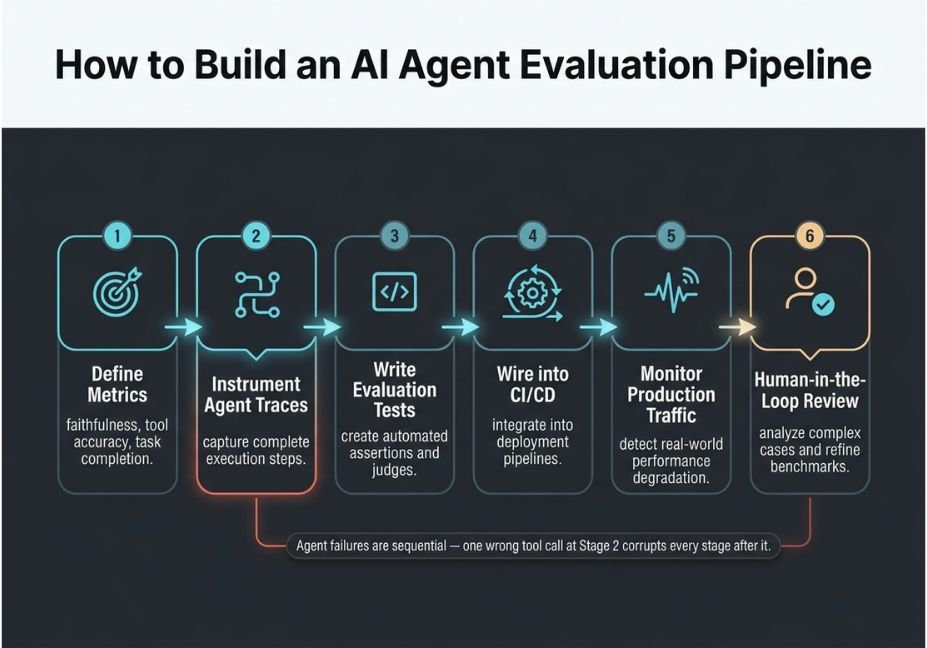
1. Define the metrics that map to real failure modes. Rather than starting with a generic “quality score,” pick faithfulness, tool-selection accuracy, and task completion for agents, or faithfulness and contextual relevancy for retrieval-augmented generation.
2. Instrument your agent to emit traces. You need the intermediate reasoning steps and tool calls not just the final output in order to score agent-specific failure modes.
3. Write evaluation tests as code:
python
from deepeval import assert_test
from deepeval.metrics import ToolCorrectnessMetric, FaithfulnessMetric
from deepeval.test_case import LLMTestCase

def test_agent_tool_selection:
    test_case = LLMTestCase
        input="What's the refund status for order #4471?",
        actual_output=agent_response,
        tools_called=agent_trace.tools_called,
        expected_tools=["lookup_order_status"]

    tool_metric = ToolCorrectnessMetric(threshold=0.8)
    faithfulness_metric = FaithfulnessMetric(threshold=0.7)
    assert_test(test_case, [tool_metric, faithfulness_metric])
4. Wire evaluation into CI/CD. Every pull request that touches a prompt, tool definition, or retrieval config should run the suite and block merges on regressions.
5. Sample and score production traffic. Because offline test sets never cover everything real users say, continuous production monitoring catches drift that pre-launch tests miss.
6. Route ambiguous or high-stakes cases to human review. LLM-as-judge scoring is fast but imperfect, so keep a human-in-the-loop review lane for anything above a risk threshold.
What Mistakes Should You Avoid When Assessing AI Agents?
- Scoring only the final output. For agents, this misses tool-call and planning failures entirely, so instrument trace-level scoring instead.
- Using one generic “quality” metric for everything. Because faithfulness, relevance, and safety are different failure modes, conflating them hides which one actually broke.
- Skipping a human baseline. LLM-as-judge metrics need periodic calibration against human annotations, otherwise false positives creep in unnoticed.
- Treating evaluation as a one-time, pre-launch step. Since model updates, prompt tweaks, and data drift all shift performance, evaluation needs to run continuously, not once.
- Ignoring the context window budget. Long agent traces can exceed a judge model’s context window, which silently truncates what gets scored so check this before trusting a metric.
What Are Developers Saying About AI Evaluation Tools?
Discussion threads on r/LocalLLaMA and GitHub issue trackers for these frameworks consistently return to the same tension: open-source libraries like Ragas and DeepEval give engineering teams full control and no vendor lock-in, while teams that need product managers or QA to participate in evaluation without writing code tend to migrate toward managed platforms once they scale past a single team. Similarly, research groups such as Google DeepMind and Anthropic have both published internal evaluation frameworks, underscoring that structured AI assessment is now standard practice at frontier labs, not just a startup concern.
Frequently Asked Questions
What are AI assessment tools?
AI assessment tools are systems that score the outputs and intermediate steps of an AI application an LLM response, a RAG pipeline, or an agent’s full execution trace against structured metrics like faithfulness, relevance, and safety, instead of relying on manual spot-checks.
How do you evaluate an AI agent’s performance?
You evaluate an agent by scoring each step of its execution, not just the final answer whether it selected the correct tool, passed the right parameters, retrieved relevant context, and completed the user’s task using metrics designed for sequential, multi-step failure modes.
What’s the difference between an AI evaluation framework and an AI evaluation platform?
A framework like DeepEval or Ragas is a code library you run locally or in CI/CD, while a platform like Confident AI adds a shared dashboard, collaboration, dataset versioning, and production monitoring on top of that same underlying metric layer.
Are open-source AI evaluation tools free to use?
Yes. Frameworks like DeepEval, Ragas, and Langfuse’s self-hosted option are free and open-source, although managed cloud platforms built on top of them typically charge for collaboration, hosting, and production observability features.
What metrics matter most when testing AI agents?
Tool-selection accuracy, task completion, faithfulness, and contextual relevancy matter most for agents, because a wrong tool call or hallucinated retrieval early in a run tends to corrupt every step that follows.
Can non-engineers run AI evaluations?
On code-first frameworks, generally not but several managed platforms now let product managers, QA, and domain experts run evaluations through a UI or HTTP interface without writing test code themselves.
What is the best AI assessment tool for evaluating AI agents in 2026?
There isn’t a single best tool for every team; instead, the right choice depends on whether you need a lightweight, code-based framework like DeepEval or a full collaborative platform like Confident AI for cross-functional production monitoring.
Conclusion
Evaluating an AI agent is fundamentally different from testing traditional software, because the same input can produce a different and sometimes wrong output every time. The practitioners getting this right treat AI assessment tools as infrastructure, not a pre-launch checkbox: they pick metrics tied to real failure modes, instrument agent traces at the span level, and run evaluation continuously through CI/CD and production monitoring, rather than just once before shipping.
Ultimately, whether you start with an open-source framework or a managed platform depends on team size and how much collaboration you need outside engineering but the underlying discipline stays the same either way. Bookmark this guide and explore more hands-on AI agent tutorials at agentiveaiagents.com.