
Most “AI insurance quote generator” lists are, frankly, just renamed form builders wearing a chatbot skin. That distinction matters if you’re evaluating these tools as a builder rather than a shopper. A real quoting agent runs a tool-use loop: it parses intake, retrieves applicable rate data, calls a rating engine as a function, and returns structured output that a human or downstream system can act on. A form that simply emails a PDF to an underwriter is not that, no matter what the landing page calls it.
Consequently, this guide sorts real AI insurance quote generator tool names into the categories that actually determine how they behave in production. Along the way, it covers the architecture each category implements or fakes plus what independent agents, brokers, and insurtech builders are asking most often, including “what’s the best AI tool to get an insurance quote instantly” and “how do I build an AI insurance quoting agent for my agency.”
What Is an AI Insurance Quote Generator? (Featured Snippet Answer)
An AI insurance quote generator is a software agent that takes structured or conversational input about a client’s risk profile and outputs a priced insurance quote automatically. The strongest versions use retrieval-augmented generation to pull current carrier rules and rate tables, then hand off pricing to a deterministic rating engine rather than letting the language model calculate the price itself.
How Does It Actually Work? Architecture Behind the Name
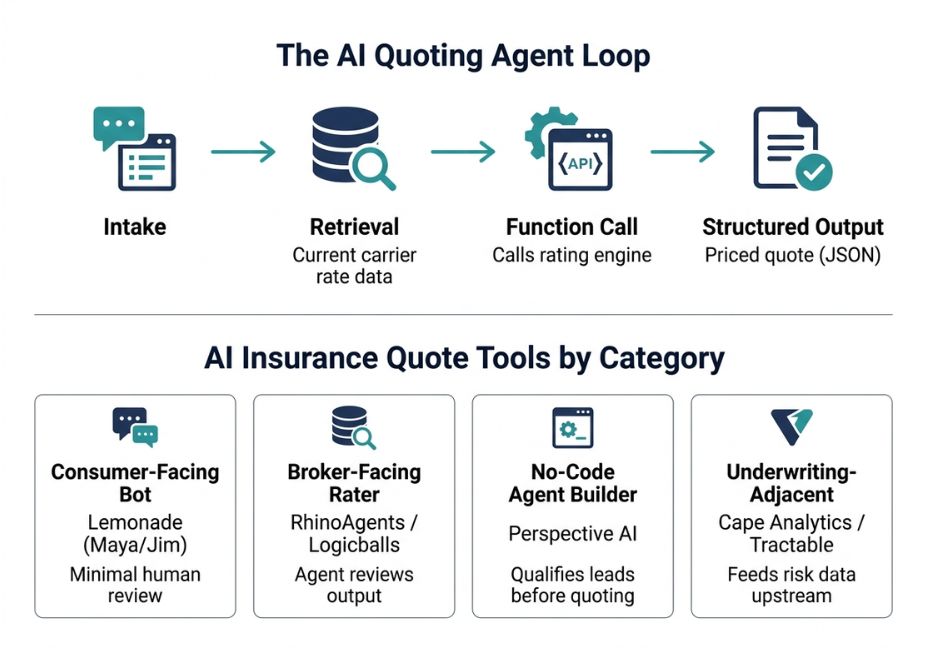
Underneath the marketing copy, a genuine quoting agent runs four stages. Understanding them is the fastest way to tell a real agent from a rebranded form:
- Intake conversational or form-based collection of applicant data
- Retrieval pulling carrier eligibility rules and rate tables relevant to that risk profile, where RAG + rating accuracy matters most
- Function call invoking a comparative rater or carrier API with structured parameters
- Structured output returning a priced quote, not free-text prose, so it can populate a CRM or binder
Pro Tip: If a vendor can’t show you what happens between “user submits form” and “quote appears,” assume step 3 is a human in a back office, not a function call.
Here’s what stage 3 looks like when built with structured function calling:
python
tools =
    "name": "get_quote",
    "description": "Call the carrier rating engine with applicant risk data",
    "parameters":
        "type": "object",
        "properties":
            "coverage_type": {"type": "string"},
            "zip_code": {"type": "string"},
            "risk_factors": {"type": "object"}

        "required": ["coverage_type", "zip_code", "risk_factors"]


response = client.messages.create(
    model="claude-sonnet-4-6",
    tools=tools,
    messages=[{"role": "user", "content": user_intake_summary}]
This is the same tool-use loop architecture used in general-purpose agent frameworks. In other words, the insurance-specific part is really just the schema and the data sitting behind get_quote.
AI Insurance Quote Generator Tool Names Real Examples by Category
Not every tool on a “best AI insurance tools” list does the same job. Splitting them by what they actually automate makes the names easier to evaluate and easier to search for if you’re looking for an AI insurance quote generator for independent agents specifically, rather than a consumer app.
Consumer-facing quote bots generate a bindable quote directly for an end customer. Lemonade’s Maya intake bot and Jim claims bot are the reference case here. However, this stack is proprietary to Lemonade as a direct carrier and isn’t licensed out to independent agents.
Broker- and agent-facing rating tools, by contrast, sit between the agent and multiple carriers. RhinoAgents’ AI Insurance Quote Generator and Logicballs’ Quote Generator Pro both take agent-entered client criteria and cross-reference it against a rate database rather than quoting the public directly. Similarly, Patra’s Quote Compare AI generates side-by-side comparisons for brokers and MGAs handling commercial lines.
No-code agent builders aren’t quoting tools themselves instead, they’re the layer agencies use to build one. Perspective AI, for example, focuses on replacing static “Get a Quote” forms with a qualifying conversational flow before a lead ever reaches a producer. Strada Workflows and similar platforms let agencies wire up their own intake-to-quote automation without custom engineering.
Underwriting-adjacent AI, meanwhile, doesn’t generate the quote itself but feeds the risk data the quote depends on. Cape Analytics (property risk via geospatial imagery), Tractable (vehicle damage assessment), and Shift Technology (fraud signals) all sit upstream of the pricing step a distinction organizations like the NAIC have increasingly focused on as regulators draw lines between pricing AI and risk-assessment AI.
| Tool | Category | What It Automates | Human-in-loop? |
|---|---|---|---|
| Lemonade (Maya/Jim) | Consumer-facing bot | Full quote-to-bind for direct consumers | Minimal |
| RhinoAgents AI Quote Generator | Broker-facing rater | Multi-product quote generation from agent input | Agent reviews output |
| Logicballs Quote Generator Pro | Broker-facing rater | Client-criteria-to-quote for agents | Agent reviews output |
| Patra Quote Compare AI | Commercial comparison | Side-by-side carrier quote comparison | Optional human review tier |
| Perspective AI | No-code lead intake | Conversational qualification before quoting | Producer picks up qualified lead |
| Cape Analytics / Tractable | Underwriting-adjacent | Risk data that feeds the pricing step | N/A data layer only |
Did You Know? Analysts at firms like McKinsey and Deloitte have repeatedly flagged retrieval quality not model choice as the biggest driver of quoting accuracy in production insurtech stacks.
Now that the categories are clear, the next logical question is which of these patterns actually holds up once you try to build or extend one yourself.
Step-by-Step: How to Build an AI Insurance Quoting Agent
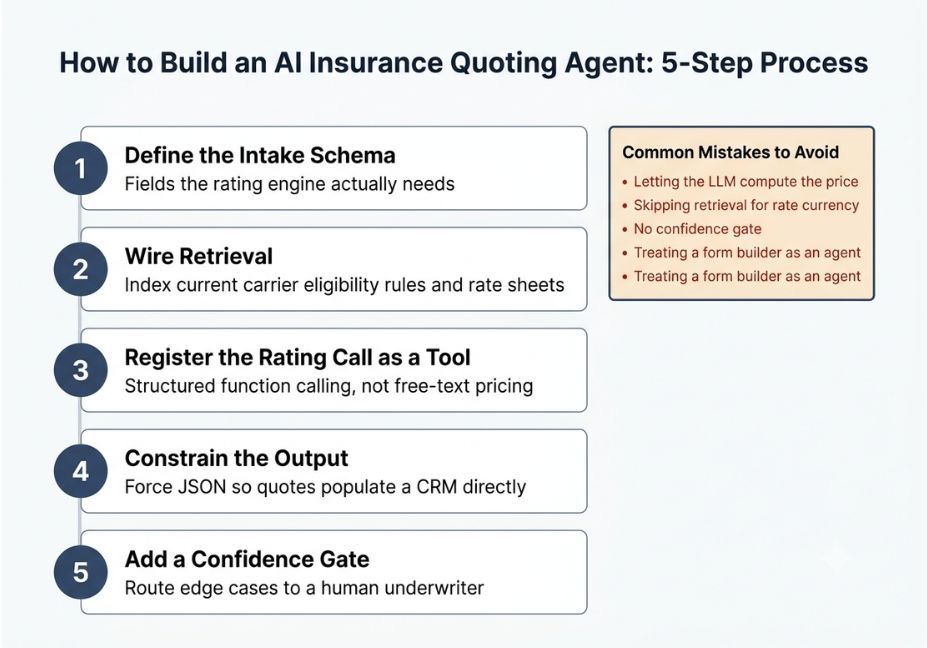
- Define the intake schema the fields a rating engine actually needs, not a generic contact form
- Wire retrieval index current carrier eligibility rules and rate sheets so the model isn’t guessing at coverage rules from training data
- Register the rating call as a tool use structured function calling rather than asking the model to compute a price in free text
- Constrain the output force JSON or another structured schema so the quote can populate a CRM without manual re-entry
- Add a confidence gate route low-confidence or edge-case risk profiles to a human underwriter instead of auto-quoting them
This mirrors the pattern described in the LangChain agents documentation for tool-use loop architecture in general. That said, insurance quoting is a narrow, high-stakes application of it, which is exactly why the confidence gate in step 5 matters more here than in a lower-stakes agent.
Common Mistakes and How to Avoid Them
- Letting the LLM compute the price itself. Language models hallucinate numbers, so a rating engine should always own the arithmetic called via structured function calling, not generated as text.
- Skipping retrieval for rate currency. Carrier rules change often enough that a model trained months ago will confidently quote stale eligibility criteria without retrieval-augmented generation pulling current data.
- No confidence gate. Auto-quoting every risk profile, including edge cases a human underwriter would flag, is the fastest way to erode trust in the tool.
- Treating a form builder as an agent. If there’s no retrieval step and no function call to a pricing source, it’s automated data entry not an agent.
What Developers Are Saying
Builders on insurtech forums tend to converge on the same complaint: vendors market “AI quoting” broadly, but the products that hold up under scrutiny are the ones that can show their tool-use-and-function-calling chain end to end, rather than describing the model as a black box that simply “processes” applicant data.
FAQ People Also Ask (Voice-Search Optimized)
What is an AI insurance quote generator?
It’s an agent that takes applicant risk data and returns a priced quote by combining retrieval of current carrier rules with a function call into a rating engine, rather than a human manually entering data into a rater.
What’s the best AI tool to get an insurance quote instantly?
There’s no single “best” tool it depends on whether you’re a consumer (Lemonade), a broker (RhinoAgents, Logicballs), or an agency building its own flow (Perspective AI, Strada).
Which AI tools generate insurance quotes automatically?
Names actively used in production include Lemonade’s Maya/Jim, RhinoAgents’ AI Insurance Quote Generator, Logicballs’ Quote Generator Pro, and Patra’s Quote Compare AI.
Can AI replace insurance agents for quoting?
Not fully. Most production tools keep a human reviewing the AI-generated quote before it binds, especially for commercial or edge-case risk profiles.
How accurate are AI-generated insurance quotes?
Accuracy depends almost entirely on the retrieval layer feeding current, correct rate and eligibility data into the rating engine, rather than on the language model itself.
Is Lemonade’s AI available to independent agents?
No Lemonade’s Maya and Jim stack is proprietary, though some claims automation is exposed to partner agents through API integration.
Conclusion
AI insurance quote generator tool names split into four real categories: consumer-facing bots, broker-facing raters, no-code agent builders, and underwriting-adjacent data tools. Only some of them, however, run a genuine tool-use loop rather than a form with an AI wrapper. If you’re building rather than buying, the architecture that matters is retrieval for current rate data, structured function calling into the pricing engine, and a confidence gate before anything auto-binds. For a deeper look at the same tool-use pattern applied outside insurance, see our guide to building tool-use agents and bookmark this page for more hands-on agentic workflow tutorials.