

AI tools that change Lexile levels such as Diffit, Brisk Teaching, and CoGrader use natural language processing to rewrite text so it hits a target reading score. They analyze word frequency and sentence length first, then regenerate the passage at the new level while trying to keep the facts the same.
A ninth-grade textbook passage and a sixth-grade reading level rarely fit in the same classroom. However, they often have to. That’s the problem behind every search for AI tools that change Lexile levels: software that rewrites text to a specific reading-difficulty target without losing the original meaning. Under the hood, this is a controlled text generation task. In fact, it’s the same category of problem agentic AI systems solve whenever they’re asked to hit a hard constraint instead of just producing free-form text. Once you understand that framing, it’s easier to see why some tools reliably hit 850L and others just swap in shorter words.
What Is a Lexile Level?
A Lexile measure is a number followed by “L” (for example, 850L). It places a reader’s ability and a text’s complexity on the same scale, a system developed by MetaMetrics. Specifically, a text’s score is built from two variables: semantic difficulty (word frequency and rarity) and syntactic complexity (sentence length and structure) — not theme, tone, or content maturity. As a result, a text can score as Lexile-appropriate and still be developmentally inappropriate, according to MetaMetrics’ own Lexile documentation. Overall, scores range from below 200L for beginning readers to above 1600L for advanced or technical text.
This is different from related readability entities you may already know, such as the Flesch-Kincaid Grade Level, ATOS (used by Renaissance’s Star Reading), and Common Core text-complexity bands. All of them measure reading difficulty, but each uses a different formula and scale, so a 900L text and a “7th-grade Flesch-Kincaid” text won’t always line up exactly.
How Do AI Tools That Change Lexile Levels Actually Work?
Most tools run a two-stage pipeline. First, a scoring pass analyzes the input text for word-frequency and sentence-length features the same variables the Lexile Framework itself uses to establish a baseline. Then, a controlled rewrite pass regenerates the text under a target constraint. This step typically uses an LLM or a fine-tuned sequence-to-sequence model (T5 or BART, for instance), or a prompted GPT-4-class model, to simplify vocabulary and restructure sentences while preserving factual content.
Did you know? A 2023 zero-shot LLM readability-control study found that general-purpose LLMs can move text toward a target readability band with a single prompt. That said, accuracy drops noticeably on domain-heavy content. Similarly, LLM-based text simplification research on biomedical abstracts found that control-token methods scored highest on SARI (a standard simplification-quality metric), but still traded meaning preservation against simplicity.
Pro tip: If you’re building this yourself instead of buying a tool, here’s a minimal readability-controlled prompt you can copy:
python
prompt = f"""
Rewrite the passage below to a {target_lexile}L reading level.
Preserve every factual claim and proper noun.
Shorten sentences over 20 words. Replace low-frequency
vocabulary with common synonyms. Do not add new information.

Passage:
{source_text}
"""
Technical disclaimer: Tool feature sets referenced below reflect their state as of early 2026. Because vendor pricing and free-tier limits change often, check each provider’s site before rolling a tool out district-wide.
Real-World Use Cases for AI Lexile Leveling
AI Lexile tools show up in several classroom and content workflows:
- Differentiated instruction the same lesson content produced at 3–5 reading bands, so one class can study the same topic at different levels.
- ELL/ESL scaffolding simplified vocabulary and shorter syntax for language learners, without stripping the content-area vocabulary students still need to learn.
- IEP accommodations text matched to a student’s individualized reading target.
- Content marketing and UX writing rewriting technical copy for a general audience while keeping key terms intact.
- Curriculum prep at scale batch-processing an entire unit instead of manually rewriting each passage by hand.
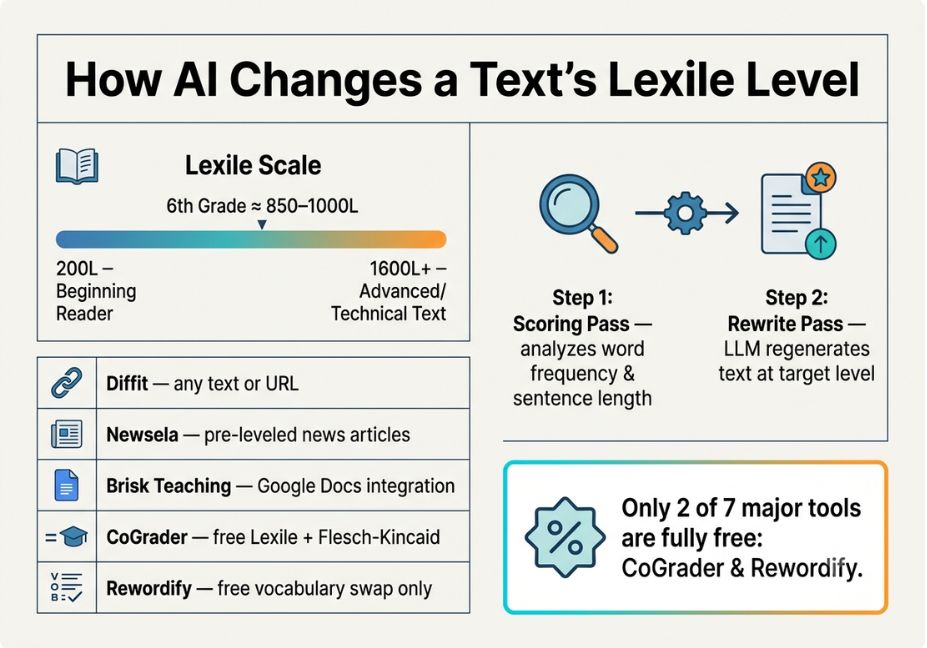
Best AI Tools That Change Lexile Levels
| Tool | Best for | How it levels text |
|---|---|---|
| Diffit | On-demand leveling of any pasted text or URL | Generates leveled passages, vocabulary lists, and questions per grade/Lexile target |
| Newsela | Curated current-events content | Human-written, AI-assisted articles pre-leveled across 5 bands (not arbitrary-text leveling) |
| Brisk Teaching | Google Docs workflows | One-click “Change Reading Level” plus multilingual translation |
| CoGrader | Free Lexile + Flesch-Kincaid conversion | Rewrites and re-scores text against both scales |
| MagicSchool AI | General-purpose teacher rewriting | Prompted rewrite to a specified grade band |
| Rewordify | Fast vocabulary-only simplification | Rule-based word substitution, not full LLM rewriting |
| Blueye Reading Level Converter | Lexile or CEFR targets | NLP-based rewrite preserving original structure |
If you only need one free option: CoGrader and Rewordify are the best free AI tools to change a Lexile level of a text right now, since both work without a paid account.
Step-by-Step: How to Change the Lexile Level of a Text with AI
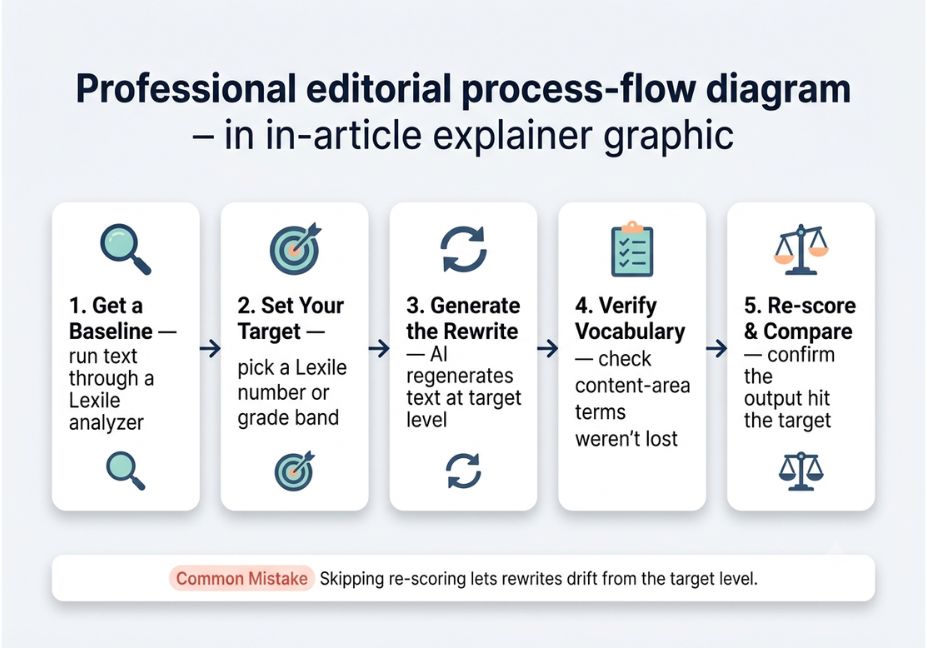
- Get a baseline. Run the source text through a Lexile analyzer or the tool’s built-in scorer.
- Set your target. Pick a Lexile number, grade band, or ELL tier.
- Generate the rewrite. Paste or upload the text, then run the leveling pass.
- Verify content-area vocabulary survived. Tools often over-simplify subject-specific terms students are supposed to learn.
- Re-score and compare side-by-side before you distribute the text to students.
This same sequence works whether you’re trying to lower the Lexile level for a struggling reader or raise it slightly to stretch an advanced one — only the target number in step 2 changes.
Common Mistakes and How to Avoid Them
- Trusting the score without reading the output. A tool can hit the target Lexile number while quietly dropping a key fact, so always spot-check the result.
- Over-simplifying content vocabulary. Struggling readers still need to learn domain terms; pair simplified syntax with a glossary instead of deleting the vocabulary outright.
- Assuming Lexile equals comprehension. Lexile measures word and sentence difficulty, not conceptual difficulty or cultural context. Therefore, a “readable” text can still be conceptually hard.
- Skipping re-scoring. Rewrites drift from the target, so always re-run the analyzer on the output, not just the input.
What Educators Are Saying
Teachers generally pair tools for different jobs rather than relying on just one. For example, many use a dedicated leveler like Diffit for the rewrite itself, then run a separate vocabulary analyzer to confirm content-area terms weren’t stripped out in the process. Overall, the consistent theme across classroom write-ups is this: these tools save hours of manual rewriting, but every one of them still gets a human review pass before reaching students.
FAQ People Also Ask
What is a Lexile level?
A Lexile level is a number, like 850L, that places reading ability and text complexity on the same scale. It’s based on word frequency and sentence length, not content or theme.
Are AI Lexile tools accurate?
Most are accurate within about one grade level for general text. However, accuracy drops on technical or domain-specific material, so a quick human review is still worth doing.
Can ChatGPT change the Lexile level of a text?
Yes. A direct prompt like “rewrite this at a 6th-grade Lexile level” works reasonably well. That said, dedicated tools score and verify the output automatically, which general chat prompting doesn’t do on its own.
What’s the difference between a Lexile level and a grade level?
A Lexile level measures difficulty on a continuous numeric scale. A grade level is a broader band that a Lexile range usually maps to for example, 6th grade is roughly 850–1000L.
Do AI text levelers preserve meaning when they simplify text?
Usually, yes, for narrative or general text. But research shows a real trade-off between simplicity and meaning preservation, especially with technical content.
Which AI Lexile tool is free?
Rewordify and CoGrader both offer free tiers for basic reading-level conversion. Most classroom-grade tools, including Diffit, Brisk, and Newsela, gate their advanced features behind a paid plan.
How do I lower the Lexile level of an article for a struggling reader?
Paste the article into a leveling tool, set a lower target Lexile or grade band, then run the rewrite and re-score it to confirm it landed where you wanted.
Conclusion
AI tools that change Lexile levels solve a constrained-generation problem: analyze a text’s semantic and syntactic difficulty, then regenerate it against a target score while preserving meaning. Diffit, Brisk Teaching, Newsela, and CoGrader each approach that differently, but none of them replace a teacher’s judgment on whether content-area vocabulary survived the rewrite. If you’re building or evaluating one of these tools yourself, start from the readability-controlled prompt pattern above it’s useful anywhere you need an LLM to hit a hard constraint, not just in EdTech. Bookmark this guide and explore more hands-on AI agent tutorials at agentiveaiagents.com.