

Imagine a support agent pasting a customer’s full name and account number into ChatGPT and that data now sitting on a server you don’t control. This happens constantly, and it’s exactly why an AI masking tool exists. In short, it’s software that finds sensitive data in a prompt and swaps it for a placeholder before the text ever reaches OpenAI, Anthropic, Google, or any other model provider.
Because prompts, RAG context, and agent tool calls all carry the same risk, masking has to work at every one of those entry points not just the first one. This guide walks through how detection and masking actually work, where teams get it wrong, and how to wire it into a real pipeline.
What Is an AI Masking Tool? (Quick Answer)
An AI masking tool detects personally identifiable information names, emails, phone numbers, financial or medical identifiers inside text and replaces it with a placeholder token before that text is sent to a large language model. Some tools also support reversible redaction, so the original value can be restored once the model’s response comes back.
Microsoft’s open-source Presidio framework is the most widely used example. First, its Analyzer engine detects entities using named entity recognition, regex, and checksum logic. Then, a separate Anonymizer engine performs the actual masking or hashing.
How Does an AI Masking Tool Work?
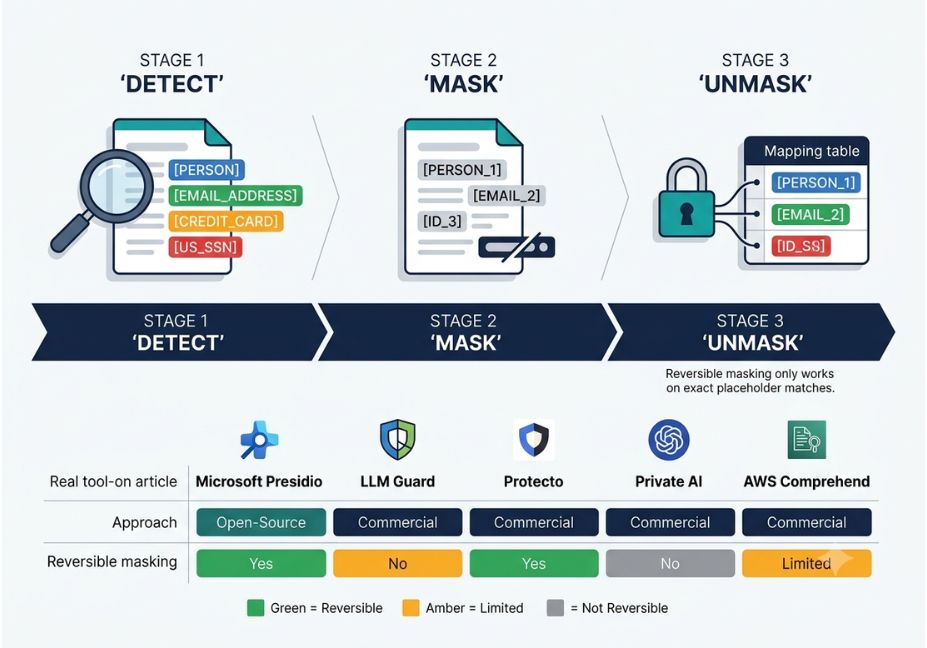
In practice, most tools follow the same three-stage flow: detect, mask, and if needed unmask.
- Detection NER models and pattern matchers scan for entity types (PERSON, EMAIL_ADDRESS, CREDIT_CARD, US_SSN) and score each one for confidence.
- Masking detected spans are replaced with placeholders like
[PERSON_1]or[EMAIL_2], and the mapping is stored securely. - Unmasking if the workflow requires it, original values are re-injected into the model’s response once it’s safely back on your side.
Did you know? Because LLMs often paraphrase, tools like Presidio can only restore a masked value if the model returns the placeholder text unchanged. As a result, deterministic unmasking is one of the most common failure points in production.
Here’s a minimal example using Presidio.
from presidio_analyzer import AnalyzerEngine
from presidio_anonymizer import AnonymizerEngine

text = "Hi, I'm John Smith, reach me at john.smith@email.com"

analyzer = AnalyzerEngine
results = analyzer.analyze(text=text, language="en")

anonymizer = AnonymizerEngine
masked = anonymizer.anonymize(text=text, analyzer_results=results)

print(masked.text)
# Hi, I'm <PERSON>, reach me at <EMAIL_ADDRESS>
Technical Note: Framework APIs evolve quickly, so always check current docs before shipping this to production.
How Do You Mask PII Before Sending It to ChatGPT? (Voice Search)
If you’re asking this out loud to your phone, here’s the short version: route every prompt through a masking layer like Presidio or an LLM gateway before it ever reaches ChatGPT, Claude, or any hosted model. That layer detects names, emails, and other identifiers, then swaps them for placeholders automatically, so the raw data never leaves your system.
AI Masking Tool Use Cases 4 Real-World Examples
- Customer support chatbots mask names and account numbers before a transcript reaches a hosted model, then unmask only in the agent-facing UI.
- RAG pipelines over internal documents sanitize retrieved chunks before they enter the context window, so the model never sees raw HR or medical records.
- Agentic workflows with MCP tools when an agent calls a database or CRM mid-task, mask the returned row before it feeds into the next planning step.
- Fine-tuning and eval datasets anonymize training data first, so the model can’t memorize and later regurgitate someone’s real details.
Pro Tip: Mask at the gateway level instead of inside individual services. That way, you enforce one policy everywhere, rather than re-implementing masking in every part of your stack.
Best AI PII Masking Tools for RAG Pipelines (Comparison)
Here’s how the leading options compare for teams building LLM, RAG, or agentic systems in 2026.
| Tool | Approach | Reversible? | Best For |
|---|---|---|---|
| Microsoft Presidio | Open-source NER + regex, self-hosted | Deterministic only | Python teams needing deep customization |
| LLM Guard | Open-source, 35+ scanners | Limited | Broad input/output validation beyond PII |
| Protecto | Commercial API, context-aware | Yes, token-based | Enterprises needing high accuracy at scale |
| Private AI | Commercial, transformer-based | Yes | Regulated healthcare/enterprise deployments |
| AWS Comprehend | Cloud-native NLP detection | No | AWS-native pipelines needing quick setup |
| Grepture | Managed SaaS gateway | Yes, reversible tokens | Teams wanting minutes-not-days setup |
Architect’s Note: Self-hosted tools give you full control but no free lunch you own the tuning and infrastructure. Managed gateways, on the other hand, trade some of that control for faster, reversible setups.
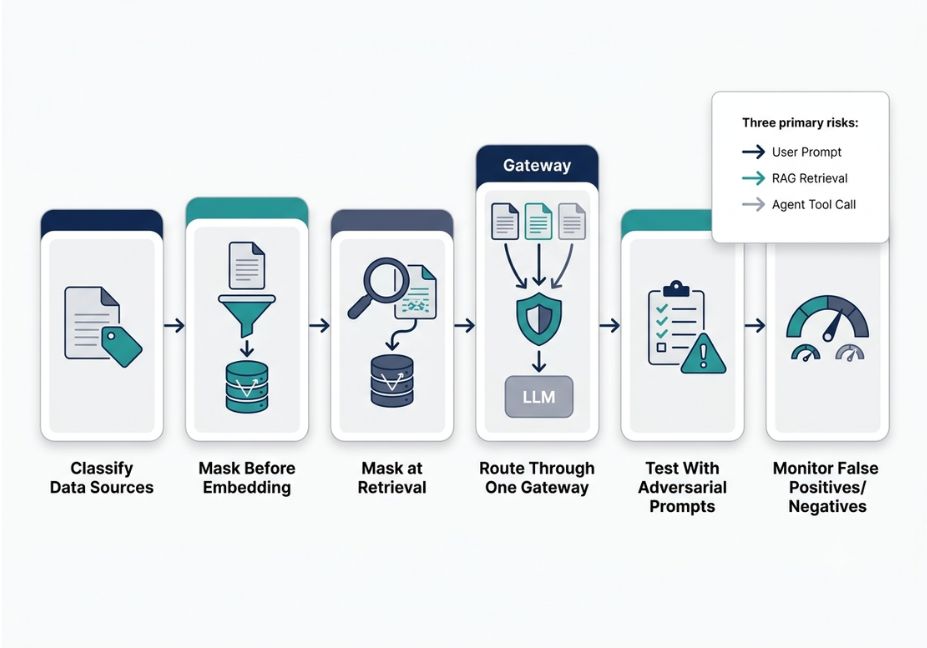
Step-by-Step: How to Implement Masking in a RAG Pipeline
- Classify your data sources first. Tag which fields are PII before building anything, because you can’t mask what you haven’t identified.
- Mask before embedding. Sanitize documents at ingestion, so raw PII never enters the vector store in the first place.
- Mask again at retrieval time. Even sanitized stores can leak context through metadata, so apply a second pass on retrieved chunks.
- Route every model call through one gateway. This way, masking applies consistently, including to agent tool calls.
- Test with adversarial prompts. Confirm known PII strings never surface in logs, embeddings, or output.
- Monitor false positives and negatives. Otherwise, overly aggressive masking degrades output quality, while overly loose thresholds leak data.
LlamaIndex’s RAG pipeline abstractions make steps 2 and 3 straightforward, since document loading and retrieval are already separate stages.
Common Mistakes and How to Avoid Them
- Masking only the initial prompt. Because RAG context and tool outputs carry PII too, mask every entry point, not just the first.
- Assuming regex is enough. Regex catches structured formats but misses names and context-dependent PII, so pair it with NER.
- Skipping the unmasking test. Verify reversible redaction survives a paraphrased response, since deterministic tools often fail here.
- Ignoring GDPR’s data minimization requirement. Masking is a control, not a substitute for not collecting unnecessary data in the first place.
What Developers Are Saying
On r/LocalLLaMA and GitHub Discussions, the same tension keeps coming up: open-source tools are free but need real tuning, while managed options trade cost for speed. Similarly, a 2024 survey of privacy-preserving prompt engineering documents this exact tradeoff across academic and industry tooling.
FAQ (Featured Snippet / Voice Search Optimized)
What is an AI masking tool?
An AI masking tool detects sensitive data names, emails, financial or medical identifiers and replaces it with placeholder tokens before that text reaches an LLM.
How does AI PII masking work in a RAG pipeline?
Masking happens twice: once before documents are embedded into a vector store, and again on retrieved chunks before they enter the context window.
Is masked data safe to send to ChatGPT or Claude?
It’s much safer than raw text, but no tool catches 100% of PII, so masking should be paired with data minimization and access controls.
Can masked data be un-masked later?
Yes, with reversible redaction but only if the LLM returns the exact placeholder text, since paraphrased responses often break the reversal.
Does masking hurt LLM output accuracy?
It can, if masking is too aggressive. However, consistent, well-tuned placeholders generally preserve accuracy.
Is Presidio enough for a production RAG app?
It’s a strong foundation, but most teams add custom recognizers and confidence-threshold tuning before trusting it in a regulated environment.
Conclusion
An AI masking tool isn’t one product it’s a detect-mask-unmask pattern that has to run at every point sensitive data can enter an LLM’s context. Open-source frameworks like Presidio and LLM Guard offer full control at the cost of tuning effort, while managed gateways trade some flexibility for speed. Either way, masking has to sit at the gateway level, get tested against adversarial input, and pair with real data minimization.
Bookmark this guide and explore more hands-on AI agent tutorials at agentiveaiagents.com.