
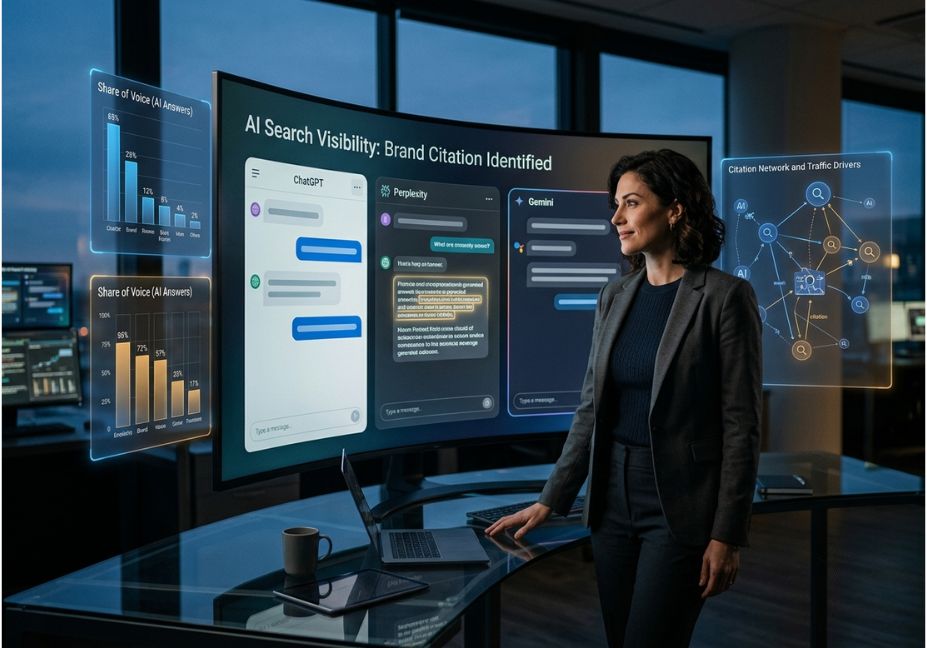
A brand can rank #1 on Google and still be invisible where buyers now ask their questions. For example, when someone types “best CRM for a 20-person sales team” into ChatGPT or Perplexity, the answer engine synthesizes a response from a handful of sources — and most companies have no idea whether they’re one of them. As a result, AI search visibility analytics has become its own tooling category in 2026, distinct from classic Google or Bing rank tracking.
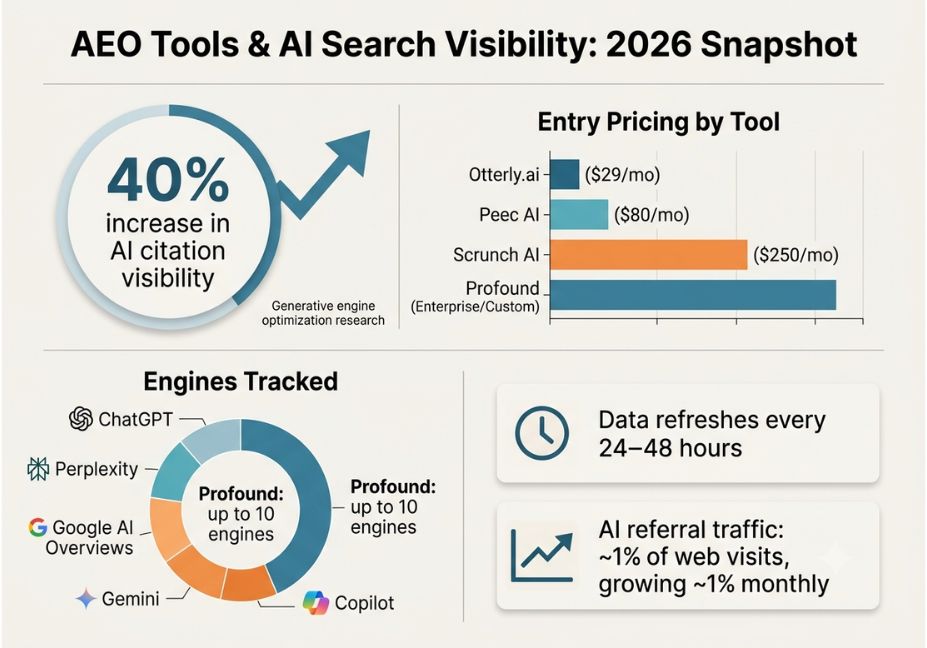
Generative engine optimization research out of Princeton found that specific content changes can lift citation rates in AI-generated responses by as much as 40%. In other words, visibility here is measurable and improvable, not a black box. The tools below turn that signal into a dashboard, organized by the job each one actually solves so you can shortlist in minutes instead of running ten demos.
What Is AEO (Answer Engine Optimization)?
Answer engine optimization (AEO) is the practice of structuring content so AI systems including ChatGPT, Perplexity, Gemini, Google AI Overviews, and Microsoft Copilot cite it when generating an answer. Unlike traditional SEO, which chases rankings and clicks, AEO tracks AI citation tracking and share of voice inside a generated response. Consequently, the unit of competition shifts from the page to the passage: engines pull small, well-structured chunks of text rather than entire articles, which mirrors how retrieval-augmented generation pipelines retrieve and assemble source material before an answer is written.
How Does AI Search Visibility Analytics Work?
AEO platforms run a defined set of prompts against multiple AI engines on a recurring schedule. Then, they parse the responses for:
- Brand mentions and citations was your domain named or linked as a source
- Position and prominence did you appear early in the answer or buried in a list
- Share of voice your citation frequency versus named competitors, similar to how tools like Semrush or Ahrefs track share of voice in traditional search
- Entity clarity whether the engine correctly understands what your company does
Most platforms refresh this data every 24–48 hours, which is fast enough for weekly review cycles but not real-time. Under the hood, this is a prompt-level monitoring loop: send a prompt, capture the raw model output, extract entities and links, then aggregate everything into a structured data markup-aware dashboard.
Pro Tip: Before shortlisting a tool, list your 15–20 highest-intent buyer questions exactly as a customer would phrase them out loud — this also makes your prompt set voice-search-ready, since it mirrors how people speak to Siri, Alexa, or Google Assistant rather than how they type into a search box.
Best AEO Tools by Job-to-Be-Done
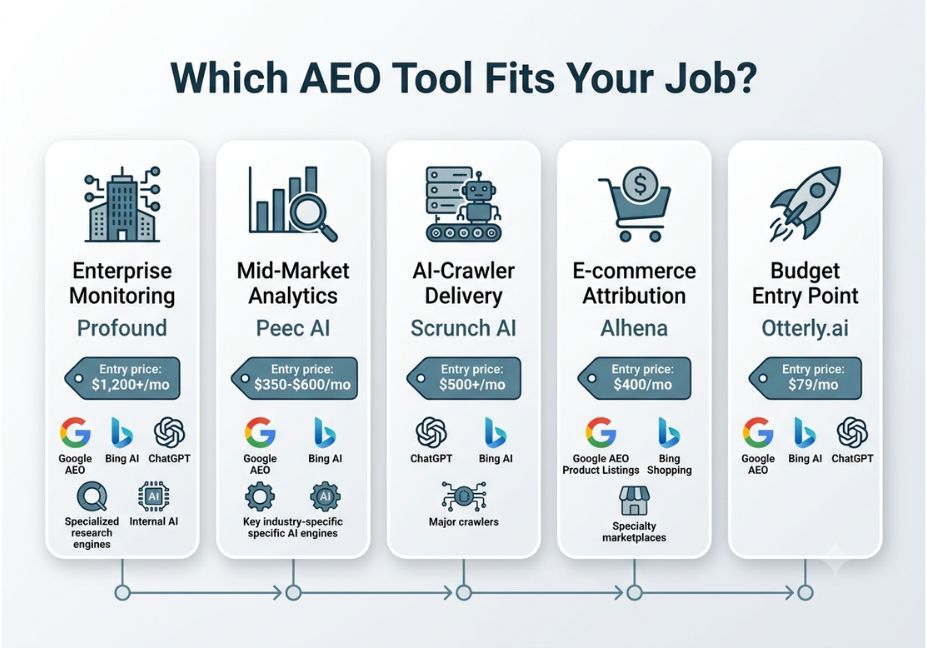
Not every team needs the same platform. Overall, the category splits cleanly into five jobs, and choosing correctly matters more than choosing the “biggest” name.
| Tool | Best for | Engines tracked | Entry pricing |
|---|---|---|---|
| Profound | Enterprise monitoring + automation | Up to 10, incl. Anthropic connector | Custom / enterprise |
| Peec AI | Mid-market analytics, agencies | 6, self-serve | $80/mo (brands), $205/mo (agencies) |
| Scrunch AI (part of Sitecore) | AI-crawler delivery layer | 8 claimed | $250/mo |
| Alhena | E-commerce, SKU-level attribution | 5 | Custom |
| Otterly.ai | Startups, low-cost entry | ChatGPT-focused | From $29/mo |
| AthenaHQ | Brand presence tracking + citation engine | Multiple | Custom |
| AIclicks | Prompt-cluster mapping tied to revenue topics | Multiple | Custom |
Technical Note: Revenue attribution is the least-solved capability in this category. Peec AI doesn’t attempt it. Profound, meanwhile, partners with third-party attribution tools. Scrunch proxies it through traffic estimates, while Alhena is the only platform with native attribution via first-party checkout data.
Did You Know? According to one 2026 benchmark comparison, Profound reports 47.1% AI-search visibility for its own brand, compared with roughly single-digit visibility for smaller competitors tracked on the same prompt set. Therefore, it’s worth sanity-checking any vendor’s self-reported visibility numbers against independent data, the same way analysts at Gartner or Forrester would treat any vendor-published benchmark.
Long-tail coverage: teams searching for “best AEO tools for small business,” “free AI search visibility tracker,” or “AEO tools comparison 2026” will find their answer in the table above Otterly.ai and Peec AI are the entry points; Profound and Scrunch are the enterprise tier.
Real-World Use Cases
- SaaS comparison pages A project-management SaaS tracks “[Product] vs [Competitor]” prompts to see which alternative gets cited when buyers ask AI for a shortlist.
- Local and regional brands A services company uses citation-consistency monitoring to confirm AI engines have the correct name, address, and category before it shows up in “near me” style AI answers a use case that overlaps directly with voice search optimization.
- E-commerce A DTC brand tracks product-level mentions in shopping-intent prompts and ties AI-driven sessions back to checkout data.
- PR and brand teams Marketing teams monitor how AI engines describe the company during a product launch, catching factual errors before they spread to platforms like OpenAI’s ChatGPT or Google’s Gemini.
Step-by-Step: Setting Up an AEO Monitoring Program
- Define 15–20 target prompts based on real buyer language, not keywords.
- Pick a tool tier that matches your budget and team, using the table above. Don’t buy enterprise capability you won’t use.
- Connect your CMS and analytics stack so citation data can be cross-referenced with GA4 referral traffic.
- Audit structured data on your highest-priority pages against Google’s structured data guidelines, since entity clarity is foundational to citability.
- Review citation and share-of-voice trends weekly, not daily. Most platforms refresh every 24–48 hours, so daily checks just add noise.
- Feed gaps back into content. If you’re missing from a comparison prompt, that’s a content brief, not just a metric.
python
# Minimal example: sending a monitoring prompt to an LLM API
# and checking whether a brand is cited in the response
import requests

def check_citation(prompt, brand_domain):
    response = requests.post(
        "https://api.example-aeo-provider.com/v1/query",
        json={"prompt": prompt, "engine": "chatgpt"}
    )
    data = response.json()
    return brand_domain in data.get("cited_sources", [])
Schema markup recommendation (AI search optimization): Mark this article up with Article schema plus FAQPage schema on the FAQ section and HowTo schema on the step-by-step section. This is hidden semantic relevance that doesn’t change the visible text but gives AI crawlers and Google’s structured data parser explicit entity and answer boundaries, which meaningfully improves both featured snippet eligibility and AI citation odds.
Common Mistakes and How to Avoid Them
- Trusting the tracker blindly. AI models sometimes invent pricing, fabricate features, or misattribute quotes to the wrong company. As a result, a monitoring tool that doesn’t flag these inaccuracies gives you a false read on visibility quality. Spot-check raw model outputs, not just the dashboard summary.
- Chasing every AI engine at once. Engine breadth varies widely by vendor. Instead, start with the 2–3 platforms your buyers actually use before paying for ten.
- Treating AI visibility like a vanity metric. AI referral traffic is still roughly 1% of total web visits industry-wide, growing about 1% monthly. That said, it’s a real and fast-growing channel, not a replacement for your core SEO program.
- Skipping entity and structured data cleanup. Citation-worthy content follows patterns identified in generative engine optimization research, particularly clear, well-sourced, statistic-backed writing. In short, it isn’t just about buying a tracking tool.
- Confusing “mentioned” with “cited.” A brand name appearing in an AI answer is not the same as being linked or credited as a source, so make sure your tool distinguishes the two.
What Practitioners Are Saying
Marketers comparing tools directly, including threads among practitioners comparing notes on r/SEO, tend to agree on one point: AI visibility platforms are strong on measurement but noticeably weaker on telling you what to actually do with the data. Consequently, budget-conscious teams increasingly pair a lower-cost tracker for monitoring with manual content sprints for execution, rather than paying enterprise prices for automation they don’t yet need.
FAQ — People Also Ask
What is AEO (answer engine optimization)?
AEO structures content so AI answer engines like ChatGPT, Perplexity, and Gemini cite it in generated responses. It focuses on citation frequency and entity clarity, not traditional keyword rankings.
How is AEO different from SEO?
SEO targets a search engine’s ranking algorithm to appear in blue-link results. AEO targets AI answer engines to get cited inside a generated response instead.
What is AI search visibility analytics?
It measures how often, where, and how prominently your brand appears in AI-generated answers, using metrics like citation frequency, share of voice, and AI referral traffic.
Can free tools track AI search visibility?
Manual prompt testing plus Google’s Rich Results Test offers a free starting point, but it won’t match the multi-model coverage or competitive benchmarking of paid AEO platforms.
How often should I check AI citation data?
Check weekly. Most platforms refresh citation data every 24–48 hours, so daily checks usually add noise rather than useful insight.
Which AI platforms should an AEO tool monitor?
Start with ChatGPT, Perplexity, and Google AI Overviews, since they carry the largest share of AI-driven query volume. Add Gemini and Copilot as budget allows.
Conclusion
Picking the right AEO tool comes down to matching platform capability to your actual job. Enterprise teams need broad engine coverage and automation; mid-market teams need clean multi-model analytics without enterprise pricing; e-commerce teams need SKU-level attribution tied to revenue. Whatever tier you land on, treat the dashboard as a diagnostic, not a fix visibility improves through structured, citation-worthy content, not the tracker alone. Bookmark this guide and explore more hands-on AI agent and search-visibility tutorials at agentiveaiagents.com.