
Most teams don’t fail at AI Overview tracking because they picked the wrong vendor. Instead, they fail because they never worked out what a “cheap” tool actually costs once prompt volume, refresh frequency, and engine coverage are factored in. For example, a $29/month plan that covers 40 prompts a week looks nothing like a $29/month plan that covers 40 prompts a day, and most pricing pages are built to blur that difference.
AI Overviews Google’s AI-generated summary blocks that now sit above the traditional blue links have already reshaped click behavior on informational queries. As a result, teams without visibility into them are flying blind on a growing share of their traffic. Fortunately, tracking that visibility doesn’t require an enterprise contract. It does, however, require understanding what you’re actually paying for: a prompt runner, a citation parser, and a place to store the history. Everything else is just UI.
This guide breaks down real per-prompt costs across the cheap end of the market — including budget-friendly options for small business teams, solo SEOs, and agencies — and shows the architecture every AIO tracker (paid or DIY) is built on. It also includes a working starter script for teams who’d rather build a thin tracker than pay for one.
What Is AI Overview Rank Tracking?
AI Overview rank tracking is the practice of programmatically running search queries and logging whether, how, and where a brand’s domain is cited inside Google’s AI Overviews feature, which surfaces AI-generated summaries above organic results for qualifying queries. Unlike classic rank tracking, there’s no fixed position 1–10 to record. Instead, tools measure share of voice, citation frequency, and which domains the model pulled from to generate the answer.
Because Google AI Overviews synthesize an answer rather than list links, tracking has to sample the actual generated text, not just a SERP position. This is also why the category is sometimes called an LLM rank tracker or filed under generative engine optimization (GEO) the same underlying mechanics apply whether you’re checking Google AI Overviews, ChatGPT, Perplexity, Bing Copilot, or Gemini/AI Mode. So, for teams specifically hunting for an affordable AI Overview tracking tool for small business use, or a budget AI visibility tracker for agencies, the fundamentals below stay the same only the scale changes.
How Does AI Overview Tracking Actually Work?
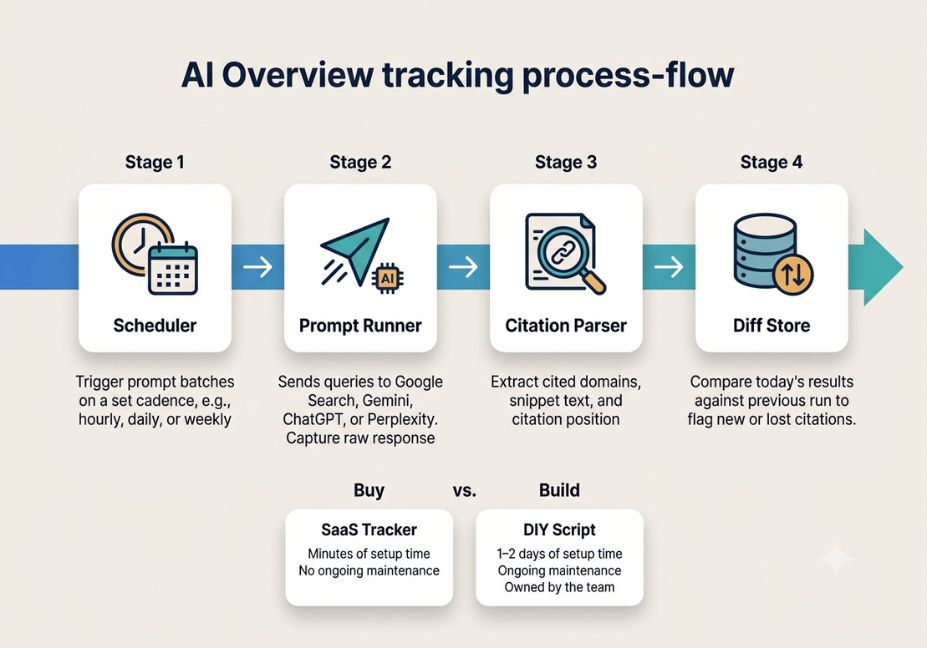
Strip away the dashboards and every AIO tracker expensive or cheap runs the same four-stage loop:
- Scheduler triggers a batch of prompts on a cadence (hourly, daily, weekly)
- Prompt runner sends each query to the target surface (Google Search, or an LLM API standing in for Gemini/AI Mode) and captures the raw response
- Citation parser extracts cited domains, snippet text, and position within the answer
- Diff store compares today’s result against the last run to flag new or lost citations
Pro tip: If you’re evaluating a vendor, first ask which stage their “credits” actually meter. Most credit-based pricing charges per prompt run, not per engine. Therefore, one prompt checked across ChatGPT, Perplexity, AI Overviews, and AI Mode can burn 3–4 credits in a single pull.
Tools that query Google directly generally scrape the live SERP, often through an open-source SERP API client or a paid equivalent. This is necessary because Google Search Console reports zero data for AI Overview appearances. Meanwhile, tools that also track ChatGPT or Perplexity call those vendors’ completion APIs directly. Consequently, multi-engine coverage costs more, since you’re paying for both the tracking vendor’s markup and the underlying LLM API usage the same cost structure that shapes pricing for platforms like OpenAI, Anthropic, and Google’s Gemini API.
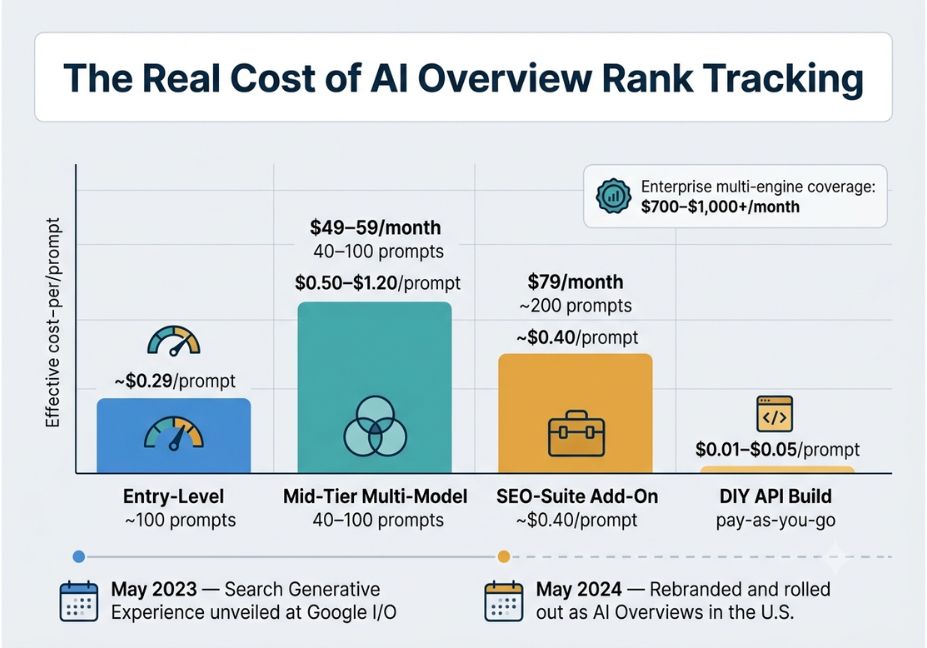
Did you know? Google first tested this feature as the Search Generative Experience at Google I/O in 2023. Then, in May 2024, it rebranded the feature as AI Overviews and rolled it out to all U.S. users.
Cheap AI Overviews Rank Tracking Tools Real Cost Comparison
Headline price tells you almost nothing on its own. Two tools can both say “$29/month” and differ by 6x in effective cost once you divide by included prompt volume. Here’s how the low end of the market actually breaks down as of mid-2026:
| Tool tier | Starting price | Included prompt volume | Effective cost/prompt | Engines covered |
|---|---|---|---|---|
| Entry-level (e.g., Otterly AI Lite) | ~$29/mo | ~100/mo | ~$0.29 | Google AI Overviews only |
| Mid-tier multi-model (e.g., Knowatoa, LLM Pulse Starter) | ~$49–59/mo | 40–100/mo | ~$0.50–1.20 | 3–4 engines |
| SEO-suite add-on (e.g., SE Ranking / SE Visible) | ~$79/mo | ~200/mo | ~$0.40 | Google AI Overviews, Gemini, ChatGPT, Perplexity |
| DIY build (SerpApi/OpenAI direct) | pay-as-you-go | scales to need | ~$0.01–0.05 | Whatever you code |
The gap between vendor pricing and raw API cost is the vendor’s margin for scheduling, parsing, dashboards, and alerting which is a fair trade if your team has no engineering time to spare, and a poor one if you already run agentic workflows for other tasks.
Architect’s Note: If your org already has an internal agent runtime (a scheduler, a queue, an LLM API key), the marginal cost of adding an AIO-tracking job is close to zero. The build-vs-buy decision usually comes down to whether someone owns the maintenance, not whether the code is hard to write.
Best Cheap Tools vs. Building Your Own
| Approach | Setup time | Monthly cost (50 keywords, weekly) | Maintenance | Best fit |
|---|---|---|---|---|
| Entry-level SaaS tracker | Minutes | $29–49 | None | Solo marketers, no dev resources |
| SEO-suite add-on | Hours | $65–99 | None | Teams already paying for the suite |
| DIY script + SerpApi/OpenAI | 1–2 days | ~$5–15 | Yours | Technical teams, agentic-workflow shops |
| API-first platform (e.g., Ziptie-style) | Days | $79+ | Light | Teams feeding data into a warehouse/BI tool |
Step-by-Step: Build a Lightweight AIO Tracker
A minimal tracker needs three things: a query list, a way to check for an AI Overview and its citations, and somewhere to store the diff. Below is a stripped-down starting point using an LLM API as the prompt runner (swap in a SERP API call if you want to hit live Google results instead).
python
import json
from datetime import datetime

QUERIES = ["best budget noise cancelling headphones", "how does RAG work"]

def check_citation(query: str, domain: str) -> dict:
    # Replace this call with your chosen SERP/LLM API request
    response = run_prompt(query)  # your API call goes here
    cited = domain in response.get("citations", [])
    return
        "query": query,
        "domain": domain,
        "cited": cited,
        "checked_at": datetime.utcnow().isoformat(),


def run_batch(domain: str) -> list:
    return [check_citation(q, domain) for q in QUERIES]

if __name__ == "__main__":
    results = run_batch("yourdomain.com")
    with open("aio_snapshot.json", "a") as f:
        f.write(json.dumps(results) + "\n")
Run this on a cron schedule, append each snapshot to storage, and diff consecutive runs to flag citation gains or losses. Swap the query list for your own keyword set and point run_prompt at whichever engine you’re tracking.
Technical Disclaimer: Framework and API versions evolve quickly. This snippet is a structural example, not production code check current rate limits and response schemas with your chosen provider before deploying it.
Common Mistakes and How to Avoid Them
- Confusing “prompt included” with “keyword tracked.” A plan with 100 prompts/month doesn’t cover 100 keywords if you’re also checking multiple engines per keyword.
- Ignoring non-determinism. AI Overviews aren’t fully deterministic the same query can return a different citation set hours apart. In fact, research from Stanford CRFM on generative model output stability has repeatedly shown that identical prompts can produce meaningfully different completions across runs, which is exactly why a single weekly check will miss real volatility. Instead, budget for at least a few checks per keyword per week if the trend matters.
- Skipping geo and device variation. Citations shift by location and device. Consequently, a cheap tool that only checks desktop, US-English results will systematically miss mobile-only or regional citation patterns.
- Treating share of voice as a vanity metric. Citation counts only matter next to a business outcome. Therefore, pair them with Google Search Console data or conversion tracking, or the number is just decoration.
What Developers Are Saying
Engineering teams who’ve tried both paths tend to converge on the same conclusion: paid tools win on time-to-value, while DIY wins on cost-per-data-point once you’re past a few hundred prompts a month. Interestingly, the recurring complaint about vendor tools isn’t price it’s that “credits” obscure true usage until the first overage bill arrives. That’s exactly why reading the fine print on prompt-to-credit ratios matters more than the sticker price advertised on the pricing page.
FAQ People Also Ask
What’s the cheapest AI Overview tracking tool right now?
Entry-level single-engine trackers start around $29 a month for about 100 prompt checks. That said, cost per prompt still varies once you factor in refresh frequency and engine coverage.
How much does it cost to track AI Overviews?
Paid tools run from roughly $29 a month for basic monitoring up to $700–1,000+ a month for full multi-engine coverage. A DIY tracker, by contrast, can cost just a few cents per prompt.
Can you track AI Overviews for free?
Not fully. Some vendors offer limited free checkers or trials, but Google Search Console gives zero direct AI Overview data, so free options stay capped in volume.
Do these tools also track ChatGPT and Perplexity?
Many do. However, multi-engine coverage usually costs more, since each extra engine adds its own API usage and parsing logic.
Can a small team build its own AI Overview tracker?
Yes, generally within a day or two if someone knows basic scripting. The ongoing cost is maintenance and parsing accuracy, not the initial build.
Is there a truly free way to monitor AI Overview rankings?
Not a fully automated one. The closest free option is manually checking priority queries in an incognito browser window, though that doesn’t scale past a handful of keywords.
Structured Data for AI Search Engines and Featured Snippets
Beyond the visible copy, add the following JSON-LD to the page <head>. This gives Google, Bing Copilot, and AI crawlers (ChatGPT’s browsing tool, Perplexity, SearchGPT-style agents) a machine-readable layer that reinforces the same entities and answers covered above this is the “hidden semantic relevance” layer that doesn’t show up in the rendered page but shapes how AI systems parse and cite it.
json
  "@context": "https://schema.org",
  "@type": "FAQPage",
  "mainEntity":

      "@type": "Question",
      "name": "What's the cheapest AI Overview tracking tool right now?",
      "acceptedAnswer":
        "@type": "Answer",
        "text": "Entry-level single-engine trackers start around $29 a month for about 100 prompt checks, though cost per prompt varies with refresh frequency and engine coverage."

      "@type": "Question",
      "name": "How much does it cost to track AI Overviews?",
      "acceptedAnswer":
        "@type": "Answer",
        "text": "Paid tools run from roughly $29 a month for basic monitoring up to $700-1,000+ a month for full multi-engine coverage, while a DIY tracker can cost just a few cents per prompt."
Pair this with HowTo schema around the DIY-tracker steps and Article schema with speakable markup on the Quick Answer block at the top the speakable property specifically helps voice assistants surface that summary for spoken queries like “what’s a cheap tool for tracking AI Overviews.”
Conclusion
Cheap AI Overview rank tracking comes down to three decisions: how many prompts you actually need checked, how many engines matter to your brand, and whether your team would rather pay a vendor’s margin or own the maintenance themselves. Entry-level SaaS tools remain the fastest path for teams without engineering bandwidth, but for shops already running agentic workflows, a thin DIY tracker built on a SERP or LLM API often beats subscription pricing by an order of magnitude. Whichever path you pick, measure cost per prompt not the headline price before you commit a budget line to it.
6 Responses