

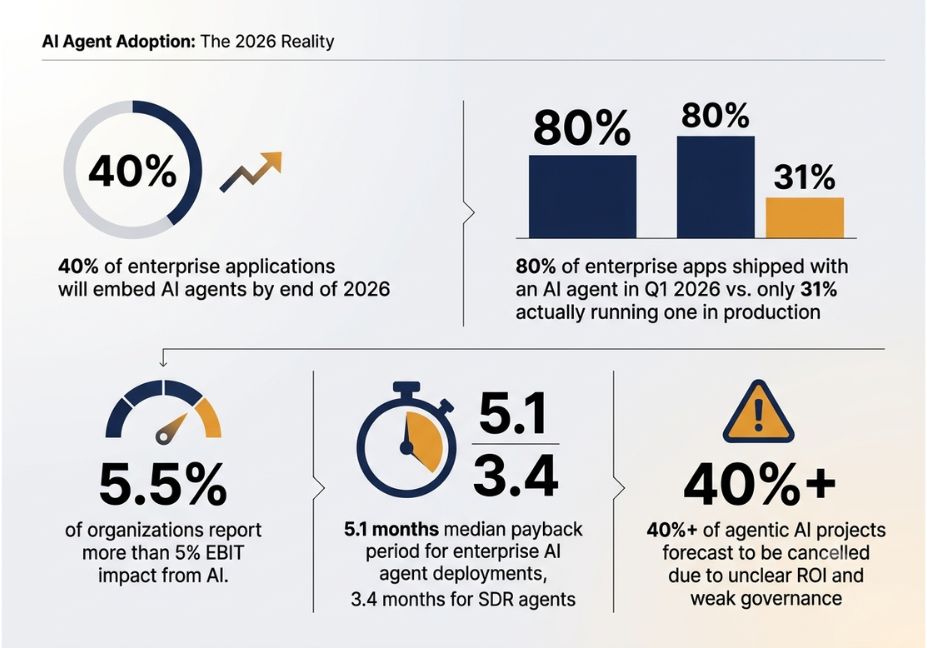
Most digital transformation programs stall for a boring reason: they bolt AI onto a process that was never restructured to use it. Gartner projects that 40% of enterprise applications will embed task-specific AI agents by the end of 2026, up from under 5% two years earlier.
However, McKinsey’s most recent State of AI survey found that only 5.5% of organizations report more than 5% EBIT impact from any of it. The gap isn’t the model. It’s the architecture around the model, and that gap is exactly what a real AI digital transformation roadmap for 2026 needs to close.
“Drovenio AI in digital transformation” has become shorthand, across a cluster of business and technology blogs, for this shift from digitizing existing paperwork to building systems where AI sits inside the decision loop itself. This guide skips the buzzword-first framing and works through the actual mechanics: where agents fit in a transformation stack, what breaks, and how to sequence a rollout that survives contact with production data.
What Is the Difference Between Digital Transformation and AI Transformation?
Digital transformation digitizes existing processes moving paper into software. AI-driven transformation goes a step further: systems reason over data and take action instead of just storing or displaying it. There’s no single vendor behind the phrase “Drovenio AI” it functions as a content-led framing for AI-driven modernization rather than a proprietary platform.
Additionally, that distinction matters technically. Only 5.5% of organizations that already use AI regularly report an EBIT impact greater than 5%, and data quality is the top barrier to scaling transformation programs, per Deloitte’s most recent survey.
Therefore, a digital transformation initiative that skips straight to agents without a clean data layer is building automation on a foundation that can’t support decisions. Enterprise software adoption curves consistently show this: tooling scales faster than the data discipline underneath it, which is where most ROI gets lost.
How Does AI Fit Into Digital Transformation?
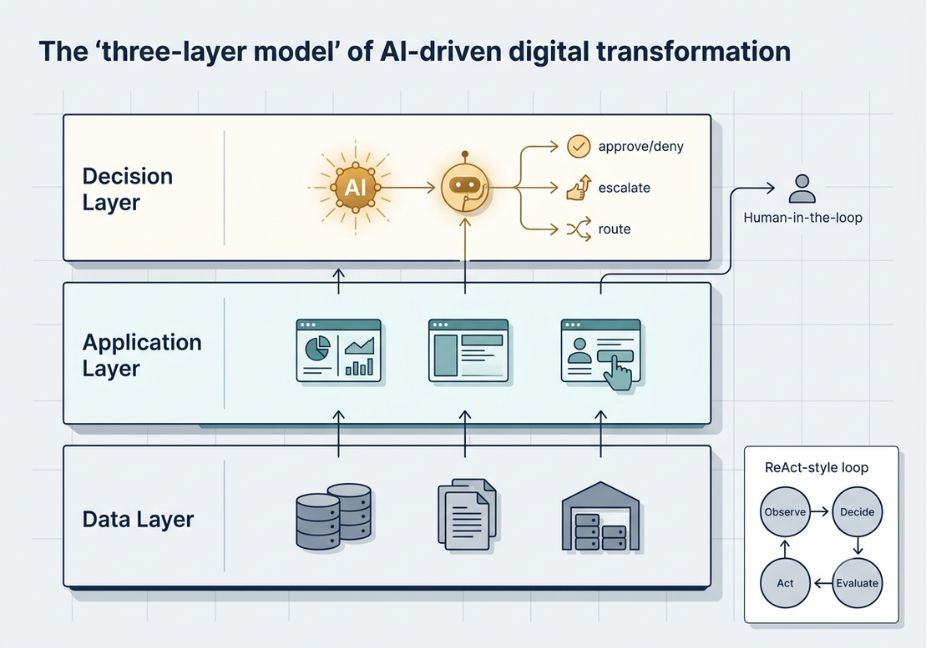
AI fits into digital transformation as a decision-layer technology it doesn’t just digitize records, it reasons over them and takes action. Enterprise systems break into three layers, and it’s the layer AI touches that determines whether a project is “digitization” or genuine transformation:
- Data layer source systems, warehouses, and the raw records a business runs on.
- Application layer the interfaces where employees and customers interact with software.
- Decision layer where judgment calls get made: approve or deny, escalate or resolve, route or reject.
Unlike fixed-rule automation, an agent reasons over context and adapts when conditions change, which is also exactly why it needs guardrails. A typical agent loop follows a ReAct-style reasoning and acting loop: observe the input, decide on a tool call, execute it, evaluate the result, and either act again or return an answer.
Meanwhile, Retrieval-Augmented Generation (RAG) extends this by grounding the agent’s reasoning in a vector database used for retrieval rather than model memory alone, which materially reduces hallucination on domain-specific questions.
Technical Note: Retrieval accuracy is only as good as the embedding model and chunking strategy behind it. Poorly chunked source documents are the single most common cause of “the agent gave a confident wrong answer” in production RAG systems.
Drovenio AI in Digital Transformation Real-World Use Cases
- Customer support and customer experience: sentiment-aware routing that escalates frustrated customers to a human agent instead of looping them through a bot.
- Finance and ops: agents that reconcile invoices against purchase orders and flag exceptions instead of processing every line manually a direct answer to how agentic AI reduces operational costs.
- Legacy modernization: AI-assisted code translation on cloud infrastructure — COBOL-to-Java conversion tooling has reportedly reached over 93% accuracy in production pilots, cutting migration timelines that used to run for years.
- Sales development: SDR agents with a median payback period of roughly 3.4 months, among the fastest-returning agent deployments tracked in 2026 enterprise surveys.
Did You Know? 80% of enterprise applications shipped or updated in Q1 2026 embedded at least one AI agent, up from 33% in 2024, but only 31% of enterprises actually have an agent running in production. As a result, that 49-point gap between “shipped with an agent” and “agent in production” is where most transformation budgets quietly disappear.
What Are the Best AI Tools for Business Process Automation?
| Framework / Approach | Best for | Tradeoff |
|---|---|---|
| LangChain | Multi-step agent orchestration, tool chaining | Steeper learning curve; frequent API changes |
| LlamaIndex | RAG-heavy retrieval pipelines | Less mature for multi-agent orchestration |
| OpenAI Function Calling | Simple, well-defined tool calls | Less flexible for open-ended planning |
| Rule-based RPA (legacy) | Deterministic, auditable tasks | Breaks on any input outside the rule set |
Pro Tip: Don’t start a transformation program by picking a framework. Instead, map which decisions in your workflow are high-volume and low-risk that’s where agent automation pays back fastest, per LangChain’s agent orchestration docs and current field data on SDR/finance-ops deployments.
Technical Disclaimer: Framework versions evolve rapidly. References to LangChain and LlamaIndex above reflect their general architecture as of mid-2026. Always check the official docs for the current API surface before implementation.
How Do You Implement AI Agents in Enterprise Digital Transformation?
Implementing AI agents in enterprise digital transformation starts with the data layer, not the model. Follow this sequence:
- Audit the data layer first. Identify which source systems are clean enough to feed an agent without heavy pre-processing.
- Pick one department, not the whole org. Enterprises that scale agents company-wide before proving one workflow see the highest cancellation rates.
- Build the tool-use loop around a narrow decision. Start with a single, well-bounded decision (route, flag, summarize) before expanding scope.
- Instrument for failure, not just success. Log every case where the agent hands off to a human that log is your next iteration’s training signal.
- Track payback in months, not vibes. Median time-to-value for agent deployments runs around 5.1 months across functions; if you’re well past that with nothing to show, the workflow was probably the wrong one to automate.
What Are the Most Common Mistakes in AI-Driven Digital Transformation?
The most common mistake is automating the application layer instead of the decision layer a chatbot skin on the same manual approval process isn’t transformation, it’s decoration. Beyond that:
- Ignoring data quality. Garbage in still means garbage out; an agent just makes the garbage faster and more confident-sounding.
- No human-in-the-loop path. Every production agent needs a clean, low-friction escalation route for the cases it shouldn’t resolve alone.
- Skipping governance. Over 40% of agentic AI projects are forecast to be cancelled in the next year, largely due to unclear ROI and weak risk controls. Consequently, governance isn’t a nice-to-have layered on later it’s a prerequisite.
What Developers Are Saying
Developer discussion threads on agent reliability consistently circle back to the same theme: orchestration and evaluation tooling matter more than model choice once you’re past a prototype. That sentiment shows up repeatedly in r/LocalLLaMA threads on production agent failures, where the recurring complaint isn’t model quality it’s brittle tool-call handling and missing observability.
Conclusion
The phrase “Drovenio AI in digital transformation” points at something real even without a single named product behind it: the shift from digitizing paperwork to putting AI directly in the decision layer of a business. The organizations getting payback aren’t the ones deploying the most agents they’re the ones who audited their data, picked one narrow decision to automate, and built a tool-use loop with a human escalation path from day one. Start there, measure payback in months rather than headlines, and scale only what already proved itself.
FAQ People Also Ask
What is the difference between digital transformation and AI-driven transformation?
Digital transformation digitizes existing processes; AI-driven transformation goes further by letting systems reason over data and take action in the decision layer, not just store or display it.
Can AI agents work autonomously without human input?
Within a bounded task, yes but production deployments almost always keep a human-in-the-loop path for edge cases the agent flags as low-confidence.
How do AI agents use tools in a transformation workflow?
Agents follow a reasoning-and-acting loop: they decide which tool to call (a database query, an API, a search), execute it, evaluate the result, and either act again or respond.
What is Retrieval-Augmented Generation and why does it matter here?
RAG grounds an agent’s answers in retrieved documents from a vector database instead of relying only on the model’s training data, which reduces hallucination on company-specific questions.
Why do so many agentic AI projects get cancelled?
Primarily unclear ROI and weak governance, not model failure. Projects that skip data-quality audits and human-in-the-loop design are the most common cancellations.