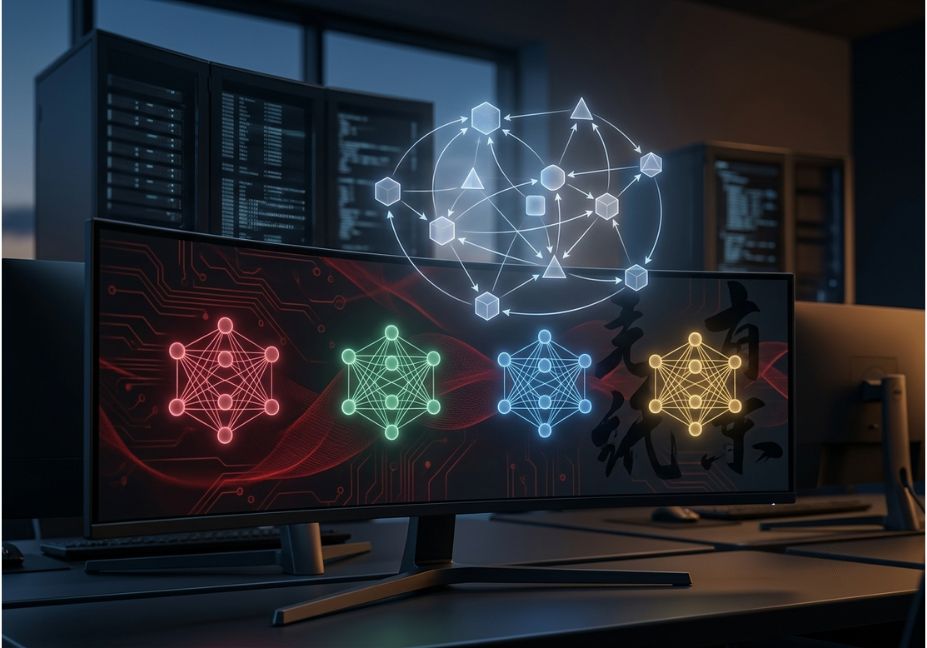
The best new AI tools like ChatGPT from China for building agents are DeepSeek V4, Qwen 3.6 Plus, Kimi K2.6, and GLM 5.1. All four support native function calling, and each one is now the strongest choice for a specific job DeepSeek for low-cost long-context work, Qwen for multilingual tool use, and Kimi and GLM for coding agents.
Most comparisons of Chinese ChatGPT alternatives focus on chat UX voice mode, personas, how “human” the replies feel. That’s the wrong lens if you’re building agents, though. What actually matters is whether a model calls tools reliably, holds a long context without losing the plan, and doesn’t blow your inference budget on a multi-step task.
A handful of open-weight labs DeepSeek, Qwen, Kimi, and GLM have cleared that bar in 2026. In fact, some now beat closed-source frontier models on agent-specific benchmarks like SWE-bench and Model Context Protocol (MCP) tool-call accuracy. So which one should you actually wire into a LangChain or AutoGen pipeline? Here’s the practical, benchmark-backed answer.
What Are Chinese ChatGPT Alternatives?
Chinese ChatGPT alternatives are large language models built by Chinese labs Alibaba, DeepSeek, Moonshot AI, Zhipu AI, and ByteDance among them that compete directly with OpenAI, Anthropic, and Google on reasoning and coding. Increasingly, they compete on tool-use loop performance too.
Unlike most Western frontier models, many of these ship as open-weight releases. In other words, developers can self-host them instead of relying solely on a hosted API. That’s a meaningful shift: recent coverage naming DeepSeek R1, Qwen 2.5, and Doubao as leading 2026 options points to open-weight access as the single biggest reason agent developers care about this category at all.
How Do These Models Work for Agent Workflows?
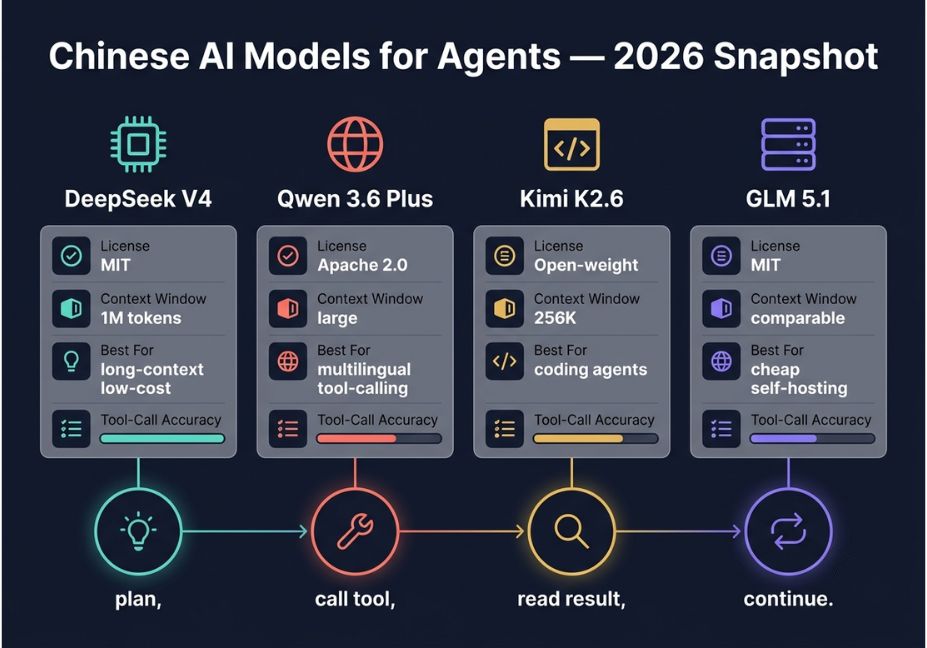
For agents, the mechanism that matters isn’t chat quality it’s the function calling loop: plan, call a tool, read the result, then continue. Several 2026 releases were built around this loop directly, rather than added on after the fact.
- DeepSeek V4 ships in two tiers a large “Pro” Mixture-of-Experts (MoE) model and a cheaper “Flash” variant. Both run under an MIT license with a 1M-token context window and native tool-call support.
- Qwen 3.6 Plus (Alibaba) is tuned specifically for tool-calling reliability, with a high first-attempt tool-call accuracy score on MCP-style benchmarks.
- Kimi K2.6 (Moonshot AI) supports parallel sub-agent orchestration. As a result, it’s well suited to harness-driven pipelines that fan work out across multiple tool-using agents at once.
- GLM 5.1 (Zhipu AI) trades a smaller parameter count for cheaper self-hosting, while still staying competitive on coding-agent benchmarks.
Technical Note: A raw benchmark score is a weak proxy for agent performance. What actually predicts reliability is tool-call accuracy under a structured harness, plus how well a model recovers after a failed step not how fluent its chat replies sound.
Best Chinese AI Tools for Coding Agents in 2026
If your use case is specifically a coding agent repo-level bug fixes, multi-file refactors, SWE-bench-style tasks the field narrows quickly. Kimi K2.6 and GLM 5.1 are the two most frequently recommended for this job, since both were evaluated directly against coding-agent benchmarks rather than general chat quality.
For teams asking “is DeepSeek better than ChatGPT for coding agents,” the honest answer is: it depends on the metric. DeepSeek is cheaper per token and highly competitive on reasoning. However, Kimi and GLM currently edge ahead on dedicated coding-agent scores.
Chinese AI Agent Tools Real-World Use Cases
- Coding agents: Kimi K2.6 and GLM 5.1 for repo-level fixes and refactors.
- Budget-constrained pipelines: DeepSeek V4 Flash, since its lower per-token cost changes the economics of high-volume agent loops.
- Multilingual support agents: Qwen 3.6, whose Apache-licensed models support tool-calling across LangChain and AutoGen in a wide range of languages.
- Document-heavy RAG agents: Kimi’s longer-context variants, built for multi-step planning over dense material like contracts or financial filings.
Because these use cases map so closely to specific models, matching the job to the model rather than picking a single “best” one is the more useful mental model here.
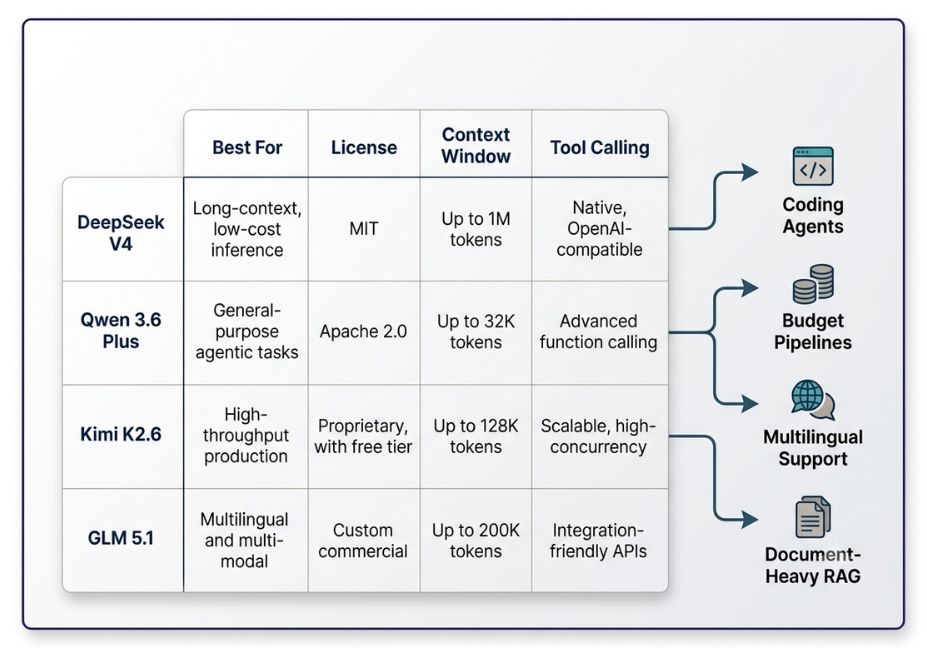
Best Tools & Frameworks Comparison Table
| Model | Best For | License | Context Window | Tool Calling |
|---|---|---|---|---|
| DeepSeek V4 (Pro / Flash) | Long-context, low-cost inference | MIT | Up to 1M tokens | Native, OpenAI-compatible |
| Qwen 3.6 Plus | Multilingual tool-calling agents | Apache 2.0 | Large (six-figure token range) | High first-attempt accuracy |
| Kimi K2.6 | Coding agents, sub-agent swarms | Open-weight | 256K (coding variant) | Native, multi-agent |
| GLM 5.1 | Cheap self-hosting, enterprise | MIT | Comparable to Kimi tier | Native |
Pro Tip: If you’re prototyping, route all four behind a single AI gateway (LiteLLM or Portkey) rather than hard-coding one provider’s SDK. That way, swapping models becomes a one-line config change instead of a rewrite of your retry and observability stack.
How to Call a Chinese Open-Weight Model From an Agent (Step-by-Step)
Most of these providers expose an OpenAI-compatible endpoint. Therefore, migrating an existing agent stack is usually just a base-URL and model-name change.
from openai import OpenAI

client = OpenAI(
    api_key="YOUR_API_KEY",
    base_url="https://api.deepseek.com/v1"  # swap for Qwen/Kimi/GLM endpoint


response = client.chat.completions.create(
    model="deepseek-chat",
    messages=[{"role": "user", "content": "Check tomorrow's weather in Lahore and summarize it."
    tools=
        "type": "function",
        "function":
            "name": "get_weather",
            "description": "Get current weather for a city",
            "parameters":
                "type": "object",
                "properties": {"city": {"type": "string"}},
                "required": ["city"]


print(response.choices[0].message)
This same request shape works across providers, which is exactly why Qwen 3.6 Plus is often recommended as a drop-in replacement for a GPT-based agent stack — the code above barely changes.
Technical Disclaimer: Model names, versions, and pricing shift quickly in this space. Consequently, confirm current parameters against each provider’s official documentation before deploying.
Common Mistakes When Adopting Chinese AI Models for Agents
- Judging by chat quality alone. A model can write charming responses and still fail inside a structured tool-use loop. So, test tool-call accuracy directly, not chat vibes.
- Ignoring data residency. Publicly hosted Chinese AI tools operate under different regulatory frameworks. As a result, sensitive business data deserves the same scrutiny you’d apply to any third-party cloud AI service.
- Skipping the license check. MIT and Apache-licensed weights (DeepSeek, GLM, Qwen) can be self-hosted freely. Not every release carries the same terms, though, so confirm before shipping to production.
- Assuming one model wins everything. In reality, the best pick depends on the task: Kimi and GLM tend to lead on coding and agent work, while Qwen is often the safer commercial choice thanks to Apache 2.0 licensing.
What Developers Are Saying
Self-hosting debates are especially active in developer communities. For instance, ongoing threads on Reddit’s r/LocalLLaMA (https://www.reddit.com/r/LocalLLaMA/) show engineers routinely benchmarking DeepSeek and Qwen against GPT-class models on their own hardware before committing to production. Meanwhile, Alibaba’s open-source Qwen repository (https://github.com/QwenLM) remains the most current primary source for API parameters and tool-calling specs, alongside independent benchmarking of open-weight coding agents on Hugging Face (https://huggingface.co/blog/daya-shankar/open-source-llms).
FAQ People Also Ask
What is the best Chinese ChatGPT alternative for AI agents?
DeepSeek V4 and Qwen 3.6 Plus are the strongest picks in 2026. DeepSeek wins on cost-efficient long-context reasoning; Qwen wins on tool-calling reliability and multilingual support.
How do I use a Chinese AI model like DeepSeek in my agent?
Point your existing OpenAI-compatible client at the provider’s API endpoint (for example, api.deepseek.com/v1) and keep your function-calling schema the same. Most agent frameworks need no other code changes.
Can Chinese AI models like DeepSeek be used outside China?
Yes. DeepSeek, Qwen, Kimi, and GLM are all available via public API outside China’s firewall. Their open-weight licenses also permit self-hosting anywhere.
Are Chinese LLMs safe to use for business data?
It depends on deployment. Hosted, publicly-run versions carry the same third-party data considerations as any cloud AI service amplified by different regulatory regimes. Self-hosting an open-weight model like DeepSeek removes most of that exposure.
Is DeepSeek better than ChatGPT for coding agents?
DeepSeek is highly competitive and often cheaper per token. However, Kimi K2.6 and GLM 5.1 currently lead on dedicated coding-agent benchmarks like SWE-bench.
Conclusion
The new wave of AI tools like ChatGPT out of China isn’t just a cheaper-chatbot story it’s an agent-infrastructure story. DeepSeek, Qwen, Kimi, and GLM now offer open-weight licensing, million-token context windows, and native function calling that rival closed-source frontier models on agent-specific benchmarks. So, the practical move is simple: route requests through an AI gateway, benchmark tool-call accuracy on your own tasks, and match the model to the job. Bookmark this guide and explore more hands-on agent-building tutorials at agentiveaiagents.com.