
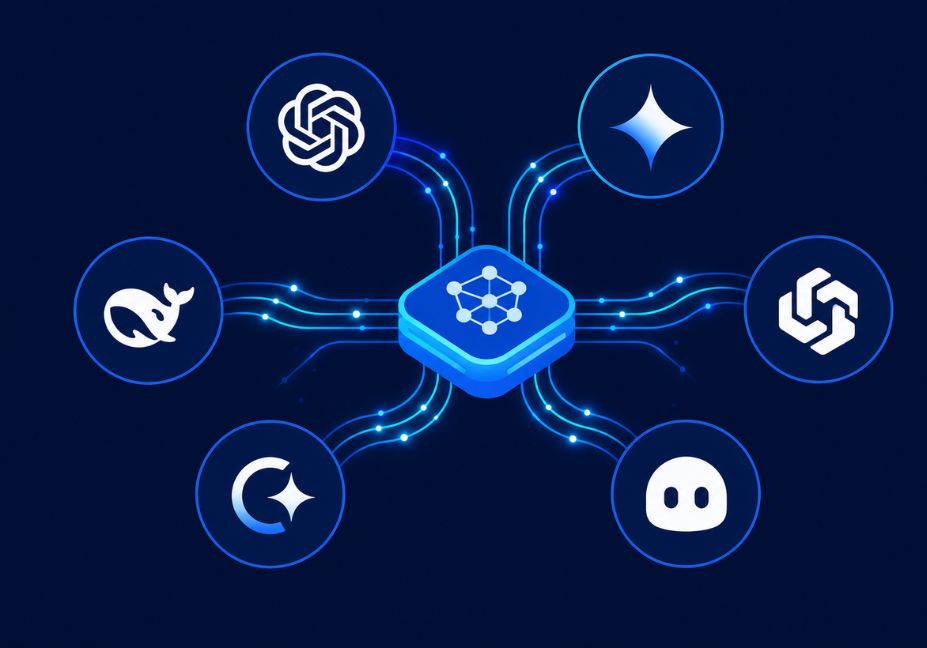
Hugging Face became the de facto GitHub of machine learning hosting over 500,000 open-source models, datasets, and community Spaces. But when you graduate from experimentation to production, the gaps show fast: variable inference latency of 200ms 2s on community endpoints, rate limits that collapse under load, and no SLA guarantees for real-time applications.
The right Hugging Face alternative isn’t a single platform it depends on whether you’re hitting a rate limit mid-prototype, trying to shave 150ms off your agent’s tool call response, or deploying a fine-tuned LLaMA model inside a private VPC. Serverless inference, dedicated GPU endpoints, model fine-tuning pipelines, and self-hosted MLOps are four different problems that four different platforms solve best.
This guide breaks down 10 of the strongest alternatives across every deployment phase with a decision matrix, benchmark callouts, and direct API comparisons so you can ship the right infrastructure, not just the most popular one.
What Makes Hugging Face Hard to Replace?
Before switching, understand what you’re actually leaving. Hugging Face’s Transformers library remains the most widely adopted framework for loading pretrained models LLaMA, Mistral, Falcon, Whisper, and thousands of fine-tunes live there. The Hub’s collaborative model cards, dataset versioning, and community Spaces ecosystem have no direct equivalent.
What Hugging Face is not is a production inference platform. Community endpoints are free but shared infrastructure. Dedicated Inference Endpoints are available but expensive at scale, with limited SLA commitments. If your use case is:
- Rapid model discovery and open-source collaboration → Hugging Face is still the best hub
- Low-latency production inference for LLMs → you need a purpose-built alternative
- Enterprise self-hosting with compliance requirements → managed cloud or on-prem MLOps wins
The platforms below solve these use cases explicitly.

The 10 Best Hugging Face Alternatives in 2026
1. Together AI Best for Startups Building on Open-Source LLMs
Together AI is the closest thing to a full-stack open-source LLM platform serverless inference, batch inference at 50% cost reduction, dedicated H100/H200 endpoints, fine-tuning, and GPU clusters, all under one OpenAI-compatible inference API.
The platform runs LLaMA 3, Mixtral 8x7B, Qwen, and dozens of other open-weight models. Because the API follows OpenAI’s format, migrating existing GPT-4 integrations takes a few lines of code, not a rewrite.
It is best for teams prototyping fast and planning to fine-tune later. Together AI lets you graduate from $0.0002/token serverless calls to a dedicated endpoint without changing providers.
Pro Tip: Use Together AI’s batch inference endpoint for RAG pipeline preprocessing 50% cheaper than real-time calls and ideal for embedding large corpora overnight.
2. Groq Best for Ultra-Low-Latency Inference
Groq’s proprietary Language Processing Unit (LPU) hardware is purpose-built for transformer inference. It delivers 300–800 tokens per second roughly 10x faster than equivalent GPU-based clouds making it the default choice for real-time AI applications.
The Groq API is OpenAI-compatible and runs Llama 3.3 70B, Llama 3.1 405B, Mixtral 8x7B, and Gemma 2. For voice agents, interactive copilots, and streaming generation use cases, Groq’s latency profile is materially better than any GPU provider.
Did You Know? Groq’s LPU architecture achieves deterministic latency unlike GPUs, which suffer from variable memory bandwidth under concurrent load. For agentic workflows making 10+ sequential tool calls, this consistency matters as much as raw speed.
It is best for real-time UX voice assistants, interactive coding copilots, live translation, and any streaming generation where latency is a product feature.
Inference Benchmark LLaMA 3 70B:
| Platform | Typical TPS | SLA | LLM Fine-Tuning |
|---|---|---|---|
| Hugging Face | ~40–80 TPS | None (community) | ✅ |
| Groq | 300–800 TPS | 99.9% | ❌ |
| Together AI | ~80–120 TPS | 99.9% | ✅ |
| Fireworks AI | ~100–160 TPS | 99.9% | ✅ |
| Replicate | ~30–60 TPS | 99.5% | ✅ |
3. Replicate Best for Community Models and Media Generation
Replicate mirrors much of Hugging Face’s open-source model catalog 1,000+ community models including image generation, video synthesis, speech, and text but wraps them in reliable production-grade hosting. Where Hugging Face community endpoints have no uptime guarantees, Replicate offers more consistent infrastructure with pay-per-inference pricing.
The standout feature is Cog, an open-source model packaging tool that containerizes any model for cloud deployment. If you have a custom fine-tune or research checkpoint, Cog handles the packaging and Replicate handles the scaling.
It is best for developers building media-heavy apps (image/video/audio) who need quick API integration without managing GPU infrastructure.
Technical Note: Replicate cold starts on infrequently used models can add 5–15 seconds to the first request. For latency-sensitive production flows, warm up critical models with keep-alive pings or switch to dedicated endpoints.
4. Fireworks AI Best Balance of Speed, Model Selection, and Cost
Fireworks AI offers optimized inference infrastructure with 700+ models and a strong focus on cost efficiency benchmarks suggest 30–50% savings versus Hugging Face Dedicated Endpoints at equivalent volume. Unlike Groq’s hardware specialization, Fireworks runs on GPU clusters with custom kernel optimizations that push throughput significantly above commodity providers.
Best production of LLM applications that need model variety with better economics than Hugging Face Dedicated Endpoints.
5. Baseten Best for Production Model Serving
Baseten occupies the gap between “run a model via API” and “manage your own Kubernetes cluster.” It provides deployment tooling for packaging custom models, managing rollouts, and versioning making it the production layer for teams graduating from Hugging Face experimentation to mission-critical inference.
It is best for ML teams with custom fine-tunes or proprietary checkpoints that need production-grade serving without full infrastructure ownership.
6. Modal Best for GPU-Native Python Workloads
Modal reframes the deployment question entirely: instead of asking “how do I host this model?”, you write Python functions and decorate them with @modal.function(gpu="A100"). It handles containerization, GPU provisioning, scaling, and cold start management transparently.
import modal

app = modal.App("llm-inference")

@app.function(
    gpu="A100",
    image=modal.Image.debian_slim().pip_install("transformers", "torch")
)
def run_inference(prompt: str) -> str:
    from transformers import pipeline
    pipe = pipeline("text-generation", model="meta-llama/Llama-3-8B-Instruct")
    return pipe(prompt, max_new_tokens=256)[0]["generated_text"]
It is best for ML engineers who think in Python and want GPU compute without YAML configuration or Kubernetes expertise.
7. RunPod Best for Cost-Effective Raw GPU Access
RunPod is a GPU marketplace, not a managed inference platform. You rent spot or on-demand GPUs at significantly lower prices than AWS, GCP, or Azure often 60–70% cheaper for equivalent compute. The trade-off is orchestration responsibility: you manage containers, model loading, and scaling yourself.
It is best for teams fine-tuning large models or running batch workloads where cost matters more than managed convenience. Not ideal as a real-time inference replacement.
8. SiliconFlow Best for Managed Inference at Scale
SiliconFlow’s proprietary inference engine achieves up to 2.3x faster speeds with 32% lower latency than competing GPU platforms according to internal benchmarks. It supports 600+ models with a unified API and has emerged as a strong option for teams that want Hugging Face’s model breadth with production-grade serving.
It is best for teams needing cost-effective managed inference at scale, particularly in Asia-Pacific regions.
9. Cerebras Systems Best for Large-Model Inference
Cerebras builds wafer-scale chips optimized for running large models 70B+ parameter models that stutter on conventional GPU clusters run smoothly on Cerebras hardware. The cloud service provides API access without requiring knowledge of the underlying silicon.
It is best organizations running 70B+ parameter models in research or production where GPU memory bottlenecks are the limiting constraint.
10. Ollama + BentoML Best Self-Hosted Stack
For teams that can’t send data to third-party APIs healthcare, finance, government the self-hosted combination of Ollama (local model runner) and BentoML (model serving framework) replicates the Hugging Face experience on private infrastructure.
Ollama handles model downloading and local inference across Mac, Linux, and Windows. BentoML wraps any model in a production REST API with monitoring, versioning, and horizontal scaling.
# Pull and run LLaMA 3 locally with Ollama
ollama pull llama3
ollama run llama3 "Summarize this document."
It is best for privacy-first organizations, air-gapped deployments, or developers who want zero cloud dependency.
Architect’s Note: For enterprise RAG pipelines on private data, a self-hosted stack of Ollama + BentoML + a local vector database (Qdrant, Weaviate, or Chroma) gives you full data sovereignty with surprisingly low operational overhead especially on modern hardware like Apple M-series or NVIDIA A-series workstations.
Which Platform Should You Choose?
| Use Case | Recommended Platform |
|---|---|
| Fastest LLM inference (real-time apps) | Groq |
| Open-source LLM API + fine-tuning | Together AI |
| Media generation (image/video/audio) | Replicate |
| Custom model + production serving | Baseten |
| GPU Python workloads, no YAML | Modal |
| Cheap GPU compute for training/fine-tuning | RunPod |
| Self-hosted / private data | Ollama + BentoML |
| Cost-efficient managed inference at scale | Fireworks AI or SiliconFlow |
| 70B+ model inference, research scale | Cerebras |
What Developers Are Saying
The r/LocalLLaMA community consistently puts Groq vs. Together AI at the center of the production LLM debate Groq wins on raw speed, Together AI on model flexibility and fine-tuning. For self-hosted builds, Ollama has become the community default for local development, while BentoML handles the production serving layer. The shared consensus: Hugging Face stays indispensable as a model discovery and research hub, but production inference has fragmented across specialized providers and that fragmentation is healthy.
FAQ People Also Ask
What is the best alternative to Hugging Face for production LLM inference?
Together AI and Groq are the strongest production alternatives depending on your priority. Groq delivers 300–800 tokens per second with near-zero latency via its LPU hardware ideal for real-time applications. Together AI offers broader model selection, fine-tuning, and an OpenAI-compatible API better for teams building full LLM-powered products that will scale.
Is there a free alternative to Hugging Face?
Yes. Ollama is free and open-source for local model inference. Groq and Together AI both offer generous free tiers for experimentation. Replicate provides free credits for new accounts. For research and prototyping, Hugging Face’s free inference tier still works well production limitations only appear under sustained load.
Can I self-host an alternative to Hugging Face?
Yes. Ollama + BentoML is the most developer-friendly self-hosted stack. Ollama handles local model running across Mac, Linux, and Windows, while BentoML wraps any transformer model in a production REST API. For enterprise deployments needing high-throughput self-hosted LLM serving, vLLM is another strong option worth evaluating.
What is the fastest inference alternative to Hugging Face?
Groq is the fastest, using proprietary Language Processing Unit (LPU) hardware to achieve 300–800 tokens per second for models like LLaMA 3 70B roughly 10x faster than GPU-based clouds. Cerebras is competitive for very large models (70B+ parameters) where GPU memory becomes the primary bottleneck.
How does Replicate compare to Hugging Face?
Replicate mirrors Hugging Face’s open-source model library but provides more reliable production hosting. Hugging Face community endpoints are free but have variable latency and no SLA. Replicate’s infrastructure is more consistent with usage-based pricing, and its Cog packaging tool makes it easier to deploy custom fine-tuned checkpoints without managing your own infrastructure.
Are there enterprise alternatives to Hugging Face?
Yes. AWS Bedrock, Google Vertex AI, and Azure AI Studio all provide enterprise-grade model hosting with compliance certifications (SOC 2, HIPAA), private networking, and SLA-backed uptime. For teams that need open-source models on enterprise infrastructure without full cloud lock-in, Baseten and Together AI’s dedicated endpoints are strong mid-ground options.
Conclusion
Hugging Face’s model hub remains irreplaceable for open-source model discovery and community collaboration no alternative has come close to its 500,000+ model repository. But the inference and deployment layer is a completely different story.
Three takeaways that matter: Groq dominates for real-time applications where tokens-per-second is a product feature. Together AI is the most complete open-source LLM platform for teams that need inference, fine-tuning, and batch processing under one API. And Ollama + BentoML is the default for self-hosted workloads where data sovereignty isn’t optional.
The smartest architecture keeps Hugging Face as the model discovery layer and routes inference to the platform that matches your latency, cost, and compliance requirements not just the one with the most GitHub stars.
Bookmark this guide and explore more hands-on AI deployment tutorials at agentiveaiagents.com.