

It’s possible for your product to be at the top of the rankings on Google but not be available to the public in reality. While this may sound melodramatic, it is a fact: if a user asks for some suggestions from either ChatGPT or Perplexity, the search engine gathers information from different sources it deems credible. Your product page was either included in this report or was not and rank trackers do not offer you this filter.
This is exactly why it was natural that in 2026, searching for AI search monitoring tools became one of the most popular queries among marketers and product developers. AI search monitoring is an effective solution here. In essence, it implies the use of a retrieval-augmented generation cycle where a query is sent to several AI engines, the results are scanned to check for brand mentions and references, and users are notified if there are any changes.
For engineers focused on creating agentic systems, it is not simply a marketing gimmick. It is a tool you are already using – this time it is focused on a new challenge: making your brand known on platforms such as OpenAI’s ChatGPT, Google AI Overviews, and Anthropic’s Claude.
Simply put, the point of using AI search monitoring tools is that conventional SEO solutions cannot determine whether brands are mentioned in the language models like ChatGPT, Perplexity, or Google AI Overview systems.
What Is AI Search Monitoring?
AI search monitoring is the practice of programmatically querying generative engines such as ChatGPT, Perplexity, Google AI Overviews, Gemini, and Claude and analyzing their answers to detect whether, how, and how favorably a brand is cited. Unlike classic rank tracking, which simply checks page position on a search results page, this process evaluates unstructured text output. In other words, it has to extract structured signal mention presence, citation position, sentiment, and source attribution from a paragraph of prose.
This is also why the discipline overlaps so heavily with Generative Engine Optimization (GEO) and Answer Engine Optimization (AEO): both draw on principles from retrieval-augmented generation architecture, since the generative engines being monitored are themselves retrieval-plus-generation systems. Consequently, an ai search monitoring tool for developers looks less like a rank tracker and more like an evaluation harness.
How Does AI Search Monitoring Work?
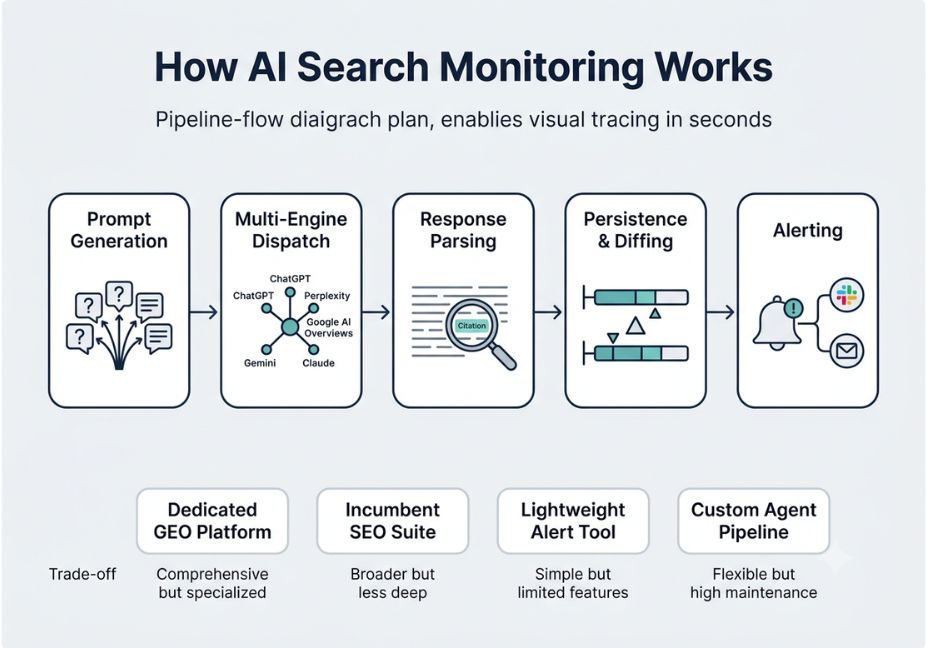
Strip away the dashboard, and an AI search monitoring platform is really a five-stage pipeline. Most of it, in fact, maps cleanly onto patterns agent builders already use this is how to build an ai search monitoring tool without starting from scratch.
- Prompt generation : first, a query-expansion step (comparable to a query-reformulation model) turns a handful of seed topics into hundreds of realistic user prompts.
- Multi-engine dispatch : next, the same prompt set is sent to each target engine’s API, or to a scraping layer where no API exists.
- Response parsing : then, an LLM classifier extracts brand mentions, citation order, linked vs. unlinked references, and sentiment from the raw text.
- Persistence and diffing : meanwhile, each run is stored so the system can compare today’s answer against last week’s, since citation sets are notoriously volatile.
- Alerting : finally, significant deltas a lost citation, a sentiment flip, a competitor gaining ground route to Slack, email, or a ticketing system.
Pro Tip: If you’re prototyping this yourself, stage 3 is where most teams underinvest. A single “did the brand appear: yes/no” classifier misses citation position, which correlates far more strongly with whether a user actually notices the mention.
Here’s a minimal version of stages 1–3 as a script, using a tool-calling loop similar to a ReAct-style agent loop:
import anthropic

client = anthropic.Anthropic

def check_citation(prompt: str, brand: str) -> dict:
    response = client.messages.create
        model="claude-sonnet-4-6",
        max_tokens=800,
        messages=[{"role": "user", "content": prompt}]

    answer_text = response.content[0].text

    # Second call: structured extraction pass
    extraction = client.messages.create
        model="claude-sonnet-4-6",
        max_tokens=300,
        messages=
            "role": "user",
            "content":
                f"Answer only JSON. Given this AI answer:\n\n{answer_text}\n\n"
                f"Does it mention '{brand}'? At what position (1st, 2nd, etc.)? "
                f"What is the sentiment (positive/neutral/negative)?"

    return {"raw_answer": answer_text, "extraction": extraction.content[0].text}
Technical Note: This pattern one call to generate, a second call to extract structured judgment from the first is the same evaluator-in-the-loop design used in most agentic QA systems. Treat citation parsing as an evaluation task, not a keyword search, or you’ll miss paraphrased mentions.
Why Use AI Search Monitoring Tools: The Core Reasons
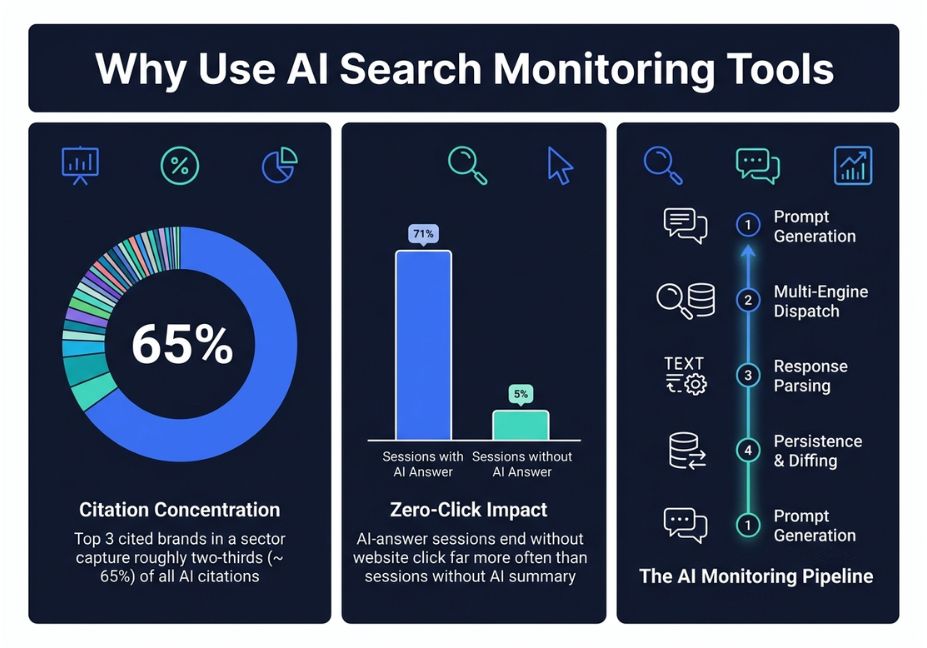
Did You Know? Independent tracking studies running thousands of prompts a month have found that the top three cited brands in a given sector capture roughly two-thirds of all citations, while dozens of other brands split what’s left. In other words, AI answers are winner-take-most, not evenly distributed like organic SERPs.
- Zero-click search hides the moment of influence. When an engine answers a question directly and the user never clicks through, that interaction is invisible to Google Analytics and Search Console alike. As a result, teams relying only on GA4 are working from an incomplete picture.
- Citation sets churn fast. Sources cited in one AI response frequently drop out within weeks, because models re-run retrieval on every query. Therefore, a single snapshot is unreliable on its own.
- Rank and AI visibility are decoupling. Pages that rank well in classic SEO increasingly fail to show up inside generative answers, since the two systems weight authority, structure, and freshness differently. This is precisely the gap that ai search monitoring vs traditional seo comparisons keep surfacing.
- Misinformation compounds silently. If a model consistently repeats an outdated limitation or a negative framing about your product, that damage scales across every user who asks a related question — and no rank-tracker alert will catch it.
- Competitive gaps are actionable, not just descriptive. Seeing exactly which prompts a competitor wins, and you don’t, turns monitoring into a prioritized content backlog instead of a vanity metric. Analysts at firms like Gartner and Semrush have both pointed to this shift as evidence that AI visibility now sits alongside classic SEO as a core marketing metric.
AI Search Monitoring Use Cases Real-World Examples
- SaaS comparison defense : tracking “best [category] tool for [use case]” prompts to catch when a competitor’s newer feature set starts winning citations.
- Brand accuracy audits : flagging when an engine describes a product using a deprecated pricing tier or a discontinued feature pulled from stale content.
- Content gap discovery : surfacing prompts where a brand is entirely absent, which becomes a prioritized brief for the content team.
- Post-launch sentiment tracking : monitoring sentiment drift in the days after a product launch or a negative news cycle.
Best AI Search Monitoring Tools for SaaS Teams: A Comparison
Coverage in this space has expanded quickly. In fact, an emerging category of GEO-focused platforms now spans dedicated visibility trackers, incumbent SEO suites that bolted on AI monitoring, and lightweight alerting tools. So which approach fits your team? The best ai search monitoring tools for SaaS teams usually come down to how much engineering time you have versus how much you’re willing to pay for a managed dashboard.
| Approach | Best for | Trade-off |
|---|---|---|
| Dedicated GEO/AEO platform | Marketing teams wanting a turnkey dashboard | Less control over prompt design and extraction logic |
| Incumbent SEO suite + AI module | Teams already invested in one SEO stack | AI features often lag purpose-built tools |
| Lightweight alerting tool | Fast detection of AI Overview appearance/disappearance | Shallow historical analytics, limited depth |
| Custom-built agent pipeline | Engineering teams needing full control and API access | Requires ongoing maintenance and evaluation tuning |
Step-by-Step: How to Build a Minimal Monitoring Loop
- Define your prompt library. Start with 20–30 realistic buyer questions, not just your brand name think “best X for Y,” not “[Brand] review.”
- Dispatch across engines. Use official APIs where available; budget for scraping fallbacks where they aren’t.
- Run the two-call extraction pattern shown above: generate, then judge.
- Store every run with a timestamp. Citation sets are only meaningful as a trend line, not a single reading.
- Set delta-based alerts, not absolute thresholds a citation disappearing matters more than a single low-sentiment score.
- Review weekly, not daily. Given how volatile individual answers are, daily noise will drown the signal that actually matters.
Common Mistakes and How to Avoid Them
- Treating a single AI response as ground truth. One query, one moment always average across repeated runs before drawing conclusions.
- Ignoring unlinked mentions. LLMs frequently name a brand without a hyperlink; a monitoring system that only tracks linked citations misses most of the signal.
- Skipping the verification pass. Extraction models can hallucinate a citation that isn’t actually in the source text always validate against the raw response, not just the model’s summary of it.
- Building for one engine only. ChatGPT, Perplexity, and Google AI Overviews cite from meaningfully different source pools; single-engine coverage tells an incomplete story.
Technical Disclaimer: Generative engine APIs and response formats change frequently. Code examples above use the Anthropic Messages API as of mid-2026; check current API docs before deploying to production.
What Developers Are Saying
Builder discussions on threads across r/LocalLLaMA and similar developer communities consistently flag the same two problems with off-the-shelf tools: opaque extraction logic that can’t be audited, and pricing that scales poorly once prompt volume grows past a few hundred queries a month. That gap is exactly why in-house pipelines even simple ones like the script above remain common among technical teams that need to see the extraction step, not just trust it.
FAQ People Also Ask
What is AI search monitoring?
AI search monitoring is the practice of programmatically tracking how brands, products, or content are mentioned, cited, or omitted inside AI-generated answers from tools like ChatGPT, Perplexity, and Google AI Overviews. It gives teams visibility data that traditional rank trackers simply can’t see.
How is AI search monitoring different from traditional SEO?
Traditional SEO tracks page rank on a results page. AI search monitoring, on the other hand, evaluates unstructured generated text for mention presence, citation order, and sentiment a fundamentally different extraction problem.
Which AI platforms should you monitor?
At minimum, cover ChatGPT, Perplexity, and Google AI Overviews, since together they drive most current AI search traffic. Additionally, add Gemini and Claude if your buyers use them.
Can you build your own AI search monitoring tool?
Yes. A minimal version is a two-call pipeline: one call generates an answer, and a second call extracts structured citation and sentiment data from it, run on a scheduled prompt library.
How often should you check AI search visibility?
Run queries daily or weekly for data collection. However, review trends weekly or monthly instead, since single-run snapshots are unreliable given how often citation sets change.
Do AI search monitoring tools prevent hallucinations about my brand?
No they detect them, not prevent them. Monitoring surfaces incorrect or outdated claims an engine is making about your brand, but fixing the underlying source content is still a separate, manual step.
Why should marketers use AI search monitoring tools in 2026?
Because visibility inside AI answers now behaves like a distinct channel from organic search. Consequently, marketers who only track Google rankings are missing a growing share of how customers actually discover brands.
Conclusion
AI search monitoring isn’t a marketing gimmick bolted onto SEO it’s an evaluation problem, and the tooling that solves it looks like the agent pipelines already familiar to anyone building with LLMs: query generation, multi-source dispatch, structured extraction, and delta-based alerting. Whether you adopt a dedicated platform or build a lightweight version yourself, the reason to use AI search monitoring tools comes down to one thing: you can’t fix a visibility problem you can’t measure. Bookmark this guide and explore more hands-on agent-building tutorials at agentiveaiagents.com.