

Most agent pipelines don’t fail because the underlying model is weak. Instead, they fail because the data feeding the retrieval layer or the fine-tuning set was never properly cleaned. For example, a single mis-parsed date column or a batch of near-duplicate records can quietly poison embedding quality for months before anyone notices the drift in retrieval accuracy.
So, what are the data cleansing process steps where AI tools can be used? In short, they span profiling, standardization, deduplication, validation, and enrichment and each step now has a mature AI or ML technique attached to it, from clustering-based entity resolution to LLM agents that write and execute their own cleaning code. Below, this guide walks through each step, shows where automation genuinely helps versus where it introduces new risk, and includes a working code example you can adapt today.
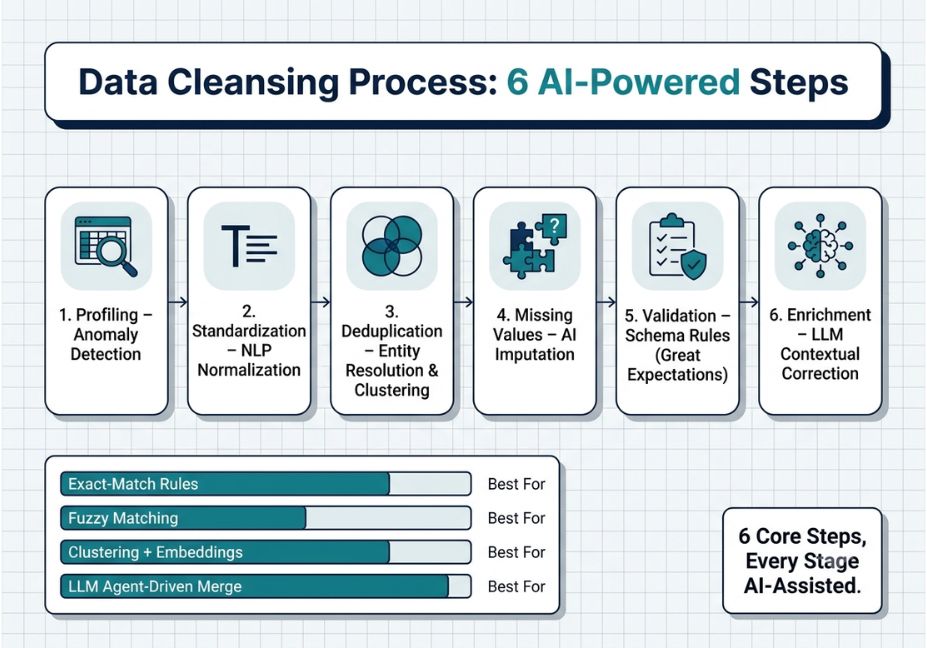
Quick Answer: The data cleansing process has six core steps profiling, standardization, deduplication, missing-value handling, validation, and enrichment. AI tools speed up every step: classification models flag anomalies, clustering algorithms catch duplicates, NLP normalizes text, and LLM agents can write and run their own cleaning code, though human review is still needed to catch AI errors.
At a glance:
- 6 core process steps, each mapped to a specific AI/ML technique
- Best for: data teams, AI/ML engineers, and analysts preparing data for RAG or fine-tuning
- Read time: ~8 minutes
What Is Data Cleansing?
In simple terms, data cleansing (also called data cleaning or data scrubbing) is the process of detecting and correcting corrupt, incomplete, or inconsistent records in a dataset before it’s used for analysis, reporting, or model training. According to Wikipedia’s entry on data cleansing, the discipline covers everything from removing duplicate rows to reconciling conflicting values across merged data sources. Many enterprise teams also align this work with ISO 8000 data-quality standards and, where personal data is involved, GDPR requirements around accuracy and retention.
For AI teams specifically, dirty data doesn’t just produce bad dashboards. It directly degrades retrieval accuracy in RAG systems and introduces label noise into fine-tuning sets. As a result, cleansing has become a first-class step in agentic data pipelines rather than a one-off spreadsheet chore a shift that research groups like Stanford HAI and IBM Research have both flagged as central to reliable, production-grade AI.
If you’re wondering how to clean data using AI tools in practice rather than in theory, the next section breaks down exactly where each technique fits.
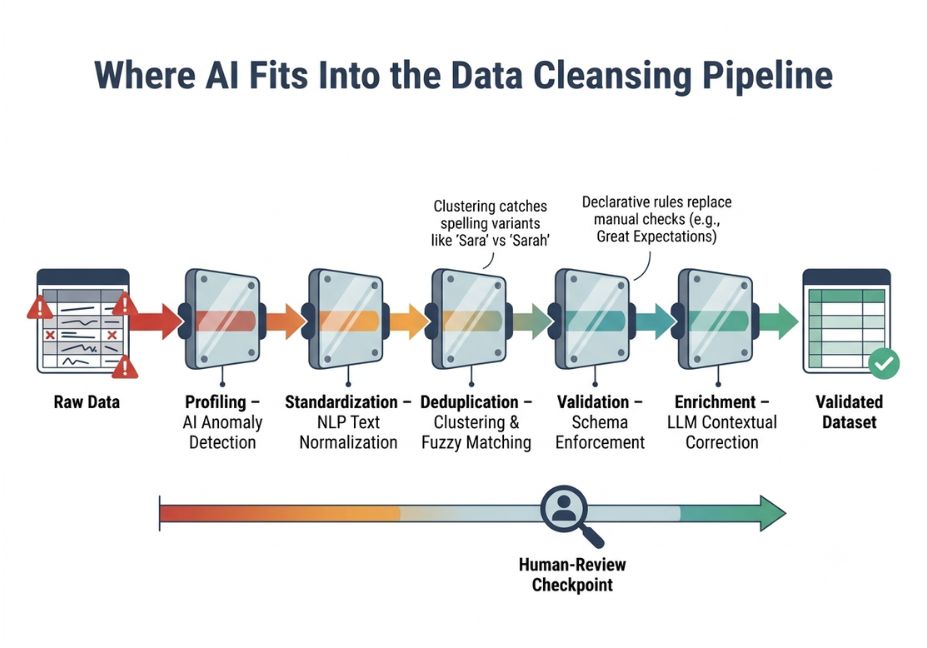
How Does AI Fit Into the Data Cleansing Process?
Traditionally, data cleansing relies on hand-written rules: regex patterns, SQL CASE statements, and manual review. However, AI-assisted cleansing replaces or augments those rules with models that learn patterns directly from the data which is exactly what makes AI-powered data cleansing tools faster to scale across large, messy datasets than rule-only pipelines.
- Classification algorithms flag out-of-place values (an email address sitting in a phone-number column).
- Clustering algorithms group near-duplicate records for deduplication, even when spelling varies (“Sara” vs. “Sarah”).
- Regression models impute missing numeric values from correlated fields.
- NLP techniques normalize unstructured text addresses, product names, free-text survey responses.
- LLM agents go a step further: given a dataset and a goal, they can write, run, and iterate on their own cleaning code inside a Python sandbox, closing the loop between error detection and correction without a human writing every rule.
Did You Know? A 2025 arXiv study tested an LLM agent paired with Python to clean tabular data and found it could match or beat hand-tuned baseline pipelines on several benchmark datasets but performance varied sharply depending on how well the agent’s prompt described the target schema.
Step 1: Data Profiling and Source Assessment
Before any correction happens, you first need to know what’s actually wrong. This is where AI-powered data profiling tools come in: they scan a dataset and automatically surface anomaly detection results missing-value rates, type mismatches, outlier distributions, and cardinality issues instead of requiring a manual column-by-column audit.
- Identify every source system feeding the dataset (CRM exports, scraped web data, sensor logs, survey tools).
- Run automated profiling to flag columns with unexpected null rates or inconsistent formats.
- Rank issues by downstream impact before deciding what to fix first.
Pro Tip: Run profiling on a 5–10% sample first. It’s fast enough to catch 90% of structural issues without burning compute on a full pass over a 10M-row table.
Step 2: Standardization and Normalization
This is where natural language processing (NLP) earns its keep. Specifically, text normalization converts inconsistent formats “St.” vs. “Street,” “NY” vs. “New York,” mixed date formats into a single canonical representation. Tools like Google Cloud Data Prep and open-source libraries such as PyJanitor apply this kind of normalization at scale.
Technical Note: Standardization should happen before deduplication, not after. Two records that look different only because of formatting ("john@x.com" vs "John@X.com ") will otherwise be treated as unique and skip the dedup pass entirely.
import pandas as pd

df = pd.read_csv("customers_raw.csv")

# Normalize text fields
df["email"] = df["email"].str.strip().str.lower()
df["state"] = df["state"].replace({"NY": "New York", "CA": "California"})

# Standardize date formats
df["signup_date"] = pd.to_datetime(df["signup_date"], errors="coerce")

df.to_csv("customers_standardized.csv", index=False)
Step 3: Deduplication and Entity Resolution
Duplicate records are, by far, the single most common data-quality complaint in customer and product datasets. That’s why AI-driven entity resolution uses fuzzy matching and clustering rather than exact-match rules alone to catch duplicates that traditional deduplication misses.
- Cluster records by similarity score across name, email, and address fields.
- Merge matched clusters using a survivorship rule (most recent record wins, or highest-completeness record wins).
- Log every merge decision for auditability this matters for compliance in regulated industries.
Comparison: Deduplication Approaches
| Approach | Best For | Limitation |
|---|---|---|
| Exact-match SQL rules | Small, well-structured tables | Misses spelling variants |
| Fuzzy matching (Dedupe, RecordLinkage) | Mid-size customer/product datasets | Requires tuned similarity thresholds |
| Clustering + embeddings | Large, messy, multi-source datasets | Higher compute cost, needs review step |
| LLM agent-driven merge | Ambiguous, context-dependent duplicates | Slower, risk of incorrect merges without oversight |
Step 4: Handling Missing and Inconsistent Values
Generally, missing data can be dropped, flagged, or imputed and AI models specifically improve the imputation option. For instance, regression and nearest-neighbor models predict a plausible missing value from correlated columns instead of defaulting to a mean or a null placeholder.
- Decide per-column whether missingness is random or systematic (a null shipping address might mean digital-only orders, not an error).
- Use model-based imputation only where the missing rate is moderate; above roughly 40% missing, imputation adds more noise than signal.
- Always keep a flag column (
was_imputed) so downstream models can weight or exclude imputed rows.
Step 5: Validation and Schema Enforcement
Validation is where AI cleansing tools intersect with data quality pipeline engineering. Instead of checking data quality manually, teams declare expectations “age must be non-negative,” “country codes must be ISO-2 format” and run automated checks on every new batch. This approach is a common building block behind AI data validation tools used across finance and healthcare pipelines.
A declarative validation library like Great Expectations lets you encode these rules once and reuse them across pipelines, producing a validation report instead of a silent failure downstream.
python
import great_expectations as gx

context = gx.get_context()
validator = context.sources.pandas_default.read_csv("customers_standardized.csv")

validator.expect_column_values_to_not_be_null("email")
validator.expect_column_values_to_match_regex("email", r"^[^@]+@[^@]+\.[^@]+$")
validator.expect_column_values_to_be_between("age", min_value=0, max_value=120)

results = validator.validate()
Architect’s Note: Treat validation rules as version-controlled artifacts, not one-off scripts. When a rule changes, you want a diff the same way you’d track a schema migration.
Step 6: Enrichment and Contextual Correction
Enrichment fills gaps using external context rather than just internal patterns appending geocoding data to an address, standardizing a company name against a canonical registry, or resolving a product SKU to a category taxonomy. LLM-based enrichment is particularly effective here because it can apply domain reasoning (“this is clearly a B2B software company based on the description”) that rule-based systems can’t express.
Common Mistakes and How to Avoid Them
- Trusting AI corrections without spot-checking. Every AI-cleaned batch needs a human-reviewed sample before it hits production — LLMs hallucinate plausible-looking but wrong corrections, especially on ambiguous fields.
- Cleaning before profiling. Fixing issues before you know their scope wastes effort on low-impact columns.
- Skipping an audit trail. Regulated data (healthcare, finance) requires a record of every automated change, not just the final clean output.
- Over-cleaning. Removing legitimate outliers (a genuinely large transaction, a rare-but-real product name) can strip signal that a fraud or anomaly-detection model actually needs.
What Developers Are Saying
Interactive tools are catching up to this workflow too. On the OpenRefine community forum, one contributor documented an OpenRefine extension that calls a local LLM to suggest cell-level corrections directly inside the standard OpenRefine interface pairing a familiar faceted-browsing UI with model-generated suggestions instead of replacing the interface entirely. It’s a pattern worth watching: AI as a suggestion layer on top of existing tools, not a full replacement for them.
FAQ People Also Ask
What are the main steps in the data cleansing process?
The core steps are: profiling the data, standardizing formats, deduplicating and resolving entities, handling missing values, validating against schema rules, and enriching records with additional context. AI tools can assist at every step, from anomaly detection during profiling to LLM-driven enrichment at the end.
How do AI tools help with data cleaning?
AI tools use classification, clustering, and NLP models to detect anomalies, match near-duplicate records, and standardize unstructured text automatically replacing manually written rules with pattern-learned corrections that generalize across a dataset.
Can AI fully automate data cleansing?
No. AI can automate detection and suggest corrections, but human-in-the-loop review is still recommended, especially for ambiguous merges or context-dependent corrections where an incorrect automated change could introduce new errors.
What’s the difference between data cleaning and data cleansing?
The terms are typically used interchangeably in practice; both refer to the process of identifying and correcting errors, inconsistencies, and missing values in a dataset to improve its quality and usability.
What are the best AI tools for data cleaning?
It depends on scale and workflow: Pandas and PyJanitor work well for code-first, notebook-based cleaning; Great Expectations handles validation and schema enforcement; OpenRefine suits interactive, exploratory cleaning; and LLM-agent pipelines are increasingly used for context-dependent enrichment and correction.
Conclusion
The data cleansing process steps where AI tools can be used aren’t a separate track from traditional data cleaning they’re the same six steps (profile, standardize, deduplicate, impute, validate, enrich), now accelerated by classification models, clustering algorithms, and increasingly by LLM agents that can write and run their own cleaning code. The tooling has matured enough that most of the manual, rule-writing burden is gone.
What hasn’t changed is the need for oversight: audit trails, spot-checks, and validation rules that catch what the model gets wrong. Treat AI as the engine that proposes corrections, and keep a human or a declarative validation layer as the check before those corrections reach production.
Bookmark this guide and explore more hands-on AI agent tutorials at agentiveaiagents.com.