
Most teams still measure search success with rank trackers built for ten blue links. However, that approach breaks down the moment Google’s AI Mode enters the picture. Instead of a ranked list, it synthesizes one conversational answer with inline citations. In fact, early research from Stanford’s Center for Research on Foundation Models found that only a small fraction of cited URLs also rank in the traditional top 10. As a result, if your dashboard only shows position #4, you have no real idea whether you were ever in the room.
This is exactly the gap an AI mode SEO analysis tool is built to close. Rather than tracking blue-link position, these tools monitor whether your brand gets named, cited, or paraphrased inside AI-generated answers a discipline increasingly called Generative Engine Optimization (GEO). Below, we’ll go past the feature-list comparisons you’ve already read. Instead, we’ll look at how these tools actually work under the hood, what separates a shallow checker from a real analysis platform, and how to build a lightweight version of one yourself.
An AI mode SEO analysis tool tracks whether your brand is cited inside AI-generated search answers, measuring citation frequency, position, and sentiment instead of keyword rank. It’s the core tool for practicing Generative Engine Optimization (GEO).
What Is an AI Mode SEO Analysis Tool?
An AI mode SEO analysis tool is software that queries an AI-driven search surface Google AI Mode, AI Overviews, ChatGPT search, or Perplexity and measures whether, how, and where a brand is cited in the generated response. Unlike a rank tracker, it captures citation frequency, source attribution, and share of voice rather than SERP position.
This category sits under the broader umbrella of generative engine optimization (Wikipedia: https://en.wikipedia.org/wiki/Generative_engine_optimization), a practice formalized in academic research showing that structuring content around evidence, authority, and clarity can meaningfully change whether it gets pulled into a generated answer.
How Does an AI Mode SEO Analysis Tool Work?
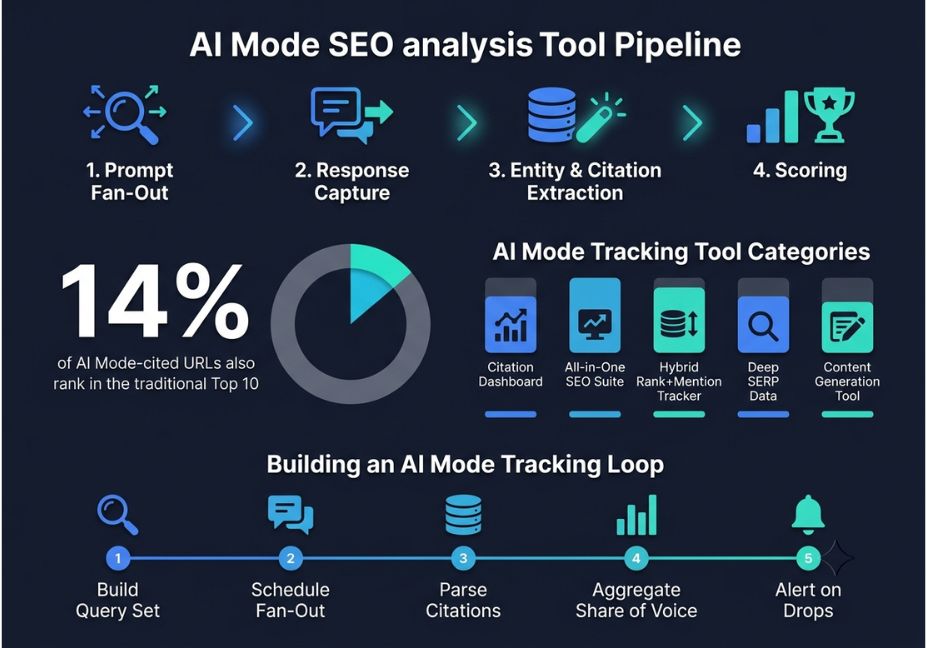
Under the hood, most tools in this category run a variation of the same pipeline. Understanding each stage helps you evaluate whether a tool is doing real analysis or just surface-level scraping.
- Prompt fan-out the tool sends dozens or hundreds of query variations, since a single phrasing rarely reflects real user behavior.
- Response capture it stores the full generated answer, including any citation markers or linked sources.
- Entity and citation extraction an NLP layer identifies which brands, domains, and passages were referenced.
- Scoring the tool calculates brand mention rate, citation position, and sentiment.
Technical Note: This is architecturally close to a RAG evaluation harness. Consequently, many teams building trackers internally lean on a retrieval-augmented pipeline (LangChain docs: https://python.langchain.com/) to reproduce query fan-out and citation parsing, then store extracted passages in a vector store for similarity scoring.
Pro Tip: Don’t just log whether a domain appears. Instead, log where in the response it appears and how much surrounding text supports it position and word count are strong proxies for how much weight the engine gave your content.
AI Mode SEO Analysis Tool Use Cases
- Brand monitoring catching when your brand disappears from AI answers for queries it used to win.
- Competitive share-of-voice comparing citation frequency against named competitors.
- Content gap discovery finding queries where competitors get cited and you don’t.
- Technical SEO validation checking whether schema changes actually move citation rates.
- PR and sentiment tracking flagging negative or inaccurate brand mentions in AI answers.
Best AI Mode SEO Analysis Tools and Frameworks
No single tool does everything well, so the right pick depends on your team size and existing stack. Here’s how the landscape breaks down:
| Tool Category | Example | Best For | Limitation |
|---|---|---|---|
| Citation + visibility dashboard | Cognizo | Combined AI Mode tracking, citation analysis, and content workflow | Newer platform, smaller data history |
| All-in-one SEO suite with AI add-on | Semrush AI Visibility Toolkit | Teams already on Semrush wanting one dashboard | AI Mode module is an add-on, not built-in |
| Hybrid rank + mention tracker | Keyword.com | Best AI mode SEO analysis tool for teams wanting classic rank and AI citation side-by-side | Lighter AI parsing than dedicated tools |
| Deep SERP data | Nozzle | Power users who want raw, granular SERP + AI feature data | Steeper learning curve |
| Content generation + optimization | eesel AI blog writer | Teams that want content built for citation from the start, not just monitored later | Not a pure analysis tool |
Did You Know? Early field research on AI Mode citations found that only about 14% of cited URLs also ranked in the traditional top 10 clear evidence that classic rank tracking and AI Mode visibility measure genuinely different things.
Step-by-Step: How to Build a Basic AI Mode Tracking Loop
If you’d rather prototype a lightweight internal tracker before buying a platform, the core loop is straightforward. Here’s how it works, step by step:
python
import requests

def check_ai_mode_citations(query, target_domain, api_endpoint):
    response = requests.post(api_endpoint, json={"q": query})
    data = response.json()
    citations = data.get("citations", [])
    mentioned = any(target_domain in c.get("url", "") for c in citations)
    position = next(
        (i for i, c in enumerate(citations) if target_domain in c.get("url", "")),
        None
    )
return {"query": query, "mentioned": mentioned, "position": position}- Build a query set that mirrors real user phrasing, not just your target keyword.
- Fan out each query on a schedule, since AI answers shift faster than organic rankings.
- Parse citations and store them with position and surrounding context.
- Aggregate results into a share-of-voice score against named competitors.
- Alert on drops a sudden citation loss is often a stronger signal than a rank change.
Technical Disclaimer: AI Mode response formats change frequently as Google iterates. Therefore, always validate the code above against the current response schema before running it in production.
Common Mistakes and How to Avoid Them
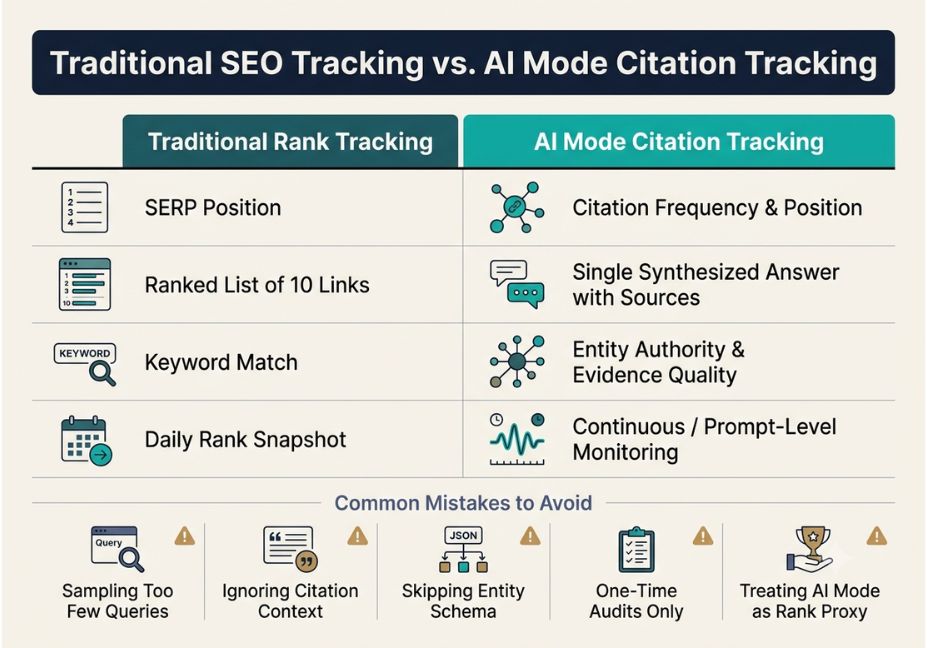
- Treating AI Mode visibility as a proxy for rankings. They correlate loosely at best, so track them separately.
- Sampling too few query variations. A single prompt tells you almost nothing about real citation behavior.
- Ignoring citation context. A negative or inaccurate mention can hurt more than no mention at all.
- Skipping entity and schema work. Sites with complete topic clusters and structured data consistently see higher AI Overview extraction rates.
- Assuming one-time audits are enough. Because AI Mode answers shift week to week, tracking needs to be continuous.
What Developers Are Saying
Builder discussions on citation tracking and GEO tooling are active on developer forums. There, practitioners compare prompt fan-out strategies, vector similarity thresholds for citation matching, and ways to reduce false positives when a competitor’s brand name overlaps with common terms. Reddit’s r/SEO threads on AI Mode tracking are a useful pulse-check on what’s breaking in production, separate from vendor marketing.
FAQ People Also Ask
What is an AI mode SEO analysis tool?
It tracks whether a brand is cited inside AI-generated search answers, measuring citation frequency and position instead of keyword rank.
How is AI Mode different from AI Overviews?
AI Mode replaces the results page with a full conversational experience. AI Overviews, by contrast, sit above traditional results as a summary box.
Can traditional SEO tools track AI Mode visibility?
No. Rank trackers measure blue-link position, which doesn’t predict AI Mode citation. You need a dedicated GEO or citation-tracking tool instead.
Is GEO the same as SEO?
Not quite. SEO optimizes for ranking algorithms, while GEO optimizes content for retrieval and synthesis by generative engines.
How do I improve my citations in Google AI Mode?
Use structured, evidence-dense content with clear entity relationships. The original GEO research paper (arXiv: https://arxiv.org/abs/2311.09735) found this can meaningfully boost visibility in generative engine responses.
What is the best free AI mode SEO analysis tool?
Several vendors, including SEOmator, offer free-tier AI Mode checkers for single-query analysis, though most serious tracking requires a paid plan for scheduled monitoring.
Conclusion
AI Mode SEO analysis tools exist because rank position no longer predicts whether your content reaches the user. The tools worth using combine citation tracking, entity authority scoring, and share-of-voice comparison. Meanwhile, the best internal builds mirror a RAG evaluation pipeline: fan out real query variations, parse citations with context, and track trends over time. Ultimately, whether you buy a platform like Cognizo or prototype your own tracker, treat AI Mode visibility as its own discipline not a rebrand of classic rank tracking.
Bookmark this guide and explore more hands-on AI agent and RAG tutorials at agentiveaiagents.com.
2 Responses