
An AI search visibility tool tracks whether a brand gets mentioned, cited, and accurately described when buyers ask ChatGPT, Perplexity, or Google AI Overviews a purchase-related question. It reports this as a Share of Voice score, alongside citation position and sentiment.
Most SaaS marketing teams buy an AI search visibility tool the same way they bought a rank tracker in 2015. They treat it as a black box that spits out a score. That’s a mistake. Under the hood, every one of these platforms runs the same architecture your engineering team already knows. There’s a retrieval loop that fetches candidate documents. There’s an embedding step that scores relevance. And there’s an LLM that synthesizes a cited answer. Once you understand that pipeline, you can evaluate or even build an AI search visibility system instead of just trusting a dashboard.
This guide breaks down how AI search visibility tools for SaaS companies actually work, where the category’s leading platforms differ, and how to stand up a lightweight monitor of your own.
What Is an AI Search Visibility Tool?
An AI search visibility tool is software that measures whether, how, and how accurately a brand appears when someone asks an AI system like ChatGPT or Perplexity a buying-related question. Instead of tracking blue-link rankings, it reports Share of Voice, citation position, and sentiment across each AI engine.
This shift matters most for SaaS and cloud vendors, because buyers now skip the comparison-site click entirely. AI search is fragmented by nature. ChatGPT, Perplexity, and Google AI Overviews each rank and cite sources differently, so tracking needs engine-specific logic. That said, the strongest platforms normalize this fragmentation into a handful of core signals: Share of Voice, citation analysis, and hallucination or sentiment monitoring.
How Do AI Search Visibility Tools Actually Work?
This is the part every competing listicle skips, and it’s the one your audience actually cares about.
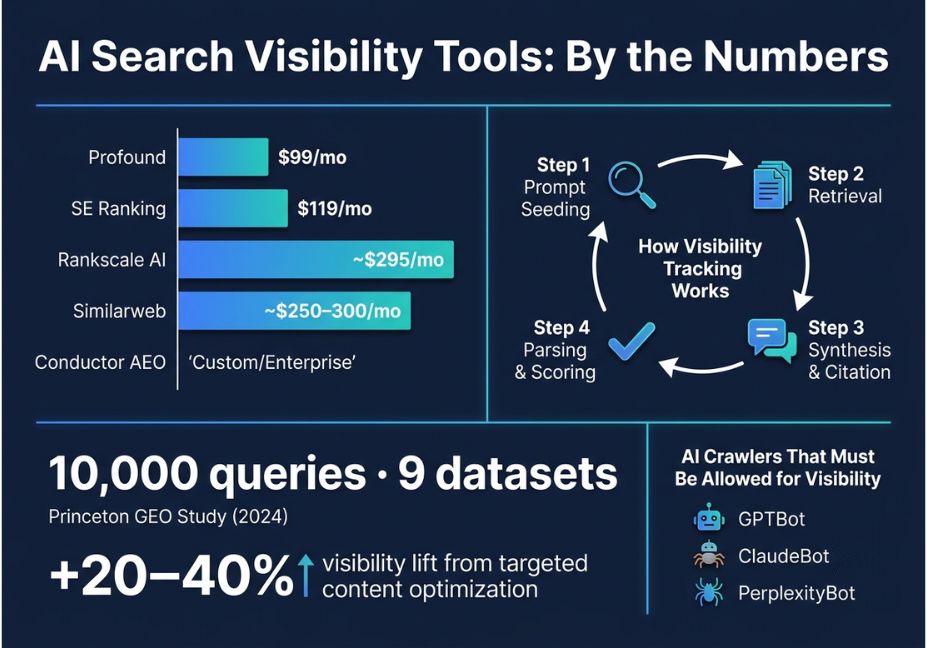
An AI visibility platform runs a variant of the same retrieval-augmented generation (https://en.wikipedia.org/wiki/Retrieval-augmented_generation) loop used in a customer-support RAG bot. The difference is that it’s pointed outward at the open web instead of your internal knowledge base. In short, it works in four steps:
- Prompt seeding the platform runs a batch of real buyer prompts, such as “best AI visibility tool for marketing agencies” or “top cloud logging vendors for Kubernetes,” against each target engine on a fixed cadence.
- Retrieval the underlying engine (ChatGPT, Perplexity, or AI Overviews) retrieves and ranks candidate source documents. This step mirrors how a vector database feeds relevant chunks into a RAG answer using embeddings.
- Synthesis and citation the LLM generates an answer and, depending on the engine, attaches citations back to the source URLs it drew from.
- Parsing the visibility platform scrapes the generated response, extracts brand mentions, sentiment, and citation position, then rolls all of it into a Share of Voice score.
Technical Note: This is exactly the citation-selection problem studied in the Generative Engine Optimization (https://arxiv.org/abs/2311.09735) paper out of Princeton University, later published at ACM SIGKDD. Its GEO-bench framework ran on the order of 10,000 queries across nine datasets. It found that deliberate content changes could shift visibility in generated answers by roughly 20–40 percent a similar order of magnitude to what a good re-ranking tweak achieves for recall@k in an internal RAG system.
Crawler access sits beneath all of this. OpenAI, Anthropic, and Perplexity each run a named crawler GPTBot, ClaudeBot, and PerplexityBot, respectively. Blocking any of them trades away visibility in that engine in exchange for IP protection. So before buying a visibility platform, check your own GPTBot’s crawling behavior (https://platform.openai.com/docs/gptbot) settings in robots.txt. No tool can track citations for a bot you’re already blocking.
AI Search Visibility Use Cases for SaaS Teams
Here are four real scenarios where SaaS and cloud teams put these tools to work:
- Competitive share-of-voice tracking. Compare how often your product, versus three named competitors, gets mentioned when a buyer asks an LLM for a category recommendation.
- Hallucination and misattribution monitoring. Catch cases where an LLM cites an outdated pricing tier, or worse, attributes a competitor’s feature to your product.
- Pitch and prospecting intelligence. Agencies use dedicated pitch workspaces to audit a prospect’s AI visibility before a sales call. As a result, a cold pitch becomes a data-backed one.
- Crawlability auditing. Some platforms score technical AI-readiness and surface concrete crawlability issues. Many of these are fixable directly through common CMS or CDN settings if the site runs on WordPress or Cloudflare.
Best AI Visibility Tools and Frameworks Compared
Pricing and platform coverage below reflect vendor-published information as of mid-2026, and it changes frequently. Verify against current vendor pages before budgeting.
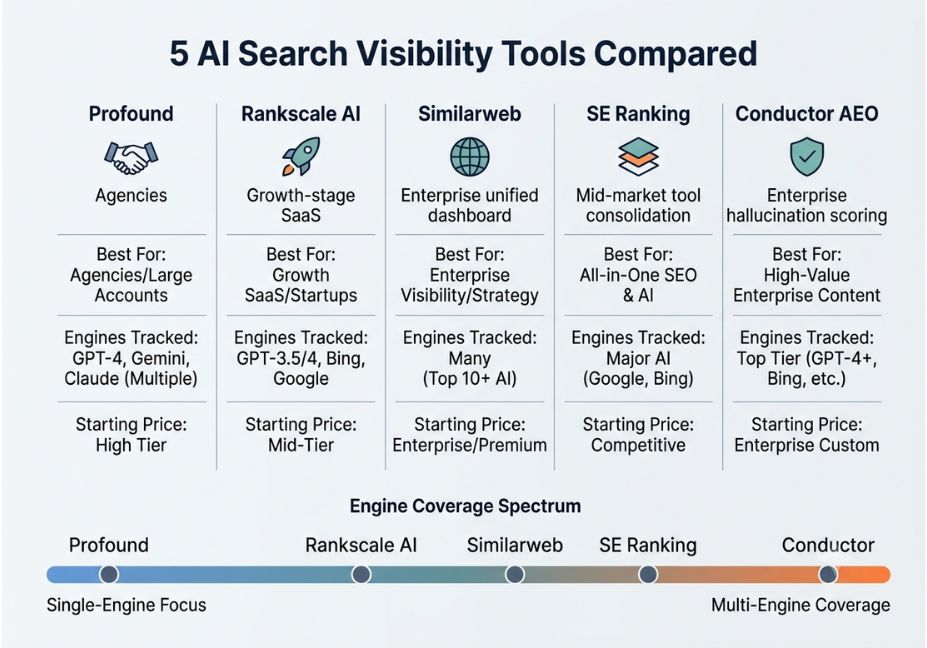
| Tool | Best For | Engines Tracked | Notable Feature | Starting Price |
|---|---|---|---|---|
| Profound | Agencies managing multiple client brands | ChatGPT, Perplexity, AI Overviews | Client pitch workspaces | $99/mo (agency tier) |
| Rankscale AI | Growth-stage SaaS | ChatGPT, Claude, Perplexity, Google AI Overviews | AI Readiness technical audit score | ~$295/mo |
| Similarweb (Agent Experience) | Enterprise teams wanting SEO + AI in one dashboard | Multiple, unified view | Serves a structured, AI-readable version of the site directly to crawlers like GPTBot and ClaudeBot | ~$250–300/mo |
| SE Ranking | Mid-market teams consolidating tool sprawl | Primarily Google AI Overviews and ChatGPT | Generous keyword/URL limits per tier | $119/mo |
| Conductor AEO | Large enterprise content/SEO orgs | Multiple | Scores hallucinations and compares brand description accuracy across AI systems | Custom/enterprise |
Pro Tip: Don’t buy full platform access before running a baseline manually. Several vendors, including Conductor, offer free entry-level tools. Use one first to get a baseline read on your current AI-system standing before you commit budget.
Step-by-Step: How to Build a Lightweight AI Visibility Monitor
You don’t need a $300-a-month platform to get a directional signal. A minimal monitor is just a scheduled prompt batch plus a citation parser. Here’s a starting point:
python
import requests, json, datetime

PROMPTS = [
    "best AI search visibility tools for SaaS companies",
    "top AI visibility tracking platforms 2026",
]
BRAND = "YourBrand"

def run_prompt(prompt: str) -> str:
    resp = requests.post(
        "https://api.anthropic.com/v1/messages",
        headers={"content-type": "application/json"},
        json={
            "model": "claude-sonnet-4-6",
            "max_tokens": 800,
            "messages": [{"role": "user", "content": prompt}],


    return resp.json()["content"][0]["text"]

def log_mentions(prompt: str, answer: str):
    mentioned = BRAND.lower() in answer.lower()
    print(json.dumps
        "date": str(datetime.date.today()),
        "prompt": prompt,
        "brand_mentioned": mentioned,


for p in PROMPTS:
    log_mentions(p, run_prompt(p))
Technical Disclaimer: This is a starting scaffold, not a production monitor. Real platforms de-duplicate phrasing variants, track citation position rather than just presence, and run across multiple engines in parallel. Framework and API details evolve quickly, so check the current API docs before deploying.
Architect’s Note: Store every raw response, not just the parsed mention flag. When an LLM misdescribes your product, you’ll need the full transcript to diagnose whether the problem is your content, a crawler-access gap, or a stale training snapshot.
Common Mistakes and How to Avoid Them
- Blocking AI crawlers, then buying a tracking tool. If GPTBot or ClaudeBot can’t reach your pricing page, no visibility platform will show citations from it.
- Optimizing only your own domain. AI answer engines pull brand signal from across the whole web, not just your own site. Third-party mentions on review sites and forums matter just as much as owned content.
- Treating a single check as ground truth. The only reliable method is running the same batch of real queries on a fixed cadence, then logging what actually gets cited. A one-off spot check tells you almost nothing.
- Skipping structured data. Schema markup, published as legitimate JSON-LD rather than hidden or cloaked text, acts as a connective layer. It tells an AI system explicitly what a piece of content is and how its concepts relate to each other, which materially affects extraction odds.
What Developers Are Saying
The gap between vendor marketing and engineering reality shows up clearly in developers debating AI crawler access (https://www.reddit.com/r/LocalLLaMA/) on r/LocalLLaMA. The recurring theme: visibility tooling is only as good as the underlying crawl-access and content-structure fundamentals. In other words, the dashboard is a reporting layer, not a fix.
FAQ People Also Ask
What is an AI search visibility tool?
It’s software that tracks whether and how a brand appears when users ask AI systems like ChatGPT or Perplexity buying-related questions. It measures Share of Voice, citation position, and sentiment instead of classic search rank.
How is AI search visibility different from traditional SEO?
Traditional SEO optimizes for ranked links a human clicks. AI search visibility, often called AEO or GEO, instead optimizes for whether an LLM retrieves, synthesizes, and cites your content inside a generated answer often with no click at all.
Can AI visibility tools track brand mentions across ChatGPT and Perplexity?
Yes. Most modern platforms run scheduled prompt batches against multiple engines. They then parse each response for brand mentions, citation links, and sentiment.
Do AI visibility tools stop LLMs from hallucinating about my brand?
No. They detect and score hallucinations after the fact. Fixing the root cause, whether that’s stale content, missing schema, or blocked crawlers, is still on you.
How much do AI visibility tools cost?
Published entry pricing in 2026 ranges from roughly $99 a month for agency-tier plans, up to $250 to $300-plus a month for enterprise platforms with broader engine coverage.
Can I build my own AI visibility monitor?
Yes, at a basic level. A scheduled script that runs prompts through an LLM API and parses mentions gets you directional Share-of-Voice data. It won’t match a dedicated platform’s citation-position tracking or multi-engine normalization, though.
Conclusion
AI search visibility tools for SaaS and cloud vendors aren’t a new SEO dashboard skin. They’re monitoring layers wrapped around the same retrieval-and-citation pipeline your own engineering team could build. The fundamentals that move the needle are unglamorous: allow the right crawlers, ship real structured data, and get cited on third-party sources, not just your own domain. So pick a platform based on which engines it actually covers, and whether it audits crawlability, rather than Share of Voice alone.
Bookmark this guide and explore more hands-on RAG and agent-architecture tutorials at agentiveaiagents.com.