

Most teams pick an AI search optimization tool the wrong way. They judge it by dashboard polish, and they never check if the data is correct. That is a mistake. A 2023 Princeton and Georgia Tech study looked at generative engine optimization. It found that AI answer engines do not just rank content. Instead, they synthesize it. As a result, a tool’s real value depends on citation precision, not just visibility.
You may be comparing the most reliable AI search optimization tools for data accuracy in 2025. If so, the key differentiator is not how many large language models a platform tracks. Instead, ask whether the tool can prove when an AI engine misrepresents your brand. It should show a traceable citation, not a vague score. This guide ranks tools on that exact basis. It also gives you a simple method to test any platform’s accuracy claims before you buy.
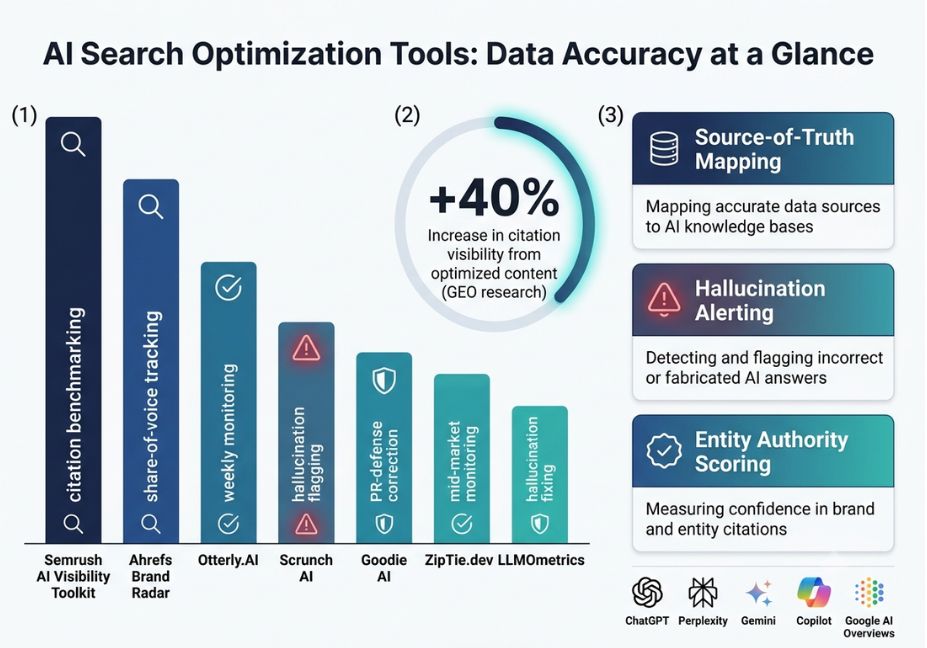
Quick answer: In short, the most reliable AI search optimization tools for data accuracy in 2025 are Semrush AI Visibility Toolkit, Ahrefs Brand Radar, Otterly.AI, Scrunch AI, Goodie AI, ZipTie.dev, and LLMOmetrics. Each tool handles citation precision or hallucination detection differently, so the right pick depends on your need: broad monitoring or dedicated error correction.
What Is AI Search Optimization?
AI search optimization is often called generative engine optimization, or GEO. Specifically, it means structuring content and tracking brand mentions so tools like ChatGPT, Perplexity, and Google AI Overviews cite you accurately. Traditional SEO targets a ranked list of links. In contrast, GEO targets a spot inside a synthesized answer, built through a retrieval-augmented generation pipeline. As a result, there is no link list to click at all.
Data accuracy is the layer most vendors skip. For example, a tool can show high visibility scores, yet still let real errors about your brand spread unchecked. Because of this gap, accuracy monitoring has become its own discipline within GEO, separate from simple mention counting.
How Does Data Accuracy Actually Work in These Tools?
Most AI search optimization platforms run a similar process. First, they send test prompts to target language models. Next, they capture the responses. Finally, they check which sources got cited, and how closely each citation matches the claim.
The accuracy layer is where tools differ most. Specifically, academic research on generative engines defines two key metrics here. Citation precision asks whether citations actually support the model’s claim. Citation recall asks something different: whether every factual claim has a citation at all. Both ideas come from foundational GEO research on citation precision and recall, published on OpenReview (https://openreview.net/pdf?id=NV6rn7j5p5).
Three capabilities matter most for accuracy:
- Source-of-truth mapping — compares what a model says against your verified data, including Wikidata, your own docs, and structured data
- Hallucination alerting — flags a false brand claim right away
- Entity authority scoring — measures something else. It checks whether a model treats you as a trusted expert in your niche. This works much like how Google’s Knowledge Graph builds topical trust
Pro Tip: Ask any vendor to show you a false negative, meaning a real hallucination their tool missed. Vendors happily show detected errors. However, a vendor that cannot show a miss has probably not been stress-tested.
Most of this monitoring runs on a retrieval-augmented generation pipeline (https://en.wikipedia.org/wiki/Retrieval-augmented_generation). Therefore, a tool’s accuracy depends entirely on the data it retrieves from. So, understand that pipeline before you trust any dashboard.
The 7 Most Reliable AI Search Optimization Tools for Data Accuracy
Below is a comparison focused on accuracy and hallucination handling, since most existing roundups skip this and cover general visibility instead. You may be searching for AI search optimization tools with built-in hallucination detection, or the best AI search accuracy tool for a regulated industry. Either way, this table was built for that exact long-tail need.
| Tool | Accuracy Feature | Best For | Multi-LLM Coverage |
|---|---|---|---|
| Semrush AI Visibility Toolkit | Brand sentiment + citation benchmarking across platforms | Teams already on Semrush | ChatGPT, Claude, Perplexity, Copilot |
| Ahrefs Brand Radar | Share-of-voice tracking with citation source breakdown | SEO teams expanding into GEO | Major LLMs via crawl data |
| Otterly.AI | Automated weekly citation and mention monitoring | Lean teams needing a simple dashboard | ChatGPT, Google AI Mode, Perplexity, Gemini, Copilot |
| Scrunch AI | Flags hallucinations and recommends corrections | Regulated/high-risk brands | Cross-platform |
| Goodie AI | Dedicated “PR defense” hallucination detection & correction | Brand reputation teams | Cross-platform |
| ZipTie.dev | Mid-market monitoring + optimization workflow | Growing marketing teams on a budget | ChatGPT, Perplexity, Gemini |
| LLMOmetrics | Purpose-built hallucination fixing | Teams needing correction workflows, not just detection | Cross-platform |
Technical Note: None of these tools remove hallucinations at the model level. Instead, they detect and help fix downstream errors. If you need model-level factual grounding, that is a different problem, one that belongs to retrieval and prompt engineering, not monitoring tools.
Even Google’s own AI Overviews documentation (https://developers.google.com/search/docs/appearance/ai-features) admits something important: AI-generated summaries pull from multiple sources at once, and dynamically. That is exactly why third-party monitoring matters now, since Search Console alone is not enough for accuracy tracking. This is especially true for brands that appear in both Google Discover and AI Overviews.
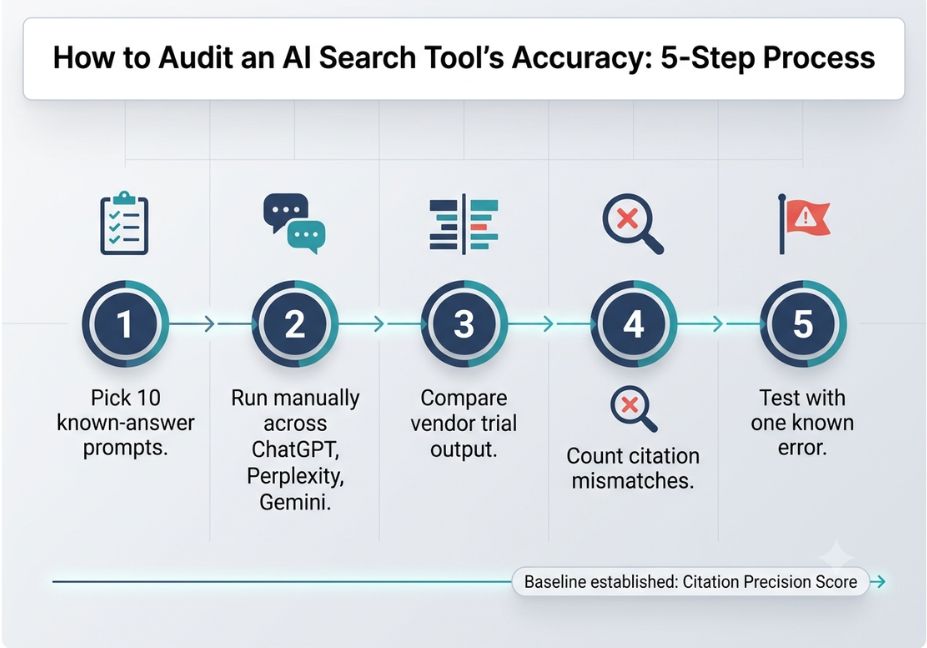
Step-by-Step: How to Audit a Tool’s Accuracy Claims Before You Buy
- Pick ten prompts where you already know the correct answer about your brand.
- Run those prompts manually against ChatGPT, Perplexity, and Gemini, and log the real responses.
- Feed the same prompts into the vendor’s trial, then compare its detected citations against your log.
- Count the mismatches. This becomes your baseline for the tool’s citation precision.
- Introduce one known error, like an outdated pricing page, then check if the tool flags the hallucination during its normal cycle.
Here’s a minimal script for logging raw LLM responses so you have a ground-truth dataset to test any vendor against:
python
import requests

def get_response(prompt, api_key):
    r = requests.post(
        "https://api.anthropic.com/v1/messages",
        headers={"x-api-key": api_key, "content-type": "application/json"},
        json={
            "model": "claude-sonnet-4-6",
            "max_tokens": 500,
            "messages": [{"role": "user", "content": prompt}]
        }
    )
    return r.json()["content"][0]["text"]

prompts = ["What is [Your Brand]'s pricing model?", "Is [Your Brand] open source?"]
baseline = {p: get_response(p, "YOUR_KEY") for p in prompts}
Did You Know? GEO research shows well-optimized content can lift citation visibility by up to 40 percent. That said, this lift means little if the citations are wrong, which is why accuracy auditing should happen before any optimization work begins.
Common Mistakes Teams Make When Evaluating Accuracy Tools
A few mistakes come up again and again:
- Confusing visibility with accuracy. A high mention count says nothing about whether those mentions are correct.
- Ignoring update lag. Some tools batch-check weekly, and a hallucination can spread for days first.
- Skipping the source-of-truth setup. Without correct reference data, accuracy tools cannot catch an AI hallucination (https://en.wikipedia.org/wiki/Hallucination_(artificial_intelligence)) at all.
- Trusting a single model’s output as representative. Different models cite things differently. Audit across at least three models to be safe.
Technical Disclaimer: GEO and AEO tooling evolves rapidly, and platform coverage changes monthly. Feature sets described here reflect vendor positioning as of mid-2025 — verify current capabilities directly with each vendor before purchasing.
Bonus: Optimizing Your Own Content for Voice Search and AI Search
If you also create content, a few habits help both voice search and AI search at once:
- First, answer questions in one direct sentence near the top of a section, since voice assistants and AI engines both favor short, extractable answers.
- Second, use structured data, including FAQPage and Article schema, so search engines and AI crawlers can parse your content’s meaning.
- Third, keep source-of-truth pages current, especially pricing and spec pages, because outdated pages are the most common cause of AI hallucinations about a brand.
FAQ
What is AI search optimization?
AI search optimization, or GEO, means structuring content and tracking mentions so tools like ChatGPT and Perplexity cite you accurately, instead of optimizing for a ranked list of links.
How do AI search tools ensure data accuracy?
They compare model outputs against a verified source-of-truth dataset. Then they score citation precision and recall, and flag hallucinations when a claim contradicts your actual data.
What’s the difference between SEO and GEO?
SEO optimizes for a ranked list of links. GEO optimizes for a citation inside a generated answer. SEO fundamentals like schema still support GEO performance.
Can these tools actually detect hallucinations?
Yes, but reliability varies by vendor. Scrunch AI, Goodie AI, and LLMOmetrics build hallucination detection as a core feature, not an add-on, which tends to make them more reliable for this job.
Is GEO replacing traditional SEO?
No. Site structure, schema, and topical authority remain a prerequisite that GEO builds on top of, rather than a strategy it replaces.
Which AI search optimization tool is best for accuracy specifically?
Scrunch AI and Goodie AI lead on accuracy specifically, since both are built around hallucination detection first, rather than general visibility tracking.
Conclusion
The most reliable AI search optimization tools for data accuracy are not the flashiest ones. Instead, they are the ones that prove their citation precision. They catch hallucinations before those errors spread. And they show you their misses, not just their hits. Start with the audit steps above on any vendor’s trial before you commit budget. Overall, prioritize tools with dedicated accuracy features. Scrunch AI, Goodie AI, and LLMOmetrics are strong picks if brand misrepresentation is your main risk.
Bookmark this guide and explore more hands-on AI agent tutorials at agentiveaiagents.com.