
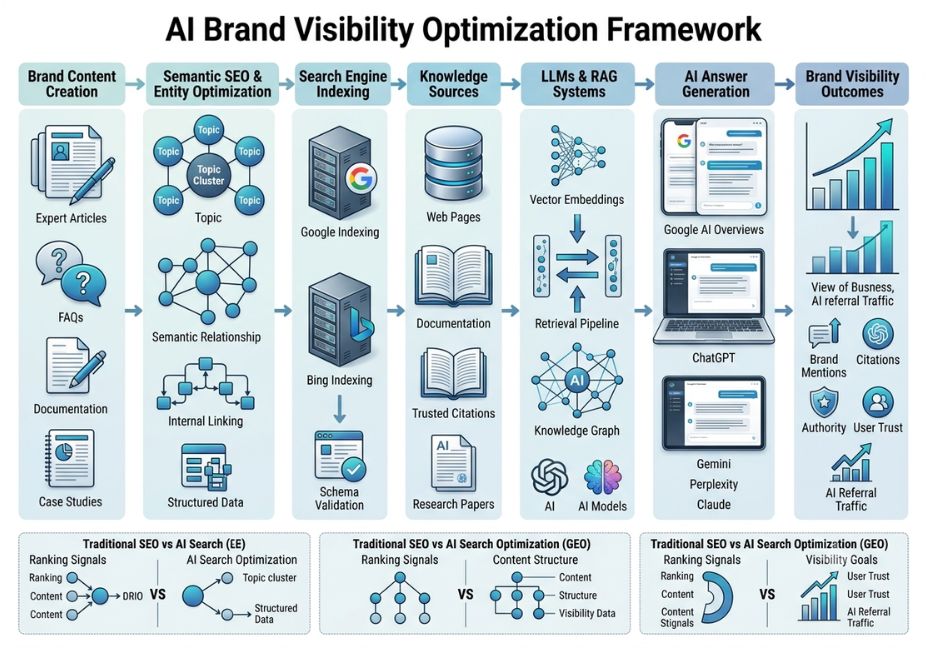
Most brand visibility dashboards can tell you that you were missing from an AI answer. Almost none explain why and that gap is where engineering teams have an edge. A generative engine doesn’t rank your page; it retrieves a handful of sources, summarizes them, and decides whether your brand is worth a sentence. If you understand that pipeline, you can debug it the way you’d debug any retrieval-augmented generation system.
This guide covers the tools for brand visibility in AI answers that marketing and growth teams are actually using in 2026, how the underlying tracking mechanism works, and because this is agentiveaiagents.com a working script for building a lightweight version yourself on top of the OpenAI and Perplexity APIs.
What Is an AI Brand Visibility Tool?
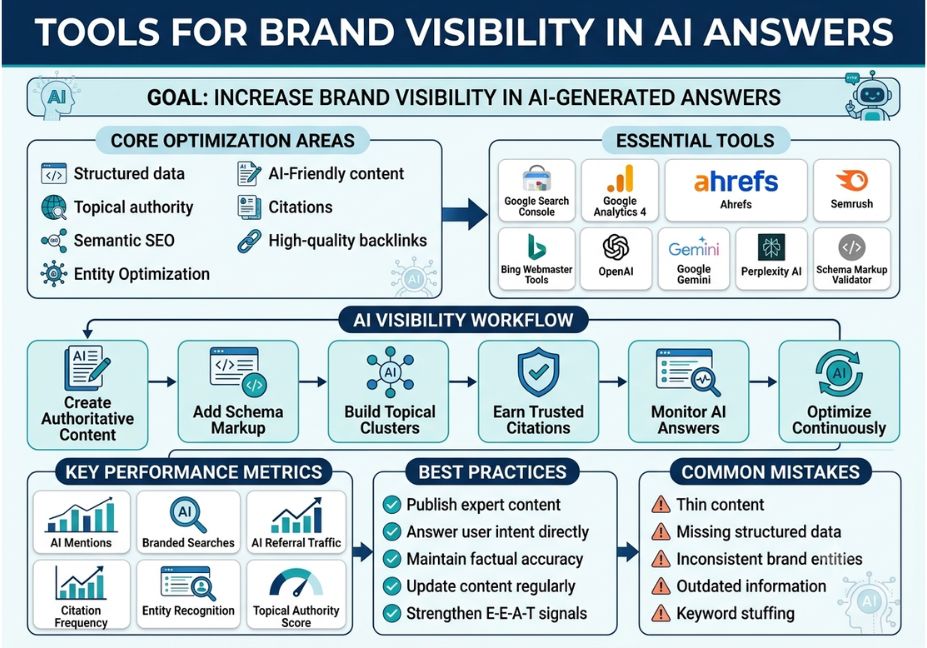
An AI brand visibility tool runs a defined set of prompts against ChatGPT, Perplexity, Gemini, and Google AI Overviews, then records whether your brand is mentioned, cited with a link, or recommended outright. Instead of tracking blue-link rankings, it tracks share of voice inside a synthesized answer.
The underlying research comes from the foundational GEO: Generative Engine Optimization paper, which introduced generative engines as a new paradigm of search that gathers and summarizes information from multiple sources to answer user queries. That paper proposed a black-box optimization framework that measurably shifts what generative engines cite, and reported visibility gains of up to 40% from specific content changes the empirical basis nearly every commercial tool in this space builds on.
How Does Brand Visibility Tracking Work?
Under the hood, every tool in this category runs roughly the same loop, whether it’s a $17/month SaaS dashboard or a script you write yourself:
- Prompt generation a bank of realistic buyer queries (“best CRM for startups,” “top AI visibility platforms”)
- Multi-engine execution the same prompt sent to several LLM endpoints, GUI-scraped or via API
- Response parsing regex/NLP extraction of brand names, URLs, and surrounding sentiment
- Scoring mention rate, citation rate, and position-adjusted “visibility score” aggregated over time
This is functionally a retrieval pipeline wrapped in a monitoring loop the same orchestration layer that powers most RAG pipelines, just pointed at production LLM endpoints instead of a private document store. That framing matters because it explains a real limitation: these platforms track output only what AI platforms show in responses rather than real AI crawler visits to your site, so a rising visibility score doesn’t always mean more crawler traffic.
Pro tip: Run every tracked prompt at least twice per session. AI answers are non-deterministic, and comparing two runs tells you what’s a stable citation versus a coin-flip mention.
Tools for Brand Visibility in AI Answers Categories and Leaders
Rather than one flat list, it’s more useful to group tools by what they actually optimize for.
Enterprise, analyst-driven platforms
- Profound daily multi-engine tracking with an “Agent Analytics” layer that tracks how autonomous AI agents interact with your brand, not just how conversational AI mentions it, plus raw API access for teams that pipe citation data into GA4 or a warehouse.
- Adobe Brand Visibility ties AI citation outcomes back to existing SEO signals in one dashboard, aimed at enterprise marketing orgs already inside the Adobe stack.
- Ahrefs Brand Radar and SE Ranking’s AI Search Toolkit bolt AI-answer tracking onto keyword and backlink data teams already have.
Mid-market, prompt-level trackers
- Peec AI leans into how a brand is described, not just whether it’s named, by interpreting tone, context and narrative patterns in AI responses rather than treating every mention as equal.
- Rankscale a credit-based platform tracking visibility across 17+ AI search engines, with page-level audits and LLM-native prompt research.
- Otterly.AI straightforward prompt tracking over time, popular with smaller teams that want fewer knobs.
Budget and DIY-adjacent
- LLMrefs, ZipTie, Geneo cheap entry points for solo marketers or freelancers who need a directional score without enterprise reporting.
- Free checkers Semrush’s AI Search Visibility Checker and similar no-signup tools give a one-time snapshot, useful for a quick sanity check before committing budget.
Did you know? Reports on generative discovery consistently cite the same pattern: brands surfaced inside an AI answer convert markedly better than brands found through a traditional search results page, because the AI has already done the filtering work for the buyer.
Comparison: Choosing by Use Case
| Tool | Best for | Multi-engine coverage | API/export | Approx. entry price |
|---|---|---|---|---|
| Profound | Enterprise, technical teams | ChatGPT, Perplexity, AI Overviews, up to 10 engines | Yes | ~$82.50/mo (annual) |
| Rankscale | Budget-conscious, broad engine list | 17+ engines including DeepSeek, Grok, Mistral | API on paid tiers | ~$17–20/mo |
| Peec AI | Narrative/sentiment analysis | 3 models per project | Limited | Mid-tier |
| Otterly.AI | Simple prompt tracking | ChatGPT, Perplexity, Gemini | Basic | ~$29/mo |
| Adobe Brand Visibility | Enterprise SEO+AI unification | Major engines | Yes, native integrations | Enterprise |
Step-by-Step: Build a Minimal AI Visibility Checker
Commercial tools are worth it once you’re tracking dozens of prompts across engines with reporting attached. But a DIY checker built on the Perplexity API costs roughly a penny per query, meaning a full 20-prompt monthly audit runs well under a dollar a reasonable first step before buying a subscription.
Technical disclaimer: The snippet below uses the OpenAI Python SDK conventions current as of mid-2026. Always check the official docs for the latest method signatures before deploying to production.
python
import os
from openai import OpenAI

client = OpenAI(api_key=os.environ["OPENAI_API_KEY"])

BRAND = "YourBrand"
PROMPTS = [
    "What are the best AI visibility tracking tools?",
    "Recommend a tool to monitor brand mentions in ChatGPT answers.",


def check_visibility(prompt: str) -> dict:
    response = client.chat.completions.create
        model="gpt-4.1",
        messages=[{"role": "user", "content": prompt}],

    text = response.choices[0].message.content
    mentioned = BRAND.lower in text.lower
    return {"prompt": prompt, "mentioned": mentioned, "response": text}

results = [check_visibility(p) for p in PROMPTS]
for r in results:
    print(f"[{'HIT' if r['mentioned'] else 'MISS'}] {r['prompt']}")
This hits the same chat completions endpoint you’d use for any other LLM app, so extending it to Anthropic’s or Perplexity’s SDK is a drop-in swap. To scale past a handful of prompts:
- Store each response in a vector store (Pinecone, pgvector) so you can later query “which competitor names co-occur with mine”
- Wrap the loop in a scheduler (cron, GitHub Actions) for weekly runs
- Log sentiment with a second LLM call rather than keyword matching alone
If you’d rather not build from scratch, several self-hosted, BYOK alternatives already exist on GitHub for teams that want to avoid vendor lock-in on citation data.
Common Mistakes and How to Avoid Them
- Treating a mention and a citation as the same signal. A mention means your brand is named; a citation means the engine linked your URL as a source the latter is the stronger signal for actual traffic.
- Running a prompt once and trusting the result. Generative answers are stochastic; single-run scores are noisy.
- Ignoring the underlying retrieval gap. If your content isn’t indexed or crawlable in the first place, no amount of prompt tuning will fix visibility check technical crawlability before optimizing copy.
- Comparing raw visibility scores across tools. Each platform defines “visibility score” differently, so a 62 on one dashboard isn’t comparable to a 62 on another.
What Developers Are Saying
Engineering-adjacent marketers increasingly frame this as a monitoring-and-observability problem rather than a pure content problem closer to instrumenting an API than writing copy. Discussion threads on r/SEO and similar developer-facing forums repeatedly note that teams treating AI visibility like uptime monitoring scheduled runs, logged history, alerting on drops get more actionable signal than teams checking a dashboard once a month.
FAQ People Also Ask
What is an AI brand visibility tool?
An AI brand visibility tool runs test prompts through generative engines like ChatGPT and Perplexity to measure whether, how often, and how favorably your brand appears in the resulting answers, tracking this as a share of voice metric over time.
How do these tools track brand mentions in ChatGPT?
They send a fixed set of prompts to the model’s API or interface on a recurring schedule, parse the response text for brand names and URLs, then score mention frequency, position, and sentiment across runs.
What’s the difference between a mention and a citation?
A mention is your brand named in the answer text; a citation is the engine linking your specific URL as a source. Citation tracking is generally the stronger signal because it reveals which content actually feeds the answer.
Can I track AI visibility for free?
Yes free tools like Semrush’s AI Search Visibility Checker give a one-time snapshot, and a DIY script against the OpenAI or Perplexity API can run a small prompt set for well under a dollar a month.
How much do AI visibility tools cost?
Entry-level plans start around $17–29/month for a handful of prompts and models; enterprise platforms with full API access and multi-engine coverage run from roughly $80/month into the hundreds.
Do these tools work for small businesses?
Yes, though budget tools like Otterly, Rankscale, or LLMrefs are usually a better fit than enterprise platforms, since small businesses need fewer tracked prompts and less reporting overhead.
Conclusion
Tools for brand visibility in AI answers fall into three practical tiers: enterprise platforms with API access and agent-level analytics, mid-market prompt trackers built for marketing teams, and a DIY layer you can build yourself once you understand the retrieval-and-citation loop underneath every dashboard. Start by distinguishing mentions from citations, run every prompt more than once, and treat this like any other monitoring system you’d instrument.
Bookmark this guide and explore more hands-on agentic AI tutorials at agentiveaiagents.com.
One Response