
Most teams building on top of LangChain or LlamaIndex have spent the last year optimizing tool-use loops and retrieval accuracy. However, almost none of them have applied that same rigor to whether their own content gets retrieved. That’s the blind spot: AI search visibility is now a retrieval problem, not just a marketing dashboard problem, and the tools built to measure it are only half the story.
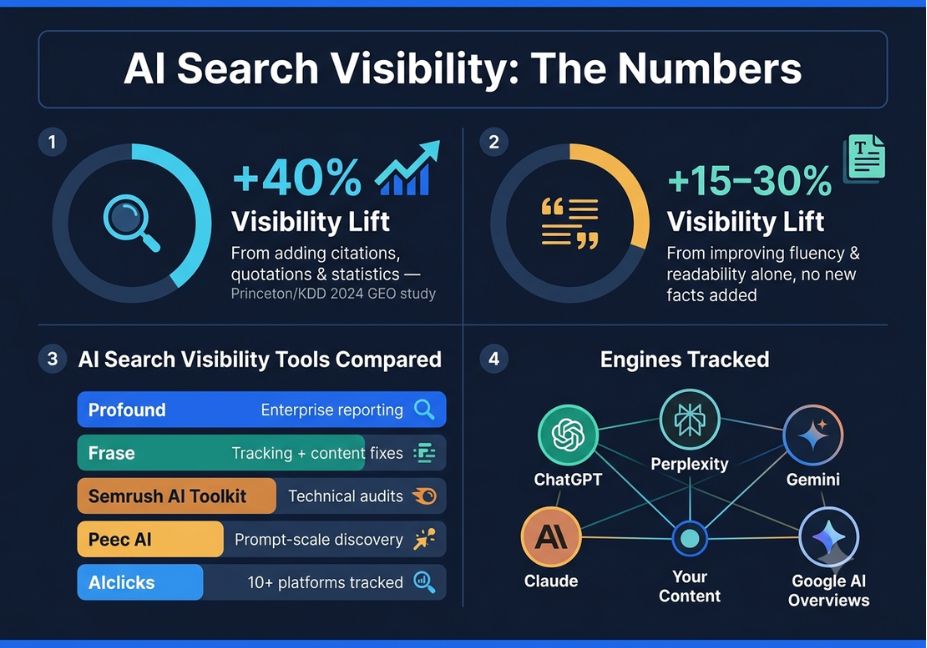
A 2024 Princeton/KDD study on generative engine optimization found that adding citations, quotations, and statistics to a page could lift its visibility in AI-generated answers by up to 40%. If you build retrieval pipelines for a living, that number should look familiar, because it’s the same lever you pull when you improve chunking and re-ranking in your own RAG stack. This guide covers the best tools for tracking AI search visibility, the mechanics behind why content gets cited, and how to actually improve your website’s visibility in AI search results.
Quick answer: Tools for AI search visibility such as Profound, Frase, Semrush AI Toolkit, Peec AI, and AIclicks track how often ChatGPT, Perplexity, Gemini, Claude, and Google AI Overviews cite or mention a brand. The strongest ones also diagnose why a page was skipped, so you can fix retrieval and citation issues instead of just watching a score.
What Is AI Search Visibility?
AI search visibility measures how often, and how favorably, a brand or piece of content is surfaced inside AI-generated answers ChatGPT, Perplexity, Gemini, Claude, Google AI Overviews, and AI Mode rather than how it ranks on a traditional results page. In short, the discipline that studies this is known as generative engine optimization (GEO), sometimes called answer engine optimization (AEO) or AI optimization (AIO), and it treats content structure itself as the lever for improving how often a source gets surfaced in AI-generated responses.
Unlike classic SEO, where average ranking position is the north star metric, generative engines return a single synthesized text block with inline citations. As a result, visibility becomes inherently probabilistic: a source can be retrieved, summarized, paraphrased without attribution, or ignored entirely, depending on the engine’s retrieval and ranking layer. This is precisely why so many teams start asking how to improve their website’s visibility in AI search results only after noticing a drop in referral traffic, not before.
Because generative engines lean on the same building blocks as any retrieval-augmented generation system semantic search, vector embeddings, a knowledge graph of related entities, and a context window that limits how much text can be considered at once the underlying entities matter as much as the wording. Companies like OpenAI, Google DeepMind, Anthropic, and Microsoft all publish guidance on how their assistants (Copilot included) prefer to consume content, and that guidance increasingly overlaps with W3C and Schema.org structured-data standards.
Pro Tip: Think of every AI search engine as a RAG pipeline you don’t control. Your content is the corpus; the engine’s retriever decides whether your chunk gets pulled into context.
How Does AI Search Visibility Work?
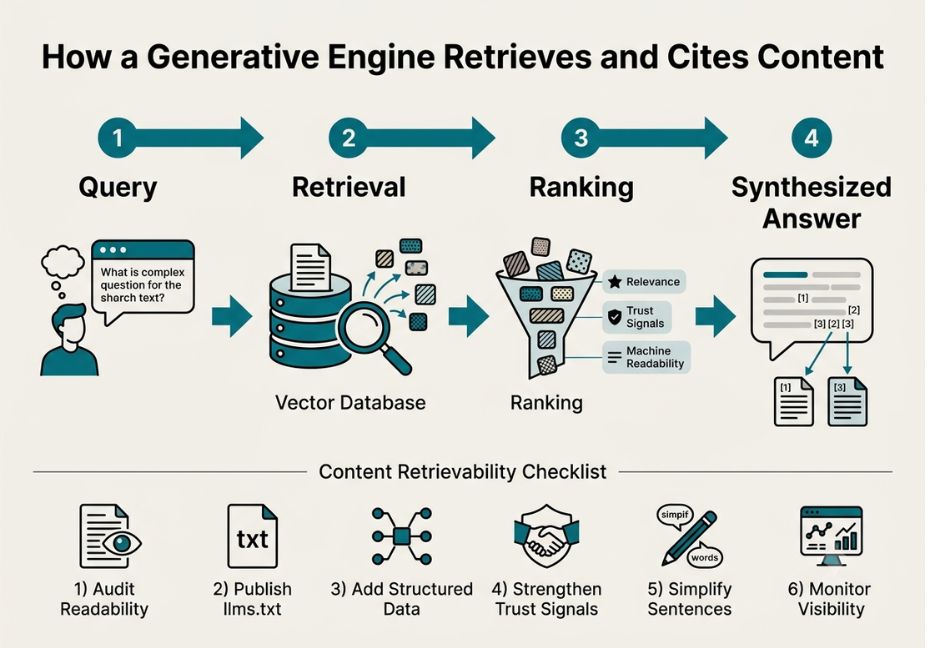
Generative engines don’t crawl-and-rank the way Google’s classic algorithm does. Instead, they run something closer to a retrieval-augmented generation pipeline: a query triggers document retrieval (via search index, vector store, or live crawl), the retrieved passages get ranked by relevance and trust signals, and an LLM synthesizes an answer with inline citations. In other words, how do AI agents decide what to cite? Mostly by scoring passages the same way your own retriever scores chunks on relevance, freshness, and trustworthiness.
Researchers first formalized this shift in a foundational paper that introduced a black-box optimization framework for generative engines, arguing that as engines synthesize answers from multiple sources rather than ranking pages, content creators need an entirely new way to compete for citation. That paper’s benchmark, GEO-bench, remains the reference dataset most later GEO research builds on, and it’s still the closest thing this space has to a peer-reviewed ground truth.
Consequently, three technical factors consistently drive citation behavior:
- Chunk-level relevance how cleanly a passage answers a specific query without requiring surrounding context
- Trust signals citations, statistics, expert quotes, and authoritative tone embedded in the source text
- Machine readability clean HTML, structured data, and increasingly, dedicated files like llms.txt that give AI crawlers a distilled map of a site’s content
Did You Know? The same KDD study found that improving fluency and readability alone — with no new facts added produced a 15–30% visibility lift, suggesting generative engines weight text quality independently of factual density.
Best Tools for AI Search Visibility Comparison
If you’re comparing the best tools to track AI search visibility in 2026, here’s how the major platforms stack up on the dimensions that matter most to a technical team: engine coverage, whether they explain why a page failed to be cited, and whether they connect to your actual publishing workflow.
| Tool | Engine Coverage | Diagnoses Citation Failures | Best For |
|---|---|---|---|
| Profound | ChatGPT, Perplexity, Gemini, AI Overviews | Enterprise-depth reporting | Large agencies and enterprise brand teams |
| Frase | ChatGPT, Perplexity, Claude, Gemini | Connects tracking to content fixes in one workflow | Teams that want monitoring + rewriting in one tool |
| Semrush AI Toolkit | ChatGPT, Gemini, AI Mode, AI Overviews | Site-level technical audits for AI crawler blockers | Teams already inside the Semrush ecosystem |
| Peec AI | Multi-engine, large prompt sets | Prompt-level discovery at scale | Teams tracking thousands of long-tail prompts |
| AIclicks | 10+ platforms including Grok, DeepSeek, Copilot | Ties visibility to GA traffic | Agencies managing many client brands |
Step-by-Step: Making Your Content Retrievable by AI Agents
- Audit machine readability first. Strip out navigation clutter, ensure semantic HTML (
<h2>,<h3>, lists), and confirm your server doesn’t block known AI crawler user agents (GPTBot, ClaudeBot, PerplexityBot). - Publish an
llms.txtfile. This is a Markdown file at your site root that gives AI systems a curated map of your key pages part of the emerging llms.txt standard, proposed in late 2024 so AI assistants can quickly identify a site’s most useful pages for summaries and citations without crawling the entire site. - Add structured data. JSON-LD schema for articles, products, and FAQs reduces ambiguity for both search crawlers and LLM-based retrievers.
- Strengthen trust signals in-text. Cite real sources, add relevant statistics, and use direct quotes from named experts the exact levers the GEO benchmark found most effective.
- Simplify sentence structure. Shorter, cleaner sentences retrieve and paraphrase more reliably than dense, jargon-heavy paragraphs.
- Monitor with a visibility tool. Track citation frequency across engines using one of the platforms above, and treat drops as a signal to re-audit chunk-level relevance.
python
# Quick check: does your site expose an llms.txt file?
import requests

def check_llms_txt(domain: str) -> bool:
    url = f"https://{domain}/llms.txt"
    resp = requests.get(url, timeout=5)
    return resp.status_code == 200 and "text/" in resp.headers.get("Content-Type", "")

print(check_llms_txt("agentiveaiagents.com"))
Technical Disclaimer: llms.txt is a proposed, not official, standard. Google has stated it is not a ranking factor for Search, while Anthropic and Perplexity have shown more direct support. Confirm current adoption before treating it as a guaranteed visibility lever.
Common Mistakes and How to Avoid Them
- Optimizing for keyword density instead of citability. Generative engines reward authoritative, quotable, well-sourced text not keyword-stuffed pages. The original GEO researchers tested keyword stuffing directly and found it largely ineffective, while adding citations and quotations produced much stronger visibility gains.
- Ignoring engine-specific behavior. A brand can rank well in ChatGPT and be nearly invisible in Gemini or Perplexity because each engine’s retriever and source preferences differ.
- Treating llms.txt as a silver bullet. It’s a readability aid, not a ranking guarantee pair it with clean HTML and structured data.
- Skipping schema validation. Mismatched pricing, stock status, or outdated facts between your structured data and visible page content erode an engine’s trust in your source.
What Developers Are Saying
Engineers working on retrieval systems increasingly describe GEO as an extension of their day job. An actively maintained GEO research index tracking papers on instruction fusion, ranking manipulation, and citation-source analysis across generative engines has grown rapidly since 2024, reflecting how fast the academic side of this field is moving alongside the commercial tooling.
Related Reading on agentiveaiagents.com
AI search visibility sits at the intersection of a few topics this site already covers in depth. For background on the retrieval side of the equation, see our guides on building RAG pipelines with vector embeddings, designing tool-use loops with LangChain and LlamaIndex, and choosing a vector store for production agents. Together, these pieces build the topical authority that makes a domain like agentiveaiagents.com a trusted entity for AI-agent and retrieval topics — for both human readers and the generative engines summarizing them.
FAQ People Also Ask
What is GEO (Generative Engine Optimization)?
GEO is the practice of structuring content through citations, statistics, clear language, and structured data to increase the odds it gets retrieved and cited by AI systems like ChatGPT, Perplexity, and Google AI Overviews, rather than just ranked on a search results page.
How can I check if my website shows up in AI search results?
Ask ChatGPT, Perplexity, or Gemini a question your content answers, and see if your domain is cited. For scale, use a visibility tool like Profound, Frase, or Semrush AI Toolkit to test hundreds of prompts automatically and track citation frequency over time.
How is AI search visibility different from traditional SEO?
Traditional SEO optimizes for ranking position on a results page; AI search visibility optimizes for whether your content is retrieved, summarized, and cited inside a single synthesized AI answer, which depends on retrieval relevance and trust signals rather than backlinks alone.
Do I need an llms.txt file?
It’s not required, but it’s low-effort: a Markdown file at your site root that gives AI crawlers a clean map of your most important pages, similar in spirit to a sitemap but written for LLM comprehension rather than URL discovery.
Can AI agents cite my content without sending me traffic?
Yes. Generative engines often synthesize an answer from multiple sources in one text block, so a citation may appear without generating a click — which is why visibility tools track citation frequency as a separate metric from referral traffic.
Which AI platforms should I track first?
Start with whichever engines your buyers actually use — most teams begin with ChatGPT and Google AI Overviews given their scale, then expand to Perplexity, Gemini, and Claude as budget allows.
Conclusion
Ultimately, AI search visibility isn’t a single dashboard metric it’s the output of a retrieval pipeline you don’t own, shaped by trust signals, machine-readable structure, and citation behavior that varies by engine. The tools above give you the monitoring layer; llms.txt, structured data, and citation-rich writing give you the levers to actually move the number. So, treat every generative engine like a RAG system evaluating your content as a candidate chunk, and optimize accordingly.
Bookmark this guide and explore more hands-on AI agent and RAG tutorials at agentiveaiagents.com.