
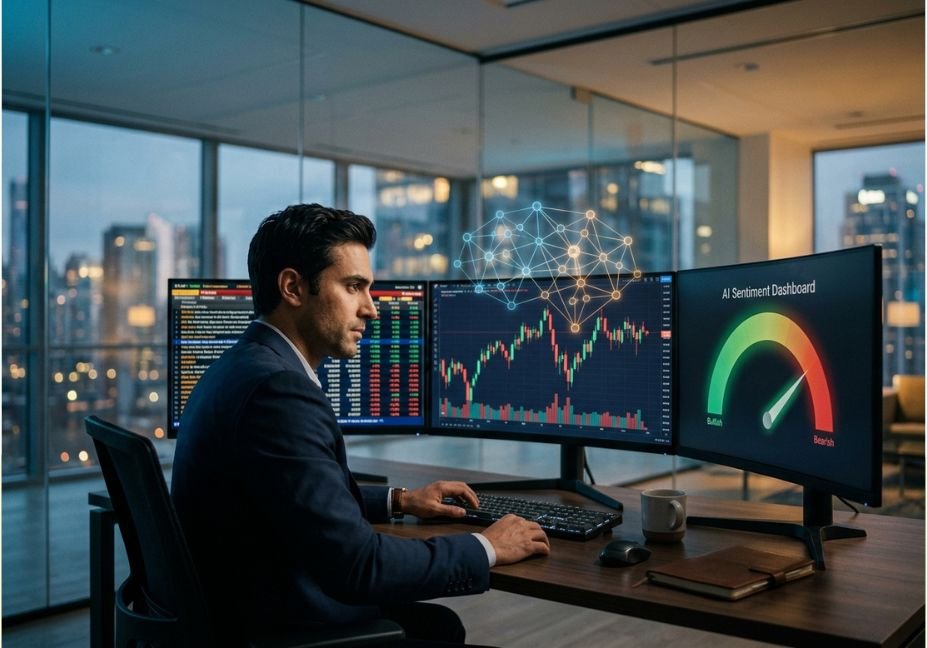
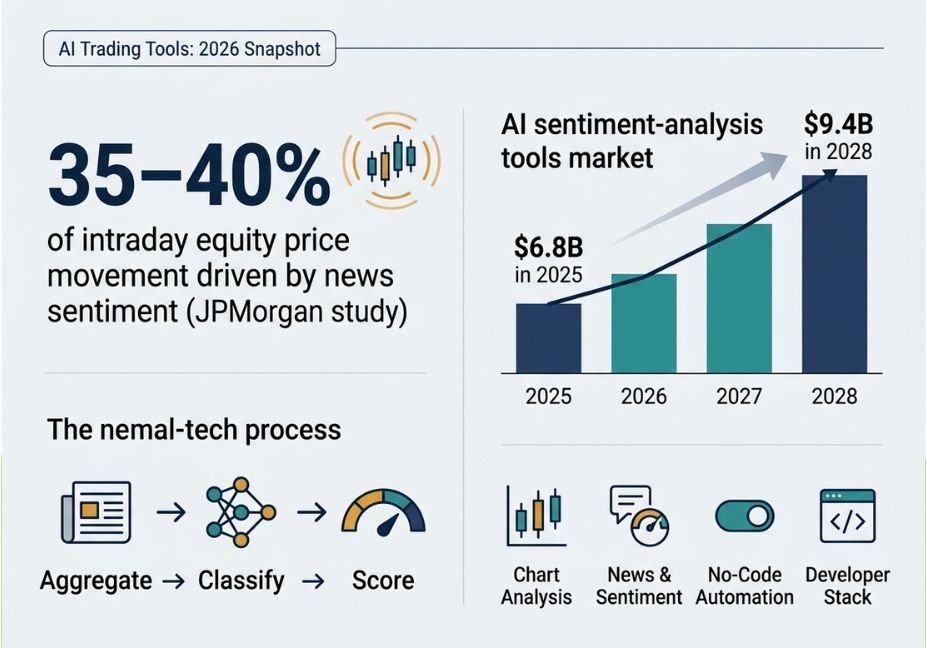
Most retail traders don’t lose money because their charting setup is wrong. Instead, they lose it because they read the news three days too late. A JPMorgan market-microstructure study estimated that news sentiment now drives roughly 35–40% of intraday price movement in US equities. As a result, that gap is exactly what AI trading tools are built to close. By 2026, the category had split into four distinct lanes: large language models, chart-analysis platforms, no-code automated systems, and API-first quant stacks. Meanwhile, the fastest-moving news in the space is coming out of the sentiment-analysis corner.
This guide breaks down what’s actually changed this year, how the underlying sentiment analysis and automation pipelines work, and how to wire one into your own workflow. Rather than another list of app names, it includes a working code example you can adapt today.
Quick answer: AI trading tools are software platforms that use machine learning, natural language processing, or large language models to analyze market news and data, generate trade ideas, backtest strategies, or automate order execution. In 2026, the biggest AI trading tools news is the shift of news-sentiment scoring from a niche institutional technique into a standard, often free, part of the retail trading toolkit.
What Is an AI Trading Tool?
An AI trading tool is a software platform that uses machine learning, natural language processing, or large language models to analyze market data and news, generate trade ideas, backtest strategies, or execute orders. In other words, it does in seconds what used to take a human analyst hours. This sits inside the broader field of algorithmic trading, where rules-based systems some AI-driven, some not replace manual chart-watching.
However, these tools are not a crystal ball. They compress hours of manual analysis into seconds, but none of them predict price with certainty, and none are licensed to give investment advice.
Did you know? The global market for AI-powered sentiment analysis tools crossed $6.8 billion in 2025 and is projected to reach $9.4 billion by 2028.
How Do AI Trading Tools Work?
Most news-and-sentiment tools follow the same three-stage pipeline: aggregate, classify, and score.
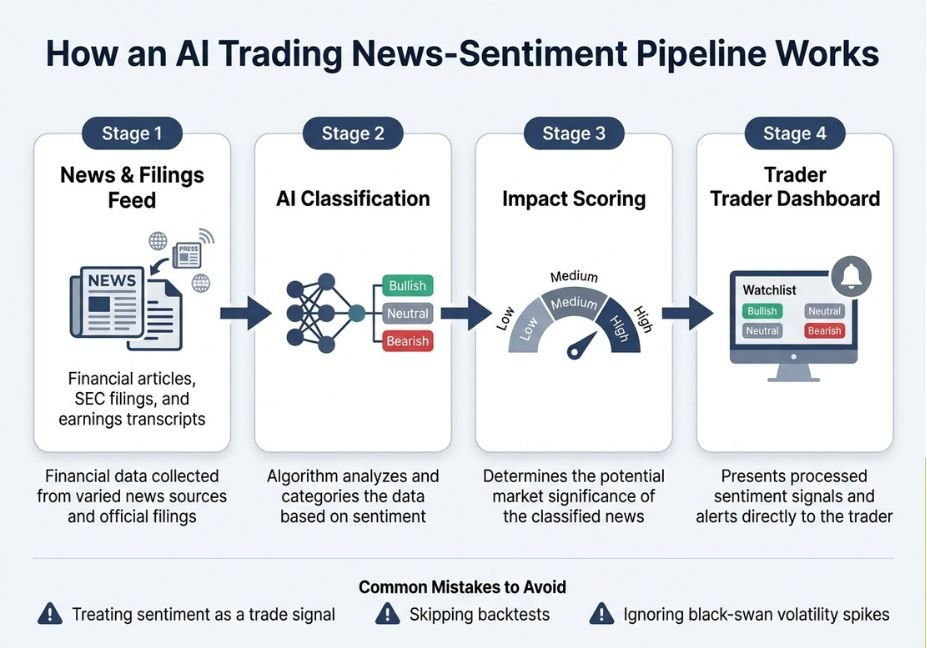
- Aggregation the platform pulls in financial articles, SEC filings, and earnings transcripts from wire services such as Reuters, Bloomberg, and CNBC in real time.
- Classification a language model or a purpose-built classifier like the FinBERT sentiment model tags each piece as bullish, neutral, or bearish.
- Impact scoring the system estimates how significant the news actually is, usually on a low/medium/high scale. Therefore, a routine 8-K filing doesn’t get weighted the same as a surprise guidance cut.
Architect’s Note: A 2024 study in Big Data and Cognitive Computing compared FinBERT, GPT-4, and logistic regression on sentiment-prediction tasks. Consequently, this is a useful reminder that “AI trading tool” can mean anything from a lightweight classifier to a full LLM doing analyst-style reasoning — and the two behave very differently under volatility, for example around Federal Reserve rate announcements.
What’s New in AI Trading Tools News for 2026?
A few shifts define this year’s coverage:
- Retail adoption has broadened. Automated trading tools used to be mostly institutional; now no-code strategy builders, AI signals, and broker-connected scanners are standard retail kit.
- LLMs have entered the sentiment stack directly. Several 2026 tools now run live web search through general-purpose models to produce analyst-style buy, sell, or hold summaries instead of a bare sentiment score.
- Agentic coding tools are being used to build trading systems. As a result, developer-facing agent tools have made it noticeably easier for individual traders to spin up custom automated strategies without a quant background.
- Convergence across asset classes. Platforms that used to specialize in either crypto or equities are now building unified dashboards that cover crypto, stocks, and ETFs — including major benchmarks like the S&P 500 and Nasdaq — in one interface.
Pro Tip: If a tool markets “guaranteed signals” or promises to beat the market every month, treat that as a red flag rather than a feature. So far, no platform in this space has a verified track record of consistent outperformance.
What Are the Best AI Trading Tools in 2026?
The tools below cover the four main buckets: chart analysis, sentiment and news, automated execution, and developer-first stacks. Because each trader’s needs differ, match the tool to your workflow rather than to whichever name is loudest online.
| Tool | Category | Best For | Coding Required |
|---|---|---|---|
| TrendSpider | Chart analysis | Automated technical scans and backtesting | No |
| Trade Ideas | Chart analysis | Real-time day-trading alerts | No |
| Stock Titan / NowNews-style tools | News & sentiment | Real-time headline sentiment tied to price charts | No |
| Composer / Tickeron | No-code automation | Rules-based rebalancing without writing code | No |
| QuantConnect | Developer stack | Custom strategy backtesting and live deployment | Yes |
| Alpaca | Developer stack | Broker API for programmatic execution | Yes |
| General-purpose LLMs (via Claude’s API documentation) | Analysis / reasoning | Narrative-style market summaries and research | Yes (light) |
Technical Disclaimer: Framework versions and pricing tiers change quickly in this space. Therefore, verify current API limits and terms directly on each provider’s site before building anything on top of them.
How Do You Add an AI News-Sentiment Signal to Your Trading Workflow?
You don’t need a hedge-fund budget to test a sentiment overlay. Here’s a minimal version, step by step:
- Pick a data source. Use a news API or RSS feed for your target tickers.
- Run each headline through a classifier. For instance, a hosted LLM or a model like FinBERT both work well for a first pass.
- Attach the score to your existing strategy as a filter. For example, block new long entries when sentiment on that ticker just flipped bearish.
- Backtest before you trust it. Tools like the open-source LEAN backtesting engine let you validate the sentiment filter against historical data before risking capital.
python
import requests

def classify_headline(headline: str) -> str:
    """Send a headline to a hosted LLM and return a bull/neutral/bear tag."""
    response = requests.post
        "https://api.anthropic.com/v1/messages",
        headers={"Content-Type": "application/json"},
        json=
            "model": "claude-sonnet-4-6",
            "max_tokens": 50,
            "messages":
                "role": "user",
                "content": f"Classify this headline as Bullish, Neutral, or "
                            f"Bearish for the mentioned stock. One word only: {headline}"


    return response.json()["content"][0]["text"].strip()

# Example
tag = classify_headline("Company X beats earnings estimates, raises full-year guidance")
print(tag)  # Bullish
Once that works, wrap the function in a loop over your watchlist, log the scores, and compare them against next-day price moves before you let the signal touch live orders.
Common Mistakes and How to Avoid Them
- Treating a sentiment score as a trade signal instead of a research input. A bearish tag tells you to investigate, not to sell automatically.
- Skipping backtests on the sentiment filter itself. Otherwise, a strategy can look fine on price alone and fall apart once a noisy sentiment feed is bolted on.
- Running real-time feeds when you’re a swing trader. In most cases, daily snapshots are enough for multi-day holds, while real-time feeds mostly matter for intraday trading.
- Ignoring black-swan behavior. Accuracy on any AI trading tool tends to collapse during sudden, high-volatility events, so plan risk limits accordingly.
What Are Traders Saying About AI Trading Tools?
Developer and trader communities on Reddit’s r/algotrading and r/LocalLLaMA remain a useful gut-check on which tools are actually reliable versus which are marketing-heavy. That’s because threads there tend to surface real drawdown numbers and API quirks that vendor pages leave out.
FAQ — People Also Ask
What is the difference between AI trading tools and trading bots?
An AI trading tool is the broader category — it can generate ideas, score sentiment, or scan charts. A trading bot, by contrast, is a subset that specifically automates order execution based on rules or AI-generated signals, without requiring a human to click “buy.”
Are AI trading tools free?
Yes, some are. Several sentiment and news-analysis tools offer usable free tiers, while advanced backtesting, real-time data, and API access are typically gated behind paid plans.
Can AI predict stock market movements accurately?
Not reliably. Research suggests AI models edge out human analysts in a slim majority of predictions, but no tool has demonstrated consistent, guaranteed outperformance, especially during sudden volatility.
Is AI trading legal for retail investors?
Yes, in most jurisdictions. That said, brokers and exchanges may have their own rules on automated order flow, and none of these platforms are licensed investment advisors, so trades remain the user’s responsibility.
How do AI sentiment analysis tools work for stocks?
They pull financial news and filings in real time, run the text through a classifier or language model to tag it bullish, neutral, or bearish, and often attach an impact score. As a result, traders can prioritize which headlines actually matter instead of reading every one.
What are the best AI trading tools for beginners?
For beginners, no-code platforms like Stock Titan-style sentiment tools or Composer for automated rebalancing are usually the easiest starting point, since they don’t require writing or maintaining code.
Conclusion
Overall, the biggest AI trading tools news of 2026 isn’t a single new app. Instead, it’s the shift of sentiment scoring from a niche quant technique into a standard part of the retail toolkit, alongside language models taking on more of the narrative-analysis work that used to require a research desk. Whichever tool you pick, use it to compress research time and flag what deserves a closer look, not as a replacement for your own judgment on risk. Bookmark this guide and explore more hands-on AI agent tutorials at agentiveaiagents.com.