
A production agent that quietly calls an internal API it was never approved to touch isn’t a hypothetical it’s the default failure mode of ungoverned AI. Enterprises now run hundreds of models and agents across cloud providers, and most compliance teams can’t even produce an accurate inventory of what’s live. That gap is why AI model governance tools have moved from a compliance nice-to-have to a production requirement, especially as regulators tie real penalties to the NIST AI Risk Management Framework and the EU AI Act’s risk tiers.
For teams building with LangChain, AutoGen, or custom orchestration layers, governance can’t just mean a quarterly audit spreadsheet. It has to mean runtime guardrails, an audit trail of every tool call, and a system that flags shadow AI before it becomes an incident report. This guide breaks down what these tools actually do, how they work under the hood, and which category fits an agentic AI stack versus a traditional MLOps pipeline.
What Is AI Model Governance?
AI model governance is the set of processes and software that track, control, and document how AI models and agents behave across their lifecycle from development through deployment, monitoring, and retirement. It differs from MLOps: MLOps builds and ships models, while governance ensures those models operate within policy, regulatory, and ethical bounds once they’re live.
Gartner frames this space as AI TRiSM (Trust, Risk, and Security Management), spanning a policy layer, an inventory layer, a runtime enforcement layer, and an observability layer. Governance platforms increasingly need to cover both classic ML models and autonomous agents that make independent tool-use decisions.
How Do AI Model Governance Tools Work?
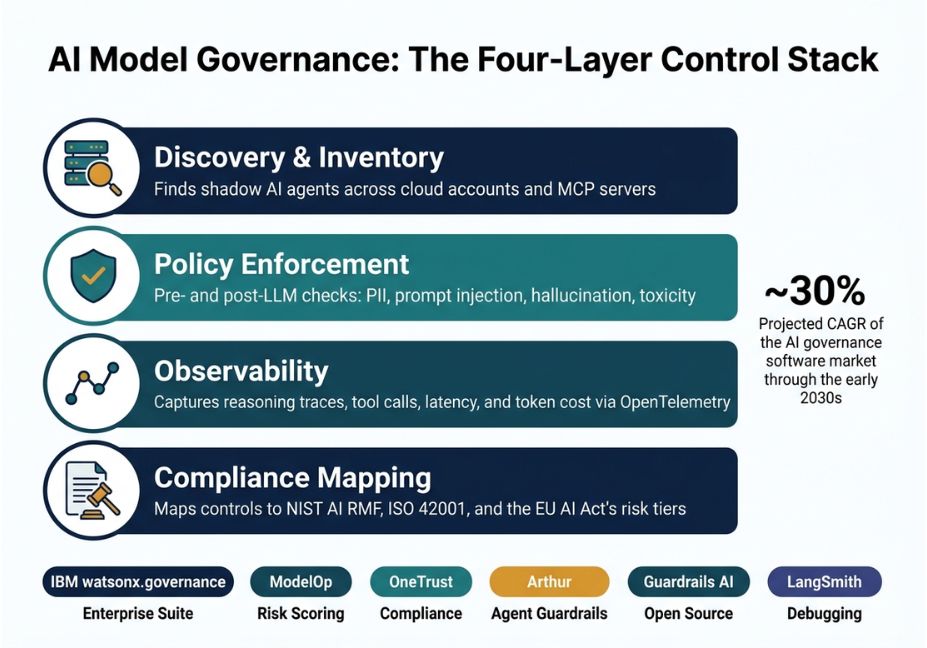
Most platforms are built around four connected functions:
- Discovery and inventory scanning cloud accounts, API gateways, and MCP servers to find every model and agent in use, including unsanctioned ones
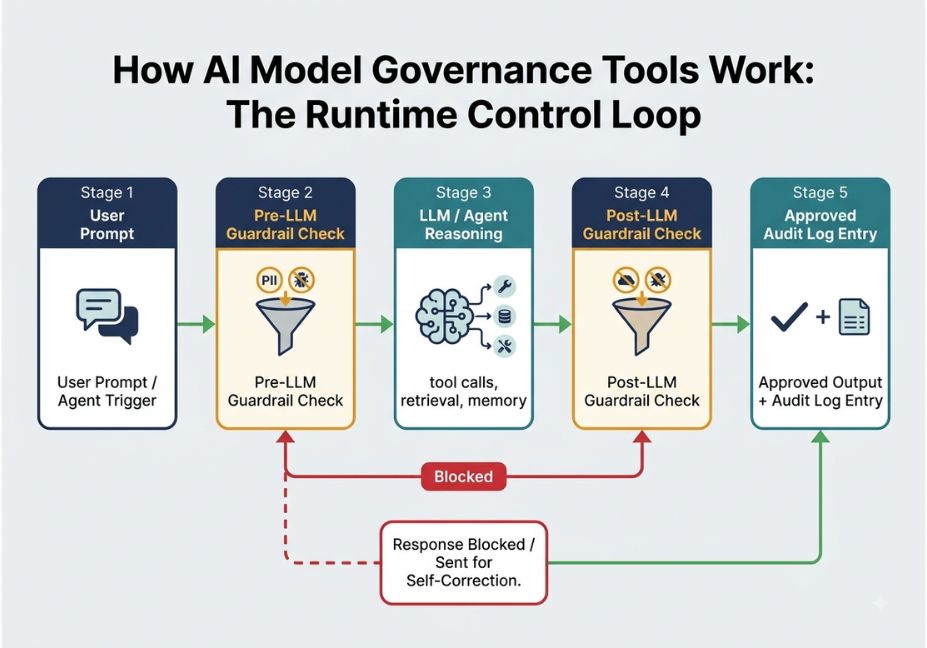
- Policy enforcement pre-LLM checks (prompt injection, PII detection) and post-LLM checks (hallucination, toxicity, format validation) applied at runtime
- Observability capturing traces of reasoning steps, tool calls, latency, and token cost, typically via OpenTelemetry-style instrumentation
- Compliance mapping tying model behavior and documentation to specific regulatory obligations, such as the EU AI Act’s risk-tiered obligations for high-risk systems
Technical Note: Governance tools don’t build or fine-tune models that’s the job of your MLOps stack. Governance sits alongside it, enforcing rules on models that are already trained and deployed.
A simplified runtime guardrail check, using an open-source validation framework, looks like this:
python
from guardrails import Guard
from guardrails.hub import ToxicLanguage, DetectPII

guard = Guard().use(ToxicLanguage(threshold=0.5)).use(DetectPII())

response = guard(
    llm_api=my_llm_call,
    prompt="Summarize this customer complaint and suggest a refund policy."
)

if response.validation_passed:
    return response.validated_output
else:
    return "Response blocked by governance policy."
This pattern — validate before the user ever sees the output is the core of the open-source Guardrails AI framework, and most commercial platforms wrap similar logic around a policy dashboard.
AI Model Governance Tools Real-World Use Cases
- Financial services model risk management: banks use governance platforms to score models against regulatory thresholds before they touch a lending decision
- Healthcare compliance: hospitals apply governance layers to flag any model output that could constitute unlicensed medical advice
- Agent discovery in enterprise IT: security teams use runtime scanning across OpenTelemetry streams and platform APIs (Vertex AI, AWS Bedrock, Azure AI Foundry) to catch shadow agents nobody registered
- Customer support agents: guardrails block hallucinated refund or warranty claims before an agent sends them to a customer
Did You Know? The AI governance software market is forecast to grow at roughly a 30% compound annual growth rate through the early 2030s, driven largely by regulatory deadlines rather than voluntary adoption.
Best Tools and Frameworks for AI Model Governance
| Tool | Primary Focus | Best For |
|---|---|---|
| IBM watsonx.governance | Enterprise-wide model + agent governance | Large orgs governing mixed ML/GenAI/agentic stacks |
| ModelOp | Model inventory and regulatory risk scoring | Regulated industries (finance, insurance) |
| OneTrust AI Governance | Policy, risk assessment, documentation | Compliance-first teams tied to privacy programs |
| Arthur | Agent discovery and runtime guardrails | Teams governing autonomous, tool-using agents |
| Guardrails AI (open source) | Declarative output validation | Engineering teams wanting code-level control |
| LangSmith | Reasoning trace debugging | Teams building specifically on LangChain |
Pro Tip: Don’t buy a full enterprise governance suite before you have an accurate agent inventory. Start with discovery and observability you can’t govern what you can’t see.
Step-by-Step: How to Implement AI Model Governance
- Inventory everything. Scan for models and agents across every cloud account and MCP server, including ones product teams spun up without approval.
- Classify by risk tier. Map each system against a framework like the NIST AI Risk Management Framework to decide how much scrutiny it needs.
- Instrument for observability. Add tracing (OpenTelemetry or a vendor SDK) so every prompt, tool call, and output is logged.
- Add runtime guardrails. Apply pre-LLM and post-LLM validation for PII, prompt injection, and hallucination on any customer-facing system.
- Automate the audit trail. Ensure guardrail decisions, overrides, and human approvals are captured automatically, not manually documented after the fact.
- Review quarterly. Regulatory frameworks and internal risk tolerance both shift treat governance as a living process, not a one-time audit.
Technical Disclaimer: Governance tooling and open-source guardrail libraries evolve quickly. Code examples in this article reflect the Guardrails AI API as of mid-2026. Always check current framework documentation before deploying to production.
Common Mistakes and How to Avoid Them
- Treating governance as documentation-only a risk register nobody reads doesn’t stop a bad output. Runtime enforcement matters more than paperwork.
- Governing models but not agents agentic systems make autonomous tool-use decisions that classic model-monitoring tools were never built to catch.
- No agent discovery process most incidents trace back to shadow AI nobody inventoried in the first place.
- Bolting guardrails on after launch retrofitting policy enforcement is far more expensive than building it into the agent’s control plane from day one.
- Ignoring latency budgets guardrail checks that add multiple seconds of latency get bypassed by frustrated engineers; effective runtime checks typically run in a few hundred milliseconds.
What Developers Are Saying
Engineering teams building agentic systems increasingly describe governance less as a compliance burden and more as a debugging tool the same trace logs that satisfy an auditor are often what an engineer needs to figure out why an agent picked the wrong tool. That dual purpose is a big part of why observability platforms and governance platforms have started to converge into a single product category rather than two separate purchases.
FAQ People Also Ask
What is the difference between AI governance and MLOps?
MLOps focuses on building, training, and deploying models efficiently. AI governance focuses on ensuring those deployed models and agents stay compliant, safe, and auditable once they’re running in production the two are complementary, not overlapping.
Do small companies need AI model governance tools?
Yes, if they deploy customer-facing LLM applications or agents, even at small scale. Regulatory frameworks like the EU AI Act apply based on risk level and use case, not company size, and a single ungoverned agent can still cause a compliance incident.
Can open-source tools replace commercial AI governance platforms?
Open-source frameworks like Guardrails AI or NeMo Guardrails handle runtime validation well, but they don’t provide the policy dashboards, cross-team reporting, or regulatory mapping that commercial platforms bundle for larger, multi-team organizations.
How do AI governance tools handle autonomous agents differently than models?
Agent governance requires discovery of tool calls and reasoning traces, not just input/output monitoring, since agents make sequential decisions and can act on external systems without a human reviewing every step.
What frameworks do AI governance tools map to for compliance?
Most platforms map controls to the NIST AI Risk Management Framework, ISO 42001, and the EU AI Act’s risk tiers, since these are the frameworks regulators and auditors reference most often.
Conclusion
AI model governance tools have split into two connected layers: the compliance layer that satisfies regulators and the runtime layer that actually stops bad outputs before they reach a user. The strongest platforms and the strongest internal setups treat agent discovery, runtime guardrails, and audit trails as one continuous system rather than three separate projects. As agentic AI moves further into production, that runtime layer is where most of the real risk, and most of the real engineering work, now lives.
Bookmark this guide and explore more hands-on AI agent tutorials at agentiveaiagents.com.