
Enterprise customer service has a dirty secret. Most companies deploy an AI chatbot, watch it resolve around 30 to 40 percent of tickets, declare success, and move on never realizing the platform was capable of 70 to 80 percent resolution if the underlying agent logic was properly built.
Ada is one of the few platforms that can genuinely reach that higher ceiling. However, reaching it requires far more configuration investment than the sales pitch suggests. Ada has processed over 5.5 billion customer interactions since 2016 and serves brands like Square, Pinterest, Canva, and monday.com. Its AI agents run across chat, email, voice, and social messaging through a proprietary multi-LLM orchestration layer called the Reasoning Engine.
So is Ada the right platform for your team? That depends entirely on your ticket volume, your technical resources, and your budget. This review covers exactly how the Reasoning Engine works, what Ada genuinely costs, where it fails in real production environments, and how it stacks up against its closest competitors in 2026.
What Is Ada CX and What Does It Actually Do?
Ada CX is an enterprise AI customer service automation platform that deploys conversational AI agents across every support channel from a single management interface. Unlike helpdesk-native AI tools such as Zendesk AI, Ada operates as a standalone intelligent layer that sits above your existing CRM or helpdesk connecting to Zendesk, Salesforce, Shopify, and Twilio via API rather than running inside them.
According to Ada’s Reasoning Engine™ documentation, the platform’s core promise is one unified intelligence that powers all channels consistently. Therefore, when you update a policy or add a new Playbook, that change propagates instantly across chat, email, voice, and SMS without separate configurations for each channel. For large support operations running multiple channels with lean CX teams, that cross-channel consistency is a genuine operational advantage.
Ada targets companies handling at least 300,000 customer service conversations per year. That minimum threshold is not a soft guideline it shapes every aspect of how the platform is priced, sold, and supported.
How Does Ada’s AI Agent Actually Resolve Customer Queries?
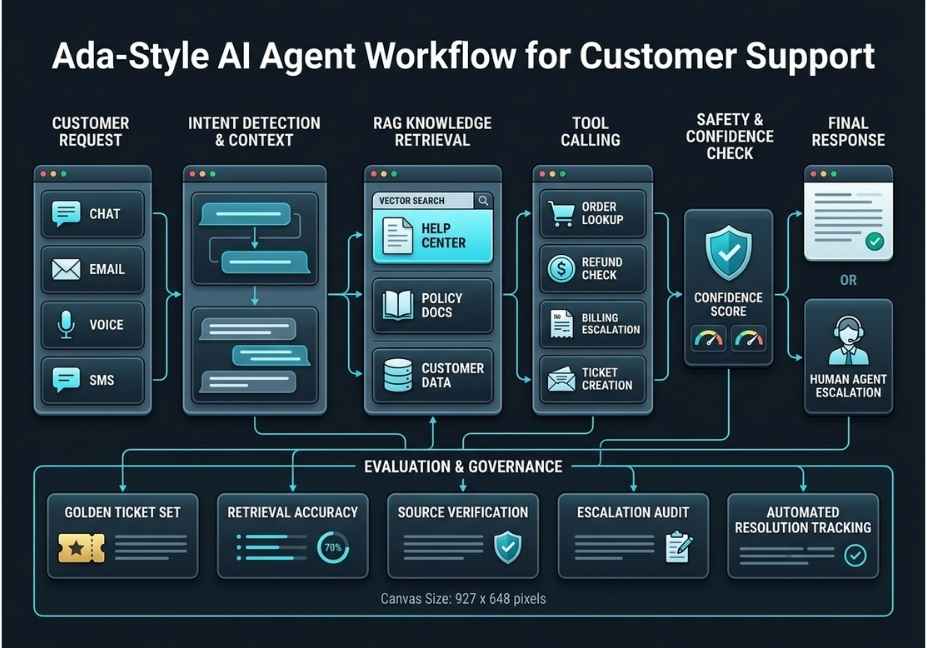
Ada’s Reasoning Engine runs a five-stage resolution loop on every incoming customer message. First, it classifies the customer’s intent using natural language processing and the prior conversation context. Second, it decides whether the resolution path requires a knowledge lookup, an API call into a connected business system, or both. Third, it retrieves content from connected knowledge sources FAQs, policy documents, and help center articles to ground its response in verified information rather than model inference alone.
Fourth, for transactional requests such as processing a refund or updating account details, the agent calls directly into your connected business systems through integrations with Zendesk, Salesforce, or Shopify. Fifth, it uses large language models from providers including OpenAI and Google to draft a response, then passes that response through a multi-layer safety and compliance filter before delivery.
As Bessemer’s technical breakdown of Ada’s multi-LLM architecture explains, this is not a single-model system. Instead, Ada routes each query to whichever model in its constellation best matches the task complexity with smaller, fine-tuned models increasingly handling the bulk of routine queries, and frontier models reserved for genuinely complex reasoning. This architecture aligns with the agentic AI taxonomy from recent AI research, which describes multi-agent orchestration as the defining characteristic of production-grade autonomous systems.
The practical implication for buyers is significant. You are not purchasing a GPT-4 wrapper with a customer service interface. You are purchasing an orchestration system that manages model selection, context injection, business rule enforcement, and safety filtering as a coordinated pipeline. That is why Ada’s resolution quality is strong on structured, high-volume ticket types and why it struggles when queries fall outside the boundaries of what the Playbook system has been trained to handle.
What Are Ada’s Core Features in 2026?
Omnichannel coverage with a unified reasoning layer
Ada deploys AI agents across chat, email, voice, and SMS. Before its February 2026 Unified Reasoning Engine relaunch, voice agents and text agents ran on separate underlying architectures. As a result, policy changes had to be duplicated across channels manually. After the unification, a single update applies everywhere simultaneously. For high-volume operations, this removes a meaningful administrative burden.
The Voice AI offering, rebuilt from the ground up in early 2025, now uses the same reasoning logic as Ada’s text channels. In practice, that means a customer who starts a chat conversation and then calls the support line can be recognized by the voice agent, which picks up the context without asking the customer to repeat themselves.
Playbooks and no-code agentic workflow automation
For multi-step workflows processing a return that requires verifying an order, checking a return policy, and triggering a refund Ada uses Playbooks. These are structured automation flows that CX teams author in plain English or by uploading standard operating procedures directly. No scripting is required.
Playbooks are, in effect, Ada’s no-code agentic workflow builder. Teams that invest heavily in Playbook coverage for their top 20 most common ticket types typically see their automated resolution rate jump from the 40 percent baseline to the 70 to 84 percent figures Ada cites in published case studies. The gap between those two numbers is almost entirely determined by Playbook depth not by the underlying AI model.
Four-level AI agent coaching
Ada’s coaching system operates across four layers. Guidelines set global tone and policy constraints. Knowledge structures the content the agent can retrieve. Playbooks define step-by-step resolution flows for specific processes. Escalation logic governs when the conversation routes to a human agent. Consequently, improving automated resolution accuracy over time requires active management across all four layers this is not a configure-once platform.
Enterprise security and compliance
Ada carries SOC 2 Type II, HIPAA, GDPR, PCI, and AIUC-1 certifications, along with Zero Data Retention agreements with all LLM providers. The AIUC-1 certification an AI governance standard that many platforms in this category do not hold is a decisive factor for regulated industries such as fintech, healthcare, and telecom.
Ada Pricing: What Does Ada CX Actually Cost?
Ada does not publish pricing. However, public signals from multiple procurement discussions, review platforms, and industry analysts consistently point to an entry point of approximately $30,000 per year. Enterprise contracts frequently reach $70,000 or more annually. Most agreements require annual or multi-year commitments.
Ada charges per resolution rather than per seat. On the surface, that sounds favorable you only pay when the AI actually solves something. In practice, however, the definition of a “resolved” conversation is not always transparent. Some buyers report that conversations escalated to a human agent are still counted as resolutions under their contracts. Before signing, it is worth demanding written clarity on two specific questions: what event triggers a resolution charge, and whether human-escalated conversations count toward that total.
For teams where pricing transparency is non-negotiable, Ada is the wrong platform to start with. The quote-based model makes ROI modeling difficult before you have sustained production data, and the multi-year commitment amplifies that uncertainty significantly.

Who Should Use Ada and Who Should Not?
Ada delivers strong results inside a specific operational context. Outside that context, the economics and complexity rarely make sense.
Ada works well for large enterprises running more than 300,000 customer conversations annually, already operating on Zendesk or Salesforce, with a dedicated CX operations team available to build Playbooks, manage coaching layers, and tune escalation thresholds. It performs strongest when the dominant ticket types are structurally predictable order status lookups, policy questions, account updates, and return requests at high volume.
In contrast, Ada is not a good fit for small or mid-size businesses without a $50,000-plus annual CX budget. Similarly, organizations whose ticket mix is heavily nuanced complex technical support, emotionally sensitive interactions, sales-adjacent conversations will find that Ada’s Reasoning Engine degrades meaningfully on off-script queries. Teams that want model observability, the ability to swap LLM providers, or the ability to ingest PDFs, historical support tickets, and Notion documents natively will encounter real limitations. Ada’s knowledge ingestion architecture is more restrictive than several newer platforms.
Ada CX vs Intercom Fin vs Sierra: Which Platform Wins in 2026?
Choosing between Ada, Intercom Fin, and Sierra comes down to three variables: your ticket volume, your existing helpdesk stack, and your need for pricing transparency.
Intercom Fin is the most practically comparable option for mid-market teams. At $0.99 per resolved conversation with publicly listed pricing, it offers a faster path to value without requiring platform migration. Fin operates as an overlay on your existing helpdesk rather than replacing it, which means your team does not face a full platform switch. It achieves 51 to 66 percent automated resolution rates at optimized deployments meaningfully below Ada’s 70 to 84 percent ceiling but the tradeoff is faster deployment, no minimum conversation threshold, and billing you can model before committing. Fin runs on Anthropic’s Claude, which performs strongly on nuanced language tasks.
Sierra CX targets the same Fortune 500 organizations as Ada. Founded by Bret Taylor and Clay Bavor, it competes on deep personalization and action-oriented agentic capabilities. However, it operates as a closed platform with no published resolution benchmarks and quote-based pricing, making side-by-side comparison difficult without a full sales cycle.
Zendesk AI is the right choice almost exclusively for teams already deeply embedded in the Zendesk ecosystem. Its native integration removes migration risk, but its autonomous resolution ceiling sits at 20 to 30 percent well below what an AI-native platform like Ada achieves at comparable configuration investment.
Decagon is a newer generative-AI-native platform that competes directly with Ada on autonomous resolution for enterprise accounts. It carries less production history than Ada’s 5.5 billion interactions but is purpose-built around modern LLM architectures without the legacy chatbot constraints that still surface in some Ada deployment patterns.
What Are the Biggest Weaknesses of Ada CX in Production?
Context loss in multi-turn conversations
Ada performs well on single-turn queries. However, multi-turn conversations where the customer’s earlier messages must carry forward accurately across several exchanges are where the system degrades most visibly. Context window management is computationally expensive, and context truncation under high load is a documented complaint in Trustpilot reviews. When context drops, the agent effectively starts the conversation over, which customers experience as the bot “forgetting” what they already said.
Off-script queries triggering deflection loops
When a customer’s request falls outside the Playbook coverage map, Ada defaults to conservative escalation behavior. In practice, this sometimes means the agent asks the same clarifying question repeatedly rather than routing cleanly to a human. This is partly an escalation logic configuration problem and partly a deliberate architectural choice the system optimizes to protect resolution rate metrics, which means it sets conservative handoff thresholds by default.
Knowledge staleness
Ada’s knowledge grounding is only as current as the last time connected sources were updated. Therefore, when pricing, policies, or product details change and are not immediately reflected in the connected knowledge base, the agent confidently delivers stale information with no visible signal to the end customer that the answer may be outdated. Knowledge base hygiene is not optional it is a core ongoing operational requirement.
Hallucination risk on edge cases
Any system that generates free-text responses through large language models carries inherent hallucination risk. Ada’s multi-layer safety filter reduces this meaningfully the Reasoning Engine’s subsystem architecture makes adversarial prompt injection attacks significantly harder to execute. Nevertheless, hallucination on edge-case queries spanning multiple knowledge domains is a real risk that CX teams should monitor actively through ongoing conversation review.
Technical Disclaimer: Ada’s platform architecture evolves rapidly. The feature details and integration capabilities described in this article reflect publicly available information as of June 2026. Always verify current specifications directly with Ada’s team for your specific deployment context.
What Are Real Users Saying About Ada in 2026?
The most telling signal about Ada’s production performance is the gap between two review scores. On G2, where CX teams who configure and manage Ada rate the platform, Ada scores 9.4 out of 10 for support quality, ease of use, and onboarding. On Trustpilot, where end customers interact directly with the deployed chatbot, the score drops to 2.0 out of 5.
That gap is not a data anomaly. It reflects a structural reality of enterprise AI CX platforms: the people who build and manage the system have a fundamentally different experience than the customers who encounter it at the resolution ceiling. Furthermore, the most common Trustpilot complaints context loss between conversation turns and difficulty reaching a human agent map directly to the production failure modes described above.
In enterprise procurement discussions, the single most frequent objection before contract is the pricing opacity. Per-resolution billing that potentially includes human-escalated conversations makes ROI projections difficult. As a result, many procurement teams request detailed billing scenario modeling before signing a step that Ada’s sales process does not always surface proactively.
Is Ada Worth It for Small Businesses?
Ada is not designed for small businesses, and it is worth stating this plainly. The $30,000 annual entry point, the 300,000-conversation minimum fit threshold, and the internal CX engineering investment required to build effective Playbooks collectively put Ada out of reach for most companies under 200 employees. For small businesses asking how to get AI-powered customer service automation, platforms like Intercom Fin, Tidio, or helpdesk-native AI agents on Freshdesk offer a more proportionate starting point at a fraction of the cost.
For scaling startups specifically companies between Series A and Series C with fast-growing support volume but no dedicated CX ops team Ada’s complexity creates more risk than value in the short term. In that context, starting with a simpler AI agent overlay and migrating to Ada once volume and team capacity justify it is the more pragmatic path.
Frequently Asked Questions About Ada AI Reviews
What does Ada CX do?
Ada CX is an enterprise AI customer service automation platform. It deploys AI agents across chat, email, voice, and SMS channels to resolve customer inquiries autonomously, without requiring human agents to intervene. The platform uses a multi-LLM Reasoning Engine to classify customer intent, retrieve relevant knowledge, and execute actions in connected business systems such as Zendesk, Salesforce, and Shopify before generating a safe, policy-compliant response.
How does Ada’s Reasoning Engine work?
The Reasoning Engine is Ada’s patent-pending multi-LLM orchestration system, launched in February 2026. Rather than routing every query to a single generalist model, it runs a constellation of specialized language models including models from providers like OpenAI and Google and selects the appropriate model based on task complexity. The engine handles intent classification, context injection, business rule enforcement, tool execution into connected systems, and safety filtering as a coordinated five-stage pipeline.
Is Ada CX worth the price for enterprise teams?
For large enterprises handling more than 300,000 conversations annually, already running Zendesk or Salesforce, with a dedicated CX operations team, Ada is worth the investment. Published case studies report 357 to 943 percent ROI with 70 to 84 percent automated resolution at well-optimized deployments. However, reaching those numbers requires sustained investment in Playbook development and agent coaching not just the platform license.
What are the main limitations of Ada CX?
The four most common production limitations are context loss in multi-turn conversations, deflection loop behavior when queries fall outside Playbook coverage, knowledge staleness when connected sources are not actively maintained, and hallucination risk on complex edge-case queries. All four are manageable with proper operational investment, but none resolve themselves automatically.
How does Ada compare to Intercom Fin in 2026?
Ada is a standalone enterprise AI platform starting at approximately $30,000 per year, requiring a 300,000-conversation minimum and existing Zendesk or Salesforce infrastructure. Intercom Fin operates as an overlay on your existing helpdesk at $0.99 per resolved conversation, with no minimum volume threshold and transparent pricing. Ada achieves higher resolution rates at optimized deployments 70 to 84 percent versus Fin’s 51 to 66 percent. However, Fin offers faster deployment, lower upfront commitment, and billing you can model accurately before going live.
Can Ada AI integrate with Shopify and WhatsApp?
Yes. Ada integrates natively with Shopify for ecommerce workflows such as order status lookups and return processing. It also supports WhatsApp and other social messaging channels as part of its omnichannel deployment. Integration depth varies by channel chat and email carry the most mature integration patterns, while voice and social channel integrations may require additional configuration depending on your existing technology stack.
Conclusion
Ada is a technically serious enterprise AI customer service platform. Its Reasoning Engine represents genuine multi-LLM orchestration architecture not a rebranded chatbot. The 70 to 84 percent automated resolution figures are real, the enterprise security certifications are among the broadest in the category, and the February 2026 Unified Reasoning Engine unification across channels is a meaningful operational advancement.
However, three things are also true simultaneously. Ada’s pricing is opaque and commitment-heavy in ways that make pre-contract ROI modeling difficult. Its production performance at the resolution ceiling as measured by Trustpilot end-user scores reveals real context management and off-script handling weaknesses. And the platform’s fit is genuinely narrow: it is built for large enterprises with high-volume, structured ticket distributions and the internal resources to manage an ongoing AI agent coaching operation.
Therefore, the right question is not whether Ada is a good platform in the abstract. It is whether your organization fits the specific operational profile where Ada consistently delivers. If you have 300,000-plus annual conversations, an existing Zendesk or Salesforce environment, a dedicated CX team, and a budget above $30,000 annually Ada deserves serious evaluation. If any of those conditions are absent, evaluate Intercom Fin or a helpdesk-native AI agent first.
For more agentic AI architecture breakdowns, platform comparisons, and production system evaluations written for technical CX and AI practitioners, explore agentiveaiagents.com.
6 Responses