

The majority of organizations are budgeting for AI projects incorrectly by a wide margin (40-60%). Most commonly, organizations are budgeting for development hours and the cost of access to the models that they are building. But this is not the end of the budget. Suddenly they receive token bills for the tokens that they create and integrate into their models which are billable as consumed based on their usage of the token and the number of tokens that they have integrated into the model. This also requires rewriting all of the integrations to make sure they have the right token configuration to be able to properly process all of the requests coming in from all of the components in the architecture. Lastly, when they do finally begin to execute with their agents, they find that they have to maintain the prompts (e.g., create new prompt templates, update old ones, etc.) on a monthly basis adding an expense that they never budgeted for.
According to Gartner, 40% of enterprise applications will have added task-specific AI agents within the next few years (by 2026) and only 5% currently, thus creating an immense burden to develop them quickly while organizations have not built out a proper change management model with accurate cost estimates.
So what does it cost to build an agent in 2026? If I’m honest, it can cost anywhere from $8,000 for a focused RAG agent to over $400,000 for a complete enterprise multi-agent system. However, the cost of the build is only the tip of the iceberg, as using infrastructure, the cost of LLM tokens, integration work and ongoing support typically require an additional 40-60% per year in 1st year.
This guide will provide a detailed breakdown of all of the various cost layers – including development, framework selection, token budgeting, vector store infrastructure, and the hidden costs that most vendors will leave out of the quoted price.
What Is an AI Agent, and Why Does Architecture Determine Cost?
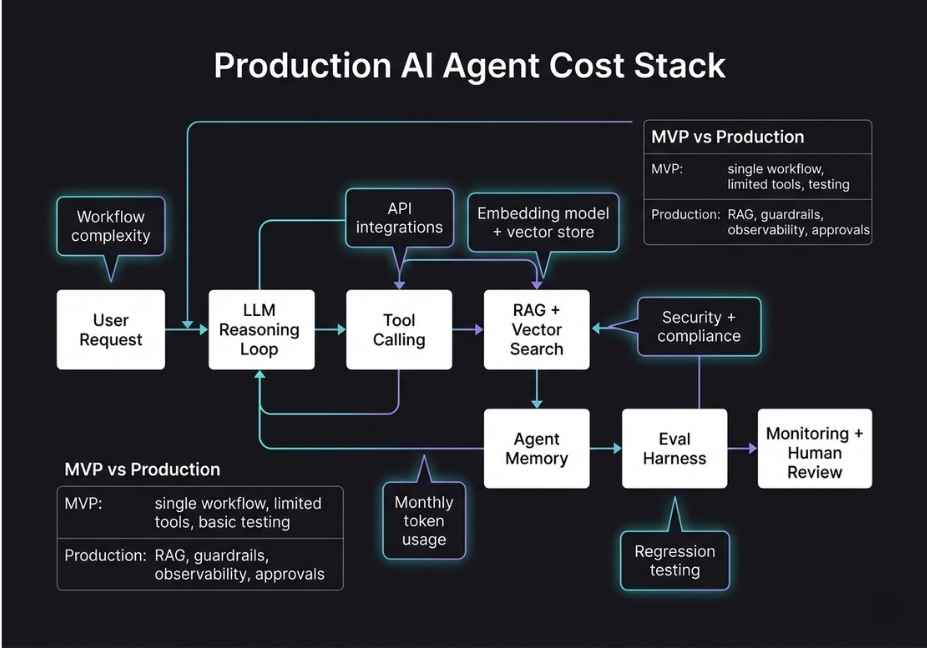
An agent based on artificial intelligence, or AIA, functions as an intelligent agent using a Large Language Model (LLM) for reasoning. Instead of providing one direct answer, the agent will plan, use an external tool, observe results, and repeat until complete.
The predominant pattern of operation for contemporary agents is the ReAct prompting pattern (Yao et al., 2022) Reason (R), Act (A), and Observe (O) constructed into a reusable loop until the desired goal is completed. Since each loop iteration executes an LLM call, the cost will increase directly with the number of loops.
For example, a simple FAQ agent would generate only one LLM invocation for each individual user turn; whereas, an autonomous planning agent may generate five to ten LLM invocations to complete a single customer request (tool selection, tool execution, tool verification, and handling of tool fallbacks, and finally completing the request). This indicates that the architecture governing the agent’s operation is an important financial decision.
Key point reactive, contextual, autonomous, and multi-agent types are all included in a spectrum of cost to build from prototype to enterprise deployment of nearly 20x variance. It is critical to have your desired architecture defined prior to requesting any vendor pricing quotes.
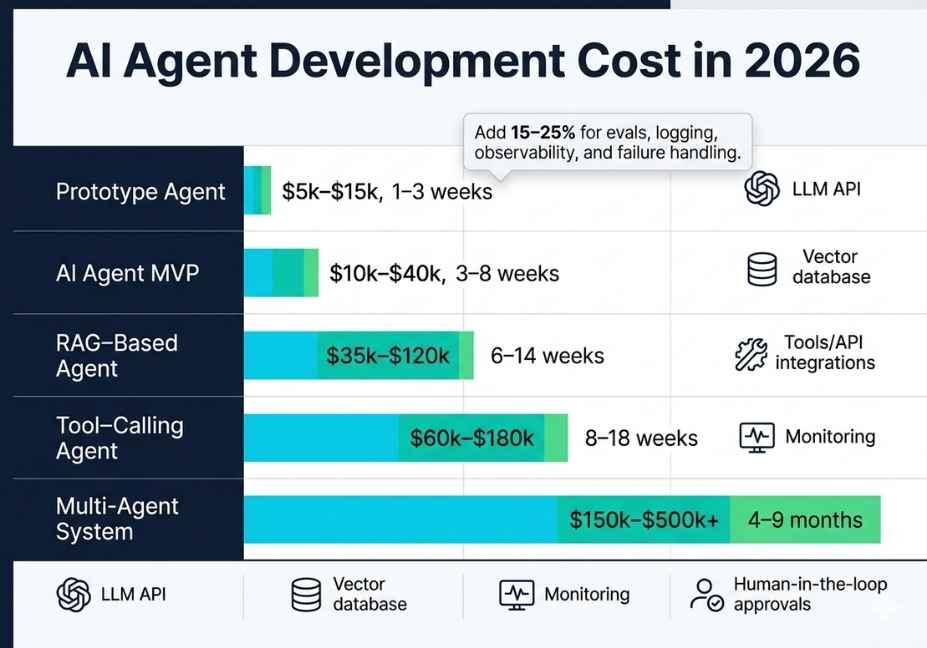
AI Agent Development Cost by Complexity Tier (2026)
Below is a clear breakdown of construction cost and operating costs per month according to type of agent. This is also the basis where Google’s featured snippet could extract the balanced data directly.
Simple agents have an average cost of between $8,000 and $25,000 to create. Mid-level agents have an average creation cost between $25,000 and $80,000, whereas highly autonomous agents have an average construction cost range of $80,000 to $150,000; while enterprise level multi-agent systems can start at around $150,000 and can go up to over $400.
| Tier | Agent Type | Build Cost | Monthly Ops |
|---|---|---|---|
| Entry | Reactive chatbot / FAQ with RAG | $8K–$25K | $500–$2K |
| Mid | Contextual agent, memory, 2–3 tool integrations | $25K–$80K | $1.5K–$5K |
| Advanced | Autonomous agent, planning loop, multi-step orchestration | $80K–$150K | $3K–$10K |
| Enterprise | Multi-agent swarm, compliance, legacy integration | $150K–$400K+ | $8K–$20K+ |
The most significant aspect of this information, however, is the 1st year total commitment for a $50,000 build at $3,000/mo operating cost is approximately $86,000. Always model your total cost of ownership over the entire 12 months, not just from the point of production.
The 5 Real Cost Drivers Behind Every AI Agent Budget
1. LLM Token Spend The Bill That Surprises Everyone
In AI agent projects, people regularly underestimate the costs of tokens. AI agents don’t make calls to computers in the same ways as traditional software. Instead of fixed calculations, AI agents utilize LLMs to create variable-length, context-dependent calculations that will continue to grow as they have conversations, receive responses from tools, and create planning loops.
If we assume a medium-sized production agent completes two thousand conversations per day, and each conversation consumes approximately fifteen hundred tokens, our token consumption will be approximately ninety million tokens each month. According to current estimates for the GPT-4o version of the LLM, we can expect to incur approximately $675 worth of token charges at an average low context depth, based on the current LLM estimates of $.025/million input tokens and $1/million output tokens. However, the growing usage beyond minimal amounts of planning loops utilizing agentic usage of tools can be expected to cause us to multiply this token consumption by 3-5 times greater than these base estimates.
PRO-Tip: When creating agentic usage models, project token consumption will be at least five times the amount of tokens that you originally calculated. For example, a ReAct-style planning loop may execute from five to ten LLM calls per request instead of one. As a result, if you do not monitor token consumption, your total monthly token expenses may end up exceeding your total development expenses within only twelve (12) months from your development completion.
2026 LLM pricing at a glance:
| Model | Input / 1M tokens | Output / 1M tokens |
|---|---|---|
| GPT-4o | $2.50 | $10.00 |
| Claude Sonnet 4.6 | $3.00 | $15.00 |
| Gemini 1.5 Pro | $1.25 | $5.00 |
| Llama 3.3 70B (self-hosted) | $0.00* | ~$0.10–$0.40** |
*Weights are free. **Estimated GPU compute per 1M tokens on self-hosted infrastructure.
2. Framework and Orchestration Layer Free to Use, Expensive to Choose Wrong
Four open-source frameworks will define your project LangGraph, CrewAI, AutoGen, and OpenAI Agents SDK. Your choice of framework will directly impact your development velocity, the efficiency of your tokens, and how much it will cost to maintain your project long-term.
LangGraph’s (v1.0 aka the default agent runtime for LangChain) uses a stateful graph runtime and provides you with typed state, checkponters (where the flow of information through your graph is being tracked) and interrupts for when humans need to intervene. This makes it the best possible foundation for a production workflow if your workflow needs an audit trail or requires multiple levels of approval.
While CrewAI offers significantly improved ergonomics for developers, it adds that their use of hierarchical crew patterns to organize their development teams costs significantly more tokens for coordination between the managers and the workers. Furthermore, the costs associated with manager/worker coordination will increase exponentially as scale increases due to increases to overhead in managing the teams.
Framework comparison (2026):
| Framework | Best For | Lines to First Agent | Token Efficiency | Observability |
|---|---|---|---|---|
| LangGraph | Stateful workflows, production-grade | 80–150 | Very High | LangSmith ($0 free / $500/mo team) |
| CrewAI | Role-based automation, rapid prototyping | 30–60 | Medium | OpenTelemetry / Langfuse |
| AutoGen | Multi-agent conversations, group dialogues | 40–80 | High | Azure Monitor |
| OpenAI Agents SDK | Python-first, fast setup, provider-agnostic | 20–50 | High | Built-in tracing |
Architect’s Note: Choosing the right framework early can save $10,000 to $25,000 in custom development. Building a custom orchestration layer from scratch instead of using a battle-tested framework adds three to six weeks to any project timeline.
3. RAG Pipeline and Vector Store Infrastructure
Retrieval-Augmented Generation (RAG) is required in order for most agents to be able to generate based on the domain knowledge of your organization instead of just relying on the data that was used to train the base model. As RAG’s effectiveness is dependent on the accuracy of retrieval, this is not a place to cut costs.
Most agentic RAG deployments have three areas where costs can be defined:
- Embedding model: Using OpenAI’s text-embedding-3-small is an approximate cost of $0.0001 per 1,000 tokens if you use them in their cloud-based environment, or free if you host your own model locally.
- Vector database: Managed services for vector storage are between $70–$700 per month depending on the size of the index. By using an open-source vector database (e.g., Chroma, Qdrant, pgvector) the only cost incurred would be compute costs.
- Ingestion Pipeline: One-time development costs for setting up the ingestion pipeline can range from $2,000–$8,000, plus the cost of re-ingestion each time the knowledge base is updated.
Finally, the relationship between vector store size and the accuracy of retrieval means that under-funding this area creates problems with degradation of the agent’s ability to work over time. This is not an easy failure mode to identify unless you have a proper infrastructure for evaluating the performance of the agents you are using.
4. Integrations Where Most Budgets Break Down
Integrations to your system are not just dependent on the existing functionality of the systems where your agent reads and writes. A few days of estimated time for “easy” integration with CRMs could easily grow to three weeks of custom development work, due to data mapping needs, error-handling requirements, defining additional cases for authentication, creating logic for rate-limits and retries, etc.
As a rule of thumb, you should estimate between 30 and 50 percent additional to your expected budget for integration development. A significant number of enterprises are underestimating integration complexity by this much each year.
The following are estimated costs to complete common integrations in 2026:
REST API integration (1 System): $2,000-$8,000
Legacy ERP/CRM (SAP, Salesforce): $15,000-$40,000
Custom database pipeline with real-time synchronization: $10,000-$25,000
Addition of security compliance layers (HIPAA/SOC 2/GDPR): Add $10,000 to $40,000 to your base cost
Beyond the actual expense associated with developing your integrations, there are also new places for potential failures. An external API may alter its schema unexpectedly, breaking your agent’s tool-use loop without a corresponding error message being generated. Therefore, monitoring and notifying stakeholders of integration health is an ongoing expense and should not be considered a “set” and forget it” task.
5. Ongoing Maintenance and Prompt Engineering
This is an expense that is almost never included in vendor quotes. Prompt engineering is ongoing due to continually evolving the underlying LLM, changing schemas of tool APIs and the drift of your data; prompts continually degrade. Therefore, agents in production must receive ongoing attention and maintenance to maintain accuracy over time.
An industry standard says to allocate 15% – 30% of your initial development cost each year to cover on-going maintenance costs that include:
Prompt regression testing against golden datasets.
Model version pinning and migration planning; i.e., which version of the model will move to a subsequent version.
Tool schema revisions if third-party API’s change.
Evaluation infrastructure—LLM as judge pipelines and accuracy benchmarking.
According to McKinsey’s 2026 state-of-AI report, only 6% of organizations qualify as “high performers” with AI and are able to realize true value from their AI deployments. The gap between builders versus high performers will usually come down to the degree of post-launch investment in evaluative and maintenance issues, not on how well the initial build was completed.
Build vs. Buy SaaS Platform or Custom Development?
Many use cases can be achieved without requiring custom development. Managed agent platforms like Relevance AI, Voiceflow, and Botpress deliver faster time to value; however, they come with high per-seat pricing at scale and very limited control over token spend.
| Approach | Best For | Typical Cost | Token Control |
|---|---|---|---|
| SaaS platform | MVP validation, non-technical teams | $99–$999/month | Low |
| Framework + managed LLM | Mid-market, iterative builds | $25K–$150K build + ops | High |
| Custom + self-hosted LLM | Enterprise, data privacy, high volume | $100K–$400K+ | Full |
Do You Know : At volume, you will often find a $999/month SaaS subscription way more than your total self-hosted infrastructure. If you are looking at high volumes of tokens (5,000,000+ monthly), the crossover point is approximately 5 million tokens/month. Teams that anticipate scaling should model both scenarios before making a commitment.
How to Build a Budget-Aware AI Agent — Step by Step
Follow these steps to avoid the 40 to 60 percent budget gap that derails most AI agent projects.
Step 1 : Define the outcome, not the technology.
Start with “reduce time to resolve support tickets from 48 hours to 4 hours,” not “build an AI agent.” The business outcome dictates the architecture used, while the architecture will dictate the cost.
Step 2 : Map every integration before scoping.
Make a list of all the systems that the agent is integrating with for reading/writing. Each integration is a cost multiplier. If you use 3 or fewer integrations you are likely to stay within the mid-tier budget. If you use more than 5 you are likely to exceed the advanced budget, regardless of the complexity of the agent.
Step 3 : Choose your LLM tier strategically.
Choose the right model for the work you need done and don’t always go with the biggest available model on the market. Some production agents will use lower-cost options like Gemini Flash or Claude Haiku for their routing tools, reserving higher-cost options like flagship model(s) until they are ready to create their final output. This type of hybrid approach can reduce total token cost by 40-60%.
Step 4 : Pick your framework for production, not prototyping.
You should use the OpenAI Agents SDK or CrewAI for two-week prototype builds. Once your needs change to require long-lived state, approval checkpoints, or replayable workflow, you should migrate to LangGraph.
Step 5 : Model 12-month TCO before signing any contract.
The formula is straightforward: Build cost + (monthly ops × 12) + annual maintenance (20 percent of build cost) = realistic year-one number.
Step 6 : Set token spend alerts on day one.
Finally, set cost alerts for 50%, 80%, and 100% of your monthly token budget. The primary cause of a bill spike is running agentic loops that aren’t stopped and running instead of pricing changes due to models.
Common Mistakes That Blow AI Agent Budgets
Even well-funded teams can make mistakes and knowing them ahead of time is much less expensive than learning them in production.
1) Budgeting for token consumption. Agents will generally consume three to ten times the tokens of chatbots. Make sure you’re budgeting for this consumption from day one.
2) Treating integrations as trivial. It’s never a one-day task to “connect to our CRM.” There should always be a separate line item for the scope of your integrations.
3) Choosing a framework for demonstration. Some frameworks work well for prototyping but do not have the necessary state management, observability or error recovery that multi agent systems will need in production.
4) Not having an evaluation pipeline. If you don’t utilize a LLM-as-judge evaluation or have a quality reference dataset, you won’t know if accuracy is degrading until your users do at the worst possible time.
5) Delaying the compliance work. It is far less expensive to implement the controls for HIPAA, SOC 2 and GDPR upfront than to do so retroactively. The difference between building a $15,000 compliance layer into your solution during development versus a $150,000 re-architecture 6 months down road after release of your solution can be significant.
6) Not properly estimating the risks of hallucination in agentic loops. Hallucinated tool calls (or other outputs) can be passed downstream for multiple passes before being discovered to contain errors where as with chatbot systems, errors are typically discovered on the first pass. Therefore, output validation and guardrails should be considered infrastructure as opposed to optional.
FAQ People Also Ask
How much does it cost to build an AI agent from scratch in 2026?
The cost of creating an artificial intelligence agent from scratch in 2026 can vary from approximately $8,000 to $400,000 or higher depending on the complexity of the agent. For example, a simple RAG-based (retrieval-augmented generation) chatbot will cost between $8,000 and $25,000 to build; whereas a more sophisticated mid-tier contextual agent with memory capabilities and tool integration will typically run between $25,000 and $80,000. Finally, for those larger enterprise-level multi-agent systems that require compliance with regulations and integrating with existing legacy systems, they can take over $150,000 to develop. Mid-market projects often fall within a range of $40,000-$120,000.
How much does it cost to run an AI agent per month?
The running costs associated with the operation of an AI agent can also vary widely. A simple support agent may have monthly operating costs in the range of $500-$2,000; while an enterprise-level multi-agent system may see monthly operating costs in excess of $8,000-$20,000. In general terms, 40%-60% of total monthly operating expenses relate to the use of language model tokens (LLM). Here is an example, assuming a mid-market agent processes 2000 conversations/day: Total combined monthly operating expenses (API and infrastructure) are estimated to be $2,000-$5,000/month.
What is the cheapest way to build an AI agent in 2026?
An open-source framework (CrewAI or the OpenAI Agents SDK) combined with a mid-tier large language model (LLM) such as Gemini Flash or Claude Haiku (examples of freely available LLMs), a free vector store (Chroma/pgvector), and standard cloud deployment represents the most cost-effective way to implement a focused single-task agent into production. A focused single-task type of agent developed in this way will cost between $8,000-$20,000 to build, and the monthly operating expense will be less than $1,000 per month at moderate usage.
Do I need to fine-tune a model to build an AI agent?
Typically, fine-tuning isn’t needed because if you have a good RAG pipeline and good prompt-design, you will get very close to the same level of accuracy that you would with a fine-tuned model for domain specific agents at a fraction of the cost of fine-tuning. Fine-tuning costs an additional $15,000 to $40,000 or more added to the project. So as you evaluate whether or not to fine-tune an agent; you should always validate your RAG-plus-prompt approach (prior to committing to fine-tuning).
What are the hidden costs of AI agent development?
Five of the top costs which are often overlooked are: LLM token spend at production scale (3X – 5X the expected amount from the development phase), external API integration drift (due to changes in external APIs), ongoing prompt engineering (estimated to be 10% – 15% of the build cost per year), evaluation infrastructure, and compliance layers for vetted industries. Collectively these items add 40% – 60% to the total quoted build cost in the first year.
What frameworks do developers use to build AI agents in 2026?
Five of the top costs which are often overlooked are: LLM token spend at production scale (3X – 5X the expected amount from the development phase), external API integration drift (due to changes in external APIs), ongoing prompt engineering (estimated to be 10% – 15% of the build cost per year), evaluation infrastructure, and compliance layers for vetted industries. Collectively these items add 40% – 60% to the total quoted build cost in the first year
Conclusion
Developing an AI Agent for Use in Production by 2026 Should Be Viewed As a Budgeting Decision Rather Than A Technological Decision.
The build cost like anything else is merely a starting point for budgeting. What follows; LLM (Language Model) type, framework choice, depth of integration, compliance architecture, and discipline over token usage – determines whether a $60,000 build becomes a sustainable Year 1 Investment of $90,000, or an unforeseen cost overrun of $180,000.
There are three principles of particular importance to take from this. First, model the 12-month total cost of ownership (TCO) before you scope any feature. Secondly, when choosing an orchestration framework, choose it to meet the production use requirement rather than for speed of demo. Third, set up token usage alerts as soon as the AI agents are deployed; runaway agentic loops have proven to be the silent budget destroyer of AI deployments.
Overall the companies that are successful with AI Agents in 2026 are not necessarily building the most sophisticated agentic systems; they are simply building the suitable agentic system relative to their budget and managing it in an intentional fashion through time.
For more detailed information on building agentic systems, RAG pipelines, and agentic workflow, visit agentiveaiagents.com.