

The failure in the deployment of most AI developer-tooling technology does not occur during the demonstration phase but rather three months after the contract is signed due to crazy behaviour of the retrieval pipeline due to particular situations when nobody knows who to contact at the customer’s side. At this time, the importance of having competent technical post-sales leaders in developer AI becomes evident. The situation is quite different from the one in the traditional post-sales positions because of the requirement of understanding the practice of utilization of the tool, integration architecture, and evaluation metrics.
The guide provided below outlines the competencies which are important to keep in mind when working with the new technology.
What Is a Technical Post-Sales Leader?
The technical post-sales leader is responsible for everything that happens with customers related to product onboarding, integration, technical support services, or the long-term usage of the product after sales have been closed. There is a close relationship between this role and customer success roles in terms of responsibilities. However, the technical post-sales leader needs to possess much more technical knowledge and be able to work with APIs and AI technology than the traditional customer success manager. In addition, especially in AI development tools, the technical post-sales leader becomes the only person who can save the situation of a disgruntled engineering team member and ensure the retention of the client.
How Does the Role Work?
Technical post-sales leadership in AI developer tools revolves around three recurring mechanics: diagnosing integration failures, translating model behavior into business impact, and coordinating expansion without overpromising.
Integration diagnosis: identifying whether a failure sits in the API layer, the RAG pipeline, or the customer’s own workflow.
Behavior translation: connecting a model’s accuracy shift to a concrete business outcome (fewer support tickets, faster onboarding, lower compliance risk).
Expansion judgment: recommending new use cases only after the current one has demonstrated measurable value.
Because most developer tooling AI products are built on agentic patterns a planner, a tool-calling step, and a memory or retrieval layer post-sales leaders benefit from understanding the ReAct pattern for tool-use reasoning, since customer-reported “bugs” are frequently just an agent looping on a failed tool call rather than a true system outage.
Technical Note: When a customer reports “the AI agent gave a wrong answer,” the root cause is almost always one of three things: a stale or misconfigured retrieval index, a tool call that silently failed, or a prompt/context window that got truncated. Diagnosing which one it is quickly is the single highest-leverage skill in this role.
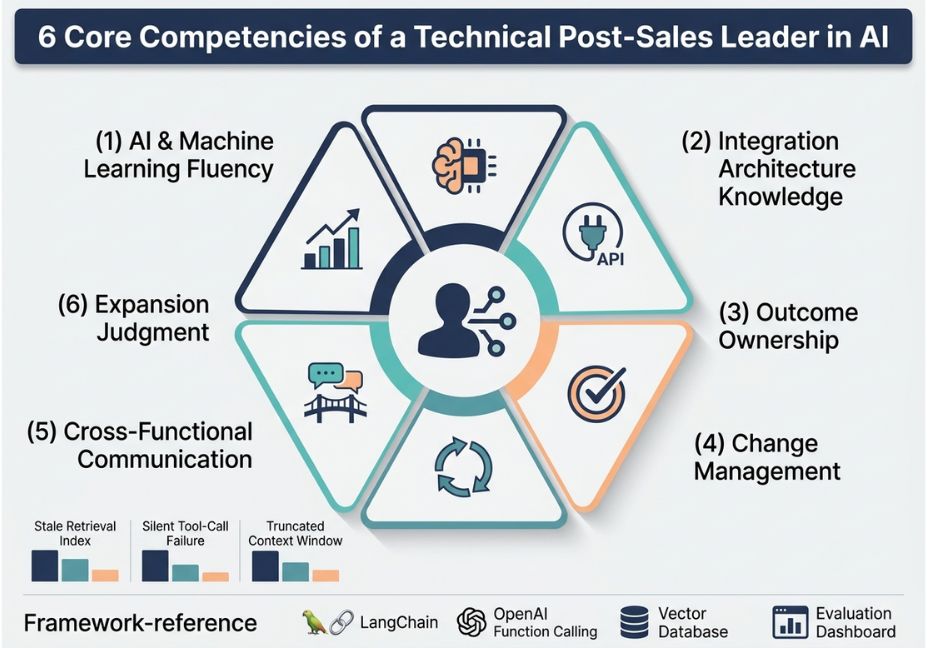
Technical Post-Sales Leader Competencies 6 Core Areas
- AI and machine learning fluency understanding model behavior, evaluation metrics, and why LLMs hallucinate under ambiguous prompts.
- Integration architecture knowledge APIs, identity platforms, cloud infrastructure, and how an agent’s tool-use loop plugs into existing DevOps workflows.
- Outcome ownership defining baseline metrics before rollout so success can be proven, not assumed.
- Change management helping human teams adapt to AI-augmented workflows without triggering distrust or workaround behavior.
- Cross-functional communication translating engineering-speak into board-level language and back again.
- Expansion judgment knowing when a proven use case justifies scaling to a second team or a more layer, rather than pushing expansion prematurely.
Best Tools and Frameworks Post-Sales Leaders Should Know
Post-sales leaders don’t need to write production code, but fluency with the frameworks their customers are building on shortens every technical conversation.
LangChain / agent orchestration used for chaining tool calls, memory, and planning steps; helps in diagnosing where in the chain a failure occurred.
OpenAI function calling used for structured tool invocation from an LLM; helps in explaining why a tool call didn’t fire as expected.
Vector databases (e.g., Pinecone) used for storing embeddings for retrieval; helps in spotting stale-index issues behind “wrong answer” tickets.
Evaluation dashboards used for tracking hallucination rate, latency, accuracy; helps in turning technical metrics into renewal conversations.
Pro Tip: Keep a one-page glossary of your product’s architecture (retrieval layer, tool-use loop, memory store) written in plain language. It becomes the fastest way to onboard both new post-sales hires and non-technical customer stakeholders.
For a deeper technical reference, LangChain’s agent architecture documentation is a useful baseline for understanding how planner-executor loops are typically structured in production agent frameworks.
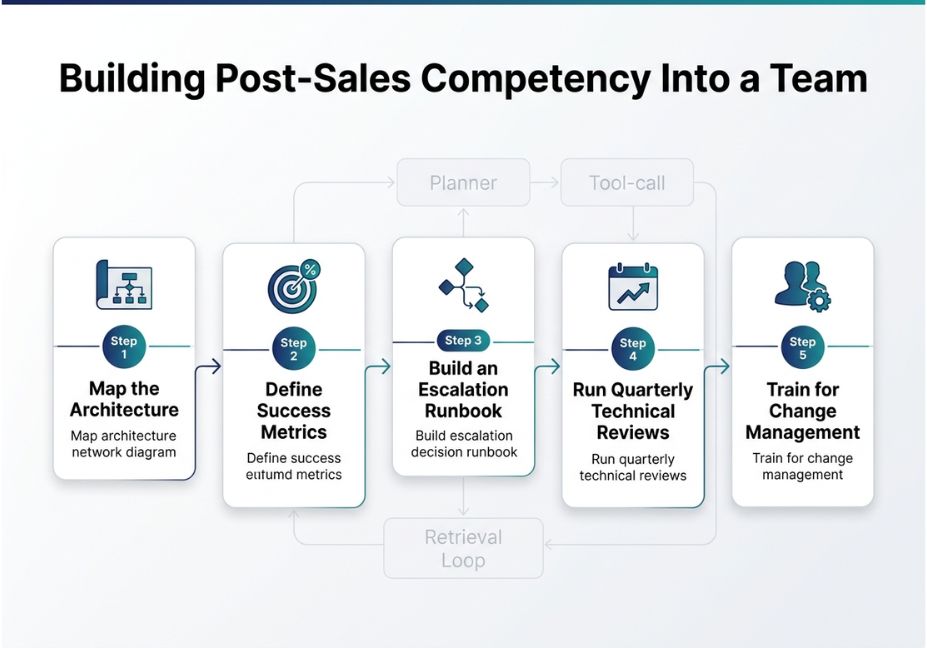
Step-by-Step: Building Post-Sales Competency Into a Team
- Map the architecture. Document the customer-facing product’s tool-use loop, retrieval layer, and API surface so every post-sales hire starts from a shared technical model.
- Define success metrics per account. Before go-live, agree on 2–3 measurable outcomes (ticket deflection rate, onboarding time, accuracy threshold).
- Build an escalation runbook. Specify exactly which issues route to engineering versus which are resolvable by post-sales alone this is where OpenAI’s function calling guide is genuinely useful reference material for support teams debugging tool-call failures.
- Run quarterly technical reviews. Revisit accuracy, latency, and adoption data with the customer, not just satisfaction scores.
- Train for change management, not just tooling. Give leaders scripts and frameworks for handling user resistance to AI-driven workflow changes.
Example code (a simplified escalation check a post-sales team might use):
def needs_engineering_escalation(ticket):
if ticket[“category”] == “tool_call_failure” and ticket[“retry_count”] > 2:
return True
if ticket[“hallucination_flagged”] and ticket[“severity”] == “high”:
return True
return False
Technical Disclaimer: Framework versions evolve rapidly. Code examples reference LangChain and OpenAI APIs as of mid-2026. Always check official documentation for the current interface before implementing.
Common Mistakes and How to Avoid Them
Treating post-sales as pure relationship management. Without technical grounding, leaders can’t diagnose whether an issue is model behavior, integration, or user error.
Skipping baseline metrics before rollout. Without a “before” number, no outcome can be proven at renewal time.
Over-promising expansion. Recommending a second use case before the first one has hit its success metric erodes trust fast connecting technical details to business outcomes matters more than technical fluency alone.
Ignoring change management. Even a technically flawless deployment fails if end users quietly route around it.
What Developers Are Saying
Threads in developer communities like r/LocalLLaMA consistently surface the same complaint: post-sales contacts who can’t explain why an agent looped or hallucinated lose credibility fast, while ones who can walk through the retrieval or tool-call layer earn trust immediately often becoming the deciding factor in a renewal conversation.
FAQ People Also Ask
What is a technical post-sales leader in AI?
A technical post-sales leader manages implementation, integration, and long-term adoption of an AI product after the sale, combining customer success skills with deep fluency in APIs, cloud infrastructure, and agent architecture.
What skills do you need for post-sales leadership in developer tools?
Core skills include AI/ML fluency, integration architecture knowledge, outcome ownership, change management, and cross-functional communication between engineering and business stakeholders.
How is post-sales different from customer success?
Customer success focuses broadly on satisfaction and retention, while technical post-sales leadership adds deep product and architecture fluency needed to diagnose integration and model-behavior issues directly.
Do post-sales leaders need to know how to code?
Not necessarily, but understanding concepts like tool-use loops, RAG pipelines, and API integration dramatically improves credibility and diagnostic speed with technical customers.
What causes AI developer tooling projects to fail after purchase?
Common causes include vague success metrics, poor change management, unclear escalation paths, and post-sales teams that lack enough technical depth to diagnose real issues.
How do post-sales teams measure success with AI products?
Effective teams define baseline metrics before rollout like ticket deflection, onboarding time, or accuracy thresholds then track them against post-deployment data.
Conclusion
Technical post-sales leader competencies in developer tooling AI go well beyond soft skills they require real fluency in integration architecture, tool-use loops, and outcome measurement. Leaders who can diagnose whether a failure lives in the retrieval layer, the API, or the customer’s own workflow build trust faster and drive renewals more reliably than those relying on relationship management alone. Bookmark this guide and explore more hands-on AI agent tutorials at agentiveaiagents.com.