

Most AI quoting projects don’t fail because the model can’t write a proposal they fail because the agent hallucinates a discount that doesn’t exist in the pricing catalog. A 30-second confidence-sounding quote with a wrong SKU or an invalid multi-year discount is worse than no automation at all, because it ships with a signature line attached.
That’s the real engineering problem behind AI customized sales quotation generation software tools: getting a large language model to produce a document that reads like a human wrote it, while staying strictly bound to a product catalog, a discount policy, and an approval hierarchy it must never improvise around. This isn’t a prompt-engineering trick it’s an agentic AI system with retrieval, tool calls, and guardrails wired together.
If you’ve already built agents with LangChain or used OpenAI function calling, you’ll recognize the shape of this problem immediately. What follows is the architecture, the tooling landscape, and the failure modes that separate a demo quoting bot from one you’d trust with real revenue.
What Is AI-Powered Sales Quotation Generation?
AI-powered sales quotation generation is the use of an LLM-driven agent rather than static templates or manual data entry to assemble a customer-specific quote from a product catalog, a pricing engine, and deal context, then output it as a structured, ready-to-send document.
Unlike a chatbot that just writes prose, a quoting agent performs retrieval-augmented generation to pull live pricing and product data, then emits a validated, structured output rather than free text. It sits functionally between a CPQ (Configure, Price, Quote) system and a conversational interface the LLM handles intent and drafting; the retrieval and pricing layers handle facts.
How Does AI Quote Generation Work? The Agent Architecture
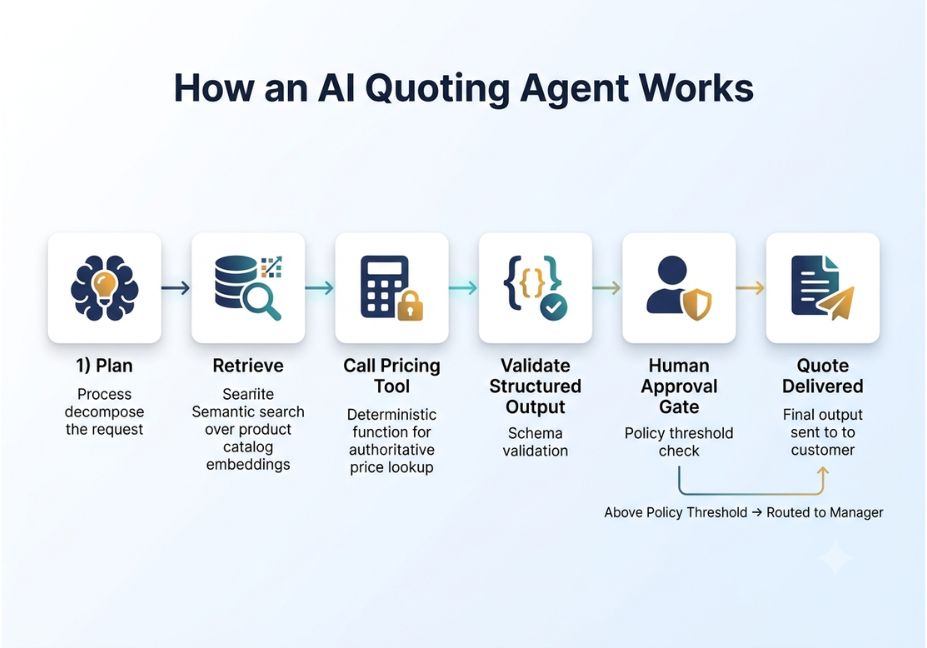
A production quoting agent is not a single prompt. It’s a loop: plan → retrieve → call tools → validate → generate → route for approval.
Core components:
- Planner/reasoner decomposes “give this customer a 3-year renewal quote with the enterprise tier” into sub-tasks
- Retriever a vector store holding product catalog embeddings for semantic lookup of SKUs, bundles, and specs
- Pricing tool a deterministic function call, never a generative one, that returns authoritative numbers
- Structured output layer forces the model to emit JSON matching a quote schema, not paragraphs
- Human-in-the-loop gate routes discounts above policy thresholds to a manager before the quote is sent
This pattern closely follows the ReAct-style reasoning-and-acting loop described in the original agent research, where the model alternates between reasoning steps and tool invocations rather than answering in one shot. The pricing step specifically should never be left to the LLM’s own arithmetic it should always be a function call against ground-truth data.
Technical Note: Treat the LLM as the drafting and reasoning layer, never the source of truth for numbers. Pricing, discount limits, and tax rules belong in deterministic code the agent calls, not in the model’s context window.
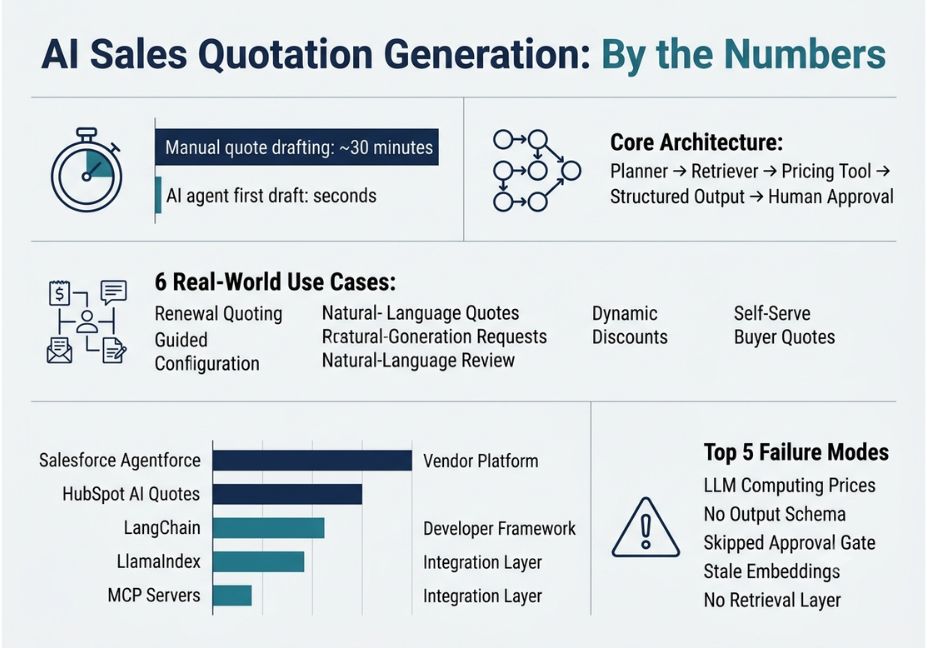
AI Customized Sales Quotation Generation Software Tools — 6 Real-World Use Cases
- Renewal and multi-year contract quoting agent pulls prior terms via retrieval and proposes an updated structure automatically
- Guided configuration for complex products the agent asks clarifying questions when a configuration is ambiguous instead of guessing
- Natural-language quote requests a rep types “10 seats, annual, with onboarding” and the agent maps it to catalog SKUs
- Multi-agent quote review one agent drafts, a second agent checks the draft against policy before it reaches a human
- Dynamic discount recommendation the agent suggests a discount within pre-approved bounds based on deal size and historical win rate
- Buyer-facing self-serve quoting external agents (not just internal reps) request structured, validated quotes through an API rather than a web form
Pro Tip: Start with renewal quoting as your first use case. The data (prior contract terms) is already structured, which sidesteps the hardest part of the problem free-text intent parsing while you validate your pricing-accuracy pipeline.
Best Tools and Frameworks for Building Quoting Agents
The vendor landscape splits into two camps: no-code CPQ platforms bolting on AI, and developer frameworks for building the agent yourself.
| Tool / Framework | Type | Strength | Trade-off |
|---|---|---|---|
| Salesforce Agentforce + CPQ | Vendor platform | Deep native CRM/pricing integration | Locked to Salesforce data model |
| HubSpot AI Quotes | Vendor platform | Fast setup, deal-record context | Limited custom agent logic |
| LangChain + a vector store | Developer framework | Full control of the tool-use loop and retrieval layer | You own reliability and maintenance |
| LlamaIndex | Developer framework | Strong catalog/document retrieval | Needs a separate agent orchestration layer |
| Model Context Protocol servers | Integration layer | Standardized, permissioned tool access for agents across vendors | Still maturing ecosystem |
Did You Know? Teams running conversational CPQ agents in production have reported reps previously spending around 30 minutes manually assembling a single multi-year quote in a CRM before automation — a task an agent with the right tool access can compress to a first-draft in seconds, with the time saved going into human review rather than eliminated review.
Step-by-Step: Building a Quotation Agent
- Define a strict JSON schema for a valid quote (line items, SKU, price, discount, approval status).
- Index your product catalog into a vector store for semantic retrieval.
- Wrap pricing and discount-policy logic as callable, deterministic functions never let the model compute prices itself.
- Give the LLM a structured tool-calling interface so it invokes retrieval and pricing functions instead of generating numbers from memory.
- Validate every generated quote against the schema and policy rules before it’s shown to a human.
- Route anything outside policy thresholds to human approval do not auto-send.
python
def generate_quote(customer_context: dict, requested_items: list) -> dict:
    # 1. Retrieve matching catalog entries (RAG step)
    catalog_matches = vector_store.search(requested_items, top_k=5)

    # 2. Call the deterministic pricing tool (never model-generated math)
    priced_items = pricing_engine.calculate(catalog_matches, customer_context)

    # 3. Force structured output against a strict schema
    quote = llm.generate_structured(
        prompt=build_quote_prompt(customer_context, priced_items),
        schema=QuoteSchema,
    )

    # 4. Policy gate before anything reaches a human or buyer
    if quote["discount_pct"] > POLICY_MAX_DISCOUNT:
        return route_for_approval(quote)

    return quote
Technical Disclaimer: Framework versions evolve rapidly. Code examples above assume a generic LangChain-style tool-calling setup as of mid-2026. Always check the official docs for current API signatures before shipping.
Common Mistakes and How to Avoid Them
- Letting the LLM compute prices directly this is the single biggest source of quoting hallucinations; always delegate math to a tool call
- No structured output schema free-text quotes are unparseable and unauditable; enforce JSON schema validation on every generation
- Skipping the human-in-the-loop approval gate even a 99%-accurate agent will eventually misprice a deal; policy-breaking quotes must be intercepted
- Stale catalog embeddings a vector store that isn’t re-indexed after a price change will confidently retrieve outdated numbers
- Treating context window size as a substitute for retrieval dumping the entire catalog into the prompt instead of using retrieval-augmented generation degrades accuracy and cost as catalogs scale
Now that you understand where these systems typically break, it’s worth checking what practitioners actually building them are reporting.
What Developers Are Saying
Field reports from teams shipping agentic CPQ describe the same pattern: the drafting and language layer is the easy part; the hard part is enforcing deterministic pricing and permissioned data access so an agent can’t fabricate a discount. Discussions on developer forums around agent memory and tool reliability echo this nondeterministic reasoning steps need deterministic guardrails wrapped around them, not just better prompts.
FAQ People Also Ask
What is AI-powered quote generation software?
It’s software that uses an LLM-driven agent to assemble customer-specific sales quotes from a product catalog and pricing engine automatically, rather than requiring manual data entry into a template.
How do AI agents generate customized sales quotes?
The agent retrieves relevant catalog data via retrieval-augmented generation, calls a deterministic pricing function, and emits a structured quote document combining language generation with tool use rather than freehand drafting.
Can AI agents access real-time pricing without hallucinating?
Yes, if pricing is handled by a dedicated function call rather than the model’s own generation. Hallucination risk drops sharply when numeric logic is delegated to deterministic tools instead of left to the LLM.
What’s the difference between CPQ and agentic CPQ?
Traditional CPQ automates configuration and pricing through rule engines a human navigates. Agentic CPQ adds an autonomous, goal-oriented agent layer that reasons, retrieves data, and drafts quotes with minimal manual navigation.
Is AI quote generation accurate enough for enterprise sales?
It can be, provided pricing math stays outside the LLM, outputs are schema-validated, and discounts above policy thresholds route to human approval accuracy is an architecture decision, not just a model choice.
What tools do developers use to build a quoting agent?
Common stacks combine an agent framework like LangChain or LlamaIndex, a vector database for catalog retrieval, a structured tool-calling interface, and a permissioned integration layer such as the Model Context Protocol for connecting to CRM or ERP data.
Conclusion
AI customized sales quotation generation software tools work best when treated as agentic systems, not chatbots with a template attached. The three things that matter most: keep pricing math in deterministic tools rather than the LLM, enforce structured output validated against a strict schema, and never skip the human-in-the-loop approval gate for out-of-policy discounts.
Bookmark this guide and explore more hands-on agentic AI build tutorials at agentiveaiagents.com.