A track that took a session musician three days to record now takes an AI model under a minute. In 2026, that track can also carry a real commercial license. AI music generation tools stopped being novelty toys sometime in 2025, and this year the market split cleanly into two camps: polished consumer platforms chasing vocal realism, and open-weight foundation models built for developers who want to self-host. Stability AI’s own research describes its newest architecture as built around a semantic-acoustic autoencoder that enables longer, more flexible audio generation a good sign of how fast the underlying tech is moving. So if you’re building on top of these models, the difference between “good demo” and “legally usable in a shipped product” now comes down to a handful of specific technical and licensing details.
Quick Answer: The best AI music generation tools in 2026 are Suno (for complete songs with vocals and an integrated DAW), Udio (for high-fidelity vocal realism and precise editing), and Stable Audio 3 (for open-weight, self-hosted instrumental generation on licensed training data). Which one is “best” depends on whether you need vocals, self-hosting, or commercial licensing certainty.
What Is AI Music Generation?
AI music generation is the process of turning a text prompt into a finished audio track using a trained generative model. A user describes genre, mood, instrumentation, and sometimes lyrics, and the model outputs a waveform. Most current systems fall into two architectural families. Autoregressive token models generate audio piece by piece, similar to how an LLM generates text one token at a time. Latent diffusion models, by contrast, denoise audio inside a compressed representation space. In practice, most modern systems work the same basic way: a text encoder converts the prompt into a numerical representation, a generative core produces audio in that compressed latent space, and a decoder converts the result back into a waveform. The architecture matters less to a listener than it does to a developer deciding what to build on top of — for example, whether you can fine-tune the model on your own audio (more on that below).
How Do AI Music Generators Work in 2026?
The generation pipeline has converged on a few shared building blocks: a text encoder, a generative core, and an audio decoder. However, what’s actually changed in 2026 is length, control, and provenance — not the basic pipeline shape.
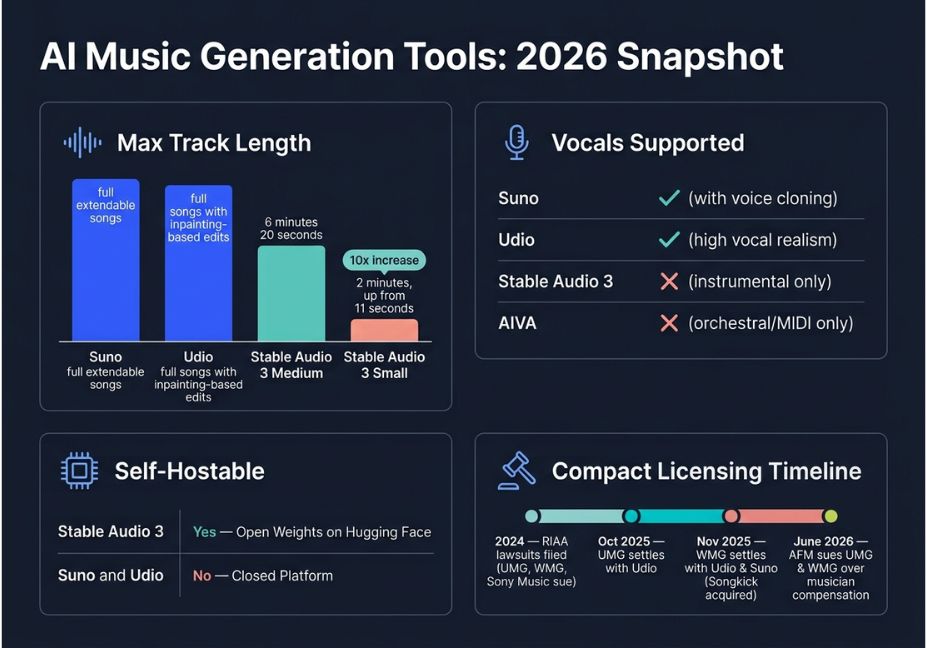
- Length: Stable Audio 3 Small jumped from 11 seconds of usable output to up to two minutes, a tenfold increase over the previous version. Meanwhile, the Medium variant handles longer, more complex tracks up to 6 minutes 20 seconds.
- Control: Suno’s newer models now allow tempo and key locking, and Udio’s editing tools support audio inpainting reworking one section of a track without regenerating the whole thing.
- Provenance: Stability AI trained its 2026 models entirely on licensed data from partnerships with Universal Music Group and Warner Music Group. As a result, the training-data question that dogs some competitors doesn’t apply in the same way here.
Pro Tip: If you’re prototyping a product that generates background music at scale, check whether the model runs locally before you architect around an API. Stability AI’s 3.0 Small and Medium models are available on Hugging Face for direct download, which changes your cost model entirely compared to paying per generation. This is also where LoRA fine-tuning becomes useful: instead of retraining a model from scratch, LoRA lets you adapt Stable Audio 3 to a specific sound library with far less compute.
AI Music Generation Use Cases — Real-World Examples in 2026
Because the tools now split by strength, the right pick usually depends on the use case:
- Songwriting and demos: Independent artists use Suno or Udio to sketch full arrangements before bringing in session musicians.
- Game and film scoring: AI music generation tools for game developers increasingly mean instrumental-only models, since adaptive soundtracks rarely need vocals.
- Podcast and video background beds: Creators generate royalty-free stems instead of licensing stock music libraries a direct answer to “how to generate royalty-free AI music” without touching a label’s catalog.
- Sound design: Small, fast open-weight models generate one-off SFX foley, transitions, UI sounds directly inside a build pipeline.
- Practice and remixing: Tools built around stem separation, meaning isolated vocals, drums, and bass, support musicians who want to practice over instrumentals or remix existing recordings.
If you’re already building agent-based tool-use loops for other tasks, a text-to-music endpoint slots in the same way any other tool-use loop that calls a music-generation API would.
Best AI Music Tools and Frameworks in 2026 — Comparison
| Tool | Vocals | Max Length | Architecture | Self-Hostable | Best For |
|---|---|---|---|---|---|
| Suno (v5.5) | Yes, with voice cloning | Full songs, extendable | Proprietary end-to-end pipeline | No | All-in-one songwriting, full DAW (“Suno Studio”) |
| Udio | Yes, strong vocal realism | Full songs, inpainting-based edits | Proprietary, diffusion-influenced | No | High-fidelity vocals, granular editing, jazz/classical/soul |
| Stable Audio 3 (Small/Medium) | No | Up to 6:20 (Medium) | Semantic-acoustic autoencoder + diffusion | Yes (Hugging Face weights) | Instrumentals, SFX, on-device/self-hosted pipelines |
| AIVA | No | Full orchestral scores | Rule-guided + generative, MIDI export | Partial | Cinematic/orchestral composition with note-level control |
Table image alt text: “Comparison table of Suno, Udio, Stable Audio 3, and AIVA for AI music generation 2026″
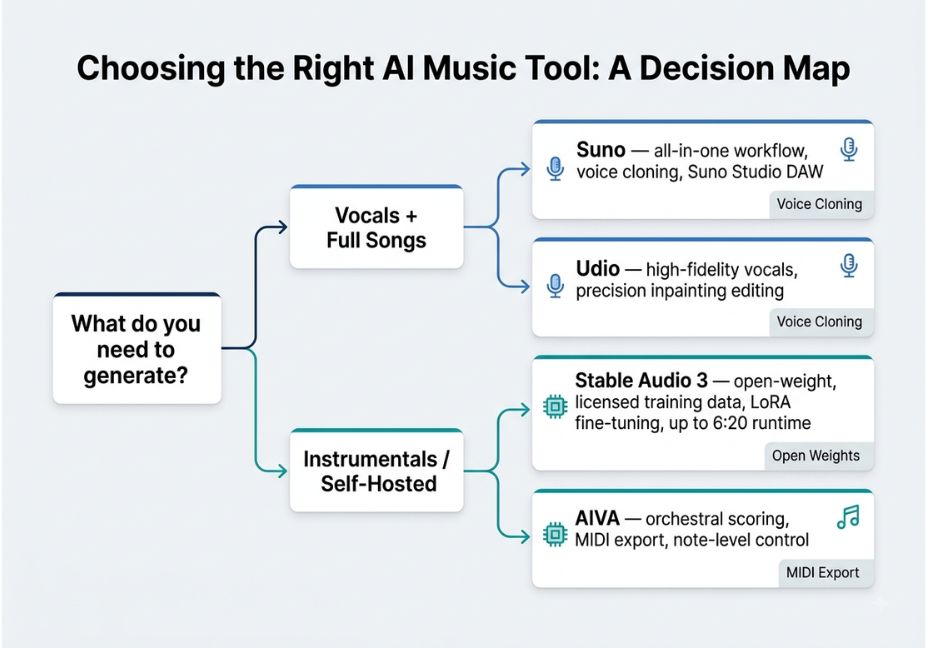
Architect’s Note: If your product needs vocals, none of the open-weight models currently compete. Stable Audio 3 explicitly does not generate vocals. Because of this, a hybrid stack Suno or Udio for vocal tracks, Stable Audio 3 for instrumental beds and SFX is increasingly common in production pipelines.
Key Takeaways:
- Suno wins on all-in-one workflow and vocals.
- Udio wins on vocal fidelity and editing precision.
- Stable Audio 3 wins on self-hosting, licensing clarity, and cost control at scale.
Step-by-Step: How to Build an AI-Generated Music Pipeline
- Define the deliverable. A single royalty-free background bed needs a different tool than a full song with lead vocals.
- Choose architecture based on hosting needs. If you need on-device or offline generation, an open-weight model is the only option, since closed platforms are API- or browser-only.
- Prompt with structure, not just adjectives. Specify genre, mood, instrumentation, and tempo separately instead of one long sentence.
- Iterate with editing tools, not full regenerations. Use inpainting or section-based re-rolls to fix a bridge or verse instead of restarting.
- Export stems if you plan to mix. Paid tiers on consumer platforms typically unlock separated vocal, drum, bass, and instrumental stems for use in a DAW.
- Confirm the commercial license before shipping. Read the plan’s terms of use see the licensing section below before you publish or monetize output.
python
# Example: calling a text-to-music API (illustrative — check current docs for your chosen provider)
import requests

response = requests.post
    "https://api.example-music-model.com/v1/generate",
    json=
        "prompt": "lo-fi hip hop, mellow, rain sounds, 80 BPM, 2 minutes",
        "duration_seconds": 120,
        "format": "wav"

    headers={"Authorization": "Bearer YOUR_API_KEY"}

audio_url = response.json()["output_url"]
Technical Disclaimer: Framework versions evolve rapidly. Model names, endpoints, and licensing terms referenced here (Suno v5.5, Udio, Stable Audio 3) are current as of mid-2026. Always check the official docs and current licensing terms before shipping a commercial product.
Licensing and Commercial Rights: What Changed in 2026
This is the section most competitor articles skip past, and it’s the one that actually determines whether you can ship AI-generated music in a real product.
Through 2024 and 2025, all three major labels under the RIAA’s coordination sued Suno and Udio for training on copyrighted recordings without permission. That litigation has since split into settled and still-active tracks. Universal Music Group settled with Udio and announced a compensatory legal settlement plus license agreements for a new AI music platform set to launch in 2026. Warner Music Group followed with its own Udio settlement. Shortly after, Warner became the first major label to settle its copyright lawsuit against Suno, and Suno acquired concert-discovery platform Songkick from Warner as part of the deal. Sony Music, however, has not settled with either company, so that litigation remains active.
Did You Know? Settling with a label doesn’t automatically resolve every legal question. In June 2026, the American Federation of Musicians sued UMG and Warner Music, alleging the labels licensed session recordings to Suno and Udio without compensating or crediting the musicians who played on them. In other words, this is a dispute over whether label-level settlements cover the individual performers whose work trained the models a useful reminder that “licensed” and “everyone in the supply chain got paid” aren’t the same thing yet.
For builders, the practical takeaway is straightforward: a paid tier’s commercial-use terms tell you what you can do with output today, but the underlying rights picture is still moving. Therefore, it’s worth revisiting before a large-scale commercial launch much like the same licensing-provenance questions that come up in RAG pipelines when the underlying data sources shift.
Common Mistakes and How to Avoid Them
- Assuming “AI-generated” means unlicensed use is automatically safe. Instead, read the specific plan’s commercial terms free tiers often restrict monetized use even when paid tiers don’t.
- Ignoring architecture when self-hosting matters. Teams that need offline or on-device generation sometimes default to a closed API and get stuck when they need to scale down costs later.
- Regenerating instead of editing. New inpainting and section-editing tools exist specifically so you don’t have to re-roll an entire track to fix one part.
- Skipping stem exports. If there’s any chance you’ll want to remix or master a track later, export stems at generation time, because some platforms don’t let you retrieve them retroactively.
What Developers Are Saying
Open-weight releases tend to generate the most technical scrutiny, and Stable Audio 3 is no exception. Developers comparing self-hosted audio models on forums like Reddit’s r/LocalLLaMA have focused heavily on inference speed on consumer GPUs versus the closed-platform alternatives, since the small variant is explicitly designed to run without a dedicated GPU at all.
FAQ People Also Ask
What is the best AI music generator in 2026?
There isn’t a single winner — it depends on the deliverable. Suno leads for complete songs with vocals and an integrated production workflow. Udio leads for vocal realism and fine-grained editing. Stable Audio 3 leads for instrumentals, sound design, and self-hosted pipelines.
Is AI-generated music free to use commercially?
It depends on the plan and platform. Paid tiers on major platforms generally grant commercial-use rights, but free tiers often don’t. In addition, the underlying training-data licensing landscape is still being litigated for parts of the catalog.
Can I train an AI music model on my own audio?
Yes, on open-weight models. Stable Audio 3 supports LoRA fine-tuning, which lets developers adapt the base model to a specific sound library without retraining from scratch — something closed platforms like Suno and Udio don’t currently offer.
Do Suno and Udio credit the artists their models were trained on?
Not directly to individual performers in most cases. Label-level settlements with Universal Music Group and Warner Music Group cover the labels’ catalogs, but a 2026 lawsuit from the American Federation of Musicians argues that session musicians themselves haven’t been compensated or credited.
What’s the difference between Suno and Stable Audio 3?
Suno is a closed, vocal-first platform built for complete songs with an integrated DAW. Stable Audio 3, on the other hand, is an open-weight, instrumental-only model family built on fully licensed data, designed for developers who need to self-host or fine-tune.
Conclusion
The AI music generation landscape in 2026 isn’t really about whether AI can write a song anymore it’s about which architecture and licensing model fits what you’re building. Suno and Udio remain the fastest path to a finished vocal track with production-quality polish. Stable Audio 3 and other open-weight models, meanwhile, give developers something the closed platforms don’t: self-hosting, fine-tuning, and training-data transparency. And the ongoing licensing disputes are a reminder that “AI-generated” and “cleared for commercial use” are related but separate questions worth checking before you ship. Bookmark this guide and explore more hands-on AI tooling breakdowns at agentiveaiagents.com.