
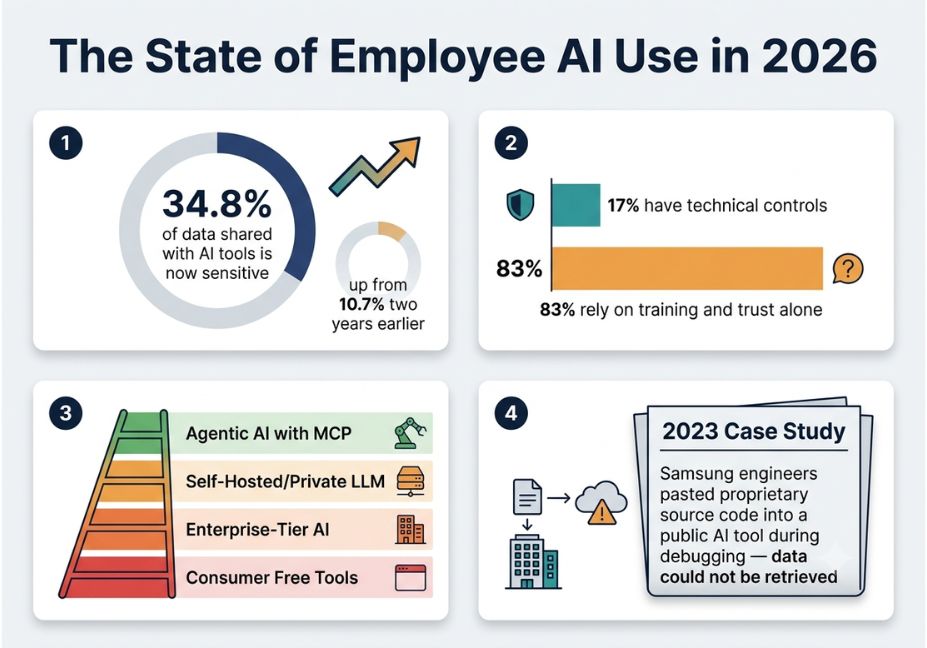
In 2023, engineers at Samsung’s semiconductor division pasted proprietary source code into ChatGPT while debugging. They couldn’t get it back. Samsung’s response was an outright ban, but that fixed nothing already submitted. This single incident is now the reference case for every employee AI tools policy conversation, because it shows the real failure mode: it’s rarely malice. It’s productivity outrunning governance.
The numbers back this up. Cyberhaven’s 2025 workforce analysis found that 34.8% of data shared with AI tools is now sensitive, up from 10.7% two years earlier. Most of it flows through unmanaged personal accounts rather than sanctioned enterprise tools like ChatGPT Enterprise, Microsoft Copilot, or Anthropic’s Claude for Business. Without a written policy that classifies data, defines sanctioned tools, and sets model training opt-out requirements, intellectual property protection becomes a matter of luck.
This guide covers what a defensible AI acceptable use policy actually contains, where generic templates fall short, and how to roll one out without killing employee adoption.
What Is an Employee AI Tools Policy?
Featured snippet answer: An employee AI tools policy, also called an AI acceptable use policy (AUP) or corporate AI usage policy, is a written document that defines which AI tools staff may use, what data they may submit, and who owns the resulting output. It typically sits inside a broader AI governance framework alongside data protection and cybersecurity policies.
This distinction matters for intellectual property specifically. Under current U.S. law, intellectual property rights in AI-generated output are limited and depend on human involvement. For trade secrets, the exposure is procedural rather than purely legal. As Wikipedia’s overview of trade secret law explains, a trade secret only stays protected while it stays secret and pasting it into a third-party model can be the disclosure that ends that protection.
Did You Know? Only an estimated 17% of organizations have technical controls, not just written policy, to stop employees uploading confidential data to public AI tools. The remaining 83% rely on training and trust alone.
How Does Shadow AI Threaten Company Intellectual Property?
Shadow AI is unsanctioned AI tool use that IT and security teams never approved or reviewed. It’s the AI-era version of shadow IT, except it only requires a browser. Consequently, it spreads faster and is harder to detect.
Three mechanisms drive the IP risk:
- Training-data ingestion. Free-tier consumer accounts (ChatGPT, Google Gemini, and similar tools) may use submitted prompts to improve future models unless the user opts out. As a result, trade secrets can persist inside a system your legal team never agreed to.
- Third-party retention. Even opted-out data is typically stored for a defined window, often 30 days at minimum, on vendor infrastructure your company doesn’t control.
- Agentic and MCP exposure. As agentic AI tools gain tool-calling and memory capabilities through protocols like Model Context Protocol (MCP), the risk surface expands. It’s no longer just “what an employee typed” it’s “what an autonomous agent can read, retrieve, and act on.”
Technical Note: Data classification, not the policy document itself, is the control that actually stops leakage. A policy that simply says “don’t paste confidential data” gives employees no practical way to identify which tier a given file belongs to.
Real-World Employee AI Policy Use Cases
- Engineering teams debugging with AI coding assistants. The Samsung case remains the clearest example: proprietary source code entered a consumer chatbot during a routine debugging task.
- HR teams drafting termination or performance documents. Pasting employee records into a public model creates a privacy breach and a confidentiality breach at the same time.
- Legal teams summarizing NDAs and contracts. Feeding non-public contract language into an ungoverned tool can itself violate the confidentiality clause being summarized.
- Marketing teams generating “in the style of” content. Instructing a model to mimic a named third-party creator’s style, then publishing the result, carries independent IP infringement risk separate from data leakage entirely.
Which AI Tools Are Safest for Employee Use? (Comparison)
Not every AI tool carries the same IP exposure. The distinction that matters most is tier, not brand:
| Approach | Data Handling | IP/Ownership Clarity | Best For |
|---|---|---|---|
| Consumer free tier (personal ChatGPT, Gemini accounts) | May train on inputs by default; low visibility | Poor no enterprise agreement | Never recommended for work data |
| Enterprise-tier AI (ChatGPT Enterprise, Claude for Business, Microsoft Copilot) | Enterprise tiers that don’t train on business data by default | Strong contractual IP and data-ownership terms | Default sanctioned option for most teams |
| Self-hosted or private LLM | Fully internal, no third-party retention | Strongest data never leaves your infrastructure | Regulated industries, source code, trade secrets |
| Agentic AI with MCP integrations | Depends on connector scope and logging | Requires explicit tool-permission review | Automation teams needs its own policy addendum |
Pro Tip: Don’t try to “ban your way” to compliance. Employees who can’t get an approved tool quickly will simply use an unapproved one instead. Pair every restriction with an equally fast approval path.
How Do I Write an AI Acceptable Use Policy for Employees? (Step-by-Step)
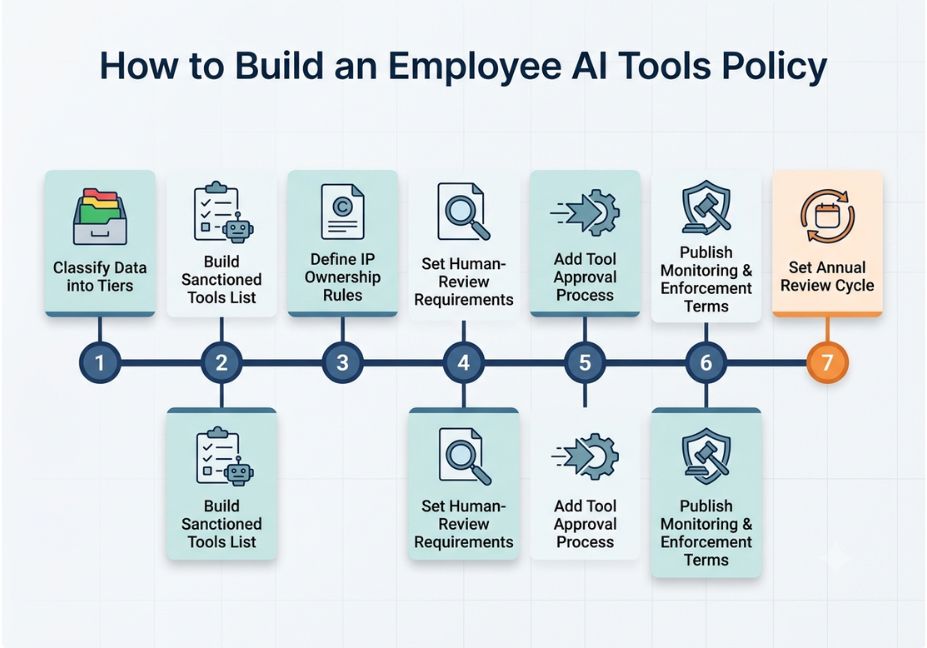
- Classify your data into at least three tiers public, internal, restricted before writing a single policy sentence.
- Build a sanctioned tools list naming the specific approved AI products and the data tier each may touch.
- Define IP ownership rules for AI-generated work created on company time. Clarify what “sufficient human authorship” means for your organization’s copyright claims.
- Set human-review requirements for anything published externally, sent to a client, or used in a regulated decision such as hiring or credit.
- Add an approval process for new AI tools so requests don’t default to shadow use.
- Publish monitoring and enforcement terms, reviewed by legal for every jurisdiction you operate in.
- Set an annual review cycle, at minimum. The AI tool landscape moves faster than most other policy domains.
Technical Disclaimer: Vendor data-handling terms change frequently. Verify current enterprise privacy commitments directly with each provider such as OpenAI, Microsoft, or Anthropic before finalizing tool-tier assignments. Don’t rely on marketing copy alone.
Common Mistakes That Undermine an AI Usage Policy
- Treating “AI policy” as one document. IP ownership, data classification, and agentic-tool permissions are related but distinct problems. Conflating them produces a policy nobody can apply consistently.
- Ignoring state-level ownership rules. Some U.S. states have introduced work-for-hire provisions specific to generative AI output, meaning employer ownership of AI-generated content isn’t automatic everywhere. Check your jurisdiction instead of assuming a single national default.
- Skipping technical enforcement. A written policy without data loss prevention (DLP) tooling, SSO-gated tool access, or browser controls is a suggestion, not a control.
- Skipping the review cadence. A policy older than 12–18 months is functionally stale, given how fast vendor terms and tool capabilities change.
What Are Practitioners Saying About Employee AI Governance?
Security and legal teams discussing this on forums like Reddit’s r/cybersecurity and r/MachineLearning tend to converge on one point: the written policy is necessary but not sufficient. Governance programs succeed when the AUP is paired with real technical enforcement SSO-gated approved tools, DLP rules, and a fast tool-approval pipeline rather than treated as a one-time compliance artifact. This aligns with frameworks like NIST AI RMF and ISO 42001, both of which treat policy as one control among several, not the whole program.
FAQ People Also Ask
What should an employee AI tools policy include?
A complete policy defines sanctioned AI tools, a data classification scheme for what may and may not be entered into them, IP ownership rules for AI-generated output, human-review requirements, an incident-reporting process, and an annual review cycle.
Who owns AI-generated work created by employees?
Ownership generally follows work-for-hire principles when the work involves sufficient human authorship and falls within the scope of employment. However, purely AI-generated output with no human authorship is often not copyrightable by anyone. Trade secret protection can serve as a fallback if the output stays confidential.
Can my employer see what I type into ChatGPT at work?
Yes, in most jurisdictions, provided employees are notified and the monitoring complies with applicable state and federal electronic-communications laws. Requirements vary by location, so legal review by jurisdiction is essential before rolling out monitoring.
What data should never be entered into AI tools?
Confidential business information, trade secrets, customer PII, credentials, and non-public contract or financial details should never go into a tool that hasn’t been reviewed and approved for that specific data type.
Do free AI tools use company data for training?
Often yes, by default, unless the account sits on a reviewed enterprise tier with a contractual opt-out. This is the single biggest reason consumer-tier accounts should be excluded from any sanctioned tools list.
Does GDPR or HIPAA apply to AI tool use at work?
Yes. If AI tools process personal data covered by GDPR or protected health information covered by HIPAA, those regulations apply regardless of which AI vendor is used. A compliant policy must map data classification directly to these existing obligations rather than treating AI as a separate, unregulated category.
Conclusion
An employee AI tools policy only protects intellectual property if it does three things at once: classifies data so employees know what’s off-limits, names the specific sanctioned tools approved for each tier, and pairs those rules with real technical enforcement rather than a single intranet PDF. Get the classification and tooling decisions right, and the rest of the policy ownership rules, review cadence, incident reporting becomes straightforward to write and easy to defend.
Bookmark this guide and explore more hands-on AI governance breakdowns at agentiveaiagents.com.
One Response