
Most “best AI music tools” roundups rank platforms the way a music blog would by vocal realism and genre coverage. That’s the wrong lens if you’re building a product, however. In 2026, the harder questions are: does this tool expose a stable API, is its output actually clear to license commercially, and can it slot into a tool-use loop the way a search or retrieval function does.
That question got a lot more consequential this year. Specifically, Warner Music Group settled its lawsuits against both Suno and Udio in late 2025, converting each into a licensed platform mid-buildout, while Sony and Universal continue litigating parts of the underlying training-data claims. As a result, if you’re an engineer wiring music generation into an agentive AI pipeline a content app, a game engine, a marketing tool the legal status of the model behind the API now matters just as much as its audio quality.
This guide, therefore, covers the current API landscape, the licensing shakeup, and a working pattern for calling a music-generation model as a tool from an agent loop in short, everything the typical “top 10 tools” listicle leaves out.
What Is AI Music Generation?
AI music generation is the use of text-to-audio models to convert a natural-language prompt genre, mood, lyrics directly into a finished audio track, replacing the older algorithmic composition tools that simply assembled pre-made loops. In other words, the current generation, including Suno, Udio, and ElevenLabs Music, uses diffusion or transformer-based audio models trained on large recorded-music datasets, a lineage documented on Wikipedia’s overview of AI-generated music (https://en.wikipedia.org/wiki/Music_and_artificial_intelligence). For builders specifically, the distinction that matters most is licensing: some of these models were trained on unlicensed catalogs and are now being retired or restricted as new deals close, which is exactly why choosing the best AI music generation API for developers in 2026 means checking legal status first and audio quality second.
How Do AI Music Generators Work in 2026?
Under the hood, most leading tools follow a similar architecture: a language-conditioned diffusion or autoregressive model generates audio in stages first structure and arrangement, then vocals and instrumentation, and finally mastering. Consequently, the same tool-use loop pattern that an agent uses to call a search function or a retrieval API applies here too the model is simply another callable capability in the orchestration layer.
- Suno V5 / V5.5 full-song generation with vocals, structure, and stem export
- Udio section-level inpainting for regenerating one part of a track without redoing the whole thing
- ElevenLabs Music built on ElevenLabs’ voice-synthesis stack, strong on vocal fidelity
- Stable Audio open, self-hostable diffusion model for instrumental and ambient generation
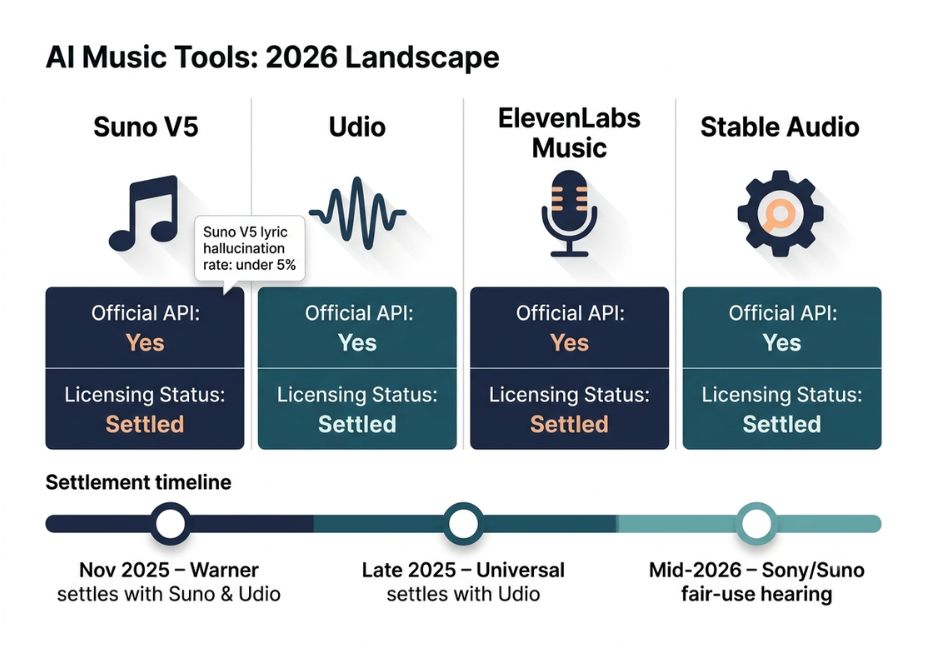
Technical Note: Prompt adherence and lyric hallucination rate are the two metrics worth benchmarking before you commit to a model some third-party evaluations put Suno V5’s lyric hallucination rate under 5%, down sharply from earlier versions, which matters if your product needs reliable lyric-to-audio matching.
Is AI-Generated Music Legal to Use Commercially in 2026?
This is the update most “top 10 tools” lists miss entirely, and it’s arguably the single biggest thing that changed this year. The original suits were coordinated by the RIAA on behalf of Sony, Universal, and Warner, and hinged on whether training a model on copyrighted recordings counts as fair use a doctrine the U.S. Copyright Office addressed in its 2025 guidance, though without binding legal force. Here’s where things stand now:
- Warner Music Group settled with both Suno and Udio in November 2025, requiring Suno to retire every model trained on unlicensed music and cap free-tier commercial use.
- Universal Music Group settled separately with Udio, pushing it toward a “walled garden” model where creations can’t be exported or downloaded.
- Meanwhile, Sony and Universal are still litigating against Suno, with a fair-use hearing scheduled for mid-2026 that could reshape the whole category’s legal footing.
- In addition, a German case (GEMA v. Suno) and a U.S. musicians’ union suit against the labels themselves are both still pending so, overall, the licensing picture is not fully settled even for the deals already announced.
Architect’s Note: If your product ships commercial output today, treat “licensed vs. unlicensed model” as a hard filter before evaluating audio quality after all, a great-sounding track from a model still under active litigation is a liability, not a feature.
Best Tools and APIs What’s Actually Buildable
| Tool | Official API? | Commercial licensing status (mid-2026) | Best for |
|---|---|---|---|
| Suno V5 | No official public API; third-party providers only | Settled with Warner; still litigating with Sony/UMG | Full songs with vocals, game/content pipelines |
| Udio | No public API; walled-garden UI only | Settled with Warner & Universal; exports restricted | Remix/mashup experiences within licensed catalog |
| ElevenLabs Music | Yes, via ElevenLabs’ developer platform | Vendor-licensed model | Vocal-quality-critical apps |
| Stable Audio | Yes, self-hostable | Open model, license varies by weights | Instrumental/ambient, full control, no vendor lock-in |
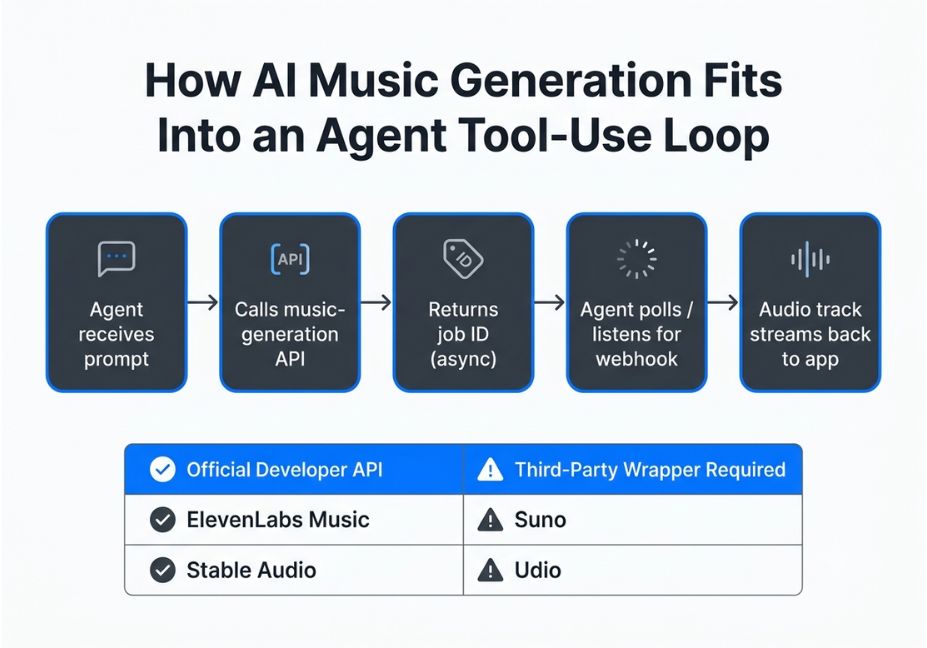
Pro Tip: Because Suno has no official API, most integrations instead go through third-party providers (SunoAPI.org, AIMLAPI, Kie.ai, or the open-source gcui-art/suno-api project on GitHub) that reverse-proxy the consumer product. That’s a real operational risk, however account bans and terms-of-service changes can break your pipeline overnight, so treat these as a dependency to abstract behind an interface, not a hard integration.
How Do You Integrate AI Music Generation into an Agent Workflow?
If you’re building on top of an orchestration layer LangChain, a custom ReAct-style loop, or OpenAI’s function-calling interface (https://platform.openai.com/docs/guides/function-calling) a music-generation call is simply another tool the planner can invoke.
python
# Simplified tool-use pattern: agent decides to call music generation
def generate_track_tool(prompt: str, instrumental: bool = False):
    response = music_api.generate(
        prompt=prompt,
        make_instrumental=instrumental,
        wait_audio=False

    track_id = response["id"]
    return poll_for_completion(track_id)  # async job, poll until "streaming"
Importantly, the generation call is asynchronous in every current provider the agent submits a prompt, gets a job ID back, and polls (or listens for a webhook) until the track streams. For that reason, design your agent’s tool-use loop to handle that latency explicitly; otherwise, a naive synchronous call will simply time out.
Common Mistakes and How to Avoid Them
- Treating “no official API” as “no API” third-party wrappers exist and work, but you’re depending on someone else’s reverse-engineered integration.
- Ignoring licensing status when choosing a model audio quality, after all, is not the same axis as legal safety for commercial use.
- Assuming synchronous generation every major model streams or polls; instead, build your agent loop around async job status, not a blocking call.
- Skipping stem/export checks
- Udio’s walled-garden restrictions mean some “great” outputs literally can’t leave the platform for downstream use.
What Developers Are Saying
Discussion threads on r/MachineLearning and r/LocalLLaMA reflect a split community: some builders, for instance, are moving toward self-hosted, open models like Stable Audio specifically to avoid the licensing uncertainty around Suno and Udio, while others argue the vocal quality gap is still too large to give up on the licensed platforms just yet.
FAQ People Also Ask
What are the best AI music tools in 2026?
Suno V5 leads for full vocal-track generation, Udio for section-level remixing within its licensed catalog, ElevenLabs Music for vocal fidelity, and Stable Audio for self-hosted instrumental work. The right pick depends on whether you need a developer API or a consumer UI.
Does Suno have an official API?
No. Suno does not offer a public, self-serve API; access goes through third-party providers that wrap the consumer product, which carries added operational risk for production use.
Is AI-generated music free to use commercially?
It depends on the model’s licensing status. Post-settlement Suno and Udio models built on licensed catalogs are on cleaner ground than earlier, unlicensed models, but the underlying U.S. fair-use question remains unresolved in ongoing litigation.
Can AI agents generate music autonomously?
Yes music generation can be wired in as a callable tool in any agent loop, but because every major provider processes requests asynchronously, the agent’s orchestration logic needs to handle polling or webhooks rather than a blocking call.
What is the legal status of AI music tools in 2026?
Mixed. Warner has settled with both Suno and Udio, and Universal has settled with Udio, but Sony and Universal continue litigating against Suno, and a German case and a musicians’ union suit against the labels remain pending.
Conclusion
Overall, the 2026 story in AI music isn’t really about which model sounds best it’s about which ones are legally stable enough to build a product on, and which expose an integration path a developer can actually depend on. In short, Suno and Udio have shifted from unlicensed generators to partially-licensed platforms mid-year, ElevenLabs Music and Stable Audio offer the clearest developer APIs, and any of them can be dropped into an agent’s tool-use loop as long as you design for asynchronous generation. Bookmark this guide, then, and check back as the Sony/Suno fair-use hearing and the GEMA verdict land later in 2026 both could reshape this table again.
2 Responses