
Most teams tracking the AI product tool launch March 2026 cycle got distracted by benchmark charts. That’s understandable, because GPT-5.4, DeepSeek V4, and Mistral Small 4 all shipped inside the same three-week window, and each one topped a leaderboard somewhere. However, the number that actually changed how agents get built wasn’t a benchmark score. It was 97 million the monthly SDK downloads the Model Context Protocol (MCP) crossed in March, confirming it as the default plumbing for the modern tool-use loop. So if you’re building agentic systems rather than just chatting with a model, this infrastructure shift matters more than another point of SWE-bench.
What Is the “March 2026 AI Launch Wave”?
Quick answer: The March 2026 AI launch wave refers to a cluster of releases GPT-5.4, DeepSeek V4, Mistral Small 4, and an infrastructure milestone for MCP that landed within a three-week span and shifted focus from raw model capability to agentic workflow maturity.
In short, this wave looked different from earlier ones. Instead of competing purely on parameter counts, labs competed on tool orchestration, computer-use reliability, and inference-cost discipline. For background on the underlying architecture, the official Model Context Protocol specification is the clearest primary source.
How Do AI Agents Use the Model Context Protocol?
Modern agent stacks separate into three layers: a reasoning model, an orchestration layer that decides which tool to call and when, and a memory system that persists state across steps. GPT-5.4, for example, pairs frontier reasoning with native computer-use ability, cutting the token overhead of tool search by roughly 47%, according to OpenAI’s own benchmarks. As a result, that efficiency gain compounds directly with MCP, which standardizes how any agent reaches any external tool. The ReAct paper on reasoning and acting in language models laid the conceptual groundwork for this loop years before MCP gave it a common wire format.
Technical Note: MCP defines a host the agent runtime, such as Claude Desktop or an IDE and a server, a lightweight wrapper around a tool or data source. Once a server exists, every MCP-compatible agent can use it without a custom integration.
Why Is MCP Important for AI Agents in 2026?
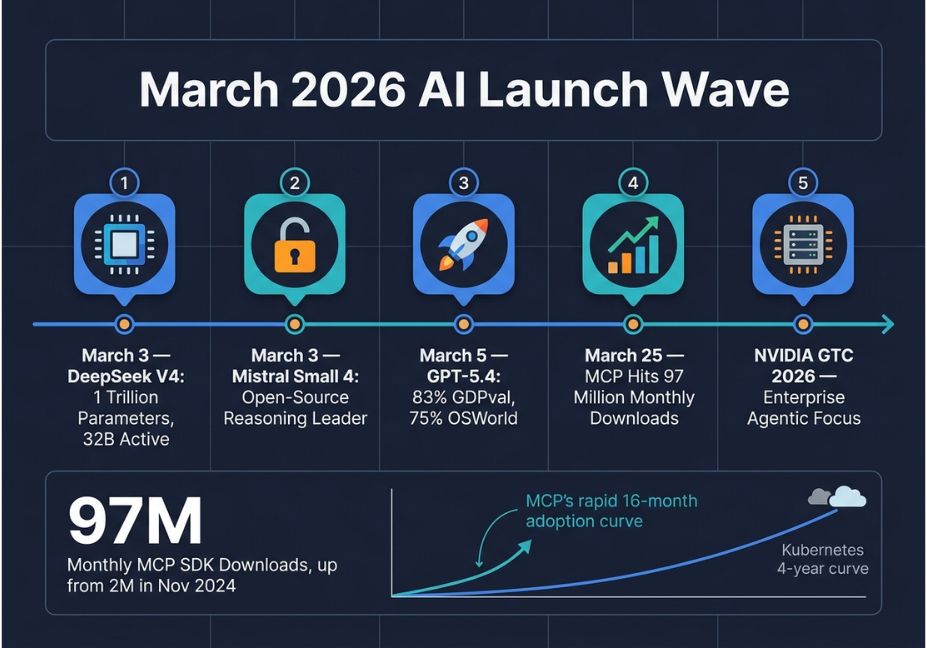
Because MCP removes the “N tools × M agents” integration problem, teams no longer need a bespoke connector for every model-and-tool pairing. Consequently, MCP’s adoption curve from roughly 2 million monthly downloads at its November 2024 launch to 97 million by March 2026 outpaced even Kubernetes, which took nearly four years to reach comparable adoption density. That comparison matters for topical authority: it places MCP alongside Kubernetes and PyTorch as foundational, industry-owned infrastructure rather than a single vendor’s product.
Did You Know? MCP’s growth from 2 million to 97 million monthly downloads in sixteen months is one of the fastest infrastructure adoption curves ever recorded faster than Kubernetes and faster than React’s climb to 100 million monthly npm downloads.
AI Product Tool Launch March 2026 Real-World Examples
- GPT-5.4 (March 5): Combined reasoning, coding, and native computer use in one model, reporting an 83% GDPval score and 75% on OSWorld.
- DeepSeek V4 (March 3): An open-weight model reportedly reaching 1 trillion total parameters while activating only 32 billion per token, timed with China’s Two Sessions.
- Mistral Small 4 (March 3): Topped open-source reasoning leaderboards the same day.
- MCP infrastructure milestone (March 25): Crossed 97 million monthly SDK downloads across more than 10,000 public servers.
- NVIDIA GTC 2026: Focused on enterprise agentic deployment rather than raw benchmark announcements, alongside the Vera Rubin platform’s claimed 10x reduction in training cost.
What Are the Best AI Tools for Agentic Workflows Right Now?
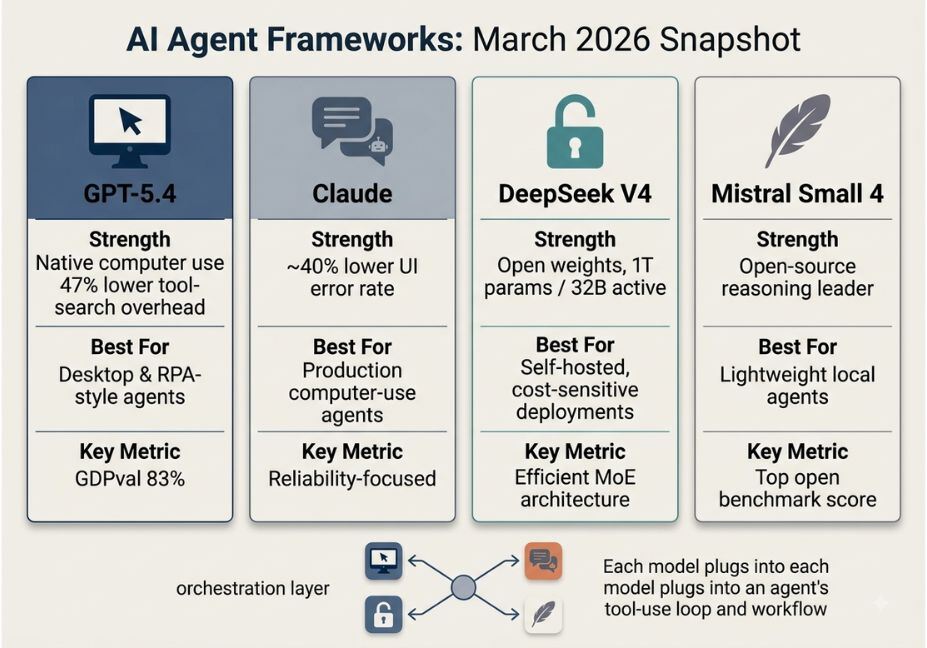
Framework choice in 2026 increasingly comes down to how tightly a platform integrates MCP and computer use, rather than which base model scores highest on a leaderboard. OpenAI’s API documentation now covers native computer-use endpoints alongside its existing function-calling interface, which is worth reading before committing to a stack.
| Tool/Framework | Strength | Best For |
|---|---|---|
| GPT-5.4 (OpenAI) | Native computer use, low tool-search overhead | Desktop/RPA-style agents |
| Claude (Anthropic) | ~40% lower error rate on dynamic UI interactions | Production computer-use agents |
| DeepSeek V4 | Open weights, low active-parameter cost | Self-hosted, cost-sensitive deployments |
| Mistral Small 4 | Open-source reasoning leader | Lightweight local agents |
Pro Tip: Don’t pick a model first. Instead, pick your orchestration layer first the model underneath it is now the easier decision to reverse.
How to Choose an AI Agent Framework After the March 2026 Launches
- Audit your tool integrations. If you’re still maintaining custom connectors instead of MCP servers, budget time to migrate, since the ecosystem has consolidated around it.
- Re-test computer-use flows. Anthropic’s documentation on computer use reflects meaningfully lower error rates on modal dialogs and multi-step forms, so flows that failed in January may now be viable.
- Separate cheap and premium tasks. Route high-volume, low-stakes steps to open-weight models like DeepSeek V4 or Mistral Small 4, and reserve frontier models for steps that need the reasoning ceiling.
- Watch inference economics, not just benchmarks. OpenAI’s quiet wind-down of the Sora public API, due to unsustainable per-minute inference cost, is a reminder that capability without unit economics doesn’t ship.
Common Mistakes and How to Avoid Them
- Chasing benchmark deltas over reliability. A two-point GDPval gain rarely matters as much as a 40% drop in UI-interaction error rate for a production computer-use agent.
- Building custom tool connectors in 2026. Since more than 10,000 public MCP servers are already in production, a bespoke integration is usually redundant work.
- Ignoring governance. MCP’s move to the Linux Foundation under the Agentic AI Foundation removed single-vendor risk, so enterprises that skipped MCP over vendor-lock concerns no longer have that excuse.
- Treating every launch as equally important. Model releases compress fast, but infrastructure milestones like MCP’s adoption curve tend to be the more durable signal.
What Developers Are Saying
Developer discussion on forums like Reddit’s r/LocalLLaMA has largely converged on a similar read: the protocol war is over, and the remaining work is choosing the right MCP servers and designing agent workflows that use the available tools well, rather than debating which standard to adopt.
FAQ People Also Ask
What was the biggest AI product launch in March 2026?
By raw attention, GPT-5.4 was the biggest single-model launch, combining reasoning, coding, and native computer use. However, by long-term impact on agentic workflow design, MCP’s 97-million-download milestone was arguably bigger, since it changed how every agent connects to tools.
What is the Model Context Protocol and why does it matter for AI agents?
The Model Context Protocol is an open standard that lets an AI agent connect to external tools, databases, and APIs through a single common interface instead of a custom integration per tool. It matters because it turns tool access from a bespoke engineering problem into a shared, reusable orchestration layer.
Why did OpenAI shut down the Sora public API?
OpenAI wound down the Sora public API because of unsustainable inference cost per generated minute of video, which signals that compute-heavy generation workloads still face real economic limits even as reasoning models get cheaper.
How do GPT-5.4 and DeepSeek V4 compare for agentic workloads?
GPT-5.4 leads on native computer use and tool-search efficiency, so it works well for desktop-style agents. Meanwhile, DeepSeek V4’s open weights and low active-parameter footprint make it a better fit for cost-sensitive, self-hosted multi-agent system deployments.
What changed in enterprise AI adoption after March 2026?
NVIDIA’s GTC 2026 conference reflected a shift toward enterprise agentic workflow deployment over benchmark hype. In addition, MCP’s move to neutral Linux Foundation governance removed the vendor-lock hesitation that had kept some enterprises on the sidelines.
Is MCP better than building custom AI tool integrations?
For most teams, yes. Because MCP is now backed by every major AI provider and supported by over 10,000 public servers, building a custom connector usually duplicates work that already exists as a shared, maintained standard.
Conclusion
The AI product tool launch March 2026 wave will likely be remembered for GPT-5.4’s benchmark charts. Still, the more durable change was infrastructural: MCP became the assumed default for the tool-use loop, computer-use reliability crossed a threshold that makes production RPA-style agents viable, and the Sora shutdown reset expectations about what inference economics still gate. Therefore, if you’re building agents rather than chasing leaderboard scores, audit your MCP coverage and your unit economics before you audit your model choice.
Bookmark this guide and explore more hands-on AI agent tutorials at agentiveaiagents.com.