
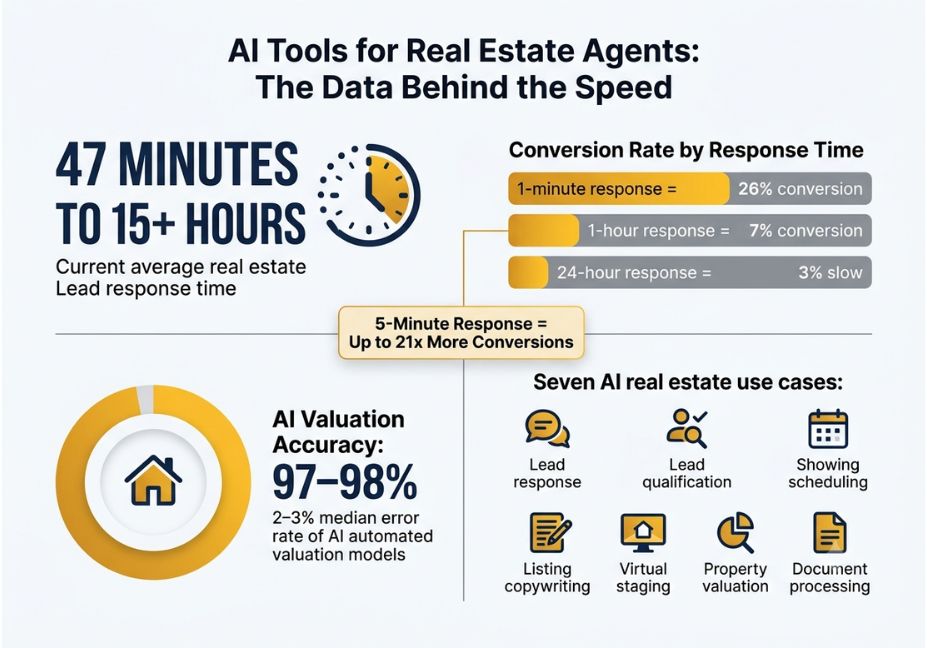
Most “AI tools for real estate agents” aren’t actually agents. In practice, they’re rules engines wearing an AI badge. However, that distinction matters more than the marketing copy suggests, because the average agent still takes anywhere from 47 minutes to over 15 hours to respond to a new lead. Meanwhile, buyers convert at up to 21 times the rate when contacted within five minutes instead of thirty.
As a result, a true agentic system one built around a tool-use loop rather than a fixed script closes that gap without a human touching a keyboard. Below, we’ll break down what separates a real AI real estate agent from an automated form-reply, where the category is headed in 2026, and how to evaluate a tool before you pay for it.
What Is an AI Real Estate Agent? (Definition)
An AI real estate agent is a system that perceives an input a new lead, a listing question, a document decides which action to take, calls a tool to execute it, and then evaluates the result. It repeats this cycle without a human writing each step.
That loop is what separates agentic software from a chatbot with an if/else tree. In other words, if a tool can only follow a pre-written script, it isn’t agentic, no matter how it’s marketed. Because this distinction is confusing to most buyers, we’ll define the underlying architecture next.
How Do AI Agents Work in Real Estate? (Architecture Breakdown)
Under the hood, a genuinely agentic real estate tool has three components:
- Planning module the reasoning step that decides what to do next, similar to a ReAct-style tool-use loop.
- Tool layer the API calls exposed to the model, typically defined with a function-calling schema.
- Memory short-term context for the current conversation and long-term memory for that lead’s full history.
For example, a minimal lead-qualification tool definition looks like this:
  "name": "qualify_lead",
  "description": "Score and route an inbound real estate lead",
  "parameters":
    "type": "object",
    "properties":
      "budget_confirmed": { "type": "boolean" },
      "timeline_months": { "type": "integer" },
      "pre_approved": { "type": "boolean" }

    "required": ["budget_confirmed", "timeline_months"]
Technical Note: This is a simplified illustration rather than a production schema. Real implementations typically add fields for source attribution, consent logging, and fallback-to-human triggers.
Additionally, some platforms pull live property data before responding a pattern that maps directly onto retrieval-augmented generation. Instead of relying on the model’s training data for comps or pricing, the system retrieves current MLS records and grounds its answer in them. This matters because ungrounded answers are exactly where hallucination risk creeps in, which we’ll cover later.
What Are the Best AI Tools for Real Estate Agents in 2026? (7 Use Cases)
Since “AI tools for real estate agents” covers a wide range of software, here are the seven most common categories agents actually use:
- Instant lead response an AI voice or text agent replies within seconds of a portal inquiry.
- Lead qualification the agent asks budget, timeline, and pre-approval questions, then scores and routes the lead.
- Showing scheduling the agent checks calendar availability and books directly.
- Listing copywriting drafting descriptions, social captions, and email blasts from raw property data.
- Virtual staging and photo enhancement AI-generated furnished renders of empty rooms.
- Automated valuation models (AVMs) instant price estimates, typically within 2–3% median error against human appraisals.
- Document and disclosure processing extracting key terms from leases, disclosures, and closing packets.
Did You Know? Lead-response benchmarks compiled in 2026 show conversion-to-appointment rates falling from roughly 26% for a one-minute reply to about 7% within an hour, and just 3% by the next day. Consequently, the tool-use loop’s speed advantage is the entire business case for these platforms.
Best AI Tools and Frameworks: A Comparison
| Tool Category | Example | Core Function | Agentic Depth |
|---|---|---|---|
| AI voice agent | Retell AI–style platforms | Live inbound/outbound calls, lead qualification | High real-time decisioning per call |
| Text/CRM agent | Structurely-style ISA bots | SMS/email nurture, scoring | Medium-High scripted branches plus LLM reasoning |
| Marketing automation | Ylopo-style ad and nurture tools | Ad generation, drip campaigns | Medium mostly rules-based triggers |
| Valuation/AVM | HouseCanary-style AVMs | Property pricing, comps | Low statistical model, not conversational agent |
| Design/staging | Virtual staging tools | Photo enhancement | Low — single-task generation, not a loop |
Pro Tip: Before buying, ask the vendor one question: “What tool calls does your agent make, and what happens when a call fails?” If they can’t answer clearly, it’s automation, not agentic AI.
How Do You Implement AI Tools for Real Estate Lead Generation? (Step-by-Step)
- Map your speed-to-lead gap. Time your current average first-response time for a week.
- Pick one workflow, not ten tools. Start with inbound lead response, since it has the clearest ROI.
- Check the tool-use loop, not the demo script. Ask what happens on ambiguous input or a failed API call.
- Wire it to your CRM, not around it. Otherwise, fragmented data will hurt lead-scoring accuracy.
- Set a human-in-the-loop threshold. Define exactly when the agent hands off to a person.
- Measure response time and booked-showing rate for 30 days, then expand to a second workflow.
Common Mistakes and How to Avoid Them
- Trusting AVM output as the final price. Although AVMs run 2–3% median error on standard homes, they can miss badly on unique properties. Therefore, always pair automated valuations with agent judgment.
- No fallback for hallucinated answers. Because an LLM asked about square footage or HOA fees without grounded retrieval can simply invent a number, require tools that cite live MLS data rather than memory.
- Treating agentic tools as “set and forget.” Since framework versions and model behavior change quickly, review call transcripts monthly.
- Skipping consent and compliance logging. Autonomous outreach still has to meet TCPA and Fair Housing Act requirements, so the tool not just the agent needs an audit trail.
Technical Disclaimer: Agent-framework capabilities and vendor feature sets evolve rapidly. This article reflects the market as of mid-2026; consequently, verify current pricing and API behavior directly with each vendor before purchasing.
What Are Developers and Agents Saying About AI Real Estate Tools?
Outside vendor marketing, the more candid discussion of agent reliability latency, tool-call failures, and when an LLM should defer to a human happens among developers building real-world agent workflows. There, the consensus is that a well-scoped tool-use loop with tight guardrails outperforms a “do anything” agent nearly every time. This lesson applies directly to real estate, where a wrong disclosure answer has legal consequences.

FAQ People Also Ask
An AI real estate agent is a software system that uses an LLM to decide and take actions responding to leads, qualifying them, booking showings by calling tools such as a CRM or calendar API, rather than following a fixed script.
No. Current tools handle repetitive, time-sensitive tasks like first response and scheduling well, but negotiation, local judgment, and legal accountability still require a licensed human agent.
Pricing varies widely: entry-level plans often start around $49–$179 per month for a single agent, while voice-agent and full workflow platforms typically scale into hundreds of dollars monthly per seat.
They ask structured questions budget, timeline, financing status through chat or voice, score the response with a lead-qualification workflow, and route high-scoring leads to a human agent automatically.
AI automated valuation models typically land within 2–3% median error of professional appraisals on standard residential properties, but accuracy drops on unique or off-market homes.
The best AI tool for real estate lead response depends on your channel: voice-first platforms suit phone-heavy markets, while text/CRM agents suit SMS-first buyers. Either way, look for sub-30-second response time and clear human handoff rules.
Conclusion
Overall, the AI tools for real estate agents worth paying for in 2026 aren’t the ones with the flashiest demo they’re the ones built around a real tool-use loop, grounded in live MLS data, with a clear human-in-the-loop handoff. So, start with your worst bottleneck, usually speed-to-lead, measure it honestly, and expand from there. Bookmark this guide and explore more hands-on AI agent tutorials at agentiveaiagents.com.