
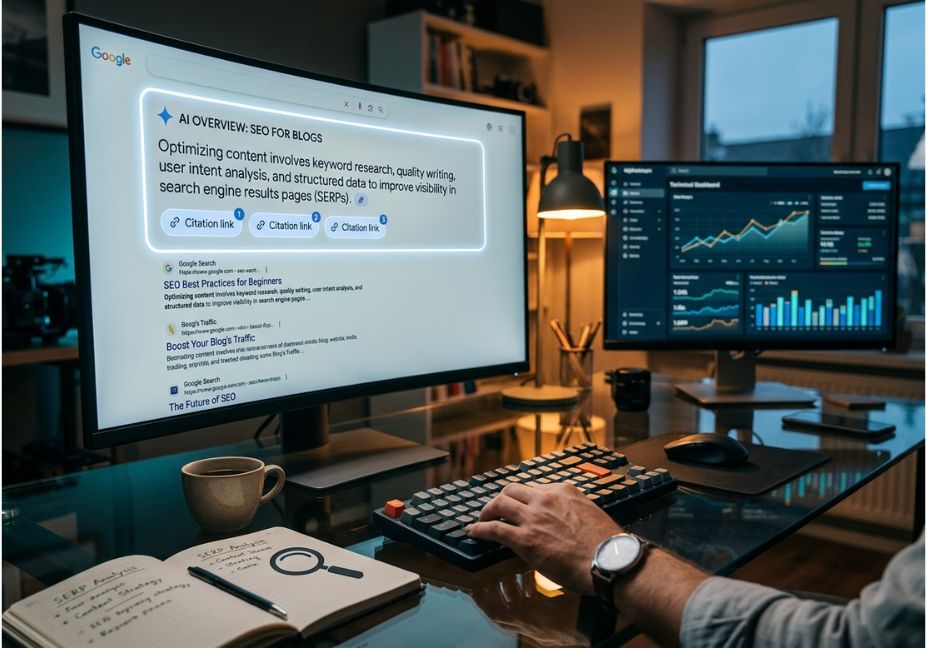
Most teams find out they’ve lost an AI Overview citation the same way they find out a server went down: by accident, days later, while looking at something else. That’s why Google AI Overview checking tools exist. They turn an invisible, personalized, constantly-rotating search feature into something you can query, log, and act on. As a result, teams stop guessing and start measuring.
This matters because AI Overviews now sit above the fold on a large share of informational queries. Meanwhile, the sources cited inside them rotate from one crawl to the next, so a citation you had yesterday may not survive today.
For teams building on retrieval-augmented generation (RAG) pipelines, the connection runs deeper than SEO. In other words, an AI Overview is a retrieval-and-generation system in disguise: Google retrieves candidate pages, ranks them, and generates a synthesized answer with inline citations. If you already build agentic content or research pipelines, you’re looking at a sibling architecture, not a foreign one.
This guide covers what an AI Overview checker, sometimes called an AI Overview tracker or AI Overview monitoring tool, actually does under the hood. It also covers which tools are worth paying for, and how to connect citation tracking to an agent stack instead of a spreadsheet.
What Is a Google AI Overview Checker?
A Google AI Overview checker is a tool that submits a query to Google, detects whether the AI Overview panel appears, and extracts the cited URLs, the generated summary text, and each source’s citation position. Some people search for this exact capability as an “AI Overview citation checker” or a “tool to see if my website is cited in Google AI Overview” — all three phrases describe the same function.
The simplest checkers handle one query at a time. Because of this, they work fine for occasional spot-checks. More capable tools, however, run scheduled checks across a full keyword list, store historical data, and expose results through a dashboard or API.
Under the hood, this overlaps with information retrieval more than with classic rank tracking. Specifically, Google’s AI Overview is a generated answer grounded in retrieved documents similar in structure to systems described in the research literature on retrieval-augmented generation, a technique that enables large language models to retrieve and incorporate new information from external data sources. Understanding that mechanism explains why citations shift unpredictably between runs. arxiv.
How Does an AI Overview Checker Work?
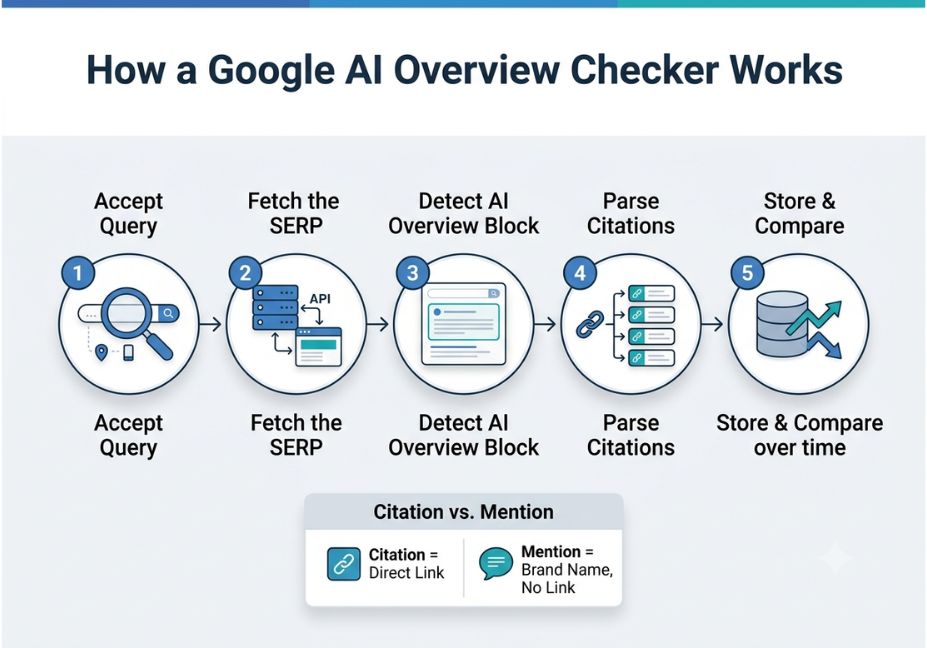
Every AI Overview checking tool, whether free or paid, follows roughly the same five-step process. Because the steps are consistent across vendors, understanding them helps you evaluate any tool quickly:
- Accept a query. Keyword, location, language, and device all matter, because AI Overviews are personalized and geo-sensitive.
- Fetch the search results page. This happens either directly or through a SERP API that manages proxies and headless browsing.
- Detect the AI Overview block. The tool parses the page for the bordered summary card.
- Parse the citations. It extracts the linked sources and, when possible, the specific sentence each source supports.
- Store and compare. The result is logged against prior runs, so you can see when a citation appeared, disappeared, or moved.
Pro Tip: Always run checks from more than one location and device combination before concluding a citation is gone for good. Personalization can hide a citation in a clean test session while it’s still showing to real users elsewhere.
Tools mainly differ at steps three and four. Scraping-based tools, for instance, have to re-parse HTML every time Google changes its layout, so they break periodically. API-first providers such as SerpApi and DataForSEO maintain that parsing layer for you instead, which means you get structured, ready-to-use data rather than raw HTML.
Google AI Overview Checking Tool Use Cases Beyond SEO Reporting
Treating this data as a monthly marketing report undersells what it can actually do. Consider these use cases instead:
- Content strategy feedback loops. Feed citation gains and losses into whatever system decides what to update next, rather than reviewing a static report by hand.
- Competitive intelligence. Track which competitor domains keep appearing in your priority citation sets, not just where you rank in classic search results.
- Answer engine optimization (AEO). The same tracking infrastructure typically extends to ChatGPT, Perplexity, and Gemini, so you get one data model across AI surfaces instead of four separate ones.
- Agentic content pipelines. An autonomous content agent can check citation status before deciding a page needs restructuring — much like a RAG system checks retrieval confidence before generating an answer.
Did You Know? Analysts typically separate a citation, where the AI Overview links directly to your URL, from a mention, where your brand name appears in the text without a link. Only citations reliably drive click-through traffic.
Best AI Overview Tracking Tools and Frameworks Compared
There’s no single best AI Overview monitoring tool. Instead, the right pick depends on whether you need a quick spot-check, an ongoing dashboard, or raw data to build on top of.
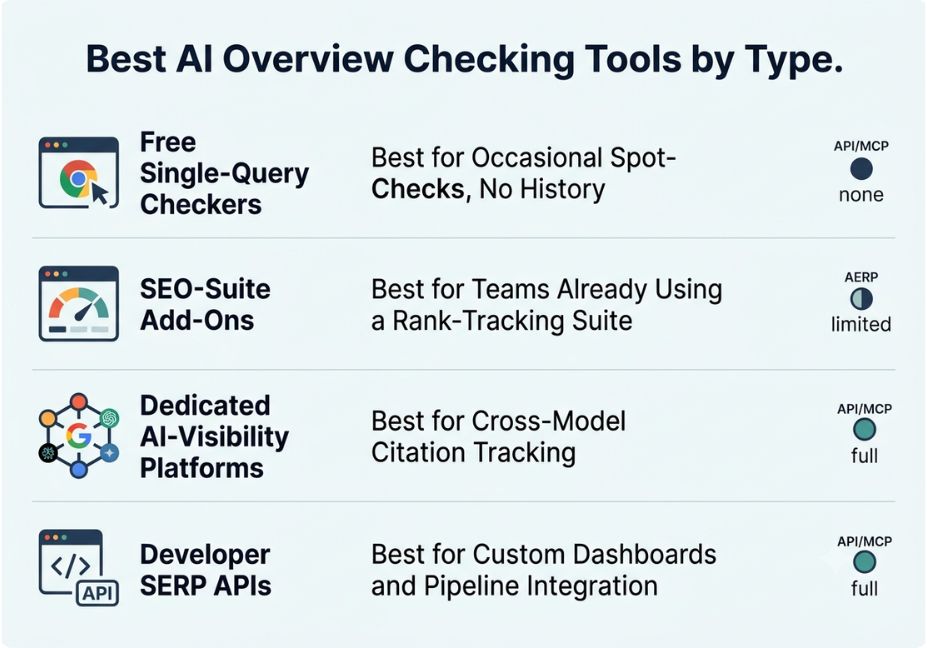
| Tool type | Examples | Best for | API / MCP access |
|---|---|---|---|
| Free single-query checkers | Chrome SEO extensions, one-off web tools | Occasional spot-checks, no history needed | None or minimal |
| SEO-suite add-ons | Semrush AI Toolkit, SE Ranking | Teams already using the suite for rank tracking | Suite-level exports, limited API |
| Dedicated AI-visibility platforms | Multi-model citation trackers | Cross-model tracking across Google, ChatGPT, Perplexity, and Gemini | REST API, some with MCP support |
| Developer SERP APIs | SerpApi, DataForSEO | Custom dashboards, bulk checks, pipeline integration | Full API, usage-based pricing |
Architect’s Note: If you already run agent workflows, prioritize tools that expose citation data through a REST API or an MCP (Model Context Protocol) server. This lets an agent pull fresh citation status as a tool call, rather than requiring you to export a CSV and re-upload it somewhere. The official Model Context Protocol specification and documentation repository is worth checking if you want to confirm whether a vendor’s “MCP integration” claim is a real server or just marketing language. GitHub
[Related reading: see our guide to building a RAG pipeline from scratch] — (internal link placeholder; link to your site’s RAG pipeline article here)
Step-by-Step: How to Build a Lightweight AI Overview Checker
If your keyword list is small and stable, a thin script built on a SERP API is often more reliable than a dashboard subscription you’ll underuse. Here’s how to build one:
python
import requests

def check_ai_overview(query, api_key, location="United States"):
    params = {
        "engine": "google",
        "q": query,
        "location": location,
        "api_key": api_key,
    }
    resp = requests.get("https://serpapi.example.com/search", params=params)
    data = resp.json()

    ai_overview = data.get("ai_overview")
    if not ai_overview:
        return {"query": query, "has_overview": False, "citations": []}

    citations = [
        {"url": src.get("link"), "title": src.get("title")}
        for src in ai_overview.get("references", [])
    ]
return {"query": query, "has_overview": True, "citations": citations}- Pick a SERP API that documents its AI Overview parsing, rather than writing your own scraper from scratch.
- Run checks on a schedule. Daily works for priority terms; weekly is usually enough for the long tail.
- Diff against the previous run so you can flag new, lost, or reordered citations automatically.
- Route alerts into Slack, a ticketing system, or an agent that drafts the content update directly.
Technical Disclaimer: AI Overview HTML structure and API schemas change without notice. Therefore, treat this code as a starting point, and validate it against current API documentation before using it in production.
Common Mistakes and How to Avoid Them
- Checking from one location only. A citation missing from a clean US desktop session may still show to mobile users elsewhere. Run multi-geo checks first.
- Treating a single run as proof. Because citation sets rotate, one missing result is noise. A result missing across five straight daily checks, however, is a real signal.
- Confusing mentions with citations. A brand name in generated text without a link won’t drive traffic the way a linked citation does, so track them separately.
- Ignoring non-Google AI surfaces. Teams that only watch Google AI Overviews miss the fact that Perplexity, Gemini, and ChatGPT often cite the same underlying pages.
- Skipping historical storage. Without stored history, you can’t tell whether a loss is a fluctuation or a real trend tied to a content change.
Where AI Overview Checking Fits in an Agentic Content Workflow
If you operate a content or research agent, citation status is simply another signal it can act on, much like it might already check embedding similarity or retrieval confidence before deciding a document needs re-chunking. This shift from static rank tracking toward retrieval-aware monitoring mirrors what’s already happened inside RAG system design, where a retrieval-augmented generation system is built around a query encoder, a retriever, and a generator working together rather than a single ranking step. In short, Google’s AI Overview applies that same architecture to the entire web as its corpus, which is exactly why citation tracking needs retrieval-aware tooling instead of legacy rank trackers. arxiv
FAQ — People Also Ask
What is a Google AI Overview checker?
A Google AI Overview checker detects whether a search query triggers Google’s AI-generated summary and shows which URLs are cited as sources.
How do I check if my website is cited in Google AI Overview?
Run your target keywords through an AI Overview checker and compare the citation list to your domain. Check from more than one location, since results are personalized.
Is there a free tool to check Google AI Overviews?
Yes. Several free single-query checkers and Chrome extensions exist. They work well for spot-checks but don’t store history or support bulk keyword lists.
What’s the difference between an AI Overview citation and a mention?
A citation links directly to your URL. A mention is your brand name appearing in the text without a link. Only citations reliably drive traffic.
Can I track Google AI Overviews using an API?
Yes. Developer SERP APIs return structured data containing the AI Overview text and citation list, which you can connect to a dashboard or an agent workflow.
Do AI Overview checker tools also track ChatGPT and Perplexity?
Some do. Many AI-visibility platforms track citations across Google AI Overviews, ChatGPT, Perplexity, and Gemini at the same time, since all four rely on similar retrieval patterns.
Conclusion
Google AI Overview checking tools exist for one simple reason: a citation you had yesterday might be gone today, and manual searching doesn’t scale past a handful of keywords. Whether you choose a free spot-checker, a full AI-visibility platform, or a script built on a SERP API, the job stays the same detect the AI Overview, extract the citations, and store enough history to separate real trends from noise. For teams already working with retrieval and agent architectures, the smartest move is to treat citation data as a signal your pipeline consumes automatically, not another dashboard someone has to remember to check.
Bookmark this guide, and explore more hands-on AI agent tutorials at agentiveaiagents.com.