
Most brands find out they’ve been misrepresented in an AI answer the hard way. A customer forwards a screenshot, or a support ticket references a feature that doesn’t exist. This happens because LLM outputs aren’t indexed the way web pages are, so there’s no crawler you can point at ChatGPT to see what it’s been saying about you.
This is the core problem behind generative engine optimization (GEO), a discipline formalized in the original generative engine optimization research (https://arxiv.org/abs/2311.09735), which framed generative engines as a new paradigm of search where LLMs gather and summarize information to answer queries directly. Consequently, the paper’s authors also found that specific content strategies could meaningfully shift how often a source gets surfaced in AI-generated answers.
Below, we break down the tools, DIY methods, and failure modes involved in tracking AI mentions across ChatGPT, Claude, Gemini, Perplexity, Google AI Overviews, and Microsoft Copilot plus a code example if you’d rather build your own. And if you’re new to how these systems retrieve information at all, our guide to building a RAG pipeline (/rag-pipeline-guide) covers the underlying retrieval mechanics.
What Is LLM Mention Tracking?
LLM mention tracking is the practice of running a set of prompts through AI chat systems like ChatGPT and Claude, then checking whether, how often, and how favorably a brand appears in the responses. It works like a rank tracker, except the result is unstructured text and citation links instead of a ranked URL list.
That said, an LLM answer is probabilistic, not fixed. The same prompt run twice can return different brands, different phrasing, or no mention at all. As a result, most tools report a share of voice or visibility score averaged across many runs, rather than a single “rank.”
How Does AI Mention Tracking Work?
In general, most platforms follow the same basic loop:
- Maintain a synthetic prompt library branded and non-branded queries relevant to your category
- Send each prompt to multiple LLMs on a recurring cadence, whether hourly, every four hours, or daily
- Parse the response text and any citation URLs for brand or competitor names
- Score the result for mention frequency, position, sentiment, and share of voice
- Finally, roll results up into a dashboard, segmented by model, prompt, and competitor
Technical Note: Some vendors query APIs directly, while others simulate the actual consumer front end (a real browser session) to capture what users see, including citations that API-only calls sometimes omit. Because of this, API and browser-session results for the same prompt can diverge significantly.
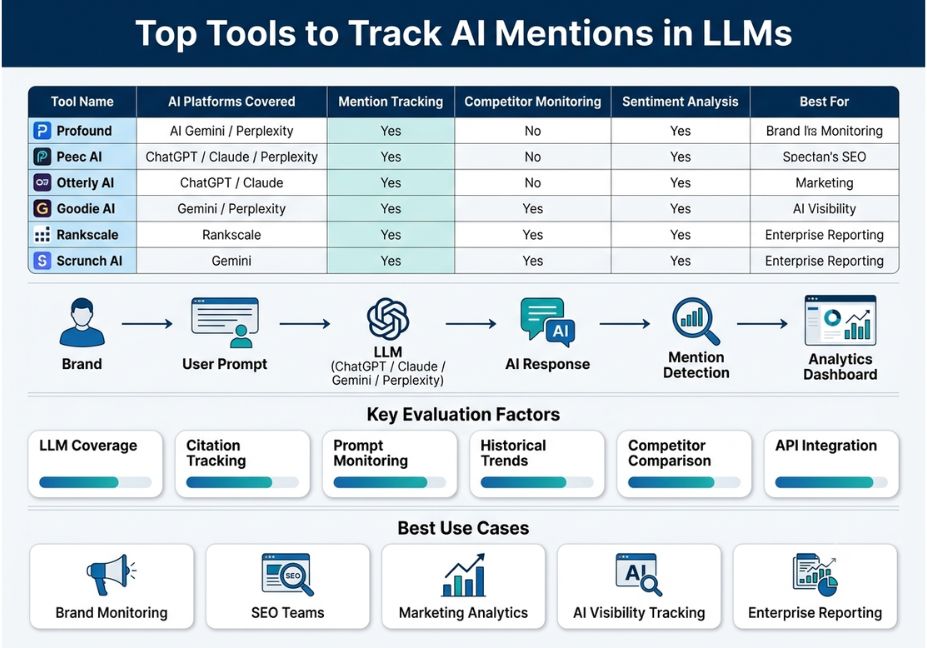
Top Tools to Track AI Mentions in LLMs
Here’s how the major players compare as of mid-2026. Since pricing and prompt caps change quickly, treat these as a starting point rather than a quote.
| Tool | Engines Covered | Best For | Starting Price |
|---|---|---|---|
| Profound | ChatGPT, Perplexity, Gemini, AI Overviews, +more (Enterprise) | Enterprise AEO reporting, Prompt Volumes dataset | $99/mo (Starter) |
| Peec.ai | ChatGPT, Perplexity, Gemini, Llama, DeepSeek, Claude | Mid-market teams wanting frequent (4-hour) refresh cycles | Custom |
| Otterly.ai | ChatGPT, Claude, Gemini, Perplexity | Prompt-level monitoring across 67+ countries | Custom |
| Writesonic | ChatGPT, Perplexity, Gemini, Claude, Copilot, Grok | Teams also wanting bundled SEO content tooling | $119/mo |
| AthenaHQ | 8 engines with action workflows | Self-serve teams wanting recommendations, not just data | $295/mo |
| SE Ranking | Multiple LLMs + traditional rank tracking | Combining classic SEO and LLM visibility in one platform | Custom |
Pro Tip: Before committing budget, check whether the tool tracks citation URLs separately from in-text mentions. Otherwise, you won’t be able to trace why a competitor is winning a given prompt.
Did You Know? Researchers demonstrated visibility gains of up to 40% in generative engine responses through content strategy alone, with no backlinks or domain authority required, since retrieval and citation weight not PageRank drive this channel.
DIY Approach: Build Your Own Tracker (Free Method)
If you’d rather not pay for a platform, here’s how to track AI mentions for free using your own script against OpenAI’s Chat Completions API (https://platform.openai.com/docs/api-reference/chat):
python
import openai
import re

BRAND = "YourBrand"
PROMPTS = [
    "What's the best tool for tracking AI search visibility?",
    "Compare the top brand monitoring platforms for 2026.",


def check_mentions(prompt: str) -> bool:
    response = openai.chat.completions.create(
        model="gpt-4o",
        messages=[{"role": "user", "content": prompt}],

    text = response.choices[0].message.content
    return bool(re.search(BRAND, text, re.IGNORECASE))

for prompt in PROMPTS:
    mentioned = check_mentions(prompt)
    print(f"'{prompt[:40]}...' -> mentioned: {mentioned}")
For orchestration across multiple models, wiring this into LangChain’s open-source repository (https://github.com/langchain-ai/langchain) makes it simple to swap between OpenAI, Anthropic, and Google clients, or add a vector store like Pinecone if you want to log historical results for trend analysis, without rewriting the prompt loop. Hugging Face’s open model hub is also worth checking if you want to test mentions against open-weight models alongside the commercial ones.
Technical Disclaimer: Framework versions evolve rapidly. This snippet uses the OpenAI Python SDK as of mid-2026. Always check the official docs for the current API surface before shipping this into production.
Common Mistakes and How to Avoid Them
- Relying on simple string matching. A model might describe your product without naming it, or misspell your brand, so plain regex will miss both.
- Treating one prompt run as ground truth. Since LLM output is non-deterministic, a single query tells you almost nothing. You need repeated runs across time to see a real trend.
- Ignoring hallucinated mentions. LLMs can invent features, pricing, or partnerships you never had. Therefore, mention tracking without sentiment and accuracy review can miss real reputational damage.
- Only tracking branded prompts. Non-branded, category-level prompts (“best X tool for Y”) reveal whether you’re even in the consideration set, which branded queries can’t show.
What Developers Are Saying
Sentiment on this category is mixed among practitioners. For example, developer threads on r/LocalLLaMA (https://www.reddit.com/r/LocalLLaMA/) frequently note that self-hosted or open-model setups produce different mention patterns than commercial APIs, since model weights, system prompts, and retrieval sources all shift which brands get surfaced. In short, that’s a useful sanity check before trusting any single vendor’s numbers as the whole picture.

FAQ People Also Ask
LLM mention tracking is the process of running prompts through AI chat systems like ChatGPT or Claude to see how often, and how favorably, a brand is referenced in the generated answers. It’s the emerging equivalent of SEO rank tracking, adapted for generative, non-indexed responses.
Use a dedicated AI visibility tool that runs a prompt library against ChatGPT on a schedule, or build a lightweight script against the OpenAI API that checks each response for your brand name and logs the result over time.
Traditional SEO optimizes for ranking in a list of blue links. Generative engine optimization (GEO), on the other hand, optimizes for being cited or recommended inside a synthesized AI answer, where there’s no fixed ranking position to target.
Yes. Manually running a handful of prompts through ChatGPT or Claude and checking the output by hand costs nothing but time. Most dedicated platforms offer limited free or trial tiers, but full multi-engine, historical tracking generally requires a paid plan.
Visibility scores are directional, not exact, because LLM answers vary by prompt phrasing and model version. So the same brand can score differently across tools using different methodologies. Trend data across many runs is more reliable than any single score.
The most reliable way is to run the same question a customer would ask for example, “best tool for X” through ChatGPT, Gemini, and Perplexity repeatedly, and track whether your brand shows up, in what position, and with what sentiment.
Conclusion
Tracking AI mentions in LLMs now sits alongside traditional rank tracking as a core visibility metric. However, the underlying mechanics probabilistic answers, citation parsing, sentiment scoring mean it needs different tooling and more skepticism toward any single data point. Whether you pick a platform like Profound or Peec.ai, or build a lightweight tracker against the OpenAI or Anthropic APIs, the goal is the same: know what AI systems are telling your prospective customers before they do.
Bookmark this guide and explore more hands-on AI agent tutorials at agentiveaiagents.com.