
Most brands don’t lose AI visibility because their content is bad. Instead, they lose it because they’re optimizing for the wrong retrieval pipeline. For example, a brand can hold the #1 Google ranking for a keyword and still be invisible when someone asks ChatGPT or Perplexity the same question. This happens because answer engines run their own query rewriting, chunk retrieval, and citation-selection logic before generating a single word. As a result, top AI search visibility tools have become a distinct product category rather than a bolt-on feature inside existing SEO suites.
These platforms exist because generative engines like OpenAI’s ChatGPT, Google Gemini, and Microsoft Copilot don’t rank pages. Instead, they synthesize answers from retrieved passages, a process first formalized in academic generative engine optimization (GEO) research. If you’re building content or agent-facing infrastructure that needs to survive that synthesis step, understanding how these tools measure visibility matters more than any single vendor comparison.
Quick answer (voice search / featured snippet): An AI search visibility tool is software that tests how often your brand appears in AI-generated answers from ChatGPT, Perplexity, Gemini, and Google AI Overviews, then reports mention frequency, citation sources, and sentiment.
What Is an AI Search Visibility Tool?
An AI search visibility tool queries large language models typically ChatGPT, Claude, Gemini, and Perplexity with a defined set of prompts, then parses each response for brand mentions, cited sources, and sentiment. In short, it’s an observability layer sitting on top of someone else’s retrieval-augmented generation system. Since you don’t control the index, the chunking strategy, or the ranking model, the tool’s job is to reverse-engineer outcomes through repeated sampling. This is different from traditional rank tracking, because a SERP is deterministic, while an LLM output is probabilistic and model-dependent.
How Do AI Visibility Tools Work?
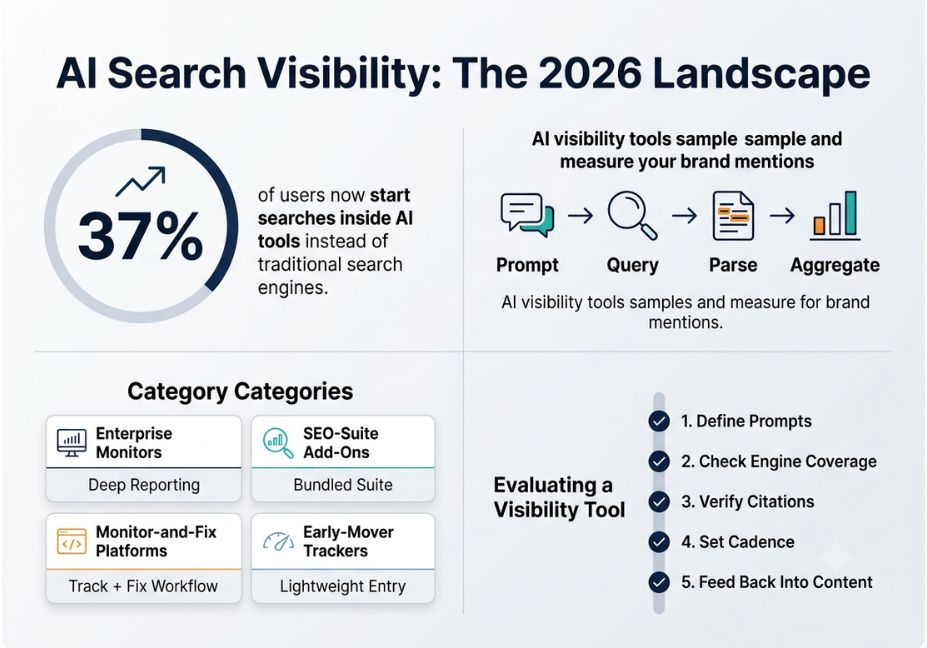
Under the hood, most platforms run the same basic loop: prompt → query → parse → aggregate.
- First, a prompt library (pre-built or custom) simulates real user queries across your category
- Then, each prompt is fired at multiple LLM endpoints on a defined cadence
- Next, responses are parsed with NLP to detect brand mentions, cited domains, and tone
- Finally, results are aggregated into visibility scores, share-of-voice metrics, and trend lines
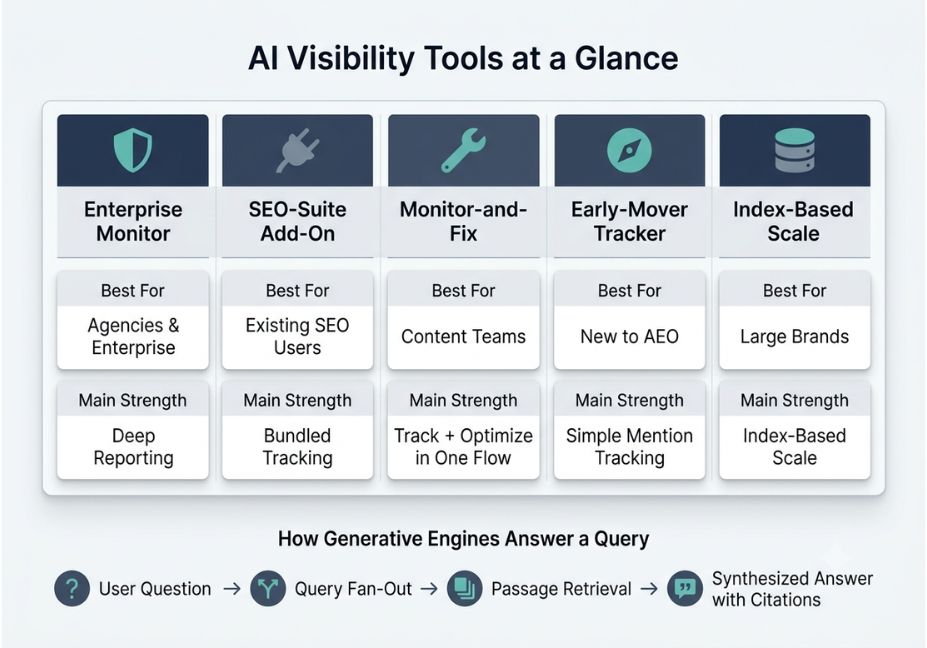
Technical Note: This differs meaningfully from crawler-based SEO tools. Because answer engines apply query fan-out decomposing one user question into several internal sub-queries before retrieval a tool that only tests literal keyword phrases will systematically under-count real visibility. Therefore, coverage depth on prompt variation is a better predictor of tool accuracy than raw engine count.
Additionally, some platforms, like Ahrefs’ Brand Radar, lean on a large internal prompt index rather than fully custom prompt sets. This trades customization for scale, so it’s worth checking against your own use case before committing to a plan.
Top AI Search Visibility Tools Real-World Categories
Rather than one ranked list, these tools generally cluster into four practical categories:
- Enterprise-grade dedicated monitors (e.g., Profound) built for agencies and large brands managing multiple client workspaces, with pitch environments and deep reporting.
- SEO-suite add-ons (e.g., Ahrefs Brand Radar, Semrush AI Toolkit) AI citation tracking layered onto existing keyword and backlink tooling.
- Monitor-and-fix platforms (e.g., Frase, Surfer) pair AI tracking with content optimization so a visibility gap and its fix live in the same workflow.
- Early-mover, mention-focused trackers (e.g., Otterly.ai) narrower engine coverage, but useful as a lightweight first step into AEO.
Best Tools / Frameworks / Approaches Comparison
| Tool | Best For | Main Strength | Limitation |
|---|---|---|---|
| Profound | Agencies, enterprise | Agency mode, deep reporting | Steeper cost for solo teams |
| Ahrefs Brand Radar | Teams already on Ahrefs | Index-based scale | Thin data for niche/small brands |
| Frase | Content teams | Tracking + optimization in one workflow | Newer AI layer on a content tool |
| Semrush AI Toolkit | Existing Semrush users | Bundled with familiar suite | AI tracking secondary to core SEO |
| Otterly.ai | Early-stage AEO adoption | Simple mention + sentiment tracking | Narrower engine coverage |
Did You Know? Industry data suggests roughly 37% of users now start searches inside AI tools rather than traditional search engines which explains the urgency around AEO tooling in 2026.
Step-by-Step: How to Evaluate and Implement an AI Visibility Tool
- Define your prompt set first. Pull real customer language from support tickets and sales calls, not just target keywords, since answer engines respond to conversational phrasing.
- Then check engine coverage against your audience. ChatGPT and Perplexity matter most for research-heavy B2B queries, while AI Overviews matters for SERP-adjacent discovery.
- Next, verify citation transparency. Confirm the tool exports which URLs and domains were actually cited, not just a mention score. Otherwise, optimization becomes guesswork.
- Set a realistic sampling cadence. Weekly monitoring is sufficient for most brands. However, reserve daily runs for high-volatility categories, since over-sampling mainly burns credits without adding insight.
- Finally, feed findings back into content structure, not just prompts. According to generative engine optimization research, structured, evidence-rich, citation-backed content consistently outperforms keyword-dense pages inside generative engine responses.
python
# Minimal example: sampling a prompt set against an LLM endpoint for mention tracking
import anthropic

client = anthropic.Anthropic()
prompts = ["best project management tools for remote teams", "top CRM software 2026"]

for p in prompts:
    response = client.messages.create(
        model="claude-sonnet-4-6",
        max_tokens=500,
        messages=[{"role": "user", "content": p}]

    text = response.content[0].text
    print(f"Prompt: {p}\nMentions your brand: {'YourBrand' in text}\n")
Technical Disclaimer: Framework versions and model behavior evolve rapidly. The snippet above illustrates the basic sampling loop only; production tracking needs prompt rotation, response parsing, and rate-limit handling well beyond this example. Always check current API documentation before deploying.
Common Mistakes and How to Avoid Them
- Testing only branded prompts. If every prompt already contains your brand name, you’re measuring recall, not discovery. Instead, include category-level, unbranded queries.
- Ignoring citation sentiment. A mention isn’t automatically good, because being cited alongside a negative comparison still counts as “visibility” in naive dashboards.
- Treating AI visibility as a one-time audit. Model updates change retrieval behavior overnight, so visibility that held last month can silently disappear.
- Optimizing for engines your buyers don’t use. Broad five-engine coverage looks impressive on a dashboard, but it wastes budget if your audience only queries ChatGPT and Google AI Overviews.
What Developers Are Saying
Outside vendor marketing, the more grounded conversation about AI citation behavior happens in practitioner communities, including developers discussing AI citation behavior on r/LocalLLaMA. There, the consensus leans toward skepticism of any single-metric “visibility score,” favoring raw, exportable citation data over proprietary indices. This aligns with the broader shift researchers describe: since generative engines rely on how retrieval-augmented generation systems fetch context rather than static page rank, tool credibility increasingly depends on sampling transparency, not dashboard polish.
FAQ People Also Ask & Voice Search
What is an AI search visibility tool?
An AI search visibility tool tracks how often and how accurately your brand is mentioned in AI-generated answers from platforms like ChatGPT, Perplexity, and Google AI Overviews, reporting metrics like share of voice and citation source.
How is AI search visibility different from SEO?
Traditional SEO tracks keyword rankings and backlinks on a fixed results page. In contrast, AI search visibility tracks probabilistic model outputs brand mentions, cited domains, and sentiment inside synthesized answers.
Can you track your brand’s ranking in ChatGPT?
There’s no fixed ranking inside ChatGPT the way there is on a search results page. Instead, tools sample repeated prompts and report mention frequency, citation rate, and position within the generated answer over time.
What is Generative Engine Optimization (GEO)?
GEO is the practice of structuring content adding statistics, citations, clear structure, and authoritative tone so it’s more likely to be retrieved and cited by generative engines.
Do AI visibility tools work for small businesses?
Index-based tools can underperform for niche or low-volume brands, since there’s limited existing data to surface. Custom prompt-based tools generally work better for smaller or newer brands.
How often should you monitor AI search visibility?
Weekly sampling is enough for most brands. Daily monitoring is only worth the added cost for categories where competitor positioning shifts quickly.
Hey Google, what’s the best tool to track my brand in AI search?
It depends on your size: agencies typically choose Profound, while smaller teams often start with Frase or Otterly.ai for lighter, faster setup.
Conclusion
Choosing among the top AI search visibility tools ultimately comes down to three questions: which engines your buyers actually query, whether the tool exposes real citation data instead of an opaque score, and whether it closes the loop by feeding insights back into content structure. Overall, treat this the same way you’d treat any RAG or agent observability problem sampling methodology and data transparency matter more than the size of the feature list. Bookmark this guide and explore more hands-on AI agent tutorials at agentiveaiagents.com.
2 Responses