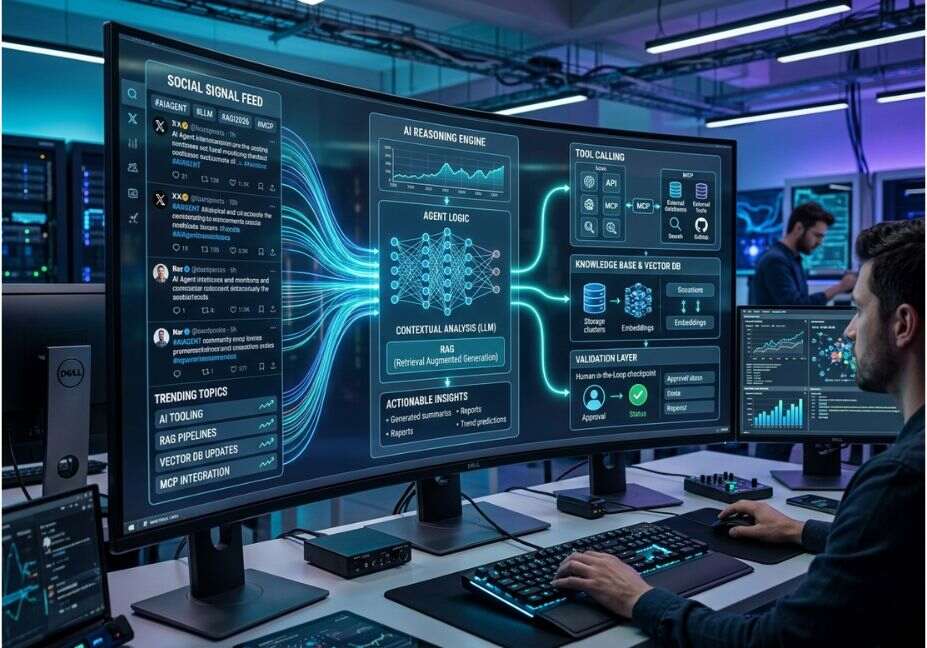
An agent harness is the infrastructure layer that coordinates a model’s memory, tool execution, and state persistence across a session the plumbing that turns a language model into something that can act over multiple steps instead of just answering once. Practitioners started using the term heavily in early 2026 as personal AI assistants moved from demos to daily-use tools, building on the formal definition of agentic AI systems that Wikipedia maintains for autonomous goal-directed systems.
Where a plain LLM call is one request and one response, a harness keeps a loop running: plan a step, call a tool, observe the result, update memory, decide the next step. That loop not the underlying model is usually what determines whether an agent actually finishes a task.
Pro Tip: If your agent keeps losing context mid-task, the problem is almost never the model. It’s usually the harness dropping state between tool calls check your memory persistence layer before you swap models.
How Does Agentic Tooling Actually Work?
The architecture pattern dominating 2026 conversations is straightforward: an orchestrator agent coordinates several specialized subagents, each holding its own dedicated context window, working in parallel rather than sequentially. This mirrors the original ReAct pattern — the original ReAct paper that popularized reason-then-act loops laid out the reason-then-act cycle that almost every modern agent framework still implements under the hood.
The mechanism, in short:
- A planner breaks a goal into subtasks
- An orchestrator assigns subtasks to subagents with scoped tools
- Each subagent executes its tool-use loop independently
- Results roll back up to shared memory
- The orchestrator resolves conflicts and produces final output
Did You Know? Community benchmarking in mid-2026 put open-source terminal agents like OpenCode past 190,000 GitHub stars a sign that “agent harness” has become infrastructure people build careers on, not just a buzzword.
Twitter/X Trend #1: MCP’s Stateless Rewrite
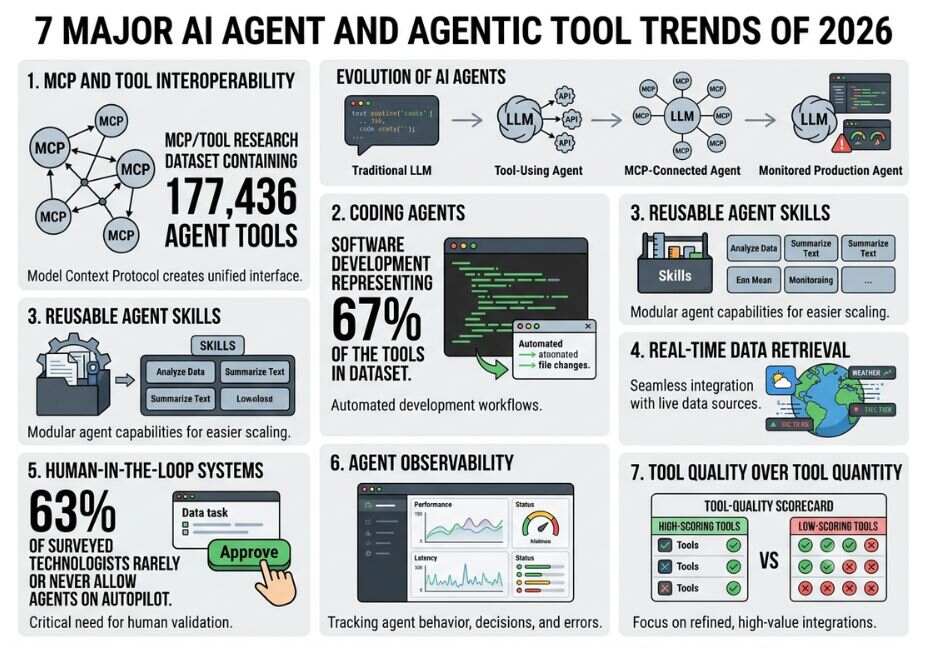
No single protocol change generated more agent-builder discourse this year than the Model Context Protocol. MCP’s 2026-07-28 spec introduced a stateless protocol core, replacing the original bidirectional, session-based design with a request/response model that scales behind an ordinary round-robin load balancer.
For developers, this mattered because:
- Servers no longer need sticky sessions or shared session storage
- Every request became self-describing, with tool and method names traveling in HTTP headers
- Client developers gained Multi Round-Trip Requests for richer server-to-client interaction
The timing amplified the buzz: barely a month earlier, X shipped its own hosted MCP server in June 2026, letting tools like Claude, Cursor, and other MCP-compatible clients connect directly to the X API using a user’s own account permissions collapsing what used to be a multi-day integration project into a config file.
| Change | Old MCP behavior | 2026-07-28 behavior |
|---|---|---|
| Session model | Stateful, sticky sessions | Stateless, self-describing requests |
| Scaling | Requires session affinity | Plain round-robin load balancing |
| Routing | Body-based | Header-based (Mcp-Method, Mcp-Name) |
| Client interaction | Single round trip | Multi Round-Trip Requests (MRTR) |
Technical Disclaimer: Framework and protocol versions evolve rapidly. Details above reflect the MCP 2026-07-28 specification as of August 2026. Always check the official docs for the latest API surface before shipping.
Twitter/X Trend #2: CLI Coding Agents Dominate the Timeline
If there’s one category that owns agent-builder Twitter in 2026, it’s terminal-native coding agents. The lineup people argue about weekly: Claude Code, OpenAI Codex, OpenCode, Gemini CLI’s successor Antigravity, and newer open-source entrants racing past 50,000+ GitHub stars within months of launch.
Three threads keep resurfacing:
- Benchmark one-upmanship Terminal-Bench and SWE-bench scores get screenshotted and debated within hours of release, often before independent verification.
- Harness vs. model debates practitioners increasingly argue the harness (subagents, hooks, memory architecture) matters more for real-world task completion than raw model capability.
- Consolidation news coding-agent startups getting acquired by larger AI labs has become its own recurring news cycle, reshuffling which tools developers trust with production code.
Architect’s Note: When evaluating a CLI agent for your team, weigh sandboxing and permission scoping as heavily as benchmark scores. An agent that can execute shell commands autonomously needs a harness with real guardrails, not just a high leaderboard rank.
python
# Minimal example: a tool-use loop skeleton
# reflecting the ReAct-style pattern agents use under the hood
def agent_loop(goal, tools, memory, max_steps=6):
    for step in range(max_steps):
        thought = plan_next_action(goal, memory)
        if thought.is_final_answer:
            return thought.answer
        result = tools[thought.tool_name].run(thought.tool_input)
        memory.append({"thought": thought, "result": result})
    return "max_steps_reached"
Twitter/X Trend #3: The Verifiability Spectrum
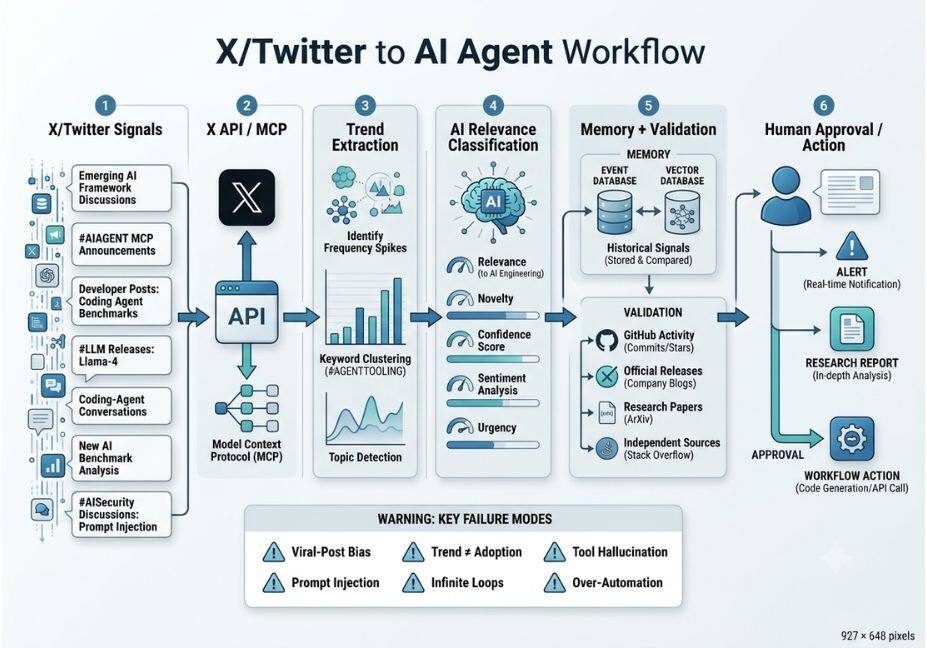
A recurring framing this year often attributed informally to well-known AI practitioners in threads is that agent autonomy should map to how verifiable a task’s outcome is. Security triage and coding agents thrive because their outputs are structured and checkable. Browser agents navigating multi-step UI flows still struggle, because success or failure is much harder to confirm programmatically.
This “verifiability spectrum” idea has become a practical filter agent builders use before greenlighting autonomous execution:
- High verifiability → CLI coding agents, security alert triage, structured data pipelines
- Medium verifiability → customer support agents with defined resolution states
- Low verifiability → open-ended browser agents, long-horizon planning tasks
Pro Tip: Before granting an agent autonomous execution rights, ask whether a failed outcome is detectable in under one step. If not, keep a human in the loop until your evaluation tooling catches up.
Best Tools & Frameworks Developers Are Comparing
| Category | Popular Options in 2026 | Known For |
|---|---|---|
| CLI coding agents | Claude Code, OpenAI Codex, OpenCode | Multi-file edits, subagents, terminal-native workflows |
| Protocol layer | Model Context Protocol (MCP) | Standardized tool/data connections across models |
| Orchestration | Custom orchestrator + subagent patterns | Parallel task execution, scoped context per subagent |
| Social/API integration | Hosted platform MCP servers (e.g., X’s) | Native account-permissioned API access for agents |
Common Mistakes and How to Avoid Them
- Treating the model as the whole system. The harness memory, tool routing, error recovery usually determines real-world reliability more than model choice alone.
- Skipping the verifiability check. Granting full autonomy to a low-verifiability task is the fastest way to ship an agent that fails silently.
- Ignoring protocol version drift. MCP’s stateless rewrite broke assumptions baked into older session-based server code; pin versions and read changelogs before upgrading in production.
- Over-indexing on benchmark screenshots. Terminal-Bench and SWE-bench numbers circulating on Twitter are useful signals, not guarantees for your specific workload.
What Developers Are Saying
Agent-builder Twitter in 2026 reads less like marketing and more like a shared engineering log: threads dissecting MCP’s header-based routing within hours of release, side-by-side terminal recordings comparing coding agents on the same repo, and recurring debate over whether “agentic” still means anything specific. That real-time, adversarial peer review happening in public, often before official benchmarks are published is arguably the best free signal available for anyone deciding which agentic tools to adopt next.
FAQ — People Also Ask
What is an AI agent harness?
An agent harness is the software layer that manages a model’s tool execution, memory, and state persistence across multiple steps. It’s what allows an LLM to plan, act, observe results, and continue toward a goal instead of answering once.
What’s trending in AI agent tools on Twitter/X in 2026?
The dominant threads are MCP’s stateless protocol rewrite, competition among CLI coding agents like Claude Code and Codex, multi-agent orchestration patterns using subagents, and ongoing debate about which tasks are reliable enough for full autonomy.
What is MCP and why is it trending?
MCP (Model Context Protocol) is an open standard for connecting AI models to external tools and data sources. It’s trending because its 2026-07-28 spec update moved the protocol from stateful sessions to a stateless core, a major architecture shift for anyone running MCP servers in production.
Why are CLI coding agents so popular in 2026?
They deliver highly verifiable output code that either compiles and passes tests or doesn’t making them one of the safest categories for autonomous execution. That reliability, combined with rapid benchmark competition, keeps them at the center of agent-builder discussion.
Are AI agents actually reliable yet?
It depends heavily on the task. Structured, checkable tasks like coding and security triage show strong reliability. Open-ended, multi-step tasks like browser navigation remain harder to verify and typically still need human oversight.
Conclusion
The most useful “Twitter trends” signal for AI agents in 2026 isn’t a hashtag it’s the live, technical argument happening among people who build agent harnesses, ship MCP servers, and benchmark CLI coding agents against each other in public. Three takeaways matter most: the harness architecture around a model often matters more than the model itself, MCP’s stateless rewrite is reshaping how agentic tools get built, and verifiability not enthusiasm should decide how much autonomy you grant an agent.
Bookmark this guide and explore more hands-on AI agent tutorials at agentiveaiagents.com.