AI Dental Imaging Companies Patient Tools 2024: Why?
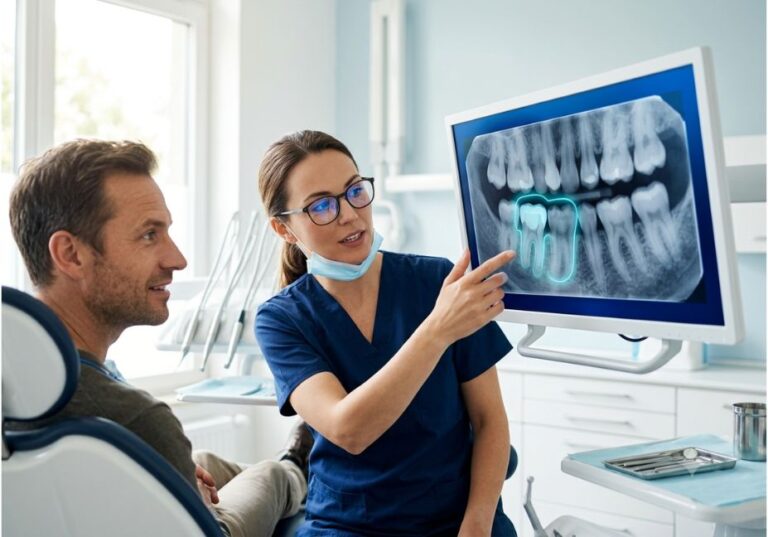
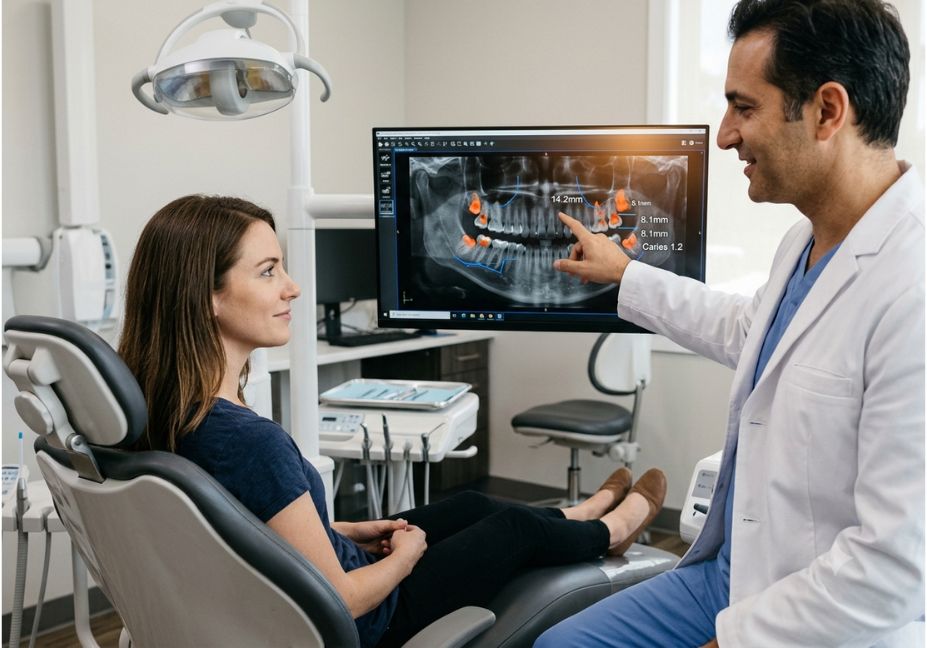
AI dental imaging patient education software takes a raw radiograph, runs it through a caries detection AI or bone-loss algorithm, and returns a color-annotated image a patient can read without a dental degree. Instead of a dentist verbally describing “early decay on the mesial surface,” the patient sees it highlighted directly on their own X-ray.
The category sits at the intersection of two separate functions: clinical diagnostic support (the FDA-regulated part) and patient-facing reports (the communication layer built on top of it). Understanding that distinction matters, because not every feature a vendor markets is FDA-cleared only the underlying detection algorithm typically is.
How Do AI Dental Imaging Tools Work?
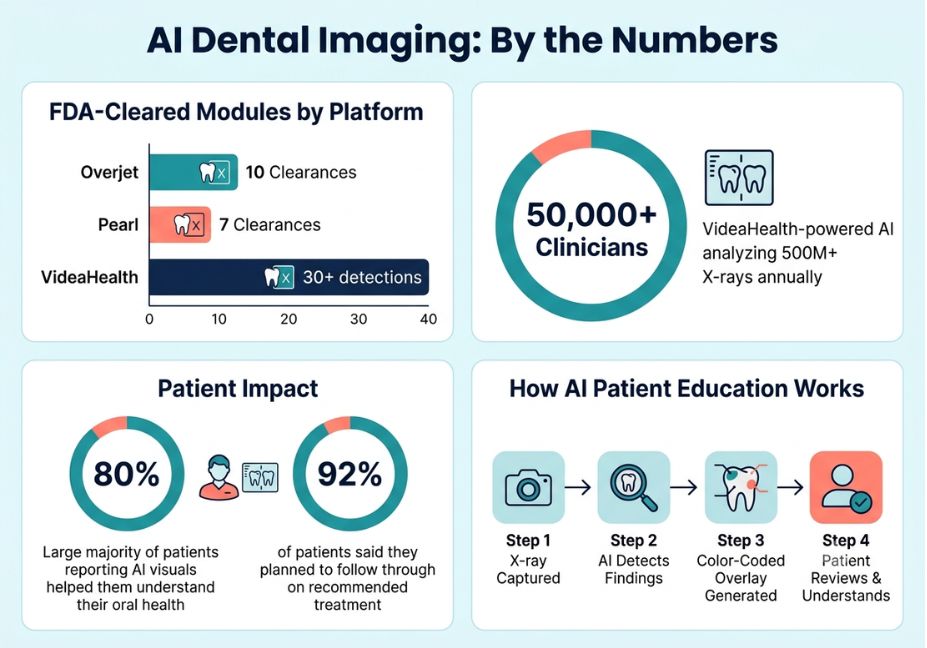
Most platforms follow the same basic pipeline:
- The radiograph (bitewing, periapical, panoramic, or CBCT) is uploaded or streamed directly from the practice’s imaging sensor.
- A trained model performs radiographic annotation outlining, segmenting, or measuring findings like caries, calculus, bone loss, or periapical radiolucency.
- The system generates a color-coded overlay and, in many cases, a plain-language summary the front desk or dentist can hand to the patient.
- Findings sync into the practice management system so they appear consistently across visits and providers.
Technical Note: FDA clearance applies to specific indications for use detection, outlining, segmentation, or quantification of a named condition not to a company’s software as a whole. A platform can hold ten clearances for ten different findings while its “patient education dashboard” itself is unregulated software layered on top.
These are the platforms most frequently deployed for chairside patient communication as of 2024–2026:
- Overjet the most heavily cleared platform in the category, with modules covering caries and calculus detection, periapical radiolucency, automated charting, and image enhancement. Its patient education dashboard converts radiographs into annotated, measured visuals designed for the consult room.
- Pearl (Second Opinion) built around real-time chairside detection, with clearances spanning multi-condition detection, periodontal bone-level measurement, and CBCT segmentation. Positioned as a fast, in-the-moment second opinion during radiograph review.
- VideaHealth received broad FDA clearance covering more than 30 detections and is used across large-scale DSO deployments, with reported adoption exceeding 50,000 clinicians analyzing hundreds of millions of X-rays annually.
- Denti.AI offers real-time detection feedback aimed at helping clinicians walk patients through findings during the same appointment, often favored by smaller and solo practices.
- Diagnocat focuses on 2D and 3D interpretation, including CBCT and panoramic imaging, and is widely cited in dental AI market and academic reviews.
Pro Tip: Ask any vendor for their FDA clearance number (K-number) and indication-for-use statement before you evaluate patient-facing claims. A demo screenshot is not a clearance.
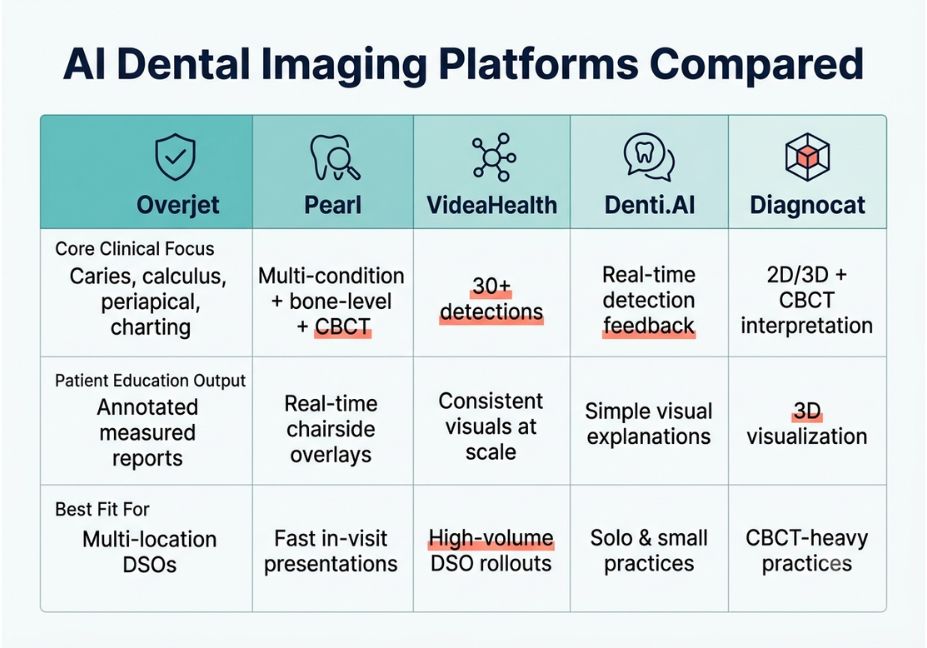
Comparison Table: AI Dental Imaging Platforms
Overjet Core focus: caries, calculus, periapical, charting, image enhancement. Patient education output: annotated, measured patient reports. Best fit: multi-location DSOs, enterprise analytics.
Pearl Core focus: multi-condition detection, bone-level measurement, CBCT. Patient education output: real-time chairside overlays. Best fit: fast in-visit case presentation.
VideaHealth Core focus: broad multi-condition detection (30+). Patient education output: consistent visuals across large networks. Best fit: high-volume DSO rollouts.
Denti.AI Core focus: real-time detection feedback. Patient education output: simple visual explanations. Best fit: solo and small group practices.
Diagnocat Core focus: 2D/3D and CBCT interpretation. Patient education output: 3D visualization for complex cases. Best fit: practices with heavy CBCT use.
Why Patient Education Tools Improve Case Acceptance
The clinical logic is straightforward, and the research backs it up. In one survey-based study on AI-produced radiographic enhancements, patients who reviewed the AI-enhanced radiographs during their visit said the visuals helped them understand their oral health, and a large majority reported they intended to follow through on the recommended treatment. Separately, a cross-sectional study on patient acceptance of AI in dental care found patients responded positively to AI-supported diagnosis overall, though they consistently wanted the dentist not the algorithm to retain final authority over treatment decisions.
Did You Know? Vendor-reported data suggests annotated AI imaging can meaningfully raise case acceptance versus radiographs alone, though figures vary by practice, procedure type, and how consistently the visuals are used in every consultation treat any single-vendor statistic as directional, not guaranteed.
Step-by-Step: Evaluating an AI Dental Imaging Tool for Your Practice
- Confirm FDA clearance for your specific use case. Look up the K-number and indication-for-use statement rather than trusting marketing copy.
- Check pediatric vs. adult indications if you treat children several clearances are age-restricted.
- Run a defined pilot. Set baseline case-acceptance and diagnostic metrics, run the tool for 60–90 days, and compare against real numbers rather than vendor case studies.
- Confirm a signed Business Associate Agreement (BAA) is in place before any patient imaging data flows to the vendor.
- Test the patient-facing report, not just the clinical detection accuracy. Show it to a handful of real patients and gauge whether it’s actually clearer than a verbal explanation.
- Check practice management system integration so findings and images sync automatically instead of creating extra manual steps for staff.
Common Mistakes and How to Avoid Them
- Assuming “AI-powered” means FDA-cleared. Many front-office and scheduling features marketed alongside imaging AI are not medical devices and don’t carry clearance only the diagnostic detection module typically does.
- Skipping staff training. Tools perform worse in practice when only a few providers are comfortable using them; full-team onboarding drives adoption.
- Treating vendor statistics as your practice’s expected outcome. Case-acceptance lift depends heavily on how consistently the visuals are used in every consult, not just the software itself.
- Ignoring the BAA and data-handling terms. Patient radiographs are protected health information; confirm compliance before any pilot begins.
FAQ People Also Ask
What are the best AI dental imaging tools for patient education in 2024?
Overjet, Pearl, VideaHealth, Denti.AI, and Diagnocat are the most widely deployed AI dental imaging companies offering patient-facing education tools, each built on FDA-cleared detection algorithms for conditions like caries, calculus, and bone loss.
How does AI improve dental patient education?
AI converts a raw, hard-to-read radiograph into a color-coded, annotated image with measurements a non-clinician can interpret, which research links to better patient understanding and higher reported treatment follow-through.
Are AI dental imaging tools FDA approved?
The detection algorithms behind major platforms hold FDA 510(k) clearance for specific indications such as caries or bone-loss detection but clearance applies to individual modules, not necessarily to every feature a vendor markets.
Does AI increase dental treatment acceptance rates?
Multiple studies and vendor-reported data associate AI-annotated imaging with higher case acceptance, largely because patients say they trust findings they can see rather than only hear described.
What’s the difference between Overjet and Pearl?
Overjet is a broader clinical intelligence platform spanning imaging, revenue analytics, and enterprise governance for DSOs, while Pearl focuses on fast, real-time chairside detection during radiograph review.
Conclusion
AI dental imaging companies have moved patient education well past “here’s your X-ray” annotated, FDA-cleared findings now let patients see exactly what a dentist sees, and the research consistently ties that clarity to stronger treatment follow-through. Whether you’re a solo practice weighing Denti.AI against a heavier platform like Overjet or Pearl, the decision should come down to your clearance requirements, patient volume, and how well the tool fits your existing workflow not the flashiest demo. Bookmark this guide as you shortlist AI dental imaging companies and patient education tools for your practice.