
What if most customer inquiries could be resolved by your support team before being seen by any humans? That’s what Watermelon AI offers a customizable and fully automated customer service tool built using OpenAI’s ChatGPT 4o and all of OpenAI’s latest technology that enables businesses looking to automate conversations, without having to hire developers.
This AI chat tool is able to use the knowledge it receives from your website, PDF files, and support documentation to create a knowledge-acquisition loop that is used to create an AI customer service agent. That customer service agent is then used across WhatsApp, Instagram, Messenger, and web chat through a single combined inbox.
Most of the existing Watermelon AI customer reviews that currently exist are either feature lists published by other companies in an affiliate marketing context or a vendor-backed comparison of this tool versus other customer support or automated agents. However, this customer review is published in a different way, and will consist of the following: 1) How the knowledge acquisition loop of GPT-4o (the underlying AI-to-human handoff loop) works and where it fails when deployed to production; and 2) what a sample of customers have said about their use of Watermelon AI on the Capterra and G2 review sites (both positive and negative).
If you’re looking to evaluate automated customer support tools in 2026, here is a first-hand appraisal of the tool itself.
What Is Watermelon AI?
Watermelon AI is a no-code AI agent builder powered by GPT-4o. It helps businesses automate customer support conversations across multiple channels without writing code.
Specifically, the platform lets non-technical teams train an AI agent on their own content website pages, PDF documents, and helpdesk articles and then deploy that agent across web chat, WhatsApp, and social messaging channels.
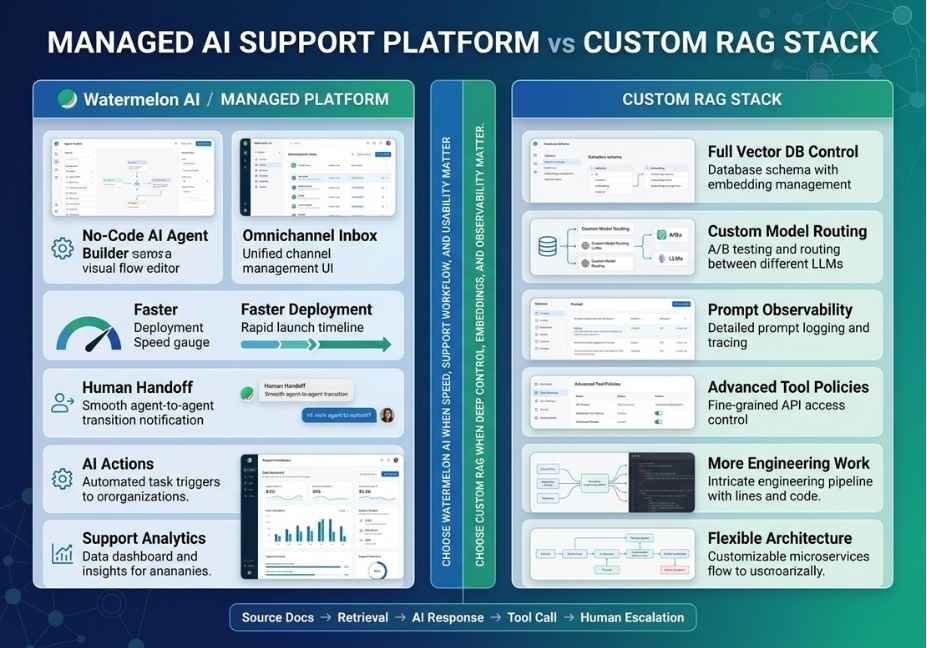
Unlike developer-facing frameworks like LangChain or raw OpenAI API access, Watermelon abstracts away the entire agent loop. As a result, you do not configure a reasoning-acting cycle manually or manage prompt chains. Instead, you get a packaged product with a visual builder. The tradeoff, therefore, is faster setup in exchange for less configurability.
Technical Note: Watermelon’s knowledge system works similarly to a simplified RAG (Retrieval-Augmented Generation) pipeline. It crawls your URLs, indexes the content into a searchable knowledge store, and retrieves relevant chunks at query time to ground GPT-4o’s responses. The platform manages crawl depth and chunking strategy not the user.
How Does Watermelon AI Work? (Step-by-Step)
Understanding the agent loop helps you predict where the tool will succeed and where it will struggle.
Step 1 : Knowledge ingestion. First, Watermelon crawls your website, PDFs, and helpdesk content. Higher-tier plans index up to 25,000 URLs. The platform stores this content in a vector-searchable knowledge base.
Step 2 : Query resolution. Next, when a customer sends a message, GPT-4o retrieves the most relevant content chunks and generates a response. This is the core FAQ deflection layer. Watermelon claims this stage handles up to 96% of conversations autonomously.
Step 3 : Escalation. Finally, when confidence is low or the customer requests a human, the conversation routes to a shared inbox. A live agent then picks it up with full conversation history intact.
Because GPT-4o brings faster inference and stronger instruction-following compared to earlier GPT-4 versions, Watermelon’s agents produce more coherent multi-turn responses than the platform’s 2023 release.
Pro Tip: Train your agent on a focused FAQ page rather than your entire domain. Crawling every URL dilutes retrieval precision. Start narrow, measure your 30-day FAQ deflection rate, then expand gradually.
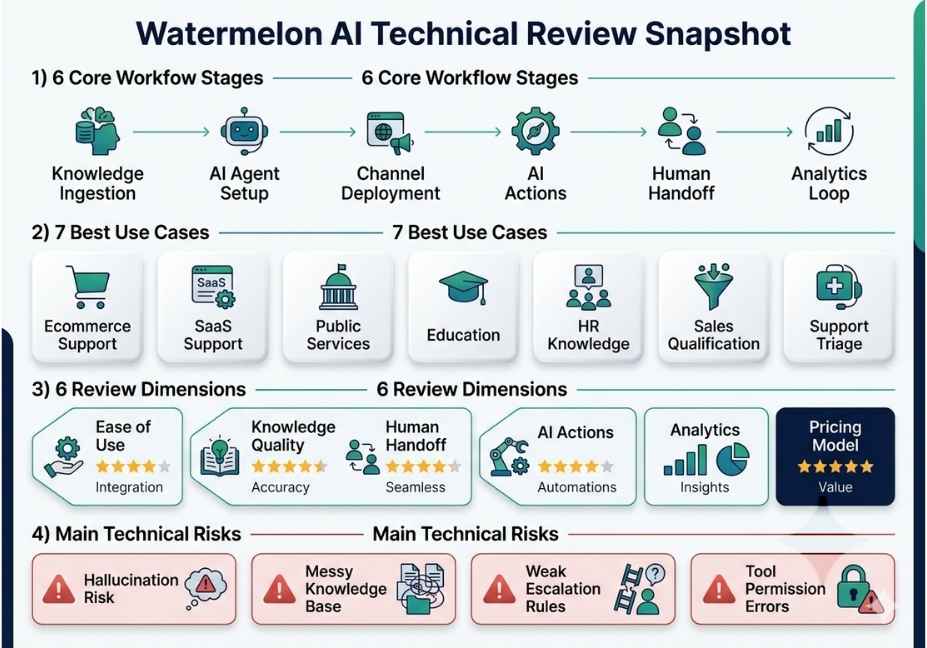
Key Features of Watermelon AI
No-Code AI Agent Builder
Watermelon’s drag-and-drop builder is one of its strongest selling points. Most teams go from account creation to a live chatbot within one business day. Furthermore, the builder supports conditional response flows, brand-customized chat widgets, and multi-language output across 100-plus languages.
That said, complexity surfaces quickly. Once you need dynamic API lookups, multi-step conditional routing, or deeply branched conversational trees, the no-code interface starts to show its limits. In other words, it is excellent for straightforward customer support automation but less suited for complex agentic workflows.
Omnichannel Deployment
Watermelon connects to web chat, WhatsApp Business API, Facebook Messenger, Instagram Direct, and email-to-chat routing. All channels feed into one shared inbox, so your support team sees every conversation in one place.
This matters because WhatsApp alone handles billions of messages daily. For e-commerce businesses especially, omnichannel coverage is not optional and Watermelon’s WhatsApp integration consistently earns high marks from verified reviewers.
AI-to-Human Handoff
The escalation system works, but it is blunt by design. The agent escalates either when it detects low confidence in a response or when the customer uses a handoff trigger phrase. Crucially, there is no configurable confidence threshold. There is also no multi-step policy such as “rephrase once before escalating.”
For small and mid-sized businesses, this level of control is usually sufficient. However, for high-volume enterprise support teams managing strict SLAs, the lack of escalation nuance creates meaningful gaps.
Knowledge Base Crawling
Business-tier users can crawl up to 25,000 URLs with JavaScript rendering enabled. This is important for single-page applications where content loads dynamically, because without JavaScript rendering, the crawler returns empty pages.
The limitation, however, is that the crawler does not re-index in real time. After a major product update or pricing change on your site, the agent serves stale answers until either the next scheduled crawl or a manual refresh. Several G2 reviewers called this out specifically as a frustrating day-to-day friction point.
Analytics and Reporting
Watermelon provides a conversation analytics dashboard showing resolution rates, handoff frequency, and customer satisfaction signals. The reporting is functional for basic monitoring. Nevertheless, reviewers consistently note it lacks depth compared to more mature platforms specifically around CSAT scoring, conversation-level drill-downs, and exportable data for BI tools.
Integration Ecosystem
The platform connects natively with WordPress, WooCommerce, Lightspeed, Mollie, and Zapier. Through Zapier, you can trigger webhooks and connect to hundreds of downstream tools. Additionally, the Business tier adds direct API access for custom integrations.
Watermelon AI Pricing Full Breakdown
Watermelon bills annually in euros. Below is the current tier structure.
| Plan | Monthly Price | AI Agents | Key Features |
|---|---|---|---|
| Starter | ~€106/mo | 1 | GPT-4o chat, multilingual, website widget |
| Growth | ~€239/mo | 1 | 10K URL crawl, shared inbox, API access |
| Business | ~€399/mo | 3 | AI actions, 25K URLs, JS rendering, dedicated CSM |
| Enterprise | Custom | Custom | SLAs, custom onboarding, full integrations |
The Starter tier is competitive with tools like Tidio and SiteGPT for simple FAQ automation. However, meaningful agentic features webhook triggers, advanced integrations, higher URL crawl limits only unlock from the Business tier upward.
Consequently, many growing teams find themselves paying €399 per month before they have validated whether the platform fits their workflow. This pricing jump is the most consistently cited criticism in verified reviews.
Architect’s Note: The “AI actions” feature in the Business tier is the closest Watermelon comes to tool-use functionality. It lets the agent fire webhooks and Zapier automations on defined triggers. This is not the same as OpenAI Function Calling or a ReAct-style agent loop it is conditional webhook execution. Powerful for simple automations; insufficient for dynamic, multi-step agentic tasks where the agent needs to decide which tool to call at runtime.
Watermelon AI Pros and Cons
Based on verified reviews from Capterra (4.6/5 rating) and G2, here is what users actually experience.
What Users Love
- Fast setup. Most teams are live within one to two days, with no developer support needed.
- Multilingual coverage. Support across 100-plus languages makes global deployment straightforward.
- GDPR compliance. EU-based data hosting is a genuine differentiator, especially for European businesses and those handling sensitive customer data.
- Responsive customer success team. Onboarding support earns consistent praise, particularly on Business and Enterprise tiers.
- WhatsApp integration quality. The WhatsApp Business API connection is stable and well-documented.
What Users Flag as Problems
- Pricing pressure. The jump from Growth to Business tier is steep relative to the feature additions for many mid-sized teams.
- Conversation caps. Once the monthly limit is hit, the bot stops responding entirely. This creates a jarring customer experience if limits are not monitored carefully.
- Knowledge base staleness. Real-time re-indexing is not available. Teams with frequently updated content must manage manual crawl refreshes.
- Limited AI transparency. There is no model selection, no prompt-level tuning, and no visibility into how the retrieval layer ranks results.
- Reporting gaps. The analytics dashboard is functional but not deep enough for data-driven support operations.
- Occasional inaccurate answers. When knowledge base coverage is thin, GPT-4o sometimes generates confident-sounding but incorrect responses.
Common Failure Modes in Production
Most Watermelon AI reviews skip the failure mode analysis entirely. However, understanding where the agent breaks in real deployments is critical before committing to a plan.
Failure 1 : Context bleed in long conversations. GPT-4o has a large context window. Even so, Watermelon’s conversation history management is opaque. In extended support threads, the agent occasionally loses track of what was said earlier and gives responses that contradict prior turns.
Failure 2 : Knowledge base staleness. Because the crawler runs on a schedule rather than in real time, product updates, pricing changes, and policy revisions leave the agent serving outdated information until the next re-index. For e-commerce teams with dynamic inventory, this is a daily operational risk.
Failure 3 : Off-hours escalation gaps. The AI-to-human handoff works well when agents are online. Outside business hours, however, conversations that should escalate simply queue with no active response. Customers experience this as the AI “breaking,” even though it is a routing configuration issue.
Failure 4 : Hallucination on out-of-scope queries. When a customer asks something outside the indexed knowledge base, GPT-4o sometimes generates a plausible-sounding answer rather than clearly stating it does not know. Because Watermelon does not expose a “stay grounded to knowledge base only” instruction override at standard tiers, this is difficult to prevent without very carefully scoping what content you index.
Technical Disclaimer: Platform capabilities evolve continuously. All details in this article reflect Watermelon.ai as of June 2026. Always verify current features and pricing at watermelon.ai before making a purchase decision.
Watermelon AI vs. Competitors Which Should You Choose?
Choosing the right customer support automation tool depends on your team size, technical capacity, compliance requirements, and budget.
| Tool | Best For | Starting Price | Key Edge |
|---|---|---|---|
| Watermelon AI | SMBs, EU businesses, e-commerce | ~€106/mo | GDPR hosting, fastest no-code setup |
| Tidio | Small e-commerce, budget-first | Free tier | Shopify-native, low cost |
| Intercom | SaaS companies, CRM-heavy teams | ~$74/mo | Deepest CRM and workflow automation |
| Zendesk AI | Enterprise with full ticketing needs | ~$55/agent/mo | Mature helpdesk plus AI layer |
| Custom LangChain agent | Engineering teams needing full control | Infrastructure cost | Unlimited configurability, no platform ceiling |
In short, Watermelon wins on GDPR compliance and deployment speed. Intercom wins on automation depth. Tidio wins on price. A custom-built LangChain agent wins on everything technical but requires a team to build and maintain it.
Who Should Use Watermelon AI?
Watermelon AI is a strong fit if you match most of these criteria.
- You run an e-commerce, retail, or service business with high FAQ volume.
- Your team has no developers available for chatbot configuration.
- You need GDPR-compliant data hosting because your customers are in the EU.
- You want a live deployment within days, not weeks.
- Your support workflows are relatively straightforward, without complex multi-step automation needs.
Conversely, Watermelon is probably not the right tool if you need model-level control, real-time knowledge re-indexing, complex escalation logic, or enterprise compliance features beyond GDPR.
Frequently Asked Questions
What is Watermelon AI and what does it do?
Watermelon AI is a no-code customer support platform powered by GPT-4o. It lets businesses build AI agents that automatically answer customer questions across WhatsApp, web chat, Instagram, and Messenger. The platform indexes your website and documents, uses that content to answer queries, and routes complex issues to human agents through a shared inbox.
Is Watermelon AI accurate?
Watermelon AI is accurate when its knowledge base is complete and up to date. When customers ask questions outside of indexed content, however, the GPT-4o model can generate confident but incorrect answers. This hallucination risk is manageable through careful knowledge base scoping but cannot be fully disabled at standard pricing tiers.
How does Watermelon AI handle the handoff from bot to human?
When the AI agent detects low confidence or a customer requests a human, the conversation transfers to a shared inbox where a live agent takes over with full context. Outside business hours, conversations queue rather than escalate actively. Configuring off-hours routing requires manual setup that some users find unintuitive.
Does Watermelon AI support GDPR compliance?
Yes. Watermelon stores all data on EU-based servers. This makes it one of the only GPT-4o-powered chatbot platforms with built-in GDPR data residency. For European businesses or any organization handling sensitive customer data under EU law, this is a significant and rare advantage.
How much does Watermelon AI cost per month?
Watermelon AI starts at approximately €106 per month on annual billing for the Starter plan. The Growth plan costs approximately €239 per month. The Business plan, which unlocks AI actions and three AI agents, costs approximately €399 per month. Enterprise pricing is negotiated. Verify the latest figures at watermelon.ai directly.
What are the best alternatives to Watermelon AI?
The best alternatives depend on your needs. Tidio is better for small e-commerce teams on a tight budget. Intercom suits SaaS companies needing deep CRM integration. Zendesk AI fits enterprise teams that need a full helpdesk plus automation layer. For technical teams that want full control over their AI agent architecture, building on LangChain with a GPT-4o backend offers the most flexibility.
Is Watermelon AI good for small businesses?
Yes, Watermelon AI is well suited for small businesses, particularly in e-commerce and retail. The no-code builder means you do not need technical staff to launch a chatbot. Furthermore, the Starter plan at approximately €106 per month is accessible for businesses with meaningful support volume. The main caveat is that conversation caps on lower tiers can disrupt customer experience if not monitored.
Conclusion
Watermelon AI earns its strong reviews for three core reasons: it deploys fast, it handles multilingual omnichannel automation without requiring technical expertise, and it offers GDPR-compliant data hosting that most competitors do not match.
However, it also has real ceilings. Knowledge base staleness, limited escalation nuance, conversation caps, and a pricing structure that jumps sharply before you reach meaningful agentic features are all worth weighing carefully.
If your team needs reliable FAQ automation across WhatsApp and web chat and you want it running within days rather than weeks Watermelon AI is one of the best no-code options available in 2026. Therefore, start with the Starter tier, measure your deflection rate over 30 days, and then evaluate whether scaling up makes financial sense for your support volume.
For more hands-on AI agent reviews, implementation guides, and agentic workflow breakdowns, explore agentiveaiagents.com.
7 Responses