

Most content teams still measure success by blue-link rankings. However, a growing share of research sessions now end inside an AI-generated answer that never sends a click. This shift is exactly why AI search optimization tools exist. They do not just track keyword position they monitor whether your content gets retrieved, cited, and paraphrased by the models sitting between your audience and your website.
If you build with agents, RAG pipelines, or LLM-powered workflows, this distinction matters more than most SEO tool marketing pages suggest. Under the hood, an AI search optimization tool is itself a small agentic system: a crawler, an embedding model, a relevance scorer, and sometimes a retrieval-augmented generation loop that reconstructs what an LLM “sees” when it answers a query. Understanding that architecture is the fastest way to choose the right tool instead of treating AI visibility as a black box.
What Is Generative Engine Optimization (GEO)?
Generative engine optimization, often shortened to GEO, is the practice of structuring content so it gets surfaced, cited, or paraphrased inside AI-generated answers including Google AI Overviews, ChatGPT, Perplexity AI, and similar systems instead of only ranking in the traditional ten blue links.
GEO shares a foundation with classic SEO: crawlability, entity clarity, and intent matching all still apply. But it adds a new success metric, LLM citation rate, which measures visibility inside an AI answer rather than position on a results page. The mechanism behind most of these systems combines information retrieval with text generation, a technique commonly known as retrieval-augmented generation (RAG). Tools that track AI visibility essentially reverse-engineer that retrieval step.
People also ask (voice search target): “Do I need to optimize for AI search near me or is this only for global brands?” GEO applies at any scale. A local business ranks the same way inside an AI answer as a global brand: through clear entities, structured content, and strong topical authority not through location alone.
How AI Search Optimization Tools Actually Work
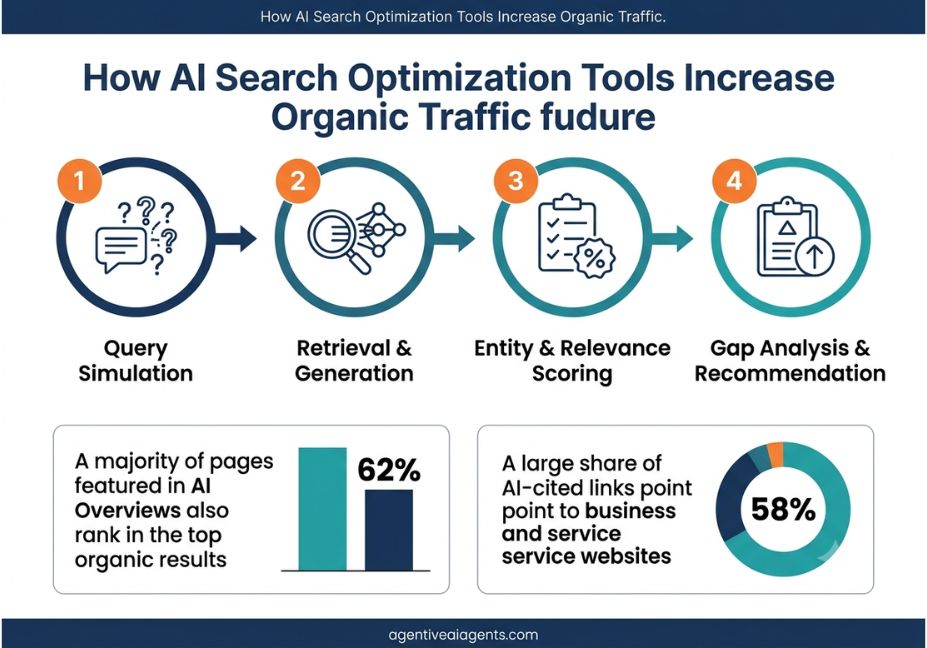
Strip away the dashboards, and every AI search optimization tool runs some version of the same four-step pipeline:
- Query simulation the tool generates realistic buyer or research prompts for your niche, such as “best vector database for RAG pipelines.”
- Retrieval and generation it sends those prompts to target LLMs and captures the full answer, including which sources got cited.
- Entity and relevance scoring an NLP layer extracts entities, topics, and semantic relevance scores from both the AI answer and your content, then measures the overlap.
- Gap analysis and recommendation the tool flags where your content is thin, poorly structured, or missing entities that competitors’ cited pages already include.
This loop resembles a ReAct-style reasoning loop, where the system alternates between retrieving evidence and reasoning over it before producing a recommendation. That is not a coincidence most AI visibility platforms, including those built by OpenAI and Anthropic partners, use the same agent patterns covered elsewhere on this site.
Technical Note: A tool that only checks keyword rankings is not doing GEO. If it cannot show you which sources an LLM cited for a given prompt, it is measuring the wrong layer of the stack.
AI Search Optimization Use Cases 5 Real-World Examples
- Brand visibility tracking: monitoring whether ChatGPT or Gemini mention your product when users ask category-level questions, for example “best project management tools for remote teams.”
- Content gap detection: comparing your page’s entity coverage against every source an LLM cited for a target query, then producing a prioritized to-do list.
- Technical health signals: catching structured data errors, thin content, or missing schema.org markup that block both classic crawlers and RAG retrieval systems from indexing a page cleanly.
- Competitive citation analysis: identifying which competitor pages get pulled into AI answers most often, then reverse-engineering their structure.
- Content refresh prioritization: ranking existing pages by how far their entity coverage has drifted from what LLMs currently cite for the same queries, so updates go where citation loss is highest first.
Semrush’s analysis of AI search traffic patterns found that a large share of AI-cited links point to business and service websites rather than pure content sites. This is a useful signal when deciding where to invest structured, answer-first content.
Did You Know? Independent research has found that a majority of pages featured in AI-generated overviews also rank in the traditional top organic results. In other words, strong classic SEO fundamentals still feed AI visibility.
Best AI Search Optimization Tools for Small Business and Enterprise Teams
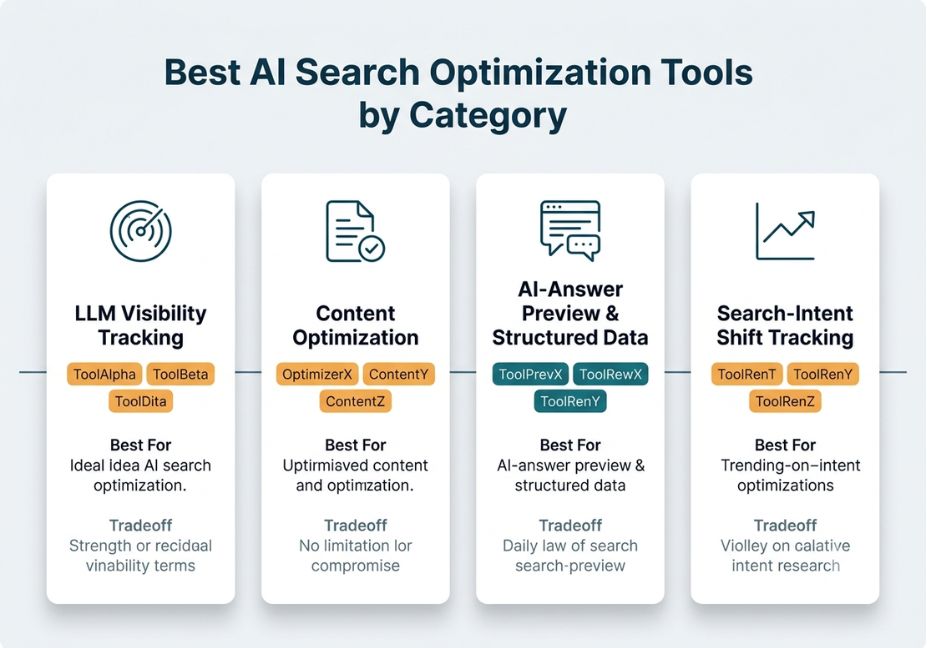
| Category | Example Tools | Best For | Tradeoff |
|---|---|---|---|
| LLM visibility tracking | Semrush AI Visibility Toolkit, Peec AI | Monitoring brand mentions across ChatGPT, Gemini, Perplexity AI | Requires ongoing prompt-set maintenance |
| Content optimization | Clearscope, Surfer SEO, Frase | Aligning drafts with what is already ranking | Optimizes for existing SERPs, not always novel angles |
| AI-answer preview / structured data | Goodie | Testing how content renders in AI-enhanced results | Narrower scope than full visibility suites |
| Search-intent shift tracking | Gumshoe | Long-tail and voice-style query drift | Best paired with a content-ops workflow, not standalone |
Pro Tip: Before buying a full AI visibility suite, validate that AI-driven queries actually reach your niche. Run a manual prompt audit first. Ask the target LLMs your five most valuable buyer questions and record who gets cited.
Step-by-Step: How to Track AI Search Visibility Without an Enterprise Tool
You do not need an enterprise platform to start measuring LLM citation rate. Instead, a minimal version of the same pipeline can be scripted directly against the Anthropic API:
import anthropic

client = anthropic.Anthropic()

prompt = "What are the best tools for building agentic RAG pipelines in 2026?"

response = client.messages.create(
    model="claude-sonnet-4-6",
    max_tokens=800,
    messages=[{"role": "user", "content": prompt}],


answer_text = response.content[0].text
print(answer_text)
# Next: extract entities/URLs from answer_text and diff
# them against your own published content to find gaps.
Run this across a batch of realistic buyer prompts, then log which entities and sources appear. Diff the results weekly. This is the same core loop LangChain’s retrieval and agent documentation describes for building retrieval-aware agents. The SEO tooling layer is simply a specialized application of it.
Technical Disclaimer: Framework versions evolve rapidly. The code above uses the Anthropic Messages API as of mid-2026. Always check the official docs for the current model identifiers and parameters before deploying.
Common Mistakes and How to Avoid Them
- Treating LLM citation tracking as a vanity metric. Citation rate only matters if it correlates with traffic or leads, so instrument your analytics to confirm the link before over-investing.
- Ignoring technical SEO fundamentals. Retrieval systems still depend on crawlable, well-structured pages. No amount of AI-tool polish fixes a blocked robots.txt file or missing schema.org markup.
- Chasing every new AI platform. Prioritize the two or three engines your actual audience uses instead of tracking every emerging chatbot.
- Skipping entity clarity. Vague, unstructured prose gets paraphrased poorly by LLMs, while clear definitions and named entities get cited more reliably.
- Optimizing for one AI engine only. ChatGPT, Perplexity AI, and Google AI Overviews retrieve differently, so content tuned exclusively for one platform’s quirks can underperform on the others. Track citation rate per engine, not as a single blended number.
- Forgetting freshness signals. LLM retrieval systems, like traditional crawlers, favor recently updated pages for time-sensitive topics. As a result, a page that has not been touched since a framework’s last major version bump will lose citation share to competitors who keep updating theirs.
What Developers Are Saying
Threads on r/LocalLLaMA and r/MachineLearning frequently note that most “AI SEO” tools are thin wrappers around prompt-and-scrape pipelines rather than genuinely novel retrieval systems. This is a useful reminder to evaluate vendors by their methodology, not just their dashboard.
Conclusion
AI search optimization tools increase organic traffic by turning an opaque process how LLMs decide what to cite into something measurable: retrieval simulation, entity scoring, and gap analysis. The tools that matter most combine LLM visibility tracking with the same structural fundamentals that have always driven classic SEO. Start small. Script a citation check against a real API before buying a platform, and treat every recommendation as a hypothesis to test, not a guarantee.
Bookmark this guide and explore more hands-on AI agent tutorials at agentiveaiagents.com.
FAQ People Also Ask
How do AI search optimization tools increase organic traffic?
They increase organic traffic by making AI visibility measurable. Specifically, they track which sources get cited in AI answers, score your content’s semantic relevance against competitors, and recommend structural fixes that also tend to improve traditional rankings.
What is the difference between SEO and AI search optimization (GEO)?
Traditional SEO optimizes for ranking position on a search results page. GEO, by contrast, optimizes for being retrieved and cited inside AI-generated answers. Both share technical foundations, but they track different success metrics.
Can AI search optimization tools guarantee higher rankings?
No. They provide measurement and prioritized recommendations, not guaranteed outcomes. Rankings and citation rates still depend on content quality, technical SEO, and competitive dynamics.
Do I need a paid AI visibility platform to get started?
Not necessarily. A manual prompt audit, or a small script against an LLM API like the one shown above, can validate whether AI-driven queries matter for your niche before you invest in an enterprise tool.
Which AI platforms should I track first?
Start with the engines your target audience actually uses. For most B2B and consumer research use cases, that typically means ChatGPT, Google AI Overviews, and Perplexity AI, rather than every emerging chatbot.
How do I optimize a page for both Google Search and AI search engines at the same time?
Structure content with clear headings, direct-answer paragraphs, and schema.org markup. Because AI engines and traditional crawlers both reward well-structured, entity-rich pages, a single well-built page can rank in both surfaces simultaneously.