

Most listing videos never get made. Not because agents don’t want them, but because a videographer, a gimbal, and a same-day edit simply don’t scale past two or three properties a week. However, agents who publish walkthroughs consistently are outperforming everyone else’s Reels and listing-portal click-throughs. As a result, the top AI avatar tools for real estate video walkthroughs have moved from novelty to core marketing infrastructure in 2026.
An AI avatar is a form of synthetic media: a rendered presenter, built from a script and a trained face-and-voice model, that narrates a property without a camera ever rolling. In addition, the best platforms now expose this capability as a REST API. That means the avatar isn’t just an editor feature it’s a component you can wire directly into a listing pipeline that pulls from your MLS feed, generates a script, and outputs a branded video automatically.
This guide compares the tools that actually hold up in production, explains how they work, and shows a real code path for automating listing videos at scale — so you can decide, in practical terms, whether an AI avatar video is worth it for your listings.
What Is an AI Avatar Real Estate Video?
An AI avatar real estate video is a listing walkthrough narrated by a synthetic presenter instead of filmed footage. The system takes a property description, script, or listing data as input. It then outputs a rendered video where a digital agent either a stock avatar or a digital twin cloned from a real agent explains the layout, features, and selling points over property photos or a 3D virtual tour.
Unlike a normal video tour, no camera crew or reshoot is required. Still, the tradeoff is trust: an avatar should never be presented as live footage from an actual showing. Consequently, most platforms now recommend a simple on-screen disclosure whenever the presenter is synthetic.
Is an AI Avatar Video Better Than a Real Filmed Walkthrough?
Not always it depends on the goal. For high-volume, repeatable content (daily listing intros, market updates), an avatar wins on speed and cost. For a flagship luxury listing where authenticity drives the sale, a filmed walkthrough or a Matterport-style 3D tour still performs better. Many successful agents use both: an avatar for daily volume, real footage for hero listings.
How AI Avatar Video Generation Works
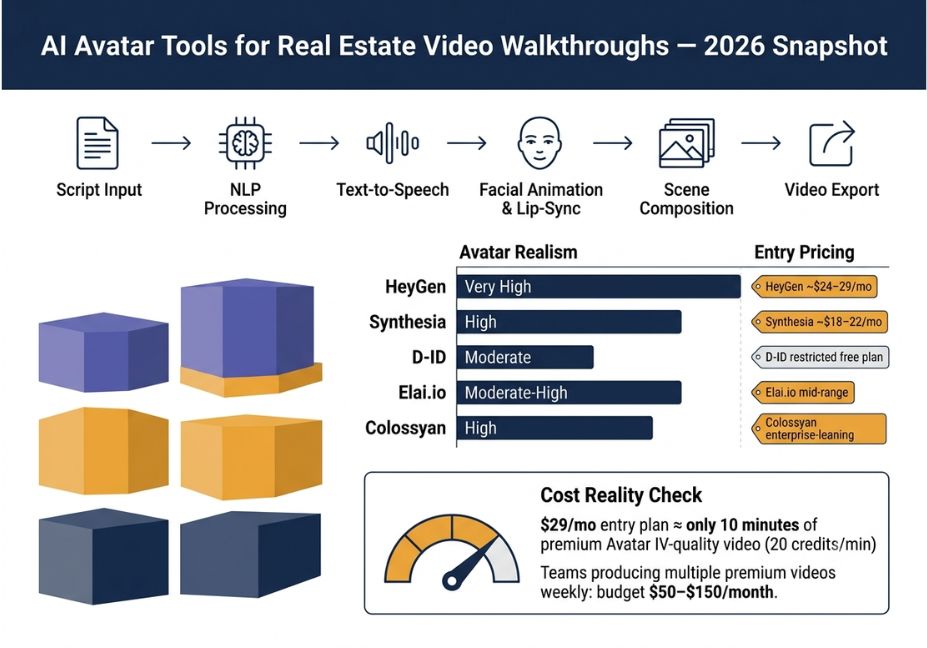
Every avatar platform runs roughly the same pipeline, whether you’re clicking through a UI or calling an API directly:
- Script input a text script or dynamically generated listing description
- NLP processing the model interprets tone, pacing, and emphasis
- Text-to-speech synthesis converts the script into narration, often using voice cloning for a consistent agent voice
- Facial animation and lip-sync generates mouth movement and expression aligned to the audio
- Scene composition layers the avatar over listing photos, floor plans, or virtual staging
- Video export renders the final walkthrough at 1080p or 4K
Technical Note: Framework and pricing details change fast in this category. Everything here reflects publicly listed plans as of mid-2026. Therefore, always confirm current rates and API terms directly with the vendor before budgeting a rollout.
For teams building this into an actual pipeline rather than producing a single video, HeyGen’s REST API documentation and Synthesia’s enterprise API docs are the two most complete starting points. Both expose programmatic script-to-video generation instead of a manual-only editor.
Real-World Use Cases for Real Estate Avatars
- Daily listing intros a 30–45 second avatar clip introducing each new listing the same day it hits the MLS
- Market update videos weekly avatar-led updates on local pricing trends, without re-recording every time a number changes
- Open house reminders short, repeatable clips that don’t require the agent to be on camera between showings
- Multilingual buyer outreach the same listing video dubbed into 30–175+ languages, useful for international buyer segments
- Personalized follow-up video a base video with variables (buyer name, property address) swapped per recipient for CRM-triggered outreach
- Cross-platform syndication the same avatar clip reformatted for Zillow, Redfin, Realtor.com, and social, instead of filming separate versions
Pro Tip: Batch-script an entire week of listings at once. Most avatar platforms charge by rendered minute, not by number of scripts written. So, front-loading script generation and rendering in one pass costs less than generating videos one at a time.
Best AI Avatar Tools for Real Estate Walkthroughs
| Tool | Best for | Avatar realism | API access | Entry pricing |
|---|---|---|---|---|
| HeyGen | Agent-branded avatars, digital twins, multilingual dubbing | Very high (Avatar IV/V) | Pay-as-you-go API, ~$0.05/sec | Free tier; Creator ~$24–29/mo |
| Synthesia | Brokerage/enterprise training and compliance-heavy content | High, standardized | Enterprise API, minute-based | From ~$18–22/mo |
| D-ID | Lightweight interactive avatars, fast turnaround | Moderate | Yes, developer-friendly | Restricted free plan |
| Elai.io | Text-to-video from listing descriptions, multilingual voiceover | Moderate-high | Yes | Mid-range |
| Colossyan | Structured training-style walkthroughs for large teams | High | Limited | Enterprise-leaning |
Did You Know? Avatar IV-quality rendering on HeyGen consumes roughly 20 credits per minute. That means a $29/month entry plan realistically produces only about 10 minutes of premium-quality avatar video before requiring a credit top-up.
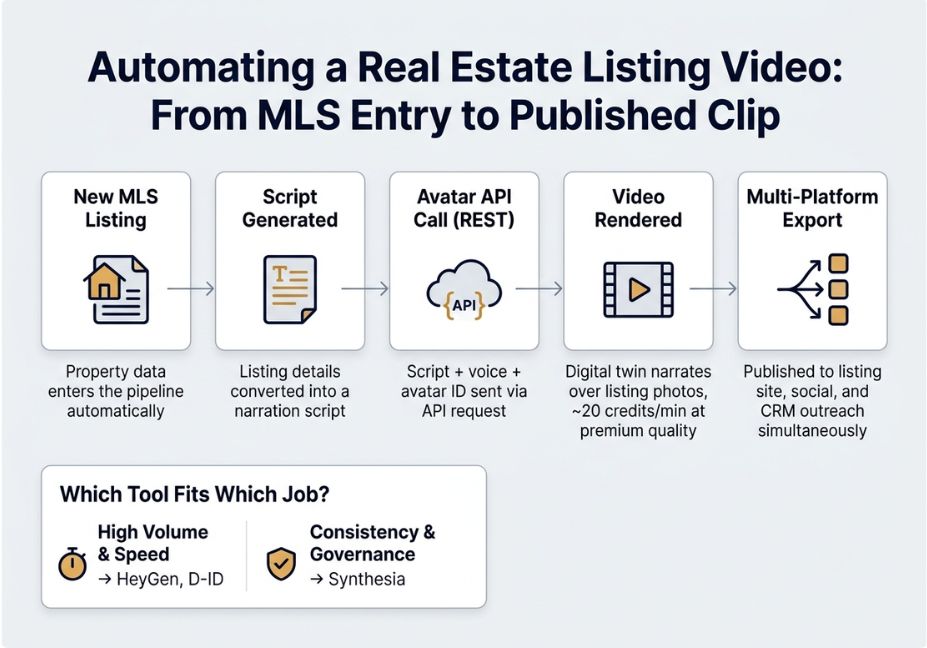
In short, the practical split looks like this: HeyGen and D-ID favor speed and volume, which suits agents publishing daily listing clips. Synthesia, meanwhile, favors governance and consistency better suited to brokerage-wide training, where predictable, minute-based billing matters more than raw avatar expressiveness.
How Much Does an AI Avatar Real Estate Video Cost?
Entry plans typically run $18–$30 per month. However, real cost depends on how much premium-quality (Avatar IV-tier) video you render, since most platforms bill by credit or minute rather than a flat unlimited rate. A solo agent posting a few clips weekly can stay near the entry tier. A team producing several premium videos a week should budget closer to $50–$150 per month.
Step-by-Step: Automating Listing Videos with an Avatar API
Below is a minimal example of triggering avatar generation programmatically once a new listing hits your data source. This uses a REST API pattern common to most platforms in this category:
javascript
// Example: generate a walkthrough video from listing data
const response = await fetch("https://api.example-avatar-platform.com/v1/videos", {
  method: "POST",
  headers:
    "Authorization": `Bearer ${process.env.AVATAR_API_KEY}`,
    "Content-Type": "application/json"

  body: JSON.stringify({
    avatar_id: "agent_digital_twin_01",
    script: `Welcome to 214 Maple Street — a 3-bedroom, 2-bath home
              with a fully renovated kitchen and a south-facing yard.`,
    voice_id: "agent_cloned_voice",
    background: "listing_photos_slideshow",
    output_format: "mp4"

const video = await response.json();
console.log("Render queued:", video.id);
You can wire this to a Zapier or n8n trigger on your listing management tool. As a result, every new MLS entry can queue a script and a rendered video without anyone opening an editor.
Technical Disclaimer: API field names, authentication schemes, and rate limits vary by vendor and change frequently. This example is illustrative, not a copy-paste integration. Always build against the specific platform’s current documentation.
Common Mistakes and How to Avoid Them
- Skipping disclosure presenting a synthetic avatar as live footage from a showing damages trust and may violate local advertising standards
- Trusting the avatar with unchecked facts always confirm that square footage, room counts, and pricing in the generated script match the actual listing before publishing
- Ignoring credit math sticker prices rarely reflect real cost; premium avatar quality can burn a monthly plan in under 10 minutes of finished video
- Using one avatar for every purpose a hyper-realistic digital twin suits agent branding, while a standardized stock avatar is often cheaper and better suited to compliance-style market updates
What Practitioners Are Saying
Agent discussions on AI avatar disclosure on forums like Reddit’s r/realtors consistently raise two concerns: whether buyers can tell the presenter is synthetic, and whether local MLS or brokerage policy requires a disclosure label. Overall, the practical consensus among agents already using these tools is straightforward treat the avatar as a marketing layer on top of accurate listing data, not a replacement for it.
FAQ People Also Ask
What is an AI avatar real estate video?
It’s a listing walkthrough narrated by a synthetic, AI-generated presenter instead of filmed footage. The system converts a script or listing description into a rendered video with lip-synced narration over property visuals.
Are AI avatars legal to use for real estate marketing?
Generally yes, but disclosure and accuracy matter. Most guidance recommends labeling a synthetic presenter clearly and never using an avatar to misrepresent a property’s actual features or condition.
How much do AI avatar tools cost for real estate agents?
Entry plans typically run $18–$30/month. Real cost, though, depends on credit consumption at higher avatar quality tiers teams producing several premium videos weekly should budget closer to $50–$150/month.
Can AI avatars replace a real estate agent on video?
No. Avatars automate the repetitive parts of listing video production, such as narration and rendering. Buyers still need accurate photos, floor plans, and a real agent relationship behind the marketing.
Which AI avatar tool is best for real estate walkthroughs?
It depends on your priority. Choose HeyGen for agent-branded digital twins and volume, Synthesia for brokerage-wide consistency and predictable billing, or D-ID/Elai.io for lighter, faster listing clips.
Is an AI avatar video better than a real filmed walkthrough?
Not necessarily. Avatars win on speed and cost for high-volume, repeatable content. Real footage or a 3D tour still performs better for flagship listings where authenticity is the main selling point.
Conclusion
The top AI avatar tools for real estate video walkthroughs in 2026 aren’t just video editors with a talking head bolted on. The strongest ones HeyGen and Synthesia expose real APIs that let agents treat listing video as an automated pipeline instead of a manual chore. Pick based on your actual bottleneck: realism and volume favor HeyGen, while governance and predictable cost favor Synthesia. Whichever you choose, keep the avatar honest: accurate scripts, clear disclosure, and a real listing behind every video.
Bookmark this guide, and explore more hands-on AI agent and automation tutorials at agentiveaiagents.com.